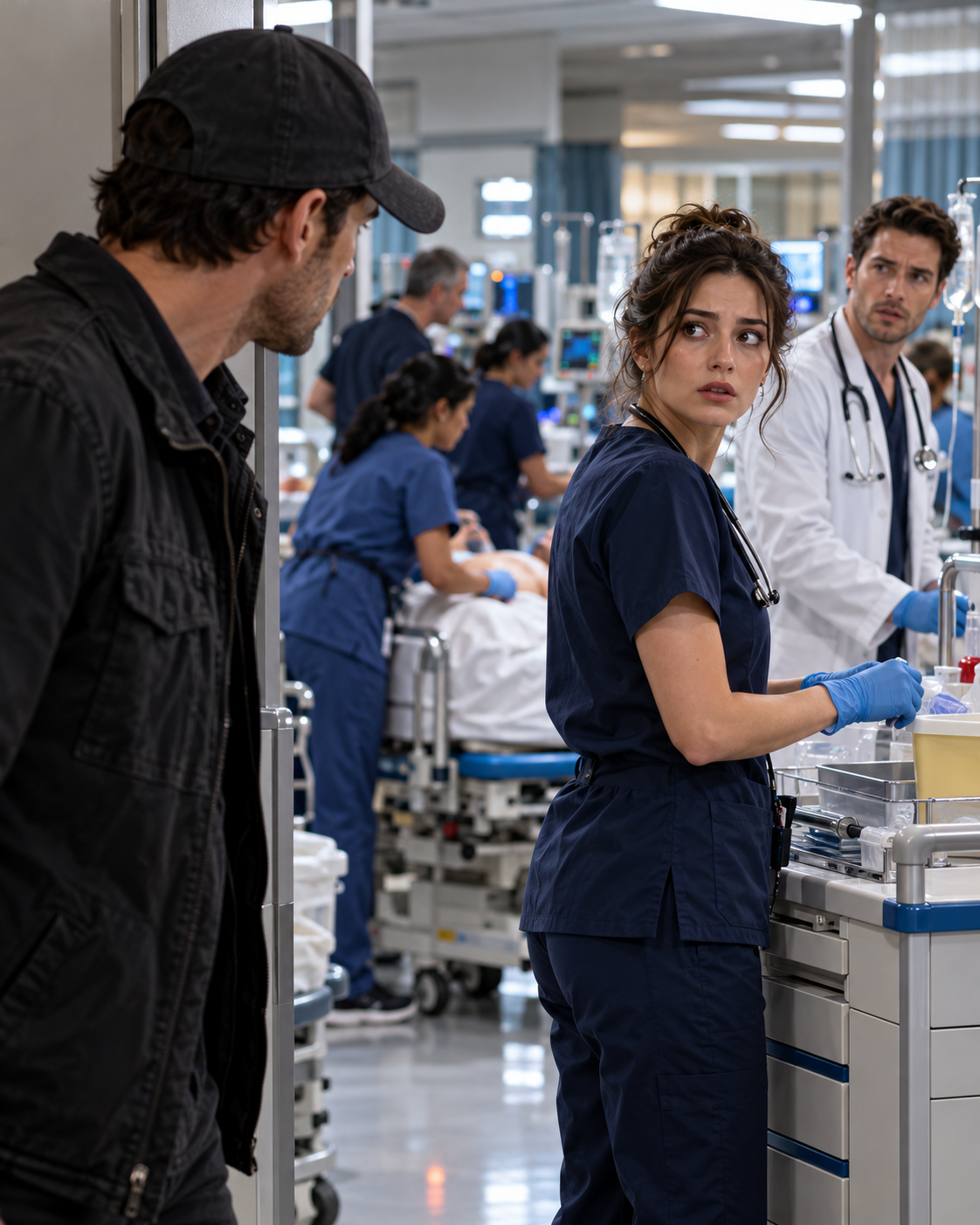
I watched an armed man in stolen scrubs turn our naval emergency ward into a killing ground while the chief physician
I knew before I opened the envelope that whatever waited inside belonged to the life I had spent two years trying to bury.
Nathan saw my expression and crossed the classroom without saying a word.
The students watched us with the uncomfortable fascination people reserve for secrets that suddenly become visible.
I broke the seal.
Inside was a thin packet, a secure drive, and a photograph.
The photograph showed the helicopter.
My helicopter.
Or what was left of it.
The Pacific had swallowed most of the wreckage, but one section of the tail remained above the water like a broken finger.
I turned the photograph over.
A handwritten notation covered the back.
“Recovery site does not match crash coordinates.”
My stomach tightened.
I read the line twice.
Then a third time.
The official story had always been simple.
Mechanical failure.
Severe weather.
No survivors.
Search suspended.
Bodies unrecovered.
Case closed.
But I knew the coordinates printed in the original report.
I had memorized them years ago because they were the last place I thought my team had existed.
The note said the debris was found nearly ninety miles from there.
Nathan looked at me.
“That’s impossible.”
“No.”
I handed him the photograph.
“It’s worse than impossible.”
He looked up.
“It means somebody moved the story.”
The classroom emptied slowly after the students were dismissed.
Nobody asked questions.
They knew something serious had happened.
When the door shut, Nathan finally exhaled.
“I need to tell you something.”
I sat down.
“Then tell me everything.”
He stared at the floor.
“The week after the crash, I was ordered to stop discussing your name.”
“By whom?”
He hesitated.
“People above my pay grade.”
I almost laughed.
“That’s not an answer.”
“I know.”
He sat across from me.
“We found a partial transmission from your helicopter.”
My chest went cold.
“Why didn’t you tell my family?”
“Because I was told the transmission had been corrupted.”
“And was it?”
“No.”
The room seemed to shrink.
Nathan’s voice dropped.
“It wasn’t corrupted.”
I stared at him.
“What did it say?”
He looked at me for a long moment.
“Your pilot warned that someone had entered the maintenance network before takeoff.”
I felt every old memory rearranging itself.
The strange inspection delay.
The unexplained warning light.
The technician who had been reassigned two days before our mission.
The senior officer who had told us not to worry.
I had spent two years believing fate had taken my team.
Now I had to consider something far more painful.
Maybe fate had never been involved.
Nathan reached for the secure drive.
“This was recovered from a dead-drop device three months ago.”
“You’ve had it?”
“Yes.”
“Why bring it here?”
“Because I couldn’t access it alone.”
He slid the drive across the desk.
“There are names on it.”
My fingers hovered above the device.
“Whose names?”
“Contractors.”
I looked at him.
“Defense contractors?”
He nodded.
“The same network connected to the procurement fraud case involving Admiral Prescott.”
Suddenly the gunshot made sense in a way that terrified me.
Prescott hadn’t simply been a witness.
He had been a witness who was still alive.
Someone had tried to remove him before he could testify.
And somebody had apparently been willing to let an entire rescue crew disappear to protect the same secret.
I inserted the drive into the secured terminal.
A list appeared.
Companies.
Transaction codes.
Shell entities.
Dates.
Then I saw a familiar name.
Commander Elias Mercer.
My former operations supervisor.
I stopped breathing.
Mercer had been the officer who signed our final mission authorization.
Nathan noticed immediately.
“You know him.”
“He signed my deployment.”
“Mine too.”
We sat in silence.
Then another file opened automatically.
It contained footage from a surveillance camera.
A hangar.
A clock in the corner.
The date was two days before our helicopter crash.
Mercer walked into frame.
Behind him was a civilian contractor I recognized from the procurement investigation.
They shook hands.
Then Mercer handed him a small black case.
The video ended.
I leaned back.
For two years, I had been living as a ghost because I thought being forgotten was the price of surviving.
Now I understood something different.
Someone had needed me to stay forgotten.
That realization hurt more than the crash ever had.
The following morning, federal agents arrived on base.
Two of them introduced themselves.
Special Agent Mara Ellis was tall, direct, and carried a file thick enough to look dangerous.
“We believe the attack on Admiral Prescott was intended to compromise the fraud prosecution.”
“And my helicopter?”
She looked at Nathan.
Then back at me.
“We believe the events may be connected.”
“May be?”
“We don’t yet have enough evidence to say otherwise.”
I appreciated the honesty.
“What happens now?”
“You become a protected witness.”
I shook my head.
“No.”
Mara frowned.
“No?”
“I’ve spent two years hiding.”
“That’s not what I asked.”
“You asked what happens now.”
I stood.
“I tell the truth.”
She studied me.
“Even if it puts you in danger?”
I looked at the photograph of my crew on the wall.
“I already know what danger feels like.”
The investigation moved quickly after that.
Names appeared in sealed affidavits.
Bank transfers surfaced.
A procurement officer disappeared overseas.
One contractor attempted to destroy a server farm before agents arrived.
The story grew wider with every document.
And every time I thought I had reached the center, another layer appeared.
Then the investigators asked me to identify one more person.
A woman.
Short hair.
Gray coat.
A scar beneath her jaw.
They slid a photograph across the table.
I recognized her instantly.
She had been standing on the dock the morning of our final deployment.
I had seen her once.
She had told me she was with logistics.
She wasn’t.
She was intelligence.
And according to the file, she had signed the first emergency authorization after the crash.
I whispered, “Where is she now?”
“Missing.”
“For how long?”
“Two years.”
Nathan and I exchanged a look.
Another ghost.
Another person officially gone.
Except this time, I knew ghosts could be alive.
Weeks later, the federal team traced a secure signal to a storage facility outside San Diego.
Nathan asked whether I wanted to come.
I almost said no.
Not because I was afraid.
Because I had finally built something worth staying for.
My classroom.
My students.
My quiet mornings.
The life I had rebuilt without classified briefings or midnight flights.
But then I remembered the names of the people who had never come home.
I went.
The facility smelled of dust and old metal.
We entered just after midnight.
Nothing moved.
No lights.
No voices.
Then we found the room.
A table.
A chair.
Three hard drives.
And a wall covered in photographs.
Our photographs.
My entire team.
Images taken before missions.
During training.
At awards ceremonies.
Even candid photographs of us eating breakfast.
I stepped closer.
Someone had been watching us long before the crash.
Nathan whispered, “How did they get these?”
I didn’t answer.
Then I noticed one final photograph.
It was me.
Taken two weeks before the crash.
On the back was a handwritten note.
“Asset survives?”
My hands went numb.
The room suddenly felt colder.
“They expected me to live,” I said.
Nathan stared at the photograph.
“Why?”
I looked at the files.
“Maybe because they needed someone to disappear.”
The hard drives contained communications that suggested my survival had been detected after the crash.
A rescue beacon had registered movement.
A search aircraft had reached the site.
Then the signal vanished.
The official report had said the beacon was destroyed.
The data suggested otherwise.
Someone had deliberately shut the investigation down after confirming that at least one person had survived.
Me.
I remembered the night I crawled from the wreckage.
Broken metal.
Burning fuel.
Salt water.
A torn raft.
Then a distant light.
A fishing vessel had found me.
I had been barely conscious.
The captain had asked my name.
I had lied.
Not because I wanted to disappear.
Because I believed whoever had caused the crash might still be looking.
I had spent two years assuming that choice was fear.
Now I realized it had also been instinct.
The part of me trained to survive had recognized danger before my conscious mind could name it.
The next discovery was worse.
The fishing vessel had been registered under a company connected to one of the contractors in the fraud case.
I felt sick.
Nathan sat down hard.
“They found you.”
“Yes.”
“And they let you go?”
I looked at him.
“Or they thought I was too injured to matter.”
Mara Ellis listened to our theory in silence.
Then she said something that changed everything.
“There’s another possibility.”
I waited.
“They didn’t let you go.”
She placed a photograph on the table.
It showed the fishing vessel from a distance.
A second boat followed behind it.
Mara pointed to the hull number.
“That boat belonged to a private security company employed by one of the contractors.”
My mouth went dry.
“Why would they rescue me?”
“Maybe they didn’t know who you were.”
“Or?”
“Maybe they did.”
Nobody spoke for several seconds.
The next file contained an encrypted audio recording.
We restored enough of it to hear two voices.
One was Mercer.
The other was a man whose identity remained unknown.
Mercer said, “If the swimmer survives, the casualty list has to stay closed.”
The other voice answered, “And if she talks?”
Mercer replied, “She won’t know what she heard.”
I looked at Nathan.
I remembered the crash.
A sound.
A warning.
An argument.
Something I had never been able to place.
Then the memory returned.
Not as an image.
As a sentence.
A voice inside the helicopter before the impact.
“We’re not supposed to be here.”
I closed my eyes.
For two years, I had thought the trauma had fragmented my memory.
Maybe someone had simply wanted me to doubt it.
We found Mercer three days later.
He was hiding in a rented house in Nevada under an alias.
He didn’t run.
When agents entered, he was sitting at a kitchen table with a cup of coffee.
They brought him to a federal facility.
I was there for the interview.
He looked older than I remembered.
He studied my face for a long time.
Then he said, “You weren’t supposed to survive.”
I felt a strange calm.
“Why?”
He looked away.
“Your team stumbled onto a diversion scheme.”
“Procurement fraud.”
He nodded.
“Money was being moved through emergency response contracts and security vendors.”
“And the crash?”
He closed his eyes.
“The helicopter was sabotaged.”
Nathan swore under his breath.
Mercer continued.
“We thought the impact would destroy the data your team had recovered.”
“Did you order it?”
A long silence.
“No.”
It was the first thing he had said that sounded like the truth.
“Who did?”
He stared at me.
“I don’t know.”
For the first time, the room frightened me.
“You don’t know?”
“We were told the operation came from someone higher.”
“Who?”
He refused to answer.
Mara stopped the interview.
Outside, Nathan leaned against the wall.
I stood beside him.
“There’s still someone above Mercer,” I said.
“Yes.”
“And they know I’m alive.”
Nathan nodded.
I looked down the hallway.
“I don’t want revenge.”
“I know.”
“I just want their names.”
“You’ll get them.”
But before he could say anything else, an alarm sounded.
Agents rushed toward the evidence room.
A server had been remotely accessed.
Someone had breached the federal network.
The screen flashed once.
Then a message appeared.
“YOU WERE NEVER THE GHOST.”
I stared at the words.
Nathan whispered my old callsign.
“Mara.”
She turned.
“What?”
“The message.”
She walked toward us.
I pointed at the screen.
Below the sentence was a set of coordinates.
My coordinates.
The exact location of my classroom on base.
For one heartbeat, nobody moved.
Then Mara’s radio erupted.
“Possible intruder on the training deck.”
I ran.
The old instincts returned before thought.
Students were still inside the building.
I reached the classroom and found the door open.
The lights were off.
A figure stood beside my desk.
He turned slowly.
I recognized him from the hangar video.
The civilian contractor.
Older.
Calmer.
Armed.
He looked at my badge.
Then smiled.
“Finally.”
Nathan reached me seconds later.
The man raised his weapon.
I moved first.
Not recklessly.
Not heroically.
Just with the controlled certainty of someone who had spent years surviving situations where hesitation cost lives.
The struggle was brief and brutal.
Nathan secured the weapon.
Federal agents stormed in.
The contractor was taken away shouting one sentence.
“You don’t understand what you’re protecting.”
I stood in the wreckage of my classroom.
My students’ notebooks were scattered across the floor.
One of them had written my name in the corner of a page.
My real name.
I picked it up.
For years, I had believed surviving meant becoming invisible.
Now I understood the opposite.
Survival had given me a responsibility to be seen.
The investigation eventually exposed the procurement network, though not every person involved was found.
Mercer testified.
Several contractors were indicted.
The attack on Admiral Prescott became the break that federal investigators needed to connect the fraud to the hidden network surrounding the crash.
And the record of my death was officially corrected.
Two years after the Pacific disaster, the Coast Guard changed my status from deceased to survivor.
The ceremony was small.
No cameras.
No speeches meant for headlines.
Just my name restored on an official roster.
Nathan stood beside me.
When the flag was folded, he whispered, “You came home twice.”
I looked at him.
“Once from the ocean.”
He smiled.
“And the second time?”
I touched my badge.
“From hiding.”
My new training curriculum grew quickly.
I taught corpsmen how to recognize deterioration before numbers became disasters.
I taught them that confidence without humility was dangerous.
I taught them that protocols existed for a reason, but that knowing when a protocol had failed could save a life.
Most of all, I taught them what nobody had taught me after the crash.
You can survive something without letting it become your identity.
Months later, after my final class of the year, I walked to the shoreline alone.
The ocean was gray beneath the evening sky.
For a moment, the old fear returned.
Then I breathed through it.
I no longer needed to defeat the memory.
I only needed to stop running from it.
Nathan joined me carrying two coffees.
“Thought you’d be here.”
I took one.
“You always did know where to find me.”
He smiled.
Then his expression changed.
“There’s something else.”
I looked at him.
He handed me a thin folder.
“No classification stamp.”
“Then why bring it?”
“Because I think you should decide whether to open it.”
I stared at the folder.
On the front was a photograph of our helicopter before the crash.
But in the background, standing near the hangar door, was someone I had never noticed.
A woman with a gray coat.
The missing intelligence officer.
Alive.
Watching me.
The photograph had been taken three days ago.
I looked toward the darkening water.
After everything, I knew better than to confuse closure with certainty.
Some stories end when the truth is uncovered.
Others end when you finally learn that the truth is larger than the wound that first forced you to seek it.
I had spent two years believing my life began again the day I crawled out of the Pacific.
It didn’t.
It began the day I stopped treating survival like something I needed to hide.
I opened the folder.
And this time, whatever waited inside, I was ready to face it with my own name.