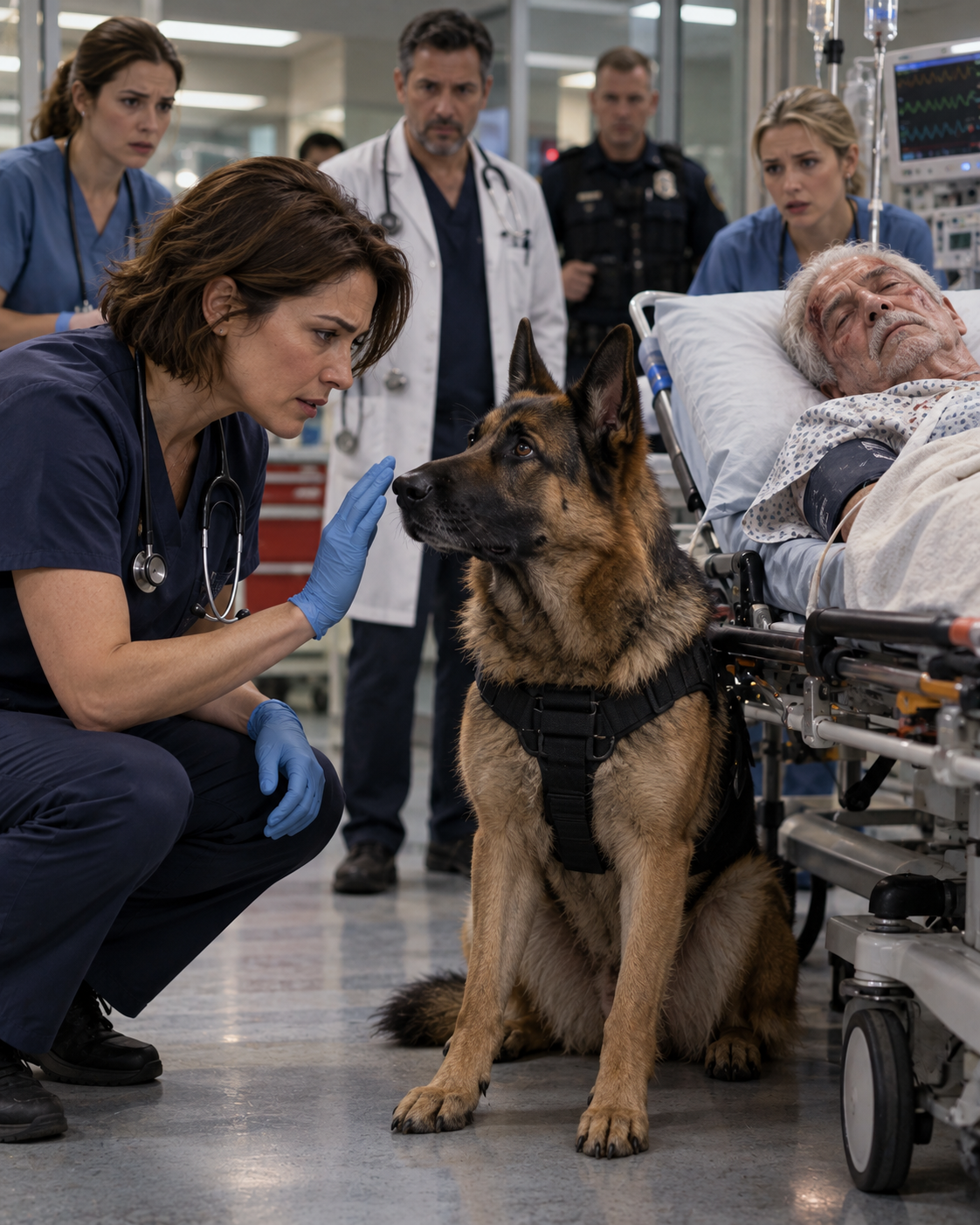
I watched a Dutch Shepherd snarl over a bleeding Navy admiral in Trauma Bay 2 while my director coldly ordered security to remove me
Clara Croft closed the office door behind her, and the sound seemed louder than it should have been.
Director Sarah Vance remained standing beside her desk, one hand resting against the back of her chair.
I could see the question in her eyes before she asked it.
“Who tried to remove Emily?”
Clara opened the folder.
“That’s what we’re here to find out.”
My pulse was still racing from everything Gunnery Sergeant Miller had told me.
For years, I had believed Karimov was a closed chapter.
A terrible place.
A terrible night.
A place where four men had survived because I had refused to leave my position.
I had never known someone had deliberately erased what happened afterward.
Now the past had walked into a hospital room carrying a federal badge.
Clara looked at me.
“Emily, I need you to tell me exactly what happened when Admiral Hayes first arrived.”
I told her everything.
The dog.
The bleeding.
The secondary line.
The hematoma.
The surgery.
Then I told her about Sunday.
Clara listened without interrupting.
When I finished, she opened another document.
“The vehicle that transported Admiral Hayes from the regional airfield was tampered with.”
My skin prickled.
“Tampered how?”
“Brake-line interference.”
Director Vance went pale.
“That could have killed him.”
“It was supposed to.”
Clara turned another page.
“The failure didn’t happen because the vehicle stopped before reaching the highway.”
“Why?”
“Because the driver noticed the brake pressure was wrong.”
I stared at the report.
“So they tried again.”
Clara nodded.
“The second attempt was at the hospital.”
She showed us a photograph of the admiral’s original medication tray.
One vial had a slightly different lot number from the others.
My stomach turned.
“What was in it?”
“Something that would have complicated his existing condition.”
I looked at Clara.
“Enough to kill him?”
“Enough to make the death look natural.”
Nobody spoke.
Then Clara said something worse.
“The person who altered the medication had access to the hospital system.”
Director Vance slowly sat down.
“How many people?”
“Twenty-three.”
Her eyes moved to me.
“Only four had access to the admiral’s medication record outside normal clinical hours.”
I already knew what she was going to say.
My name wasn’t among them.
Neither was Dr. Lawson’s.
But one name was.
A senior clinical administrator named Mark Ellison.
He had been the person who approved my background review.
He had also been the person who recommended I be terminated.
I remembered his expression when he first saw my military file.
He hadn’t looked surprised.
He had looked afraid.
Clara saw recognition cross my face.
“You know him.”
“Yes.”
“Tell me everything.”
I did.
Every conversation.
Every strange comment.
Every time he had asked questions about my military experience that didn’t seem relevant to nursing.
Then I remembered something.
“There was one question he asked me twice.”
“What?”
“He wanted to know whether I had ever worked with Admiral Hayes.”
Clara stopped turning pages.
“Did you?”
“Not directly.”
“Are you sure?”
“Before Sunday, I had never met him.”
She exchanged a look with Vance.
“What?”
Clara placed another photograph on the desk.
It showed a young Marine corpsman standing beside an armored vehicle.
The image was grainy.
The face was partly hidden.
But I knew the uniform.
I knew the posture.
And I knew the shoulder injury visible beneath the torn sleeve.
“That’s you,” Clara said.
My mouth went dry.
“Where did you get that?”
“Admiral Hayes kept it.”
I stared at the photograph.
“I didn’t know anyone took pictures that night.”
“Hayes did.”
“Why?”
“Because he was one of the four operators you saved.”
The room disappeared for a second.
I remembered the night in fragments.
Dust.
Heat.
Radio static.
The metallic taste of blood.
A voice telling me to move.
My refusal.
Then darkness.
I had remembered faces without knowing their names.
I had carried the weight of that night without knowing who had survived.
Now I knew one of them had been the man lying upstairs.
Clara lowered her voice.
“He spent years trying to identify the corpsman who saved his team.”
I looked away.
“Why didn’t he find me?”
“Because someone made sure he couldn’t.”
That was the moment the pieces finally touched.
My buried commendation.
My incomplete public record.
My sudden hiring at the hospital.
The pressure to terminate me.
The assassination attempt.
None of it felt random anymore.
Clara leaned forward.
“Someone has been protecting a secret for a very long time.”
Director Vance looked at me.
“Does that secret involve your former colonel?”
I swallowed.
“I don’t know.”
Clara answered for me.
“His name appears in our investigation.”
The colonel who had buried my commendation was still alive.
And he had spent the years since Karimov building a consulting company that handled security contracts for military hospitals.
I felt sick.
“Is he involved?”
“We don’t know yet.”
“Then what do you know?”
Clara closed the folder.
“We know he had financial contact with Mark Ellison.”
That was enough to make me understand how dangerous this had become.
Someone had buried my heroism once.
Now someone was trying to bury me.
That evening, I returned to Admiral Hayes’s room.
His dog lifted its head when I entered.
I sat beside the chair.
For a while, neither of us moved.
Then the admiral opened his eyes.
“Corpsman.”
The word barely escaped his throat.
I froze.
“You remember me?”
His lips curved into the faintest smile.
“I’ve spent fourteen years trying to.”
I couldn’t speak.
“I thought you were dead.”
“So did a lot of people.”
He looked toward the dog.
“Ranger remembers.”
I smiled sadly.
“He has good instincts.”
“He has better instincts than most officers.”
The admiral’s expression changed.
“Emily, listen to me.”
I leaned closer.
“The night in Karimov wasn’t an accident.”
I felt my chest tighten.
“What do you mean?”
“The evacuation route was changed.”
“By whom?”
He closed his eyes.
“Someone inside our command.”
I waited.
“Your unit was sent into a position that should never have existed.”
My hands went cold.
“That’s why my commendation disappeared.”
“Yes.”
“Because they didn’t want anyone asking why four operators were left there.”
He nodded.
“Your colonel needed the mission to look clean.”
“And you?”
“I refused to sign the report.”
I stared at him.
“That’s why they targeted you now.”
He opened his eyes.
“Not just because of Karimov.”
“What else?”
He looked at Ranger.
Then back at me.
“I found the financial records.”
“What records?”
“Payments from defense contractors to officers who altered operational reports.”
The air seemed to leave the room.
Clara had been right.
This wasn’t one man’s secret.
It was a network.
Admiral Hayes had been trying to expose it.
And someone had decided that killing him was easier than letting him talk.
“Where are the records?”
He didn’t answer immediately.
“Safe.”
“Where?”
He looked toward the door.
“Not here.”
A sound came from the hallway.
Ranger immediately stood.
His body stiffened.
The hair along his spine rose.
I turned toward the door.
Someone was standing beyond the frosted glass.
Then the lights went out.
The hospital dropped into darkness.
Ranger growled.
I reached for the emergency switch.
Nothing.
“Emily,” Hayes whispered.
“Stay down.”
Footsteps moved outside.
One.
Two.
Three.
Slow.
Controlled.
Not a confused visitor.
Not a frightened family member.
Someone who knew exactly where we were.
I moved toward the bed.
Ranger positioned himself between Hayes and the door.
The handle began to turn.
I grabbed the nearest metal IV pole.
The door opened.
A shadow stepped inside.
I swung.
The pole struck an arm.
The intruder cursed and stumbled backward.
Ranger lunged.
Then emergency lights flickered on.
A security officer was on the floor.
His badge was real.
His face was familiar.
Mark Ellison.
He looked at me with something between hatred and panic.
“You’re making a mistake,” he said.
“No,” I answered.
“You already did.”
Clara and two federal agents rushed into the room seconds later.
Ellison was arrested before he could reach his weapon.
In his pocket, investigators found a syringe.
Inside his vehicle, they found medication, forged credentials, and a second phone.
The phone contained messages from my former colonel.
But the final message was from someone neither Clara nor I expected.
It came from a private number belonging to a defense contractor.
“Eliminate Hayes first.”
Then another message.
“Make sure the corpsman is discredited before the hearing.”
I stared at the screen.
They had known about me.
They had known who I was.
They had known exactly what I had done in Karimov.
And they had spent eleven months trying to make me disappear quietly.
The arrests began before sunrise.
My former colonel was taken from his home.
Two hospital administrators were detained.
A contractor was arrested at an airport.
More names followed.
For days, the story spread through military circles.
But I stayed away from the cameras.
I didn’t want fame.
I wanted the truth.
Then Clara came to my apartment one evening.
She carried a thin envelope.
“I think you should open this yourself.”
Inside was my original commendation.
Not a copy.
Not a reconstructed version.
The real document.
The signature of the commanding general was still visible.
At the bottom, someone had written a sentence in blue ink.
“She held the line.”
I started crying before I finished reading.
Clara sat quietly across from me.
“There’s more.”
She handed me another paper.
It was a formal restoration of my military record.
My service.
My actions.
My medical discharge.
Everything that had been buried was finally being placed back where it belonged.
I expected relief.
Instead, I felt grief.
Because I realized how long I had spent believing that my silence was a form of healing.
It wasn’t.
It had only been survival.
The hospital eventually cleared me publicly.
Director Vance apologized in front of the entire nursing staff.
“I was wrong about you,” she said.
I shook my head.
“You were given incomplete information.”
She looked at me.
“So were you.”
That sentence stayed with me.
Because it was true.
I had been given an incomplete version of myself.
The hospital offered me a choice.
I could return to my old position or help establish a specialized Veteran Trauma Unit.
I chose the second.
We built it slowly.
One room became three.
Three became an entire wing.
Veterans began coming through the doors carrying injuries nobody could see.
I knew that look.
The careful silence.
The instinct to minimize pain.
The belief that asking for help meant weakness.
So I told them what I had needed someone to tell me.
“You don’t have to prove you deserve to survive.”
Admiral Hayes recovered enough to visit the new unit months later.
Ranger walked beside him.
The dog stopped in front of me and sat.
I laughed for the first time that day.
Hayes smiled.
“Still remembers the command.”
“So do I.”
He looked around the unit.
“You built something good.”
“We built it.”
He shook his head.
“No.”
He pointed toward the veterans filling the waiting room.
“You held the line again.”
Weeks later, the official commendation arrived in a dark blue folder.
I opened it alone.
The restored citation described the night in Karimov.
Thirty-three minutes.
Four operators.
One wounded corpsman.
Then I saw the handwritten note beneath the official text.
“She held the line.”
I touched the words with my fingertip.
“Every operator came home.”
For years, I had thought the line I held that night was made of dirt, bullets, and fear.
I finally understood it was something else.
It was the line between giving up and staying.
Between hiding and speaking.
Between believing what others said about you and remembering who you were before they convinced you otherwise.
I framed the commendation and hung it outside my office.
Not as proof that I was brave.
As proof that the truth can survive being buried.
One evening, long after everyone had gone home, I found Admiral Hayes standing in the hallway with Ranger.
He handed me a sealed envelope.
“What’s this?”
“The last piece.”
I looked at the handwriting.
It belonged to my former colonel.
My heart began to pound.
“You should read it.”
I opened the envelope.
Inside was a single page.
The first line made my blood run cold.
“Emily, if you’re reading this, then the investigation has already reached the person who gave the order.”
I looked at Hayes.
“Who gave the order?”
He didn’t answer.
He simply looked toward the darkened hospital entrance.
Then Ranger suddenly lifted his head and stared into the empty hallway.
Someone had just walked through the front doors.
Someone wearing a military uniform.
And before the figure disappeared around the corner, I heard my name spoken softly in the darkness.
Not Nurse Carter.
Not Emily.
The name I had buried with my old life.
“Corpsman.”
I closed my hand around the letter.
This time, I didn’t hide.
I stepped forward.
Because some lines are worth holding for the rest of your life, and sometimes the hardest part of surviving isn’t making it home—it is finding the courage to finally stand where everyone can see you.