I watched a billionaire’s future heir laugh as I bought a BLACKENED helicopter hull for $222 in Hangar 12
Part 2
Three days later, I developed the film in a darkroom I hadn’t used since I was a teenager.
The first image emerged slowly.
A helicopter on a runway.
The second showed the same aircraft airborne.
The third showed Evelyn Prescott standing beside it, helmet under one arm, smiling at someone outside the frame.
Then came the photographs that changed everything.
Donald was there.
Young, exhausted, and standing beside the rotor assembly.
Behind him was a whiteboard covered with equations.
At the bottom was a handwritten note.
“Six mounts. Forty-three percent less vibration.”
I stared at the photograph until my eyes hurt.
The final frame showed the helicopter inside Hangar 12.
There was no fire.
No destruction.
No wreckage.
Just HX1001 sitting intact beside a wall of equipment.
Someone had taken the photograph shortly before the aircraft supposedly burned.
I needed answers.
The only person I could think of was a retired company archivist named Brenda Chase.
I found her number after calling half a dozen former employees.
When she answered, she sounded suspicious.
“Who is this?”
“My name is Jack Mercer.”
Silence.
“Mercer?”
“Donald Mercer was my mentor.”
Another silence followed.
Then her voice softened.
“Where did you hear that name?”
“I found something.”
“What?”
“Halcyon.”
She stopped breathing for a moment.
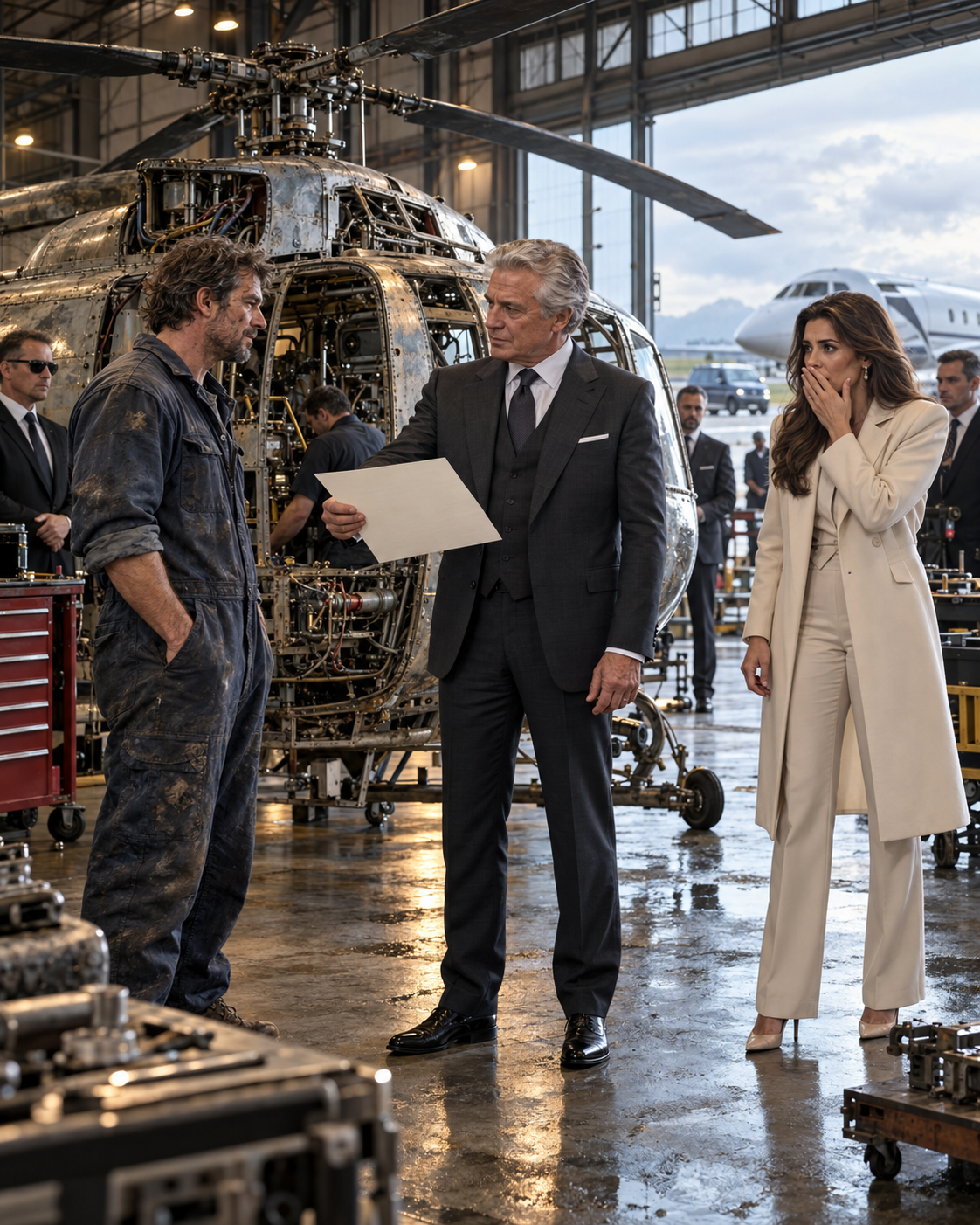
“Where are you?”
We met the next morning at a diner outside town.
Brenda arrived carrying a cardboard archive box tied with faded string.
She sat across from me and stared at the photographs.
“I thought this aircraft was gone.”
“So did everyone else.”
She opened the box.
Inside were old engineering memos, maintenance records, handwritten calculations, and blueprints folded so many times the paper had become soft.
Brenda’s hands trembled.
“I was told to destroy these.”
“By whom?”
She looked toward the window.
“The company’s president.”
“Who was that?”
“Richard Vance.”
Cynthia Vance’s father.
I felt the pieces beginning to connect.
Brenda pulled out a sealed envelope.
“This was never mailed.”
The handwriting on the front belonged to Donald.
She handed it to me.
Inside was a letter dated three weeks before the supposed Halcyon fire.
Donald had written that the prototype’s vibration system worked.
Not perfectly.
Not safely enough for production.
But enough to prove the concept.
He also wrote that Evelyn had completed the most dangerous test flights and had identified a flaw in the original control response.
She had proposed a correction.
Her correction worked.
Then came the final paragraph.
Donald wrote that Richard Vance intended to shut the program down and bury the aircraft because outside investors wanted the company focused on conventional contracts.
But that wasn’t the worst part.
Richard had learned that competitors were interested in the vibration technology.
He feared the design could be copied.
So he planned to remove HX1001 from the official inventory.
Donald believed Evelyn’s flight records were also going to disappear.
The letter ended with a sentence that stayed with me.
“If they destroy the machine, they can deny the machine existed, but they cannot erase the hands that built it.”
I looked at Brenda.
“Why didn’t you tell anyone?”
Her eyes filled with tears.
“Because I was twenty-six, Jack.”
She swallowed.
“I had a mortgage, two children, and a husband who had just lost his job.”
“I understand.”
“No, you don’t.”
She looked directly at me.
“I spent forty years telling myself that surviving wasn’t the same as betraying them.”
Neither of us spoke for a while.
Then my phone rang.
Cynthia Vance.
I answered.
“Jack, we need to discuss the helicopter.”
“How did you know I had it?”
“Because our records show it belongs to the company.”
“You sold it to me.”
“I was informed that the asset classification was incorrect.”
I looked at Brenda.
She lowered her eyes.
“Bring it back,” Cynthia said.
“No.”
Her voice hardened.
“You don’t understand the situation.”
“I understand the bill of sale.”
“You could face regulatory problems.”
“I have the signed auction documents.”
“Then you should understand that paperwork can be challenged.”
The line went dead.
Two hours later, Cynthia arrived at my shop with a man named Gerald Trent.
He was the company’s chief financial officer.
He wore an expensive coat and the expression of someone accustomed to making problems disappear.
Gerald looked at the helicopter.
“You bought this for $222?”
“Yes.”
“You should return it.”
“No.”
He smiled.
“You are a mechanic, Mr. Mercer.”
“That’s right.”
“This is corporate property.”
“It was corporate property when you sold it.”
He stepped closer.
“You don’t want to make an enemy of a company with lawyers.”
I looked at him.
“You don’t want to make an enemy of a mechanic with nothing left to lose.”
His smile vanished.
Cynthia stepped between us.
“Give us the airframe.”
“No.”
“We can offer you your money back.”
I laughed.
“You want me to sell you back something you sold me for scrap?”
Her face tightened.
“You’re making a mistake.”
“No.”
I touched the blackened fuselage.
“I’m making a discovery.”
They left without another word.
That night, I barely slept.
The next morning, an auditor from the bankruptcy trustee arrived.
He wasn’t interested in the helicopter itself.
He was interested in Gerald Trent.
Apparently, someone had discovered that several supposedly worthless assets had been misclassified over the previous two years.
They had then been purchased by a salvage company owned by Gerald’s family.
The pattern was simple.
Expensive assets were labeled damaged.
They were sold cheaply.
Then Gerald’s family’s company bought them.
The same thing had happened with engines, avionics, machine tools, and experimental components.
HX1001 wasn’t an accident.
It was supposed to disappear into the same pipeline.
The auditor asked me one question.
“Did Mr. Trent pressure you to return it?”
“Yes.”
“Did he threaten you?”
“Not directly.”
The auditor nodded.
“That may be enough.”
Two days later, Cynthia suspended Gerald.
A week later, the company withdrew every legal claim against me.
Then something happened that I never expected.
Brenda called.
“Jack,” she said, “you need to come to the shop.”
“Why?”
“There are cars outside.”
“How many?”
She hesitated.
“Enough.”
Part 3
Exactly ten days after the auction, I stepped outside my garage and saw a line of black vehicles stretching down the street.
Men and women in dark suits stood beside them.
Then the center door opened.
A tall older man stepped out.
He had silver hair, tired eyes, and the posture of someone who had spent decades carrying something invisible.
He looked at me.
“Are you Jack Mercer?”
“Yes.”
“My name is Arthur Prescott.”
The name hit me immediately.
Evelyn Prescott.
Her son.
He walked past me without saying another word.
When he saw HX1001, he stopped.
His face changed.
For a few seconds, he looked less like a billionaire and more like a child who had finally found his way home.
“My mother told me about this aircraft,” he whispered.
I didn’t know what to say.
He walked around the fuselage slowly.
His fingers never touched it.
“My father told me she was wrong about the aircraft.”
I said nothing.
“He said the project was a failure.”
Arthur’s jaw tightened.
“But my mother kept one photograph.”
He looked at me.
“She died believing somebody had hidden the truth.”
I handed him the developed photographs.
He stared at the first image.
Then the second.
Then the photograph of Evelyn standing beside HX1001.
His eyes filled.
“Where did you get these?”
“From inside the aircraft.”
He looked at his team.
They spent hours examining the weld patterns, structural marks, archival documents, and flight records.
Every detail matched.
The aircraft was real.
The serial number was authentic.
The titanium construction was original.
The rotor hub was the same experimental system described in the buried blueprints.
And the flight tag belonged to Evelyn.
Arthur finally walked over to me.
“I want to buy it.”
I looked at the helicopter.
Then at him.
“How much?”
He gave a number that made the room feel suddenly smaller.
Twenty million dollars.
I thought about my bank account.
My aging equipment.
The roof over my shop.
The years I had spent rebuilding machines other people had thrown away.
Then I thought about Donald.
I thought about Brenda.
I thought about Evelyn.
And I thought about how easily history could have been erased.
“I’ll sell it,” I said.
Arthur nodded.
“Thank you.”
“But I have three conditions.”
His expression changed.
“Name them.”
“First, HX1001 goes into a public museum.”
He nodded.
“Agreed.”
“Second, the plaque carries every important name.”
“Your name?”
I shook my head.
“Donald Mercer. Evelyn Prescott. The engineers. The welders. The technicians. Everyone who worked on it.”
Arthur looked at me for a long moment.
“Agreed.”
“Third, I oversee the restoration.”
He smiled faintly.
“Of course.”
“And one more thing.”
He raised an eyebrow.
“The burned section stays.”
“Why?”
“Because that scar is part of the truth.”
He looked back at the blackened fuselage.
Then he nodded.
“Keep it.”
The check arrived the following morning.
I held it in my hands for almost a minute before depositing it.
I expected to feel different.
I didn’t.
Money couldn’t change the fact that Donald was gone.
It couldn’t give Evelyn back the years she had lost.
It couldn’t give Brenda back the courage she wished she had possessed at twenty-six.
But it could give the truth somewhere permanent to live.
I didn’t buy a mansion.
I didn’t buy a fleet of cars.
I didn’t leave my garage behind.
I bought better tools.
I expanded the repair shop.
Then I did something Donald would have understood.
I started an apprenticeship program.
Young mechanics came through my doors carrying the same uncertain look I once carried.
Some were gifted.
Some were stubborn.
Some had never held a welding torch before.
I taught them anyway.
Then I created scholarships for students who wanted to study aviation maintenance, engineering, fabrication, and aircraft restoration.
The first time one of those students asked me why I was giving away money instead of keeping it, I told him the truth.
“Because somebody once gave me knowledge when he had every reason to keep it.”
Years later, HX1001 stood inside a museum beneath soft white lights.
Half the fuselage had been restored.
Half remained scarred and dark.
The titanium frame was visible through a section of glass.
The experimental rotor hub sat beneath a plaque explaining what the engineers had attempted and what they had achieved.
Donald Mercer’s name was there.
Evelyn Prescott’s name was there.
Brenda Chase’s name was there.
So were the names of the technicians whose work had nearly disappeared from history.
Arthur attended the opening.
He stood beside me for several minutes without speaking.
Then he said, “My mother would have wanted this.”
I looked at the aircraft.
“I think so.”
He smiled.
“You know what she used to say?”
“What?”
“That the machine doesn’t care who gets the credit.”
I smiled.
“Sounds like Donald.”
Arthur looked through the glass at the burned metal.
“Maybe they would have gotten along.”
After everyone left, I stayed behind for a few minutes.
The museum was quiet.
The lights reflected across the old titanium skin.
I could almost hear Donald’s voice from fifteen years earlier.
Listen before you touch.
Respect the machine.
Respect the people who built it.
I put my hand against the glass.
For years, I had believed the greatest lesson he gave me was how to repair machines.
I was wrong.
He taught me that value and price are not the same thing.
A price can be written on a tag by someone who never understood what they were holding.
A value is something deeper.
It lives in the hands that built it.
In the lives that depended on it.
In the truth that survived when everyone else wanted it forgotten.
I bought HX1001 for $222 because the world had been told it was worthless.
I sold it for twenty million dollars because someone finally understood what it was.
But the money was never the real victory.
The real victory was seeing Donald’s name restored.
It was seeing Evelyn’s story returned to her family.
It was watching young mechanics learn that their hands could build things worth remembering.
And it was knowing that a machine once hidden in the darkest corner of Hangar 12 would never be hidden again.
Before I left the museum that night, I looked back one last time at the scarred helicopter.
The blackened metal still carried the marks of the fire that was supposed to erase it.
Instead, those scars had become its signature.
And I finally understood something Donald had spent his life trying to teach me.
When an ignorant seller sets the price of an object, that price only tells you what they were willing to lose.
Its true worth belongs to the person who can see what everyone else missed.