I watched a $4 million Bugatti sit dead beneath the white lights of a Denver showroom while its owner called me a nobody
Part 2
The panel was hidden behind a section most technicians would never touch unless the diagnostic tree specifically told them to.
That was the problem.
The diagnostic tree wasn’t telling anyone anything.
I crouched beside the car.
Preston stood behind me.
Margaret remained several feet away, watching every movement.
And then a younger technician stepped forward.
“Do you want a light?”
I looked up.
He was maybe twenty-six.
Thin.
Quiet.
His name tag read Toby Miller.
“Sure.”
He handed me a work light.
His eyes weren’t mocking me.
They were curious.
That mattered.
I removed the fasteners and lifted the concealed cover.
The compartment looked untouched.
“See?” Preston said.
“Nothing.”
I didn’t answer.
I moved the light deeper.
There.
A small ground lead disappeared behind the auxiliary battery management assembly.
I touched it.
Toby leaned closer.
“Is that it?”
“Maybe.”
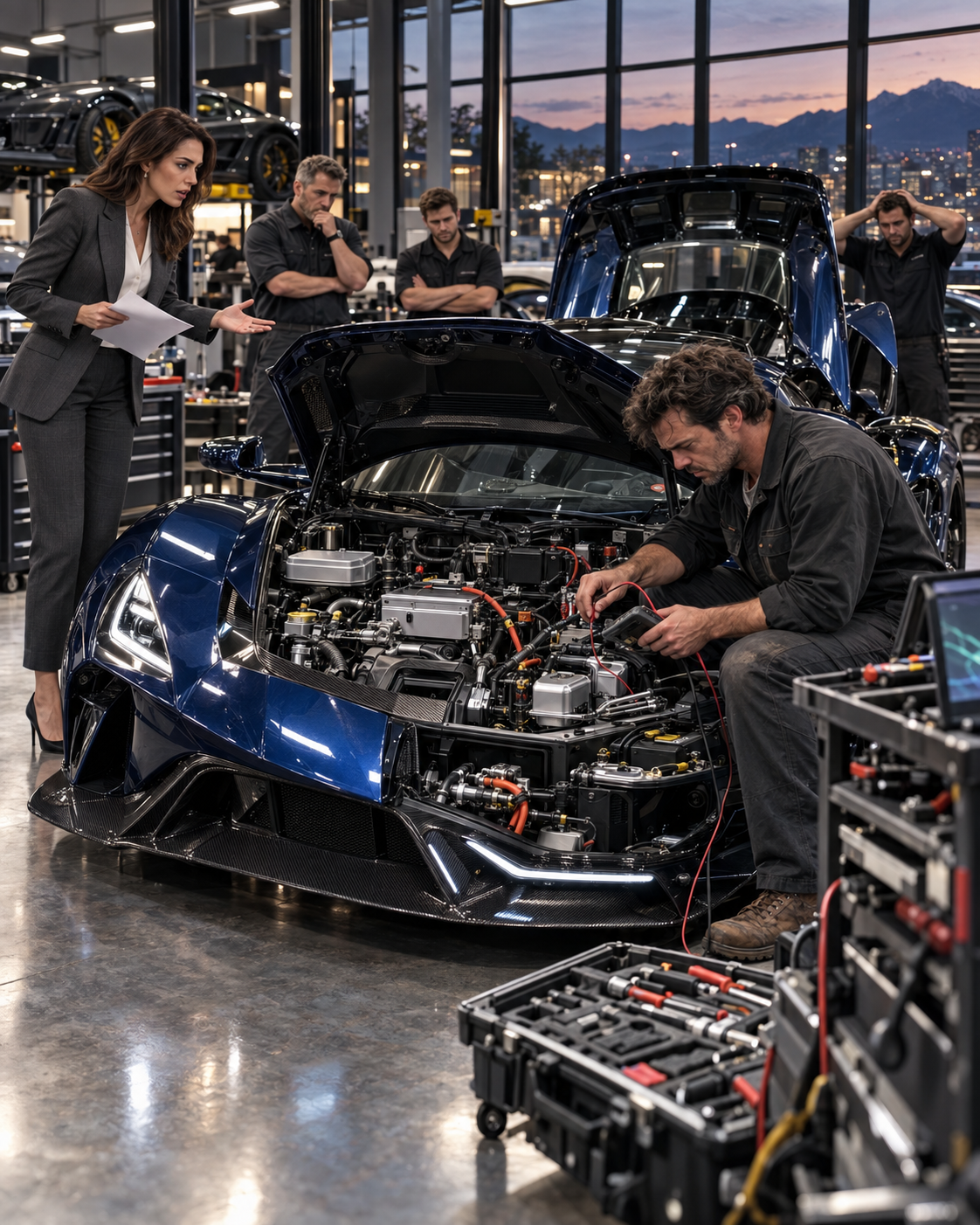
Preston shook his head.
“We inspected that compartment twice.”
“You inspected what the diagnostic procedure told you to inspect.”
I traced the cable with one finger.
“I’m looking for what the procedure doesn’t know to ask.”
I borrowed a multimeter.
The first reading looked normal.
Preston smiled.
“Exactly.”
I waited.
Then I asked Toby something.
“How cold was the car when it first failed?”
He checked his notes.
“Twenty-nine degrees.”
“And how warm was the service bay when the first scan was performed?”
“About sixty-eight.”
I looked at him.
“There’s our ghost.”
I connected the meter again.
The reading stayed stable.
Preston folded his arms.
“Well?”
I didn’t answer.
Instead, I reached for the ground lead and gently flexed it.
The resistance changed.
Only slightly.
But enough.
Toby’s eyes widened.
“That’s not supposed to happen.”
“No.”
I held the lead still.
“The crimp is contracting under cold conditions.”
Preston crouched beside me.
“That’s not possible at a magnitude that would matter.”
“It doesn’t need to move much.”
I pointed to the meter.
“It only needs to cross the threshold.”
I explained it slowly because Toby was listening.
The starter enable system didn’t need a dramatic electrical failure.
It needed certainty.
A clean signal.
A stable reference.
If that ground connection developed just enough resistance, the system could interpret the condition as unsafe.
No catastrophic fault.
No burned component.
No warning light.
Just silence.
And because the connection behaved normally once the car warmed up, every indoor diagnostic scan came back clean.
The problem existed in the morning.
The evidence disappeared by the time anyone looked for it.
Preston stared at the meter.
“This isn’t confirmed.”
“No.”
I nodded.
“It’s a hypothesis.”
“Then you haven’t fixed anything.”
“I know.”
I stood up.
“That’s why I’m going to test it.”
I walked back toward my truck.
Margaret followed me.
“What are you doing?”
“Getting a tool.”
“From your truck?”
“Yes.”
She looked at the expensive equipment scattered around the bay.
“You don’t have what you need here?”
“Not for this.”
I opened the driver’s door.
Behind the seat was a faded red toolbox.
The paint was chipped.
One hinge was slightly bent.
My wife had bought it for me years ago.
She’d written my name inside the lid with a black marker because I kept losing my tools.
I ran my fingers over the old letters.
For a second, I could hear her voice.
“You’re impossible.”
I smiled despite myself.
Then I grabbed the crimping tool, a few terminals, and a roll of wire.
Toby followed me.
“You’re really going to use that?”
I looked at the toolbox.
“She gave it to me.”
He didn’t ask who she was.
He just nodded.
We went back inside.
I built a temporary jumper lead.
Nothing fancy.
No proprietary software.
No factory laptop.
Just copper, terminals, and a clean connection.
I bypassed the suspect crimp without disturbing the original harness.
Then I checked the meter again.
Stable.
I looked at Margaret.
“Now we find out.”
She nodded.
Preston moved closer.
“I still think you’re wasting everyone’s time.”
I didn’t answer him.
I opened the driver’s door.
The interior smelled like leather and cold metal.
I had sat in cars like this hundreds of times.
But this one felt different.
Because I knew what lived behind the dashboard.
I knew the logic.
I knew the sequence.
I knew exactly how many conditions had to be satisfied before that engine was allowed to wake.
My hand rested on the starter button.
For one second, I thought about my wife.
She had watched me leave Bugatti.
She had watched me trade conference rooms for a two-bay garage.
She never once told me I had made the wrong choice.
She only said, “Come home.”
I pressed the button.
The car came alive.
The sixteen-cylinder engine exploded into the room.
The sound hit the glass walls and rolled through the showroom like thunder trapped indoors.
Everyone froze.
Toby’s mouth fell open.
One technician stepped backward.
Margaret covered her lips with one hand.
Even Preston didn’t move.
The Bugatti idled with a deep, controlled violence that seemed almost alive.
I watched the gauges.
Everything stabilized.
No warning.
No fault.
No hesitation.
Just power.
I let the engine run for several seconds before shutting it down.
Silence returned.
But it wasn’t the same silence as before.
This time, it was stunned.
Toby looked at me.
“How did you know?”
I looked at the red toolbox sitting on the floor.
“I listened.”
He laughed softly.
“That’s it?”
“Sometimes.”
I closed the driver’s door.
“The machine usually tells you what’s wrong.”
He glanced at Preston.
“Even when the computer doesn’t?”
“Especially then.”
Margaret walked toward Preston.
Her face was calm.
Too calm.
“Come with me.”
He looked at her.
“Margaret—”
“My office.”
He hesitated.
Then followed her.
The door closed behind them.
Toby and I stood beside the Bugatti.
Through the glass, I could see Margaret speaking.
I couldn’t hear every word.
I didn’t need to.
Preston’s shoulders had changed.
The confidence was gone.
The certainty was gone.
What remained was a man realizing that eight days of expensive expertise had been defeated by a connection smaller than a fingernail.
Toby broke the silence.
“Does that happen a lot?”
“What?”
“People overlooking the obvious because they expect the answer to be complicated.”
I thought about it.
“More than you’d think.”
He nodded.
“My dad does that.”
I smiled.
“So does everyone.”
A few minutes later, Margaret came out alone.
Preston followed behind her carrying nothing.
She stopped in front of me.
“I’ve terminated the contract.”
I didn’t react.
She looked at the Bugatti.
Then at the temporary jumper.
Then at me.
“I owe you an apology.”
“You don’t owe me anything.”
“I do.”
She paused.
“I judged you by your truck.”
I looked through the window at the old pickup.
“It happens.”
“No.”
Her voice was quieter.
“It shouldn’t.”
For a moment, none of us spoke.
Then she asked the question I hadn’t expected.
“How much would you charge to repair it properly?”
I gave her the number for the labor and parts installation.
She stared at me.
“That’s all?”
“That’s what the job is worth.”
She almost smiled.
“After everything?”
“After everything.”
She looked toward the Bugatti.
“The factory replacement harness is already being shipped.”
“Then I’ll install it when it arrives.”
She nodded.
“Good.”
Toby looked between us.
“Can I watch?”
I turned toward him.
“If you want.”
He smiled.
“I do.”
Margaret smiled too.
But there was sadness behind it.
Maybe because she had just learned that money could buy access to experts without buying wisdom.
Maybe because she had spent eight days listening to certainty while the truth sat quietly behind a panel.
Or maybe because she realized how much time had been wasted simply because nobody expected the right answer to come from someone who arrived in an old truck.
I packed my tools.
The red toolbox felt heavier than usual.
Not because of the tools.
Because I remembered where it came from.
My wife had always believed I could fix more than machines.
After she died, I stopped believing much of anything about myself.
That morning, standing beside a Bugatti worth millions, I realized I hadn’t lost my skill.
I had only lost the place where people expected to see it.
Part 3
The factory harness arrived two days later.
I drove back to the dealership before sunrise.
The sky over Denver was gray, and frost covered the windshield of my pickup.
Toby was already waiting.
He had coffee in one hand and a notebook in the other.
“You came early,” I said.
“So did you.”
“I always do.”
He smiled.
We worked quietly.
The temporary jumper came out.
The factory harness went in.
Every connection was checked.
Every ground point was inspected.
Every measurement was recorded.
No drama.
No speeches.
Just careful work.
When we finished, the Bugatti started immediately.
Cold engine.
Cold morning.
Perfect response.
Margaret came into the bay as I shut the hood.
She listened to the engine for a moment.
Then she said, “It sounds different.”
“It sounds healthy.”
She nodded.
“There’s a difference.”
I smiled.
She walked toward me.
“I’ve spent most of my life believing expertise announces itself.”
I waited.
She looked at my old toolbox.
“I was wrong.”
I didn’t tell her she was wrong to think that way.
People learn at different speeds.
Some lessons cost money.
Some cost pride.
Some cost eight days of frustration and half a million dollars.
But the most expensive lesson is the one you refuse to learn.
Margaret reached into her coat and handed me a folder.
Inside was the formal service contract.
I looked at it.
“You don’t have to do this.”
“I know.”
She held my gaze.
“That’s why I’m doing it.”
I signed.
Not because the money was enormous.
It wasn’t.
My garage didn’t need rescuing.
What mattered was that the work had come back to me without me chasing it.
A world I thought I had buried had opened a door.
And this time, I could walk through it without leaving my life behind.
Toby stood nearby.
“Can I ask you something?”
“Sure.”
“Why did you leave Bugatti?”
I looked at the Bugatti.
Then through the glass at the Denver morning.
“My wife got sick.”
He lowered his eyes.
“I’m sorry.”
“She was sick for a long time.”
I paused.
“When she died, the company kept going.”
Toby nodded.
“Of course.”
“And I realized I couldn’t.”
He didn’t say anything.
That was the right response.
Sometimes grief doesn’t need advice.
It needs room.
I closed the folder.
“Come work at my shop sometime.”
His face lit up.
“Really?”
“You’ll learn more there than you will watching people argue over computers.”
He laughed.
“I might take you up on that.”
“Do.”
I carried my red toolbox back to the truck.
Before I climbed in, Margaret called my name.
I turned.
She stood beside the Bugatti.
“One more thing.”
“What?”
“I used to think the most valuable thing in this car was the engine.”
I smiled.
“What changed?”
She looked at the panel where the tiny ground connection had been hidden.
“Now I think it’s the fact that somebody cared enough to understand what the engine needs before it ever turns.”
I nodded.
“That’s the whole job.”
She smiled.
“Drive safe.”
I climbed into my pickup.
The door creaked the way it always did.
The heater rattled.
The dashboard had a crack running through it that I kept promising to repair.
I put the red toolbox behind the seat.
For a moment, I sat there without starting the engine.
Through the windshield, I could see the Bugatti resting beneath the showroom lights.
It looked perfect again.
But I knew better.
Perfect machines don’t exist.
Perfect people don’t either.
Everything has a weak point.
Sometimes it’s hidden.
Sometimes it only appears when the temperature drops.
Sometimes it disappears the moment someone starts looking in the wrong place.
I started my truck.
The old engine coughed twice before settling into its familiar rhythm.
It sounded nothing like the Bugatti.
And I loved it anyway.
Because it was mine.
As I pulled away from the dealership, I thought about the question Toby had asked.
Why did I leave?
For years, I had thought the answer was that grief had taken my career away from me.
But sitting behind the wheel of that battered pickup, I finally understood something else.
I hadn’t abandoned my old life.
I had carried the best part of it home.
Not the title.
Not the factory badge.
Not the polished offices.
The knowledge.
The patience.
The habit of looking twice when everyone else had already decided they knew.
That afternoon, I returned to my little garage.
The first customer was waiting with an old Ford that wouldn’t start.
I opened the hood.
He apologized for bringing me something so ordinary.
I smiled.
“Ordinary is fine.”
He looked embarrassed.
“Think you can figure it out?”
I reached for my tools.
“I’ll listen to it.”
He laughed.
I did too.
Then I opened the hood and began.
Years later, people would sometimes ask me about the Bugatti.
They’d expect a story about the engine.
Or the price.
Or the famous specialist who got it wrong.
But I never told it that way.
Because the Bugatti wasn’t the lesson.
The lesson was the tiny connection nobody respected because nobody expected it to matter.
It was the old toolbox behind my seat.
It was my wife’s handwriting fading beneath the lid.
It was the fact that a man can lose his place in a world without losing what made him valuable in the first place.
And sometimes, the person everyone overlooks is carrying exactly what everyone else has been searching for.
The difference is that he doesn’t need the room to believe in him.
He only needs one honest chance to prove what he already knows.
That morning, I had walked into a luxury dealership carrying a delivery.
I walked out carrying something I thought I had lost years ago.
Not my old career.
Something better.
A reason to believe that the quiet parts of us can survive even after the people who taught us to value them are gone.
And as I drove home in that battered old pickup, with my wife’s faded red toolbox behind me and the Denver sky turning gold in the windshield, I realized that some things are never really left behind.
They simply wait for the right moment to start again.