I watched 17 world-famous engineers fail to start my grandfather’s $37 million Ferrari, so when the exhausted janitor quietly said
Noah looked at me for several seconds without speaking, and the silence between us felt heavier than the Ferrari’s engine had.
“You know my grandfather?”
“No.”
“Then why would he write your name?”
Noah lowered his eyes to the journal.
“I don’t know.”
I didn’t believe him.
Not because his voice sounded dishonest, but because it sounded afraid.
I opened the green journal again.
The first pages were not financial records or engineering sketches.
They were personal notes.
Names.
Dates.
Short observations about people Raymond had met throughout his life.
Some were politicians.
Some were engineers.
Some were philanthropists.
Then I saw Noah’s name.
I froze.
There was no explanation beside it, only a date from eight years earlier.
I looked at him.
“Why is your name here?”
He didn’t answer immediately.
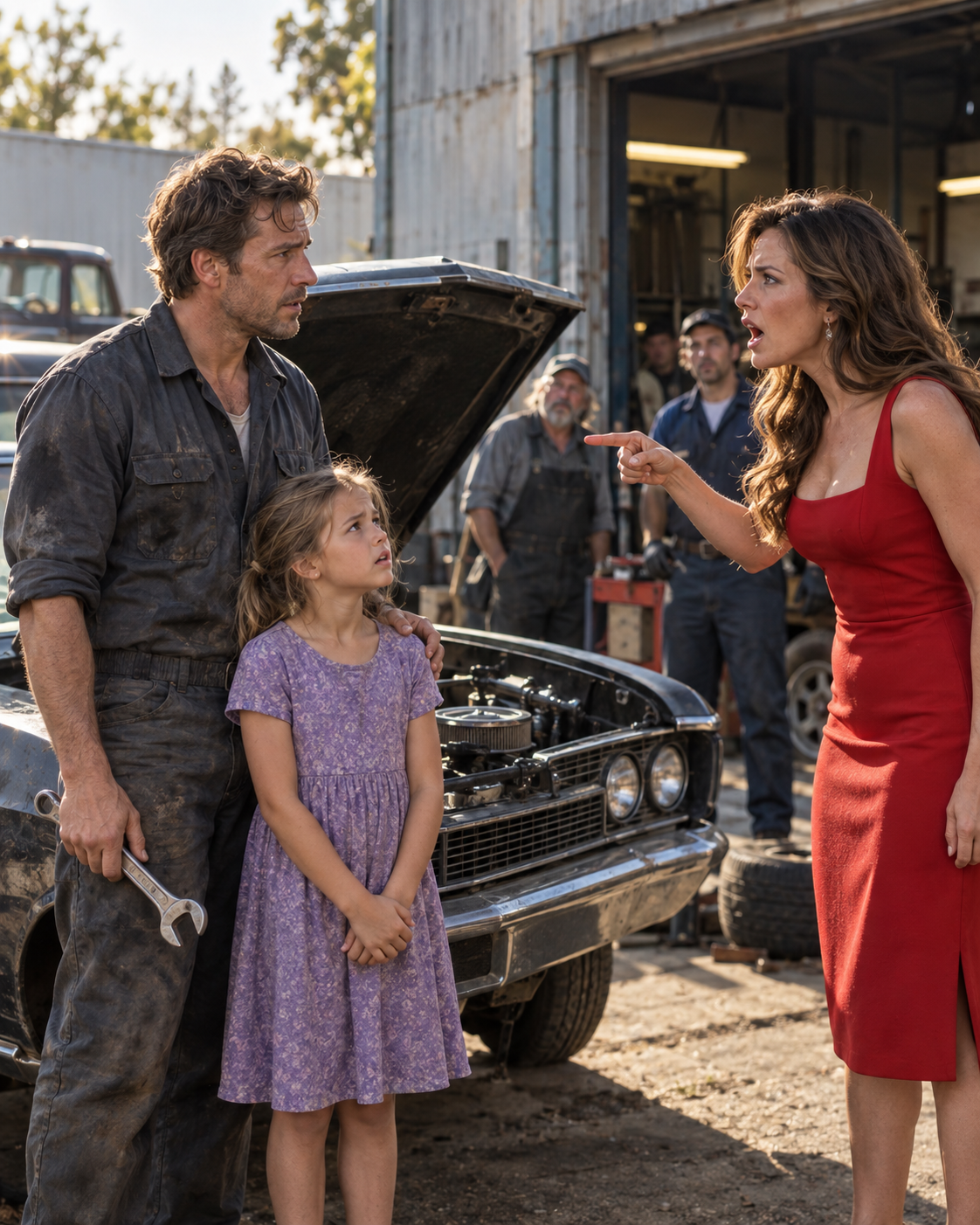
Finally, he pulled a chair from the wall and sat down.
“I knew your grandfather.”
My heart skipped.
“When?”
“Before you ever met me.”
The garage seemed to shrink around us.
“Tell me everything.”
He stared at the Ferrari.
“I used to work in automotive engineering.”
I knew that much from the way he had handled the car, but hearing him admit it felt different.
“Where?”
“A restoration company in Michigan.”
“Doing what?”
“Complex mechanical systems.”
“Why are you cleaning floors here?”
He rubbed his hands together.
“Because four years ago my wife died.”
His voice changed when he said it.
Not dramatic.
Just smaller.
“Her name was Elena.”
I said nothing.
“She got sick when our daughter, Lily, was three.”
He stared at the concrete floor.
“I quit my job to take care of her.”
I felt something inside me soften.
“After she died, I couldn’t go back.”
“Why?”
“Every engine reminded me of her.”
He gave a sad smile.
“She loved old cars more than I did.”
I sat across from him.
“So my grandfather knew you.”
“Not exactly.”
Noah reached into his coverall pocket and pulled out a folded photograph.
It showed a younger Raymond standing beside a group of engineers at a restoration event.
A much younger Noah stood near the edge of the photograph.
My grandfather had circled him in blue ink.
“You were there.”
“Yeah.”
“Why?”
“Because Raymond noticed something I’d designed.”
He explained that years earlier, he had helped develop an analog mechanical security system for valuable historical vehicles.
Raymond had been fascinated by it.
“He told me computers could be hacked, copied, corrupted, or stolen,” Noah said.
“He wanted something physical.”
Something that required patience.
Something that couldn’t be bypassed with a password.
I remembered the hidden keys.
The compartments.
The impossible ignition sequence.
“Your grandfather took my design and made it better.”
I looked at him.
“Without telling me?”
“He paid me for the consultation.”
“Then why did you leave?”
Noah’s jaw tightened.
“Because when Elena got sick, I stopped answering calls.”
He looked at the journal.
“Raymond called me twice.”
My chest tightened.
“When?”
“About six years ago.”
The same year my grandfather died.
“He wanted me to inspect the Ferrari.”
I stared at him.
“Did you?”
“No.”
“Why?”
“Because Elena was in the hospital.”
He closed his eyes.
“She died two weeks later.”
I couldn’t speak.
For six years, I had blamed myself for not understanding my grandfather’s final message.
For six years, I had thought I was the one who had failed to hear him.
But Noah had missed those calls too.
Maybe none of us had been ready.
I picked up the wooden box.
Inside was a photograph of me and Raymond in his old garage.
I remembered that day instantly.
I had been twelve.
I was covered in grease.
He was laughing.
On the back, there was a note.
“People think legacy is what you leave behind.”
I turned the photograph over.
“It isn’t.”
I read the next line.
“Legacy is what someone else becomes because you believed in them.”
I looked at Noah.
His eyes were wet.
My grandfather had chosen him for a reason.
Not because he was the world’s greatest engineer.
Because he was patient.
Because he had once loved something enough to lose everything for it.
Because Raymond knew grief could either make a person disappear or teach them how deeply they could care.
The next morning, Noah and I went to the safety deposit box from the note hidden in the wooden case.
Inside was a single envelope.
There was no money.
No secret stock.
No treasure.
Just a letter and a set of foundation documents.
I opened the letter.
“Scarlet, if you’ve made it this far, then you understand the car.”
I read silently until my vision blurred.
“Every machine has a purpose, but people need one too.”
My hands shook.
“The foundation is not about charity.”
I read the next paragraph slowly.
“It is about dignity.”
That word stayed with me.
My grandfather had planned water systems where families walked miles to find clean water.
He had planned schools where children were being taught in buildings that should have been condemned.
He had planned medical centers where people died because a clinic was too far away.
He had spent decades earning money because he wanted to prove he could.
Then, at the end, he realized making money wasn’t the same as making a difference.
The final line of his letter was simple.
“Don’t build it because I asked you.”
“Build it because you finally know why.”
I closed the envelope.
Noah looked at me.
“What are you going to do?”
I smiled through the tears.
“Everything.”
The months that followed were harder than either of us expected.
Money didn’t solve logistics.
Fame didn’t create trust.
Governments had regulations.
Communities had fears.
Nonprofits had different priorities.
Every decision seemed to reveal ten more problems.
My board wanted efficiency.
My lawyers wanted safeguards.
My public-relations team wanted a launch campaign.
Noah wanted to know whether the people receiving help had actually been heard.
One afternoon I walked into a meeting and found three executives arguing over a water project budget.
I listened for five minutes.
Then I interrupted.
“Stop.”
Everyone went silent.
“We’re debating numbers.”
“We’re debating impact,” one executive corrected.
“No.”
I shook my head.
“We’re debating numbers because none of you have sat beside the people who will use this system.”
Noah was standing at the back of the room.
He didn’t smile.
He just nodded once.
That became our rule.
Before approving a project, we listened.
We visited.
We asked questions.
We learned what people needed instead of arriving with expensive solutions designed in a glass office thousands of miles away.
The first water project was in Ghana.
The engineers predicted six months.
It took nine.
There were supply problems, local disputes, and a flooding season none of our projections had handled properly.
When the system finally opened, I expected applause.
Instead, an elderly woman walked slowly toward the pump.
She filled a bucket.
She looked at the water.
Then she touched Scarlet’s hand.
She didn’t speak English.
She didn’t need to.
Her expression told me everything.
For the first time since my grandfather died, I felt the weight inside my chest become something other than grief.
It was responsibility.
The foundation expanded.
A medical center in Nairobi.
A school renovation in Detroit.
Clean water projects across communities that had been promised help many times before.
Noah became the foundation’s director of engineering.
The internet eventually discovered that the man who had started a priceless Ferrari was a former engineer working as a janitor.
People called him a genius.
He hated that.
One reporter asked him why he had stayed in such a low-paying job for so long.
He looked at the camera and said, “Because my daughter needed me more than my career did.”
That answer traveled farther than anything else.
Lily became a regular presence at the foundation’s headquarters.
She drew pictures of pumps, schools, cars, and people holding hands.
She once asked me why my grandfather had hidden everything inside a Ferrari.
I laughed.
“Because he liked puzzles.”
She shook her head.
“No.”
She had the serious expression she always wore when she thought adults were missing something obvious.
“He hid it because he wanted the right person to find it.”
I looked at Noah.
He smiled.
“She’s got you there.”
Years passed.
The Ferrari was restored to running condition without changing its original configuration.
We drove it occasionally at private tracks, never for publicity.
It became less of a trophy and more of a ritual.
Sometimes Noah drove.
Sometimes I did.
Sometimes Lily sat in the passenger seat wearing oversized headphones because the engine was too loud for her.
Every time the V12 came alive, I thought of Raymond.
Every time I heard Lily laugh, I thought about what he meant by legacy.
Then, one evening, a letter arrived.
It was from an attorney representing a company called Ashworth Holdings.
The name meant nothing to me.
The attorney claimed my grandfather’s foundation plans were derived from intellectual property that belonged to their client.
They threatened litigation.
My legal team panicked.
Noah didn’t.
He asked for the full file.
We found the name in Raymond’s journals.
Ashworth Holdings had approached him years earlier about acquiring several of his humanitarian projects.
Raymond refused.
They had tried to pressure him.
When that failed, they tried to discredit him.
Then we found something worse.
A missing page had been removed from one of the old journals.
Noah stared at the binding.
“There should be a page here.”
We searched the Ferrari again.
This time, not for a hidden compartment.
For evidence.
Inside a tiny cavity beneath the dashboard badge, we found a folded strip of paper.
The handwriting was Raymond’s.
“They will tell you I stole from them.”
I kept reading.
“I did not.”
“They will tell you the foundation was their idea.”
“It was not.”
“They will tell you the projects cannot succeed.”
“That is the only prediction I trust them to make.”
At the bottom, one sentence.
“Fear always arrives before change.”
We took everything to our attorneys.
The legal fight lasted more than a year.
We won.
Not because my company was powerful.
Not because my family name opened doors.
Because Raymond had documented every agreement, every contribution, and every refusal to compromise.
The same patience that had built the Ferrari’s hidden locks had protected the foundation decades later.
After the case ended, I returned to the garage alone.
Noah was there under the car, inspecting something.
“You know,” I said, “I used to think the Ferrari was my grandfather’s greatest invention.”
Noah slid out from beneath it.
“It wasn’t.”
“What was?”
He pointed toward the wall where we had framed Raymond’s photograph.
“You.”
I laughed.
“That’s incredibly sentimental.”
“It’s also true.”
I looked at the photograph.
My grandfather had spent his life building machines, companies, systems, and wealth.
But his greatest act of engineering had been simpler.
He had built a path between people.
He had trusted one grieving engineer.
That engineer had helped me hear my grandfather.
I had helped him remember who he used to be.
And together, we had turned grief into something that could help other people live.
One Saturday morning, I found Noah standing beside the Ferrari with Lily.
She was holding the same oversized wrench I had once held at twelve.
She looked at me.
“Can I try?”
I smiled.
“Of course.”
Noah handed her the tool.
She immediately dropped it.
The wrench hit the concrete with a loud clang.
Lily froze.
“I broke it.”
Noah laughed.
“No.”
He picked it up.
“You tried.”
She looked at me.
“Grandpa would be mad?”
I shook my head.
“He’d probably say you finally did something worth doing.”
Lily smiled.
Noah looked at me.
For a second, neither of us spoke.
There are moments in life when you realize the people you lost are not actually gone in the way you once feared.
They remain in habits.
In lessons.
In stories.
In the way your hands reach for a tool.
In the way a child laughs from the passenger seat of a car.
In the quiet decision to keep going.
That evening, Noah and I took the Ferrari onto the private track.
The sun was dropping behind the trees.
The engine warmed slowly.
The gauges climbed into their proper ranges.
Noah rested his hands on the wheel.
“Ready?”
I smiled.
“Always.”
He started the ignition sequence.
Three hidden triggers.
One flat brass tool.
Two keys.
Then the V12 came alive.
The sound rolled across the track and into the trees.
Lily laughed in the back seat.
For the first lap, Noah drove slowly.
For the second, he opened the throttle.
For the third, I looked at the dashboard and realized I wasn’t listening for my grandfather anymore.
I was listening to the people beside me.
That was the real secret.
The car had never been waiting to be fixed.
It had been waiting to be understood.
And maybe people are the same.
Sometimes the person everyone overlooks is carrying the answer.
Sometimes the quietest person in the room has already survived the thing you are afraid to face.
Sometimes grief doesn’t disappear.
Sometimes it becomes a road.
My grandfather left me a Ferrari.
He left Noah a second chance.
He left Lily a story she would tell long after we were gone.
And he left all of us the same lesson.
Do not measure a life only by what it owns.
Measure it by what becomes better because it was here.
When we finally stopped the Ferrari, the engine ticked softly as it cooled.
Lily was asleep against the window.
Noah looked at her, then at me.
“You know what Raymond got right?”
I smiled.
“What?”
“He built something that outlived him.”
I looked at the red Ferrari glowing beneath the last light of evening.
“Yeah.”
I thought about the foundation.
The water.
The schools.
The clinics.
The people whose names I would never know but whose lives had changed anyway.
Then I looked at Noah.
“He just didn’t realize the thing that would outlive him wouldn’t be the car.”
Noah smiled.
“It never is.”
We sat there in silence as the sky darkened.
The Ferrari rested beside us, warm and quiet, holding its secrets the way it always had.
And somewhere inside that old machine, behind leather and steel and decades of careful engineering, my grandfather’s fingerprints were still there.
Not just in the metal.
In the lives that followed.
In the people who listened.
In the people who refused to give up.
In the people who discovered that sometimes the door you’ve been pounding on isn’t locked at all.
You’ve simply been using the wrong key.