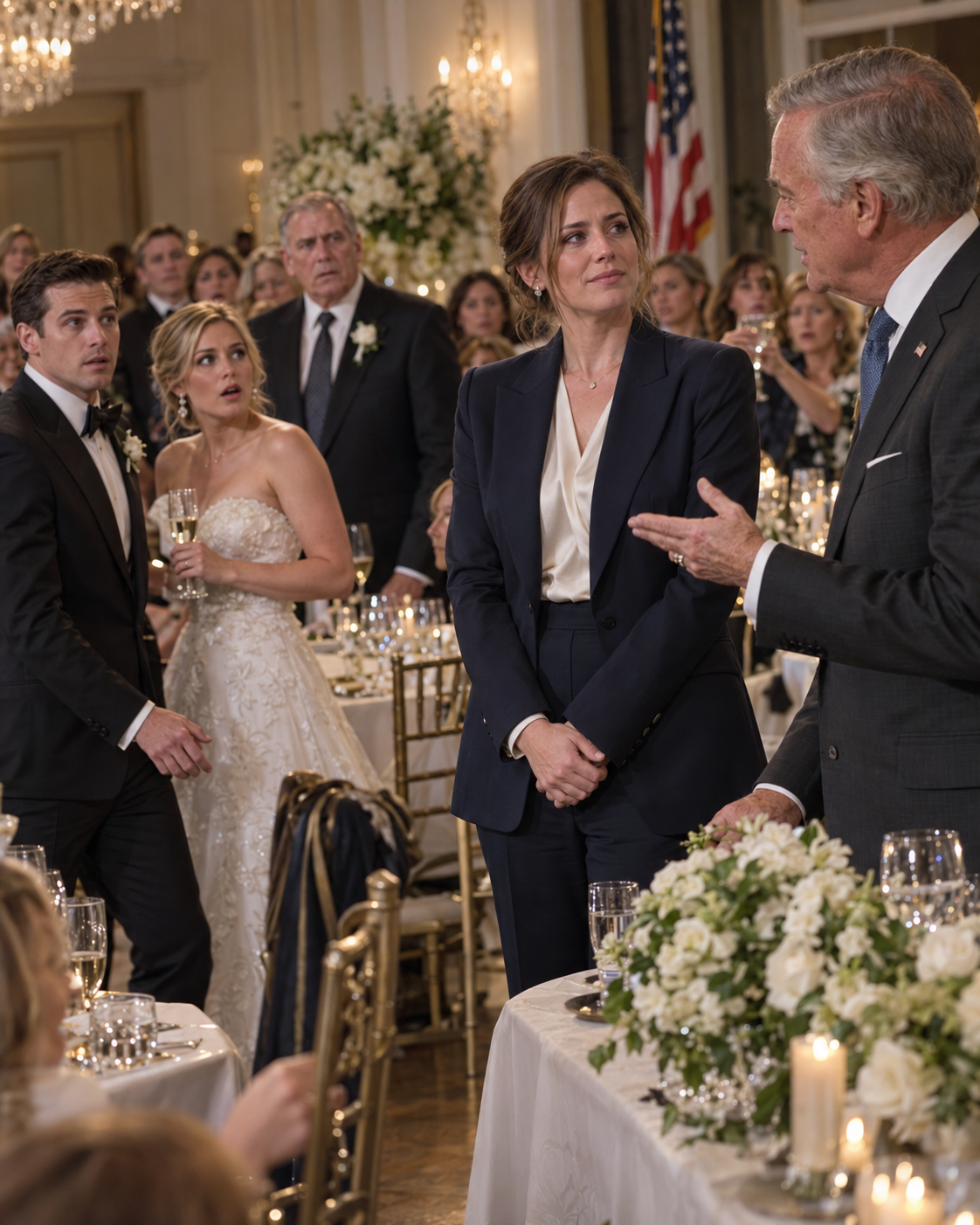
I was standing outside the Georgetown country club when my father told me I was too embarrassing to attend my own brother’s rehearsal dinner
I read the message three times before putting my phone away.
The ballroom around me was still glittering with crystal glasses, polished silver, and people pretending nothing had changed.
But something had.
And I could feel it in the way conversations stopped when I walked past.
My father had spent years making me small because small was easier to explain.
Now the room had seen evidence that his version of me had never been true.
The next morning, before sunrise, I was back at the Pentagon.
The building felt almost comforting after the strange theater of the rehearsal dinner.
Concrete.
Fluorescent lights.
Coffee that tasted like punishment.
No one cared what designer suit someone wore.
They cared whether the numbers were right.
My director, Daniel Reeves, met me outside the conference room.
“We’ve been asked to expand the review.”
“How far?”
“Everything connected to the programs from yesterday.”
I opened the briefing packet.
The initiative involved a massive modernization effort spread across several agencies and multiple states.
My job wasn’t to decide policy alone.
My job was to make sure the people making those decisions understood exactly what the numbers meant.
I spent most of the morning tracing discrepancies that should have been obvious but somehow weren’t.
There were duplicate projections.
Unreconciled procurement assumptions.
Several cost estimates that looked suspiciously optimistic.
By noon, Congressman Vance requested another briefing.
When I walked into his office, he was standing beside a whiteboard covered in figures.
“Tell me what I’m missing.”
I put the report down.
“Three things.”
He smiled.
“Good.”
I explained them one by one.
He listened without interrupting.
When I finished, he said, “This is why I asked for you.”
That sentence followed me for the rest of the day.
Not because he was a congressman.
Because for once, someone powerful was recognizing the work instead of dismissing the person doing it.
Then my phone buzzed.
It was my father.
“I’d like you to come home this weekend.”
I almost declined.
Instead, I asked why.
He replied, “Family.”
I stared at that word for a long time.
Family had always meant obligation in my father’s vocabulary.
It meant showing up when they wanted a photograph.
It meant swallowing insults because blood was supposed to make everything forgivable.
I decided to go.
Not for him.
For myself.
When I arrived Saturday morning, the house looked exactly as I remembered it.
Same brick steps.
Same porch light.
Same dining room where my father had once told me my career was “temporary.”
He was waiting alone.
“I owe you an apology.”
I put my bag down.
“Okay.”
He looked disappointed by the lack of emotion.
“I was wrong about your job.”
“You were wrong about me.”
He sighed.
“What’s the difference?”
“Everything.”
He sat down.
“I thought you were unhappy.”
“I wasn’t.”
“I thought you were settling.”
“I wasn’t.”
He looked at me.
“Then why did you never tell us?”
That question hurt more than I expected.
“Because every time I tried to talk about work, you interrupted me.”
He had no answer.
So I continued.
“You wanted to know how much I made, whether I was getting promoted, whether my position looked impressive, whether people recognized my name.”
I paused.
“You never asked whether I was proud of what I did.”
His eyes lowered.
That was the closest we had come to honesty in years.
Then he said something unexpected.
“Liam has been asking about you.”
I nearly laughed.
“What does he want?”
“Advice.”
That word sounded strange coming from my father.
“About what?”
“The company.”
I looked at him.
“What company?”
My father hesitated.
“Liam and Chloe are planning to buy into a defense technology firm.”
I felt my stomach tighten.
“Does it have anything to do with the programs I work on?”
“I don’t know.”
“Then find out.”
He stared at me.
“You think it’s a problem?”
“I think you should stop assuming I don’t notice things.”
That afternoon, Liam called.
His voice was completely different from the confident one I remembered.
“Emma, I need a favor.”
“What kind?”
“I want to talk to you about Chloe’s family’s business.”
I sat down.
“Why?”
“They’re investing in a company that says it can deliver technology for one of the programs you’re reviewing.”
I closed my eyes.
Suddenly, my family dinner was no longer just a family issue.
It was a professional boundary issue.
“Liam, I can’t discuss anything nonpublic with you.”
“I know.”
“Then why are you asking?”
“Because I don’t trust the people around Chloe.”
I was silent.
He continued.
“Her family keeps telling me this deal is guaranteed.”
“By who?”
“That’s the problem.”
He didn’t know.
Or wouldn’t say.
I told him to speak with a private attorney and keep me out of it.
When the call ended, I sat staring at the wall.
There are moments when life stops giving you separate problems and starts tying them together.
This was one of those moments.
Monday morning, I received another request from Congressman Vance.
This time, his staff included a new document.
It was a corporate ownership chart for a private defense contractor.
I recognized the name immediately.
It was the company Chloe’s family planned to invest in.
My pulse quickened.
The ownership chain passed through several holding companies.
One of the directors was connected to an executive whose name had appeared in our procurement review.
I brought everything to Daniel.
He read it slowly.
“We’re opening a conflict review.”
I nodded.
“Keep personal relationships out of it unless they are directly relevant.”
“I understand.”
That mattered to me.
Whatever happened next, I wasn’t going to turn professional responsibility into family revenge.
The investigation moved quietly.
No headlines.
No dramatic announcements.
Just requests for documents, internal reviews, legal consultations, and questions that made people increasingly uncomfortable.
Then one evening, Daniel came into my office.
“We found something.”
He placed a file on my desk.
Several investment commitments had been made before certain procurement decisions became public.
The pattern did not prove wrongdoing by itself.
But it demanded scrutiny.
I spent the next week working late.
Every night, I went home exhausted.
Every morning, I returned.
During that time, I barely spoke to my family.
Then Chloe called me.
I almost didn’t answer.
“Emma, please.”
Her voice trembled.
“We need to talk.”
“About what?”
“My family.”
I waited.
She took a breath.
“I think they lied to Liam.”
“About the investment?”
“About everything.”
That afternoon, we met at a quiet café in Arlington.
Chloe arrived without makeup, sunglasses, or the polished confidence I had seen at the country club.
She looked frightened.
“They told Liam the deal was basically approved.”
“It isn’t.”
“I know that now.”
She stared at her coffee.
“They used your name.”
My entire body went still.
“What did they say?”
“That someone in Washington had already signed off.”
I felt a chill move through me.
“Did they say who?”
She shook her head.
“They didn’t name you.”
“But they implied me.”
“Yes.”
I leaned back.
That was the moment I realized how dangerous appearances could become.
People who had mocked my position were now using an exaggerated version of it to make money.
My father had been obsessed with appearing close to power.
Chloe’s family seemed obsessed with appearing able to control it.
And Liam had become trapped between them.
I reported the conversation immediately.
From then on, I stayed completely out of the family discussions.
The professional review continued without me making conclusions beyond the evidence.
Eventually, outside investigators were brought in.
Several investment arrangements were suspended.
A number of people were questioned.
No one in my family was accused merely because they knew me.
That distinction mattered.
Facts had to remain facts.
Not ammunition.
When Liam finally called again, he sounded broken.
“I should have defended you.”
I didn’t answer right away.
“You should have respected me.”
“I know.”
“Do you?”
He went quiet.
“I thought Dad was right.”
“About what?”
“That influence was something you could see.”
I looked out my apartment window.
“And now?”
“Now I know it can look like someone sitting alone at midnight making sure a number is correct.”
For the first time, my brother understood something my father had missed.
Real responsibility rarely looks glamorous.
The wedding happened six weeks later.
It was smaller than originally planned.
Some guests never came.
Several business arrangements were canceled.
The political theater disappeared almost completely.
I attended.
Not because my father had earned forgiveness.
Because Liam was still my brother, and I wanted to see whether he had finally learned the difference between family and status.
Before the ceremony, he found me behind the venue.
“I’m glad you’re here.”
“So am I.”
He smiled sadly.
“Do you think Dad will ever stop caring about what people think?”
I looked toward the doorway.
“He might.”
“How?”
“By learning that respect given only after public validation isn’t really respect.”
After the ceremony, my father approached me.
He didn’t mention Congressman Vance.
He didn’t mention my job.
He didn’t mention how important people had started treating me.
He simply said, “I’m proud of you.”
I looked at him carefully.
“For what?”
He seemed confused.
“For the work you’ve done.”
I smiled faintly.
“That’s better.”
He hugged me.
It wasn’t perfect.
It didn’t erase years of disappointment.
But for the first time, the hug didn’t feel like a transaction.
Months later, I received another invitation.
This one wasn’t from my family.
It came from a national policy institute asking me to lead a new advisory initiative.
The position would mean more visibility, more responsibility, and far less anonymity.
I read the offer twice.
Then I thought about my father’s voice years ago.
“Why would anyone care what a government clerk thinks?”
I smiled.
I signed the acceptance letter.
Not because I needed to prove him wrong.
Because I had finally stopped measuring my worth against his expectations.
That evening, I called my father.
“I accepted a new position.”
He sounded proud.
“That’s wonderful.”
There was a pause.
Then he asked, “Are you happy?”
I looked around my apartment.
At the stacks of briefing papers.
At the coffee cup on my desk.
At the life I had built quietly while everyone else was busy impressing each other.
“Yes,” I said.
And this time, I meant it.
A year after the wedding, Liam and Chloe sent me a photograph of their new home.
It was beautiful.
But what caught my attention was the handwritten note attached to the back.
“We finally understand why you never needed the room to know your name.”
I placed the photograph beside an old picture of the family before everything changed.
For years, I had thought being overlooked was the wound.
I was wrong.
The deeper wound was believing I had to become impressive enough to deserve love.
The real victory was realizing I never had to.
That night, I stood on my balcony overlooking Washington, with the Capitol lights glowing in the distance.
My phone buzzed.
It was a message from Congressman Vance.
“There’s a new assignment, and your name is already on it.”
I smiled, but before I could open the attachment, another message appeared from an unknown number.
“Congratulations, Emma.”
Then a second line appeared.
“Now ask why your father knew more about your career than he ever admitted.”
I stared at the screen as the city lights blurred beyond the glass.
For the first time, I wasn’t afraid of what my family had hidden.
I was afraid of how long they had been hiding it.
And somewhere inside me, an old question quietly opened its eyes again.
What exactly had my father known all along?