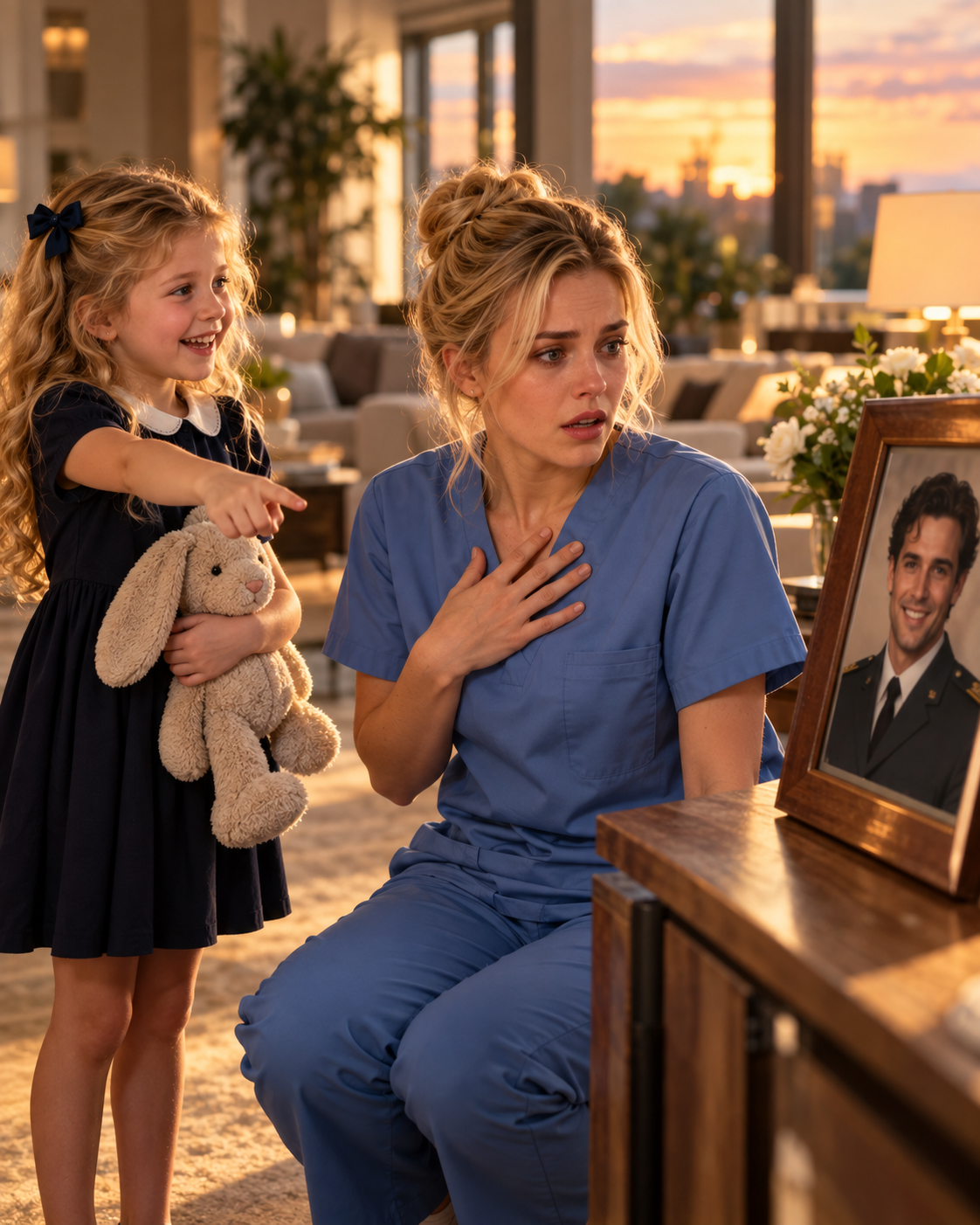
I was standing in the naval hospital courtyard when a three-year-old girl touched my dead lover’s photograph and announced
Three days later, I drove back to Virginia alone.
Aaron wanted to come with me, but his neurologist insisted that the long trip could trigger another seizure, and for the first time since he returned to my life, I hated the distance between us.
So I kissed him goodbye in our kitchen, promised to call when I arrived, and watched Maisie press her nose against the window as I pulled away.
The hospital looked smaller than I remembered.
Or maybe grief had made everything larger.
His mother was waiting in the records office with two cardboard boxes on the table.
She looked exhausted.
“I should have shown you these before,” she said.
I stared at the boxes.
“What are they?”
“Things your leaving prevented me from giving you.”
My stomach tightened.
She opened the first box.
Inside were copies of Aaron’s medical records, photographs, receipts, and a small spiral notebook with a torn blue cover.
I recognized the handwriting immediately.
Aaron’s.
My hands started shaking before I even touched it.
“You said he lost the year before the accident,” I whispered.
“The doctors said his memories were inaccessible,” she replied carefully.
“That isn’t always the same thing as them being gone.”
I opened the notebook.
The first page had one sentence written across it.
If I forget, remind me about the porch.
I stopped breathing.
His mother sat beside me.
“He started writing things down after the headaches began,” she said.
“What headaches?”
She looked at me with tears gathering in her eyes.
“The ones he never told you about.”
I turned the page.
The handwriting became messier.
March 3: Another headache during training.
March 11: Lost five minutes today.
March 17: Couldn’t remember where I parked.
March 21: Dreamed about the pier.
My fingers went cold.
I turned another page.
April 2: She thinks I’m just tired.
April 6: I need to tell her.
April 8: If something happens, don’t let them tell her I stopped loving her.
I closed the notebook.
For several seconds, neither of us spoke.
“He knew something was wrong,” I said.
His mother nodded.
“He was afraid.”
“Why didn’t anyone tell me?”
“He didn’t want you frightened.”
I wanted to be angry with him.
Instead, I remembered the way Aaron used to rub the back of his neck whenever he was hiding something from me.
That tiny gesture suddenly felt like a door opening.
His mother pushed the second box toward me.
“There’s more.”
Inside was an envelope.
My name was written across it.
Not “Doc.”
Not my last name.
Just my first name.
The envelope had never been mailed.
I opened it with trembling hands.
The letter was dated six days before the crash.
I read it once.
Then again.
Then a third time because my eyes kept filling with tears.
He wrote that he had bought the ring because he wanted to ask me to leave the military with him after his next assignment.
He wrote that he had spent weeks looking at houses.
He wrote that he had chosen one with a small porch because he remembered how much I loved sitting outside when it rained.
Then came the sentence that broke me.
If I ever become someone who doesn’t remember you, please don’t mistake that for me choosing to leave.
I pressed the paper against my chest.
His mother reached for my hand.
“He never stopped looking for a way to protect you,” she said.
I shook my head.
“I thought I abandoned him.”
“You didn’t abandon him.”
“I left before he woke up.”
“You left because they told you he was dying.”
That distinction should have comforted me.
Instead, it hurt.
Because for six years I had carried the guilt of walking away from a man who had already been walking toward me.
I stayed in Virginia until sunset.
Before I left, his mother gave me the spiral notebook.
“You should have it.”
I drove home through rain.
Aaron was sitting at the kitchen table when I walked in.
Maisie was asleep upstairs.
He looked at my face and immediately knew something had happened.
“What did you find?”
I placed the notebook between us.
He stared at it.
Then at me.
“I wrote that?”
“Yes.”
He opened it.
For several minutes, he said nothing.
Then his thumb stopped on the sentence about the porch.
“I remember the feeling,” he whispered.
“What feeling?”
“Waiting for someone.”
My heart twisted.
“You were waiting for me.”
He shook his head.
“No.”
He closed his eyes.
“I was waiting for someone I couldn’t see.”
I sat beside him.
“Maybe that was me.”
He looked at me for a long time.
“Maybe.”
That night, we didn’t try to force his memories.
We sat on the porch beneath the same light that had once watched us whisper about impossible futures.
Rain tapped against the roof.
Maisie slept upstairs.
Aaron held my hand.
“I need to tell you something,” he said.
I looked at him.
“I don’t want my life to become an investigation into who I used to be.”
His voice cracked.
“I love what you’re telling me, but sometimes I feel like I’m standing beside a man everyone expects me to become again.”
I squeezed his fingers.
“You don’t have to become him.”
He stared at me.
“You can become whoever you are now.”
His eyes filled.
“And if I never remember?”
“Then I’ll tell you the story as many times as you need.”
He smiled sadly.
“Even the embarrassing parts?”
“Especially those.”
He laughed.
It was the first time his laugh sounded exactly like the man in the photograph.
I cried before I could stop myself.
He leaned closer.
“Don’t cry.”
“I’ve waited six years to hear that laugh again.”
His expression softened.
“Then I’ll do it more often.”
For a while, life became almost ordinary.
We learned each other’s habits again.
I learned which foods he hated now.
He learned that Maisie needed exactly two bedtime stories, never one.
He learned I still woke from nightmares whenever thunderstorms shook the windows.
I learned he became quiet whenever too many people spoke around him.
We weren’t rebuilding the old relationship.
We were building a new one on top of everything that survived.
But the notebook kept bothering me.
Not because of what it contained.
Because of what it didn’t.
There were four missing pages between April 8 and April 14.
I asked his mother about them.
She swore she had never removed anything.
Aaron’s neurologist said memory loss could sometimes cause fragmented recollections, but the missing pages were still strange.
Then one afternoon, Maisie found something.
She was playing with an old wooden box in Aaron’s closet when she called me.
“Mommy, what’s this?”
I walked over.
She was holding a tiny brass key.
I recognized it immediately.
Aaron used to keep it on a chain around his neck.
“What does it open?”
I asked.
He appeared behind us.
His face changed when he saw it.
“I don’t know.”
I took the key.
A faded number had been scratched into the metal.
317.
Aaron stared at it.
Then he whispered, “Virginia.”
The next morning, we called the hospital.
There was an old storage locker in the basement numbered 317.
It had been assigned to Aaron before the crash.
His mother still had authorization to access it.
We went together.
The locker smelled like dust and metal.
Inside were training manuals, a pair of boots, old photographs, and a sealed envelope.
Aaron stood very still.
“I know this place.”
“You’ve been here before.”
“No.”
He touched the wall.
“I mean I remember being afraid here.”
I opened the envelope.
Inside was a flash drive.
No letter.
No explanation.
Just Aaron’s handwriting on the label.
WATCH THIS IF I FORGET.
My hands went numb.
We found an old computer in the records office and opened the file.
The video showed Aaron sitting alone in a parked car.
He looked exhausted.
There was a bruise along his jaw.
He stared into the camera for several seconds before speaking.
“If you’re watching this, then I was right.”
Aaron beside me stopped breathing.
The recording continued.
“I don’t know what happens next.”
Aaron’s younger voice trembled.
“But something is happening to me.”
He rubbed his eyes.
“I keep losing pieces of time.”
Then he leaned toward the camera.
“There is something about the crash you need to know.”
The video suddenly cut to black.
The room went silent.
Aaron stared at the screen.
“What did he mean?”
“I don’t know.”
He looked at me.
“But I think I was trying to remember before I forgot.”
We contacted the military investigator who had handled the accident.
The official report said the crash resulted from mechanical failure during training.
Two fatalities.
One survivor.
No misconduct.
No further action.
But the investigator agreed to meet us.
He was retired now, living in North Carolina.
When we showed him the video, his face changed.
“I haven’t seen that footage,” he said.
“Are you sure?”
“I would remember.”
He watched it again.
Then he leaned back.
“There was an earlier version of the report.”
“Earlier?”
“Yes.”
“What changed?”
He hesitated.
“The original report mentioned a maintenance discrepancy.”
Aaron’s hand tightened around mine.
“What discrepancy?”
“A brake system inspection had been signed off before the training run.”
“And?”
“The signature belonged to a technician who wasn’t on base that day.”
Nobody spoke.
The investigator looked at Aaron.
“Your case was closed quickly because command believed the accident was mechanical and unavoidable.”
“But it wasn’t?” I asked.
“I didn’t say that.”
“You’re saying someone signed a safety inspection they didn’t perform.”
“I’m saying the paperwork raised questions.”
“Why weren’t they investigated?”
He looked away.
“Because by the time I pushed for answers, I was ordered to stop.”
The room seemed to tilt.
Aaron stared at the floor.
Then he said quietly, “My memory didn’t disappear because of the crash.”
I looked at him.
“It disappeared before.”
The retired investigator nodded.
“That is what your notebook suggests.”
Aaron’s breathing became shallow.
“What happened to me before the crash?”
“We don’t know,” the man said.
“But your video suggests you were trying to find out.”
On the drive home, Aaron said almost nothing.
When we reached the house, he went straight to the porch.
I followed.
He sat beneath the light.
“Do you remember this place?”
“Not exactly.”
He looked at me.
“But I remember you standing here.”
My heart stopped.
“What were you wearing?”
He frowned.
“A gray sweatshirt.”
I smiled.
“That was six years ago.”
“No.”
He looked confused.
“It was raining.”
“It was.”
“You were angry.”
I laughed softly.
“I was furious.”
“Because I forgot our anniversary.”
“You were deployed.”
“I forgot anyway.”
He smiled.
Then suddenly his expression collapsed.
His hand went to his temple.
“Aaron?”
He doubled over.
I caught him.
“Look at me.”
He gasped.
“I remember the crash.”
My blood went cold.
“What?”
“I remember someone shouting.”
His eyes squeezed shut.
“I remember the brakes.”
I held him tighter.
“Don’t force it.”
“I remember the vehicle moving.”
His breathing became ragged.
“And I remember thinking I hadn’t told you.”
“Told me what?”
He opened his eyes.
“That I knew.”
“Knew what?”
His face went pale.
“That someone had been watching us.”
I couldn’t move.
“Who?”
He stared past me toward the dark yard.
“I don’t know.”
Then he whispered the words that had haunted his missing year.
“But they knew about you.”
That night, I locked every door.
For the first time since Aaron came home, I understood that memory was not the only thing we had lost.
Someone had been trying to erase a story.
And perhaps they had succeeded.
Weeks passed without another breakthrough.
The military reopened an inquiry into the maintenance records, but there were no promises.
Aaron continued therapy.
Some days he remembered fragments.
A song.
A hallway.
The smell of gasoline.
My hand in his.
Other days, everything disappeared again.
I stopped asking him to remember.
Instead, I taught him how to live with what he had.
That became our real love story.
Not finding the old Aaron.
Finding the man standing in front of me.
One year after the first Memorial Day, we returned to the naval hospital.
Maisie wore a tiny blue dress.
Aaron wore his uniform.
I carried the pier photograph.
We placed it on the same table where I had once sat alone.
Aaron looked at the picture.
“I know him,” he said.
“You do?”
He smiled.
“No.”
He touched the glass.
“But I know why he loved you.”
My eyes filled.
“Why?”
“Because he looked at you like he had finally found somewhere safe.”
I couldn’t speak.
Maisie tugged Aaron’s sleeve.
“Daddy?”
“Yes?”
“Did Mommy save you?”
He looked at me.
Then down at our daughter.
“No,” he said.
“Your mom didn’t save me.”
He took my hand.
“She reminded me that I was still worth finding.”
That sentence stayed with me.
Because sometimes love isn’t about restoring what was lost.
Sometimes it is about refusing to let loss decide what comes next.
We never recovered every memory.
The missing pages were never found.
The investigation eventually proved that the safety inspection had been falsified, but the person responsible was never identified.
Aaron carried scars on his skin and gaps in his mind for the rest of his life.
And I carried the knowledge that leaving him had not been betrayal.
It had been grief.
There is a difference.
Years later, the porch light still hangs above our front door.
We turn it on whenever one of us travels.
Not because we’re afraid.
Because it became our promise.
Come home.
One evening, long after Maisie had grown old enough to understand our story, she found the original photograph in a drawer.
She studied it.
“Mom?”
“Yeah?”
“Why does Daddy look so happy here?”
I looked at Aaron across the room.
He was older now.
Silver threaded through his hair.
His scars were still visible.
His memory still imperfect.
But when he caught my eye, he smiled.
“Because,” I told her, “he didn’t know yet how much life was going to ask of him.”
Maisie looked at the picture again.
“Would you choose him again?”
I glanced at Aaron.
He didn’t answer for me.
He never did.
I walked over and took his hand.
“I already did.”
That night, after Maisie went upstairs, Aaron and I stood beneath the porch light.
He leaned against the railing.
“Do you ever wish you had never met me?”
I looked at him.
“Not once.”
“Even with everything?”
“Especially with everything.”
He kissed my forehead.
Then he went quiet.
I felt his fingers tighten around mine.
“What is it?”
He looked toward the road.
“I remembered something.”
My heart began to race.
“What?”
His eyes filled with tears.
“The night before the crash.”
I waited.
He swallowed.
“You asked me why I kept leaving the porch light on.”
I smiled through sudden tears.
“What did I say?”
He looked at me.
“You said, ‘Because someday, even if you forget the way home, you’ll still know where to look.’”
I covered my mouth.
He touched my cheek.
“I think that’s why I found you again.”
Then he looked over my shoulder.
His face changed.
“What?”
He pointed toward the street.
A car was parked beneath the trees.
Its headlights were off.
Someone was sitting inside.
I turned.
The car pulled away before I could see the driver.
Aaron didn’t move.
“Did you recognize it?”
He shook his head.
“No.”
Then his eyes dropped to my hand.
The engagement ring was still there.
He stared at it for several seconds.
“There is one thing I still haven’t remembered,” he whispered.
“What?”
“Who I bought that ring from.”
I looked at him.
He looked toward the empty road.
And for the first time in years, the porch light suddenly felt less like a promise that someone would come home…
and more like a warning that someone had never really left.