I was standing in the middle of a crowded airport when my phone showed my front door swinging OPEN
The photograph showed my house in darkness, my bedroom window glowing faintly on the second floor.
I stared at it until my eyes began to ache.
For several seconds, I convinced myself it was probably another cruel joke from Ryan.
Then I noticed the date.
The photograph had been taken that night.
Not hours earlier.
Not before the family meeting.
That night.
I immediately checked every camera around the property.
The backyard camera showed nothing.
The driveway camera showed nothing.
The side gate was closed.
Then I opened the front camera and froze.
At 11:43 p.m., a shadow moved across the sidewalk.
Someone stopped directly across from my house.
They stood there for almost thirty seconds before walking away.
I called Officer Bradley.
He answered on the second ring.
“I received something strange,” I said.
After I explained everything, he told me not to confront anyone.
“Save the photograph and keep your doors locked,” he said.
“If someone comes onto the property, call us immediately.”
I barely slept that night.
Every creak sounded like footsteps.
Every passing car made me sit upright.
By morning, I was exhausted and angry with myself for being afraid inside my own home.
Then I noticed something else.
The photograph had been taken from a position directly beside the old maple tree.
That was the same place where I had seen Ryan standing during the police incident.
I called him.
He didn’t answer.
I called again.
Nothing.
So I sent one message.
“Did you send me this photograph?”
He replied five minutes later.
“No.”
I stared at the answer.
Then another message appeared.
“Clara, I swear I didn’t.”
For the first time since everything happened, I believed him.
Not because I trusted him.
Because I knew his usual lies.
This one sounded different.
I drove to the café where we had held the family meeting and asked my father to meet me.
He looked older than he had a week earlier.
His shoulders were bent, and he kept rubbing his wedding ring with his thumb.
“I didn’t know about the photograph,” he said.
“Did you know about everything else?”
He looked down.
“I knew your mother wanted to move in.”
“That isn’t what I asked.”
He stayed silent.
That silence hurt more than an argument.
Finally, he admitted he had known about the plan for nearly two months.
My mother had convinced him that I would eventually agree.
“She said you were lonely,” he whispered.
“She said you had more house than you needed.”
I laughed bitterly.
“I was lonely because every time I built something for myself, someone in this family decided they were entitled to it.”
My father closed his eyes.
“I know.”
“No, Dad,” I said quietly.
“You know now.”
He didn’t argue.
That was the first honest thing he had given me in years.
But there was something else I needed to understand.
I asked him why they had photographed my deed.
He hesitated.
Then he admitted my mother had contacted an attorney before they moved in.
They had asked whether Ryan could eventually establish a business interest in my property.
I felt sick.
“So this wasn’t just about living here.”
“No.”
“What was the end goal?”
My father looked at me.
“Your mother wanted Ryan to have a permanent business address, and she believed once everyone was under one roof, you would eventually put his name on something.”
I sat there silently.
They had not simply crossed a boundary.
They had built an entire plan around the assumption that my boundaries did not matter.
When I returned home, I searched through every document connected to the house.
The deed was safe.
The mortgage was in my name.
The insurance was in my name.
The utilities were in my name.
Everything was secure.
Still, I changed my passwords.
I added two-factor authentication.
I replaced the garage keypad.
I installed a second camera facing the street.
And I put the original deed in a safe-deposit box.
For the first time, protecting my home felt less like paranoia and more like self-respect.
Three days later, Samantha Higgins contacted me.
Her email was brief.
She wanted to meet.
We sat across from each other at a coffee shop downtown.
She looked embarrassed.
“I owe you an apology,” she said.
“You don’t owe me anything.”
“I signed that contract because Ryan presented himself as the owner of a consulting firm operating from that address.”
She slid a folder toward me.
Inside was a copy of his proposal.
My home address was printed beneath his company logo.
There was even a photograph of my living room.
I recognized it immediately.
It had been taken from one of my security cameras.
Someone had taken a screenshot from the online security portal.
My stomach tightened.
“That account was private.”
Samantha looked confused.
“I received the image directly from Ryan.”
I stared at the photograph.
It wasn’t just an image of my house.
It was a frame from the exact camera feed I had watched while my family invaded.
I had changed my password after the police incident.
But apparently, someone had already downloaded old footage.
The next morning, I contacted the security company.
They reviewed the access logs.
There had been one unauthorized login.
The login originated from a device associated with an old email account.
My brother’s email.
I confronted Ryan.
He didn’t deny it.
“I was trying to prove the office was real,” he said.
“You were using my private security footage to sell a business that wasn’t located there.”
“I thought you’d eventually let me use the address.”
“You thought?”
He looked away.
Then he whispered, “Mom said you would.”
That sentence broke something inside me.
Not because Ryan was innocent.
He wasn’t.
But because I suddenly understood how easily my family had turned one another against reality.
My mother had created a story where my house was already theirs.
Ryan had believed it.
My father had tolerated it.
And I had been expected to surrender simply because refusing would make me the difficult daughter.
I told Ryan the next sentence slowly.
“You don’t get to use my kindness as evidence that you own me.”
He began to cry.
I didn’t comfort him.
That was difficult.
I had spent my entire life believing love meant fixing things when people hurt.
But sometimes fixing everything only teaches people that they can keep breaking it.
A week later, my mother called.
I almost didn’t answer.
When I did, she didn’t apologize.
She said she was tired of being treated like a criminal.
“You called the police on your own mother,” she said.
“You entered my house without permission.”
“We’re family.”
“That doesn’t change the law.”
She became silent.
Then she said something I would remember for the rest of my life.
“I gave birth to you.”
I closed my eyes.
For years, those words had been used as a debt I could never repay.
As if being born meant surrendering every boundary forever.
I answered quietly.
“And I am grateful you gave me life.”
She waited.
“But you don’t get to own the life I built.”
She hung up.
That was the last conversation we had for almost three months.
During those months, everything changed.
My father paid the locksmith bill as promised.
Ryan made the first payment on his debt.
Then the second.
The $2,300 property damage was divided into scheduled payments, and every receipt was documented.
There were no more family emergencies.
No surprise visits.
No keys disappearing.
No emotional demands.
At first, the silence felt cruel.
Then it began to feel peaceful.
I started using my office again.
I bought a new desk.
I repaired the scratched floor.
I planted flowers beneath the maple tree.
Slowly, the house stopped feeling like evidence from a crime scene and started feeling like home again.
One Saturday morning, I found an envelope beneath my front door.
There was no stamp.
No name.
Inside was a handwritten letter from my father.
He wrote that he had spent years confusing keeping the family together with keeping everyone happy.
He admitted he had allowed my mother to control difficult situations because confrontation frightened him.
He apologized for failing to protect me when I needed him.
At the bottom, he wrote, “I don’t expect forgiveness just because I’m sorry.”
I read that sentence three times.
Then I folded the letter and put it away.
I wasn’t ready to forgive him.
But I was ready to stop carrying his choices as if they were my responsibility.
Months passed.
Ryan’s business survived, barely.
The $24,000 contract was gone.
His shared office was small and plain.
He eventually sent me a photograph of it.
There was one sentence beneath the picture.
“I finally built something that actually belongs to me.”
I didn’t know whether to laugh or cry.
I replied, “Then protect it.”
He wrote back, “I will.”
My parents eventually moved into their smaller condo.
It was nowhere near as impressive as the house they had sold.
My mother hated it at first.
My father said they were learning to live within what they actually owned.
I didn’t visit.
Not yet.
Then, almost six months after the invasion, my father asked whether he could come to my house.
He didn’t ask to stay.
He didn’t ask for money.
He asked if he could sit on my porch for ten minutes.
I almost said no.
Instead, I told him he could come Saturday at two.
He arrived alone.
He stood outside the gate until I opened it.
That small gesture affected me more than I expected.
He didn’t walk in.
He waited.
“May I come inside?”
I nodded.
We sat in the kitchen.
For ten minutes, neither of us spoke.
Then he looked around.
“You made this place beautiful.”
I smiled faintly.
“I had to make it mine again.”
He nodded.
“I know.”
Before he left, he reached into his coat and handed me a small envelope.
Inside was the final receipt for Ryan’s old $6,000 debt.
Paid in full.
Every dollar.
I looked at my father.
“He did this himself?”
“Yes.”
That mattered.
Not because of the money.
Because for once, someone in my family had taken responsibility without asking me to rescue them.
My father stood.
“I won’t come back unless you invite me.”
I looked at the front door.
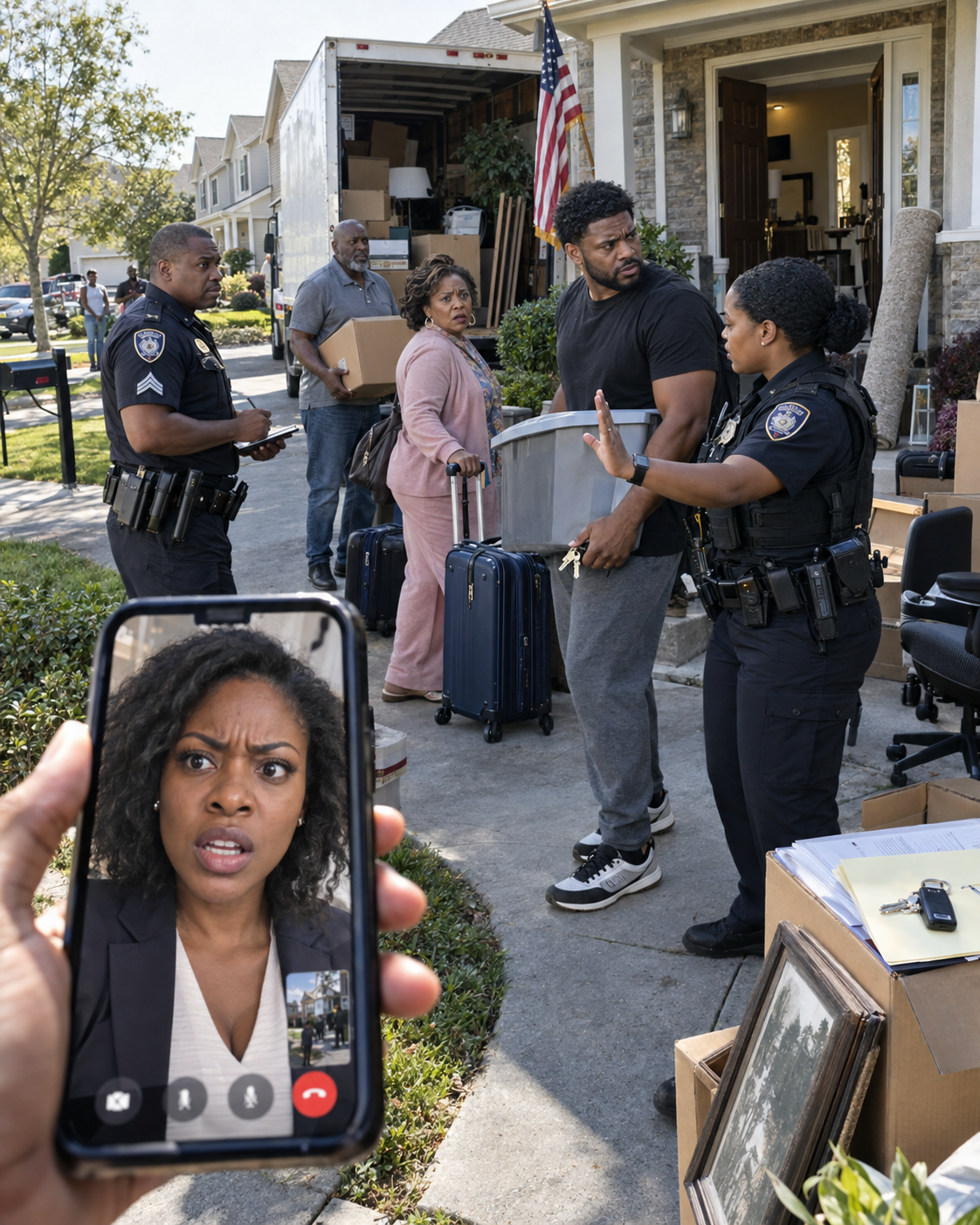
The same door that had once opened without my permission.
The same door through which my family had carried furniture, suitcases, and assumptions.
Then I looked at him.
“Thank you.”
He walked away.
I closed the door myself.
And this time, the sound of the lock turning didn’t feel like fear.
It felt like freedom.
I never repaired the relationship with my mother in the way she wanted.
Maybe someday we would speak again.
Maybe we wouldn’t.
But I stopped measuring my worth by whether my family approved of my boundaries.
I learned that love without respect can become possession.
I learned that guilt can be used like a key if you let someone convince you that saying no makes you cruel.
And most importantly, I learned that protecting what you worked for doesn’t make you selfish.
Sometimes it is the first honest act of love you can offer yourself.
A year after the invasion, I stood beneath the maple tree one evening and watched the sunset disappear behind the rooftops.
My phone buzzed.
It was a message from an unknown number.
For one terrifying second, I thought about the photograph.
Then I opened it.
There was no threat this time.
Only a single sentence.
“Your mother wants to tell you something she never told you.”
I stared at the screen as the wind moved through the branches above me.
I didn’t know whether I was ready to hear another family secret.
But I knew something I hadn’t known that night at the airport.
Whatever waited on the other side of that conversation, I would meet it standing on my own ground.
And for the first time in my life, the person deciding whether that door opened was me.