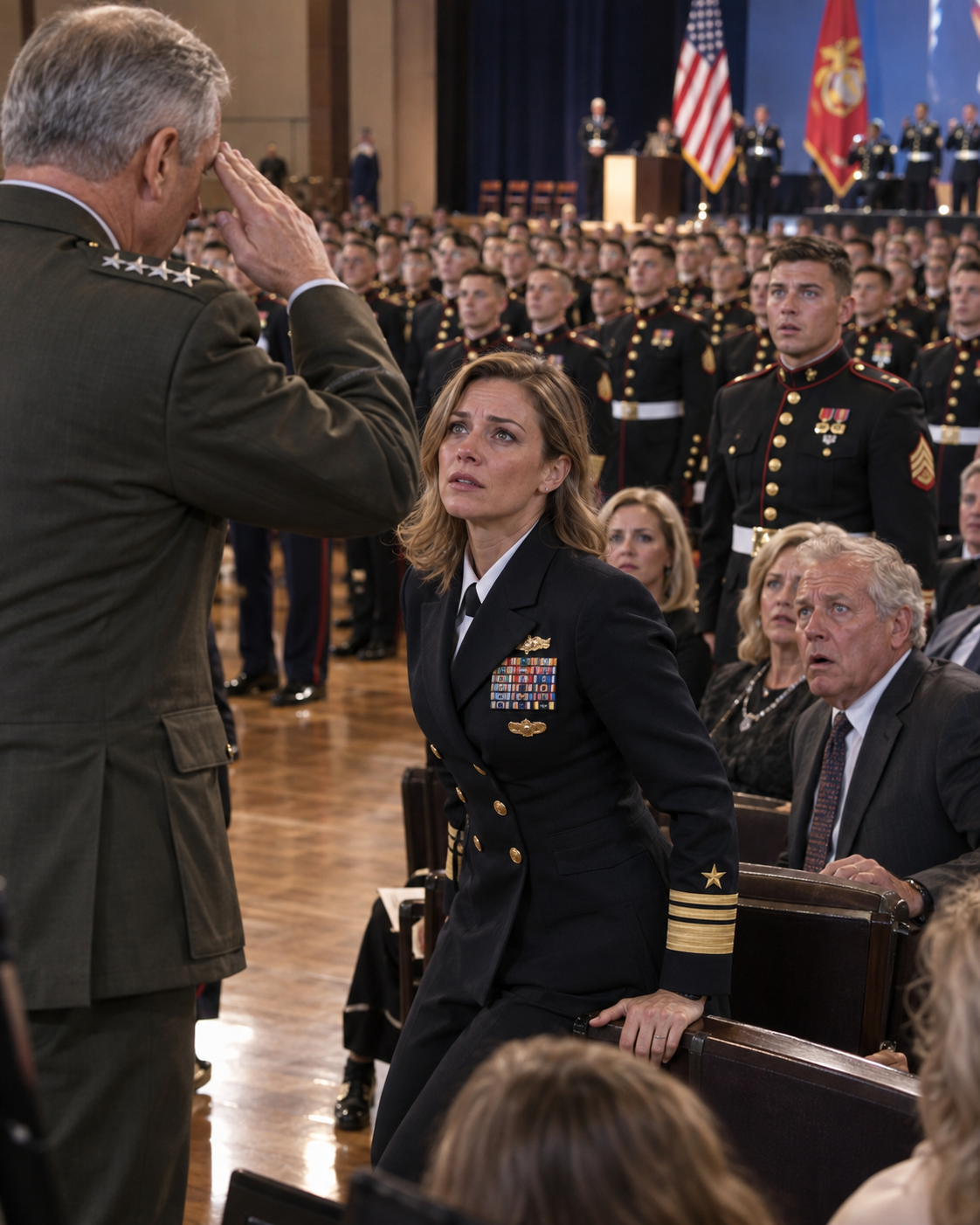
I was standing in the back row at Quantico, carrying water pitchers because my father said I had washed out of the Navy
For several seconds, I couldn’t move.
My father’s arms were still around me, but his words had created a distance between us that felt larger than the entire auditorium.
I pulled back and searched his face.
“What didn’t you tell me?”
He looked toward the empty seats.
“Not here.”
Three months had passed since Quantico, yet I still wasn’t used to seeing my father sit in the front row whenever I spoke.
He had started attending my public events quietly, usually arriving early and taking the same seat near the aisle.
He never introduced himself as my father.
He never mentioned my rank.
He simply listened.
It was the strangest kind of apology.
After the ceremony, we walked outside into the cool Annapolis evening.
The campus lights had begun to glow, and young midshipmen crossed the courtyard in neat formations.
My father seemed smaller than I remembered.
Older.
“Tell me,” I said.
He stopped beside a stone bench.
“I didn’t burn all forty-one letters.”
My stomach tightened.
“What?”
He looked down at his hands.
“I burned the first few.”
“How many?”
“Seven.”
I waited.
He took a breath.
“Then I started keeping them.”
I stared at him.
“Where?”
“In a box.”
He looked ashamed.
“I hid it in the garage.”
For twenty years, I had imagined my words turning to smoke in some fireplace.
Apparently, at least some of them had survived.
“Why keep them if you couldn’t stand reading them?”
He gave a broken little laugh.
“Because every time I tried to throw them away, I couldn’t.”
He reached into his coat and pulled out a photograph.
It was old and slightly bent.
I recognized myself immediately.
I was twenty-seven, standing in uniform outside a naval facility.
My father had never mentioned having it.
“You sent this with your first promotion notice,” he said.
“I remember.”
“I put it in the box.”
He looked at the photograph for a long moment.
“Then your mother found the box.”
My heart sank.
“What did she do?”
“She asked me why I was keeping things from you.”
“And?”
“I told her I was protecting the family.”
I almost laughed.
“From what?”
He looked directly at me.
“From the truth.”
That sentence stayed between us.
Then he told me everything.
For decades, my father had built his identity around one simple idea: Caleb would become the successful son, while I would always be the daughter who needed guidance.
When I joined the Navy, he expected me to return home quickly.
When I didn’t, he told people I had failed.
When letters began arriving with increasingly impressive titles, he panicked.
The first promotion notice had frightened him.
The second had frightened him more.
By the time I became a captain, he had already told dozens of people that I worked behind a desk in Washington.
Admitting the truth would have forced him to correct every lie.
So he kept lying.
Then came the day he received a letter announcing my promotion to admiral.
He read it alone.
He cried.
Then he burned it.
“Why?” I whispered.
“Because Caleb had just been accepted into officer training.”
He closed his eyes.
“I told myself your success would make him feel smaller.”
I stared at him.
“Did Caleb know?”
“No.”
That mattered.
More than I expected.
My father continued.
“When Caleb became a Marine, people praised me for raising such a successful son.”
His voice cracked.
“And every time they did, I felt like a fraud.”
I sat beside him.
“So you made me the failure.”
He nodded.
“I did.”
The honesty was brutal.
But somehow, it hurt less than the lies.
“I don’t know how to forgive twenty years,” I said.
“You don’t have to.”
He looked at me.
“I’ll spend the rest of my life making it possible.”
Those were the first words he had ever said that didn’t ask anything from me.
Not forgiveness.
Not understanding.
Not another chance.
Just a promise to stop making the wound deeper.
We sat there until the sky darkened.
Before we left, he handed me a small key.
“There’s something else in the box.”
I looked at him.
“What’s the key for?”
“The bottom drawer.”
“Of what?”
He swallowed.
“My desk.”
I didn’t understand until I returned to Missouri two days later.
His house looked exactly as I remembered it.
The same porch.
The same faded curtains.
The same framed photograph of Caleb in his Marine dress uniform hanging above the fireplace.
But something had changed.
There was a new photograph beside it.
Me.
Not in uniform.
Not receiving an award.
Just me standing in a classroom surrounded by children.
My father had taken it secretly.
I stared at it for a long time.
He came up behind me.
“I didn’t know how to tell people I was proud of you.”
“You could have started with me.”
“I know.”
We walked into his study.
He opened the desk drawer.
Inside was a wooden box.
My hands shook as I lifted the lid.
Letters filled the compartment.
Some were unopened.
Some had been read so many times that the folds had nearly disappeared.
There were photographs.
Promotion certificates.
A commendation from a foreign allied command.
A newspaper clipping with my name partially cut away.
And beneath everything else was a letter dated eighteen years earlier.
I unfolded it.
It was from my father.
I had never received it.
“Valerie,” it began, “I don’t understand what you’re becoming, and I’m afraid that if I admit I’m proud of you, I’ll have to admit how wrong I’ve been.”
I stopped reading.
He had written the truth.
Then he had never sent it.
I looked up.
“Why?”
“Because I was a coward.”
For the first time, I believed him completely.
Not because the confession made his behavior acceptable.
It didn’t.
But because there was no excuse left between us.
We spent that night reading through the box together.
Some letters were ordinary.
Some described deployments without revealing classified details.
Some simply said, “I wish you were here.”
One contained a photograph of a medal I had never shown anyone.
Another had a handwritten sentence at the bottom.
“Someday, I hope Dad will understand.”
I looked at him.
He couldn’t meet my eyes.
“I did understand,” he whispered.
“Just too late.”
The next morning, something unexpected happened.
Caleb came into the kitchen.
He had driven from his base without telling us.
He stood in the doorway for several seconds.
Then he said, “Dad told me.”
I looked at my father.
He nodded.
Caleb walked toward me.
“I spent my whole life thinking I had to be the successful one.”
He laughed bitterly.
“I didn’t know you were the person everyone in my unit was talking about.”
“Nobody talks about me that way.”
“They do.”
He pulled a chair out.
“Do you know what happened after Quantico?”
I shook my head.
“Half the class searched your name.”
I smiled despite myself.
“That sounds dangerous.”
He laughed.
Then his expression softened.
“They were proud of me because I was your brother.”
My eyes filled with tears.
Caleb reached across the table.
“I’m sorry I never asked what you actually did.”
“You were young.”
“So were you.”
That sentence broke through me.
For years, I had treated my own loneliness as something inevitable.
Now I realized how much of it had been inherited.
My father had taught Caleb to measure success.
I had spent my life trying not to become another person who did the same.
That evening, we ate dinner together.
No speeches.
No medals.
No ranks.
Just three people around a kitchen table trying to learn one another again.
It wasn’t a miracle.
There were awkward silences.
There were old arguments.
There were moments when my father’s instincts returned and he made some careless comment about my career.
But now he stopped himself.
“I’m sorry,” he would say.
And sometimes that was all we could manage.
A month later, he asked if he could attend a ceremony where I was receiving a service award.
“You don’t have to,” I told him.
“I know.”
“Then why?”
He smiled.
“Because I spent twenty years standing in the wrong place.”
So he came.
He sat in the front row.
When my name was called, he stood before anyone else.
The applause filled the hall.
I looked at him.
He was crying.
Afterward, a reporter asked whether I had always known my father would eventually understand me.
I thought about the burned letters.
The wooden box.
The years of silence.
“No,” I said.
“I learned that sometimes people don’t change because you finally prove them wrong.”
The reporter waited.
“They change because they finally become brave enough to admit they were wrong.”
My father heard me.
He nodded.
That Sunday, something happened I never expected.
He stood in church again.
The same church where he had spent twenty years quietly rewriting my story.
He walked to the pulpit.
His hands shook.
“I told you all my daughter failed,” he began.
The congregation became completely silent.
“I was wrong.”
He looked toward me.
“She didn’t fail.”
His voice cracked.
“She served.”
Then he told them my real rank.
Not as a boast.
Not as a trophy.
As an apology.
“I spent twenty years making her smaller because I was afraid her success would expose my failures.”
Nobody moved.
“I was ashamed of myself, so I made my daughter carry that shame.”
When he stepped away from the pulpit, I stood.
He looked surprised.
I walked toward him.
We hugged in front of everyone.
It didn’t erase the past.
But it stopped the past from owning the future.
Three months later, I stood at the Naval Academy in Annapolis.
Hundreds of incoming midshipmen sat before me.
I told them that leadership wasn’t always loud.
That some of the most important work in the military happened in rooms where nobody would ever know your name.
I told them patience mattered.
Integrity mattered.
And sometimes the hardest battle was refusing to become bitter after being misunderstood.
At the end of the speech, I looked toward the front row.
My father was there.
Caleb sat beside him.
My father stood and applauded.
Not because I was an admiral.
Not because other people were watching.
But because, finally, he understood that I had never needed him to make me important.
I had only needed him to see me.
Afterward, he waited for me outside.
He held out the wooden box.
“I think this belongs to you.”
I took it.
“You kept it for twenty years.”
“I know.”
“Why give it to me now?”
He smiled sadly.
“Because those letters aren’t proof of what you became.”
He touched the lid.
“They’re proof of how long I was wrong.”
I carried the box home.
That night, I opened it again.
At the very bottom was an envelope I had never seen before.
There was no date.
No return address.
Only my name.
I opened it slowly.
Inside was a single sheet of paper.
The handwriting wasn’t my father’s.
It was my mother’s.
I read the first line.
Then I read it again.
My hands began to tremble.
She had written about a conversation she had overheard twenty years earlier, one that my father had never told me about.
And according to her letter, the lie about my career hadn’t actually started with my father.
Someone else had started it.
Someone who had known exactly what I was becoming.
I looked at the closed door of my bedroom.
For the first time in twenty years, I wondered whether my father’s confession had finally uncovered the truth…
or only the first layer of it.