I was standing in my parents’ kitchen at 6:08 a.m., still wearing my wedding ring, when my new mother-in-law
The email was only four lines long, but I read it so many times that I eventually knew every word by heart.
“Make sure she never sees the full plan before the ceremony.”
Underneath it, Tristan had replied, “She won’t.”
Then Brenda wrote, “Once the ring is on her finger, everything becomes easier.”
I stared at the screen until the apartment around me seemed to disappear.
For months, I had been trying to convince myself that maybe Tristan had panicked, maybe his mother had pressured him, maybe the whole thing had grown out of control after the wedding.
That email destroyed every excuse I had built for him.
This had not been a misunderstanding.
It had been a plan.
And I had been the only person in the room who didn’t know I was part of it.
I called Camilla immediately.
She answered on the second ring.
“Did you get one too?”
My stomach tightened.
“You knew about this?”
“No,” she said. “Not this one.”
She sounded frightened.
“What do you mean?”
There was a pause.
Then she said, “I think you need to hear what happened to me before you decide what that email means.”
I sat on the edge of my bed and listened.
Camilla had married Tristan’s older brother, Derek, six years earlier.
Before their wedding, Brenda had presented her with what she called a temporary favor.
The company’s office administrator was taking medical leave, and Camilla could “help for a few weeks.”
A few weeks became months.
Months became years.
Whenever Camilla asked about payment, Brenda told her the family was “all working together.”
Whenever she mentioned getting another job, Derek reminded her that they had a young daughter and that the company needed her.
Eventually, Camilla stopped asking.
She became the person who knew every password, every vendor, every appointment, every unpaid invoice, and every family secret.
She had become invisible because everyone depended on her.
“I kept thinking,” she said quietly, “that if I worked hard enough, they’d eventually recognize what I was doing.”
“Did they?”
“No.”
The answer came without hesitation.
“They just gave me more.”
I closed my eyes.
The eleven-item laundry list suddenly looked different in my memory.
It wasn’t about towels.
It was about conditioning.
Start with something small.
Call it tradition.
Make resistance look selfish.
Then add another responsibility.
Then another.
Eventually, the person stops asking whether she agreed.
She simply learns to obey.
“What happened when you left?” I asked.
“I haven’t left.”
Her words hit harder than I expected.
“Camilla.”
“I’ve been planning to.”
She told me she had opened a private bank account, gathered copies of her records, and contacted an attorney.
“But I’m scared.”
I understood that fear.
Walking away from a life you had spent years maintaining felt like stepping off a bridge and trusting there would be ground somewhere below.
“You don’t have to decide today,” I said.
“I know.”
She breathed slowly.
“But hearing that you left after one morning made me wonder why I waited six years.”
I didn’t have an answer.
Maybe because courage doesn’t always arrive before fear.
Sometimes it arrives because someone else proves that the door can actually open.
The next week, Camilla met with a lawyer.
Two weeks later, she resigned from the company.
Derek called me furious.
“You ruined this family.”
I almost laughed.
“You’re blaming me?”
“You knew what you were doing.”
“No,” I said. “For the first time, I knew what I was refusing to do.”
He went silent.
Then he said something I’ll never forget.
“You could have just talked to Tristan.”
“I did.”
“No, you didn’t give him a chance.”
“I gave him my trust,” I replied. “He used it to hide a contract I never agreed to.”
He hung up.
The divorce proceedings continued.
Tristan eventually asked to meet.
We chose a coffee shop across town because I didn’t want to go anywhere near his family’s house.
He looked different.
Not dramatically.
Just tired.
For a moment, I remembered the man who had held my hand during our wedding vows.
The memory hurt because it had once been real to me.
“I didn’t think you’d actually leave,” he said.
“That was the problem.”
He looked down.
“I thought you’d adjust.”
“Adjust to what?”
He hesitated.
“To our family.”
I shook my head.
“Marriage wasn’t supposed to erase me.”
“I never wanted to erase you.”
“You hid the plan because you knew I’d say no.”
He didn’t answer.
I pushed the printed email across the table.
His face changed when he saw it.
“Where did you get that?”
“Does it matter?”
He stared at the page.
“My mother wrote that.”
“You answered her.”
“I was trying to keep the peace.”
“You kept the peace by sacrificing my consent.”
He rubbed his forehead.
“I thought once we were married, we could figure everything out.”
“That wasn’t figuring it out, Tristan.”
I pointed toward the paper.
“That was deciding my life without me.”
For several seconds, neither of us spoke.
Then he asked, “Did you ever love me?”
The question broke something in me.
“Yes.”
His eyes lifted.
“I did.”
“Then why couldn’t you stay?”
I looked at him for a long time.
“Because loving someone doesn’t make their betrayal disappear.”
He swallowed.
“I should have told you.”
“Yes.”
“I was afraid you’d leave.”
“I left because you lied.”
He looked away.
And that was the moment I understood something I had struggled with for weeks.
He had been more afraid of losing access to my compliance than losing my trust.
The divorce was finalized later that year.
There was no dramatic courtroom confrontation.
No speech that made everyone understand.
Just signatures.
A judge.
A folder closing.
A marriage ending on paper after it had already ended in my heart months earlier.
My settlement allowed me to recover a fair portion of what I had contributed before the marriage.
It wasn’t revenge.
It wasn’t victory.
It was simply a legal recognition that my work, money, and property had value.
Brenda continued talking.
She told relatives I had become “too ambitious.”
She said I had chosen a career over family.
She claimed Camilla had been manipulated by me.
I never responded publicly.
Every time someone sent me another rumor, I deleted it.
I learned that not every lie requires your voice to defeat it.
Sometimes the strongest answer is building a life so clearly different from the accusation that the accusation eventually collapses under its own weight.
My former firm kept me busy.
The contract work became a permanent position.
I rented a brighter apartment.
I bought a dining table that was entirely mine.
I started cooking when I wanted to and ordering takeout when I didn’t.
The first time I left a pile of clean laundry unfolded for three days, I laughed.
It was such a small thing.
But I realized nobody was coming to inspect it.
Nobody was waiting to decide whether I deserved to belong.
I was home.
Camilla’s story took longer.
She filed for separation from Derek and began rebuilding her finances.
For the first time in years, she received actual pay for her administrative work through a negotiated agreement.
Her daughter watched her mother walk into an office wearing a badge with her own name on it.
Camilla later told me that her daughter asked, “Mom, are you finally allowed to have your own job?”
Camilla cried when she told me.
“That’s what I had become,” she said.
“Someone waiting for permission.”
I told her she wasn’t anymore.
Months passed.
Then one evening, while I was reviewing a real estate contract at my kitchen table, my phone rang.
It was Camilla.
“You’re not going to believe this.”
“What happened?”
“Derek found another folder.”
My stomach tightened.
“What kind of folder?”
“The family transition plans.”
I stopped reading.
“What does that mean?”
She was quiet.
Then she said, “It’s not just about the company.”
She sent me photographs.
The folder contained names.
Duties.
Dates.
Notes about who would take over which responsibilities after certain family events.
Some were household responsibilities.
Some were business responsibilities.
Some involved money.
And next to my name was a line I had never seen before.
“Primary administrative successor.”
Beside it was another sentence.
“Marriage secures long-term continuity.”
I stared at the screen.
For the first time since leaving, I felt something colder than anger.
I felt grateful.
Not because the story had been easy.
Not because leaving had been painless.
But because I had listened to that uncomfortable feeling at 6:08 in the morning.
The feeling that whispered, This isn’t what you agreed to.
That whisper had saved me.
Camilla and I eventually stopped talking about Brenda as though she were some terrifying figure controlling our lives.
She became something else.
A lesson.
A warning.
A reminder that manipulation often arrives dressed as tradition.
Sometimes it sounds like family.
Sometimes it sounds like love.
Sometimes it places a laundry basket at your feet before the sun is even up and tells you that obedience is the price of belonging.
But belonging that requires you to disappear isn’t belonging.
It’s surrender.
Years later, I still remember the exact sound of that knock.
Three sharp hits.
6:08 a.m.
I remember the hallway.
The basket.
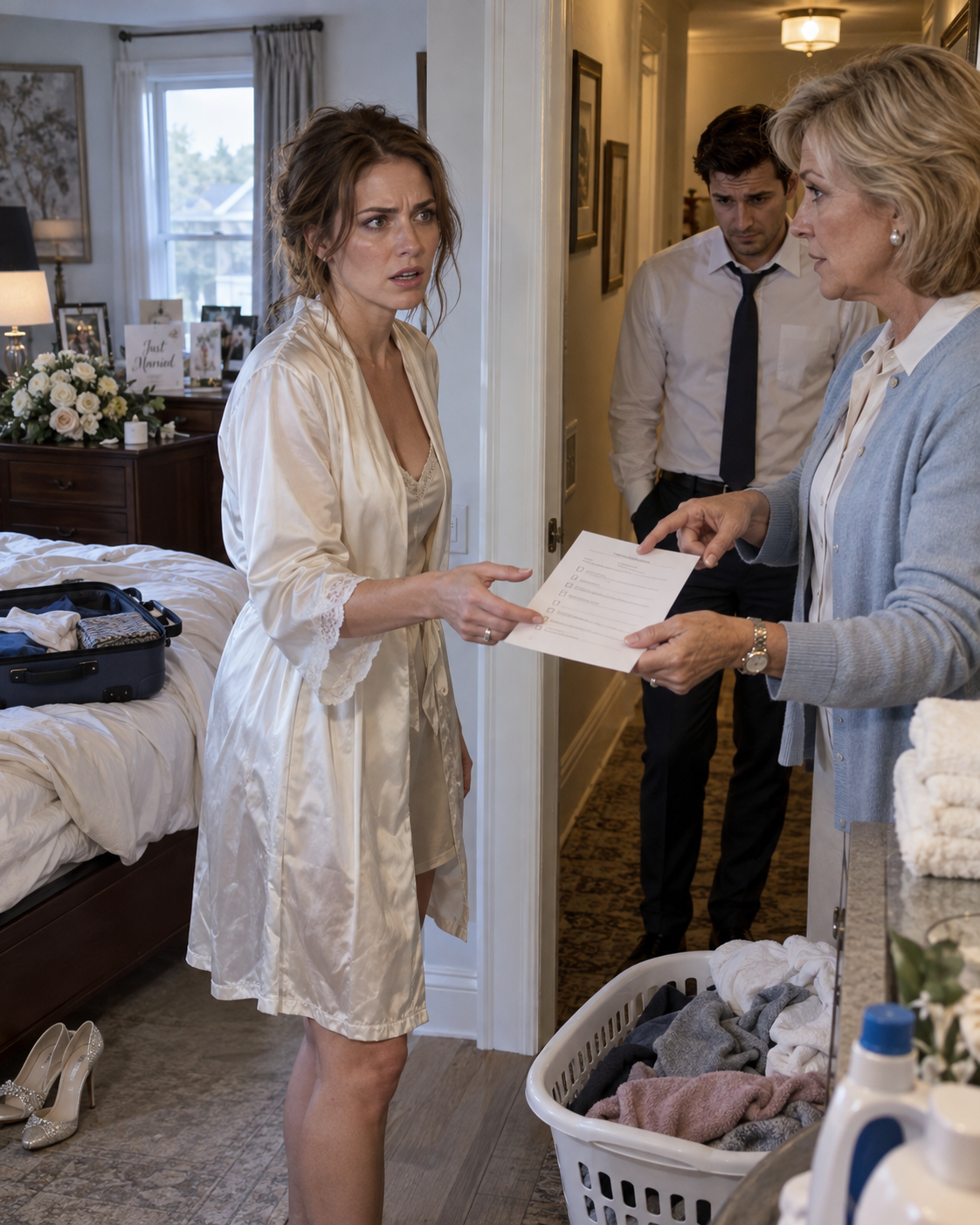
The handwritten list.
Tristan standing behind his mother.
And I remember the strange calm that came over me when I realized I could simply say no.
Not loudly.
Not cruelly.
Not dramatically.
Just no.
That single word changed the direction of my entire life.
I never learned whether Brenda had other plans for me beyond the company and the house.
Maybe the folder contained everything.
Maybe it didn’t.
Sometimes I wonder what would have happened if I had stayed one more week.
One month.
One year.
I don’t let myself imagine it for too long.
Because there are lives we grieve even though we never lived them.
There are versions of ourselves who might have spent years waiting for permission to leave.
And sometimes the most important decision isn’t knowing exactly what comes next.
It’s recognizing what you can no longer accept.
A year after the divorce, Camilla and I met for coffee.
She had her own apartment.
Her own bank account.
Her own career.
She smiled differently.
Not happier every second.
Just freer.
She raised her cup and said, “To 6:08.”
I laughed.
“To 6:08.”
We clinked our cups.
Then my phone buzzed.
I looked down.
There was an email from an unknown address.
No subject.
Only one attachment.
The file name was simple.
“TRISTAN_FINAL.”
For several seconds, neither of us moved.
Camilla looked at me.
“Are you going to open it?”
I stared at the screen.
The old fear wasn’t there anymore.
But curiosity was.
I reached for the attachment, knowing that whatever was inside could never change the decision I had made that morning.
Still, some doors stay closed for a reason.
And some secrets wait years for someone brave enough to turn the handle.