I was standing in my own office when a deliveryman opened a crate and revealed a brass sign bearing my sister’s name
For the entire drive back to Ohio, Willa’s last sentence stayed in my head like a stone I couldn’t swallow.
“There’s something else Dad never told you.”
I kept replaying it.
Over and over.
By the time I reached Dayton, it was nearly midnight.
I didn’t go home.
I couldn’t.
I parked outside a twenty-four-hour diner and sat behind the wheel with the engine running, staring at the glow of the dashboard.
Eleven years earlier, I had left that city believing my family had chosen Willa over me.
Now I knew the truth was more complicated.
My father had chosen silence.
My mother had helped him keep it.
And Willa had been trapped inside a story she never wrote.
But what else could there possibly be?
At 12:17 a.m., my phone buzzed.
It was Willa.
“I know you’re awake.”
I stared at the message.
Then another appeared.
“Can I meet you tomorrow?”
I typed, “Yes.”
Three dots appeared.
Then disappeared.
Finally, she wrote, “Not at Mom and Dad’s.”
We met at a small coffee shop the next morning.
Willa arrived wearing the same tired expression I remembered from the night I left, except now she was twenty-six and carrying herself like someone who had spent years learning how to survive quietly.
She sat across from me and placed a manila envelope on the table.
“I found this in Dad’s garage.”
My stomach tightened.
“What is it?”
“Your old acceptance letter.”
I stared at her.
“My copy?”
She shook her head.
“The original.”
For a moment, neither of us spoke.
I remembered the letter I had carried in my back pocket that night.
I had always assumed I took it with me.
Apparently, I hadn’t.
Willa opened the envelope.
Inside was my acceptance letter, folded exactly the way I remembered folding it.
There were also several pages of handwriting.
My handwriting.
I read the first line and felt my chest tighten.
It was a letter I had written to Willa the morning after I left.
I had completely forgotten it.
I had written that I was sorry.
I had written that I loved her.
I had written that I hoped one day she’d understand that I wasn’t leaving her.
I looked at Willa.
“How did Dad have this?”
“He kept a box.”
“What box?”
She lowered her eyes.
“Everything connected to you.”
I laughed once, but there was no humor in it.
“Everything?”
“Letters. Awards. Newspaper clippings. Photos.”
My throat tightened.
“Why?”
“I don’t know.”
Then she slid another paper toward me.
It was a receipt from a storage facility.
The date was eleven years old.
The storage unit had been rented three days after I left.
I looked at Willa.
“Why would Dad rent a storage unit for my things?”
She swallowed.
“Because Mom told me he couldn’t stand seeing your room empty.”
That answer should have made me feel loved.
Instead, it made me angry.
“If he cared so much, why didn’t he call?”
Willa looked at me for a long moment.
“Because he thought calling would mean admitting he was wrong.”
That sounded exactly like him.
And somehow, that made it worse.
I went back to my hotel and called my mother.
She answered on the fourth ring.
“Odette?”
“Why didn’t you tell me?”
Silence.
“About the letters.”
She started crying.
“I was afraid.”
“Of Dad?”
“At first.”
“And later?”
She didn’t answer.
I sat on the edge of the bed.
“Mom, eleven years is a long time.”
“I know.”
“No, you don’t.”
My voice cracked.
“You don’t know what it was like to wonder if your own mother wanted you.”
She whispered, “I wanted you every single day.”
“Then why didn’t you come after me?”
Her breathing became uneven.
“Because your father made me choose.”
I closed my eyes.
“Between what?”
“Between keeping the house together and losing him.”
I stared at the wall.
“And you chose him.”
“I chose what I thought would keep Willa safe.”
That sentence stopped me.
“What did Dad do?”
She didn’t answer.
“Mom.”
“I can’t tell you over the phone.”
“Then tell me in person.”
“I will.”
We agreed to meet that evening.
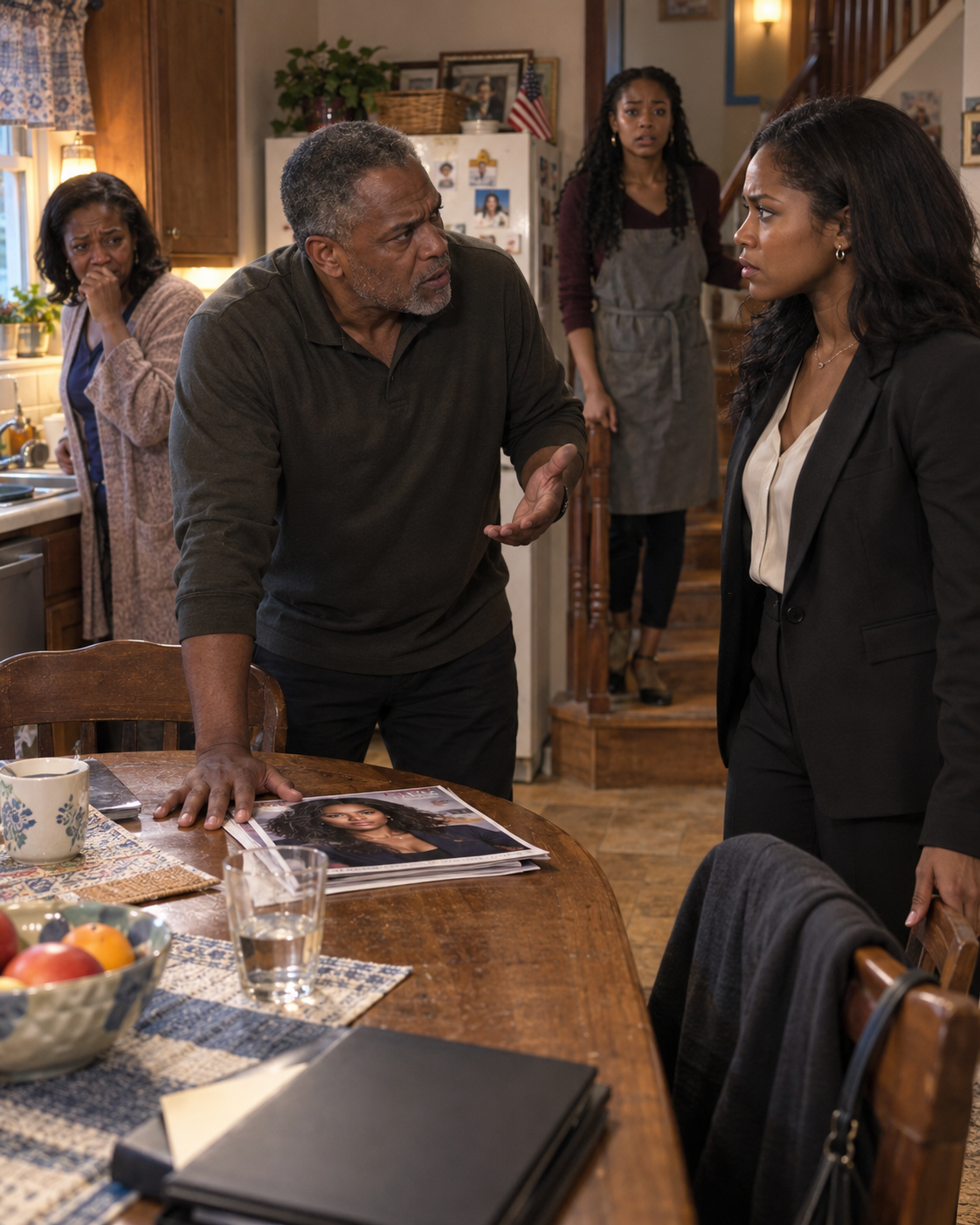
When I arrived, she was sitting alone in the kitchen.
The same kitchen.
The same counter.
The same flickering porch light outside the window.
For a moment, I was seventeen again.
Then she looked at me and said, “Your father didn’t only blame you for leaving.”
“What else?”
“He blamed himself.”
I waited.
She reached into a drawer and pulled out a folded piece of paper.
“He found out something about Willa’s college application.”
I stared at her.
“What?”
“He knew she wasn’t going to get in.”
My stomach dropped.
“What do you mean, he knew?”
“He knew her grades weren’t strong enough.”
“Then why did you all act like the rejection destroyed her?”
“Because he wanted her to believe the school rejected her for one reason.”
I felt cold.
“What reason?”
“He told her she had failed because she wasn’t good enough.”
I stared at my mother.
“That doesn’t make sense.”
“It does if you understand your father.”
She wiped her eyes.
“He believed disappointment would motivate her.”
“Instead, it destroyed her.”
“I know.”
“And then he blamed me for wanting to leave.”
She nodded.
“Because your success made him afraid Willa would feel inferior.”
I stood up.
“So he sacrificed my future to protect her feelings.”
My mother looked down.
“Yes.”
The word landed harder than any scream.
I walked toward the window.
Outside, the neighborhood looked exactly as it had when I was seventeen.
But I was no longer that girl.
I was twenty-eight.
I had employees.
Clients.
A company.
A life.
And suddenly, I realized something that frightened me.
My father hadn’t been trying to keep the family together.
He had been trying to control the shape of it.
He wanted Willa protected.
He wanted me nearby.
He wanted every failure explained in a way that preserved his authority.
And when I refused, he punished me by making me believe I had been unwanted.
I turned around.
“Where is the storage unit?”
My mother gave me the address.
I went that night.
Willa came with me.
The unit smelled like dust, cardboard, and old winter coats.
My father had kept everything.
My high school drawings.
My first design award.
Photographs from birthdays.
A newspaper clipping about my scholarship.
And beneath them all was a small wooden box.
Willa lifted the lid.
Inside were eleven years of unopened letters.
Not from my parents.
From her.
I looked at her.
She whispered, “I told you I wrote twice.”
There were more than two.
There were nine.
Some were from when she was eighteen.
Some from college.
One was dated three years ago.
I opened the newest one.
“Dear Odette, I don’t know if you’ll ever read this.”
My vision blurred.
“I’ve spent years thinking you left because you hated me.”
I stopped reading.
Willa looked away.
“I didn’t know Dad was returning them.”
I folded the letter.
“I’m sorry.”
She shook her head.
“You don’t have to apologize.”
“I do.”
“No.”
She reached for my hand.
“We were both kids.”
That sentence broke something inside me.
For eleven years, I had imagined my sister as the person who took my place.
But she had never asked for it.
She had been another child trying to survive our father’s decisions.
I hugged her.
She cried against my shoulder.
And for the first time since I was seventeen, I didn’t feel like I was losing my family.
I felt like I was finally meeting it.
The next morning, I went back to my studio.
The brass plaque was still sitting in the crate.
I called the signage company.
“Send someone to pick it up.”
Joanna looked at me.
“Are you sure?”
“Yes.”
Then I looked at the empty wall where my father wanted Willa’s name displayed.
“I don’t want a family business built from guilt.”
That afternoon, Willa came for her interview.
She wore a plain black shirt and carried a portfolio that looked like it had been assembled at two in the morning.
It wasn’t polished.
It wasn’t perfect.
But it was hers.
I studied every page.
“You designed these?”
“Yes.”
“Why?”
She smiled nervously.
“Because I couldn’t afford to stop.”
I looked at her.
That answer told me everything I needed to know.
I interviewed her for forty minutes.
I didn’t ask about Dad.
I didn’t ask about the past.
I asked about design.
At the end, I said, “You start Monday.”
Her eyes filled with tears.
“Really?”
“Really.”
She smiled.
“Thank you.”
I shook my head.
“Don’t thank me.”
I pointed toward the portfolio.
“You earned it.”
She nodded.
Six months later, Willa became one of the strongest junior designers in the office.
She stayed late.
She challenged ideas.
She made mistakes.
She learned.
And when clients praised her, she never mentioned that her last name was Larkin.
She simply said, “Thank you.”
My mother began sending Christmas cards again.
The first one contained only three words.
“I miss you.”
I kept it.
The next year, she added a photograph.
The year after that, she asked if she could visit my office.
I said yes.
My father never apologized.
Not once.
He sent one message through Willa.
“Your father says he’s proud of you.”
I answered, “Then he can tell me himself.”
He never did.
For a while, I thought that meant the story had no ending.
Then one rainy Thursday, nearly a year after the brass sign arrived, Joanna knocked on my office door.
“There’s a package for you.”
I opened it.
Inside was the original brass plaque.
Not the one that had said Willa was a founding partner.
This one was different.
The words had been changed.
LARKIN STUDIO.
FOUNDED BY ODETTE LARKIN.
Underneath was a handwritten note.
I recognized the handwriting immediately.
My father’s.
“I was wrong.”
That was all.
Fourteen years of pride.
Eleven years of silence.
One sentence.
I sat there for a long time, staring at it.
Willa walked in and saw the plaque.
“Did he send that?”
I nodded.
“What are you going to do?”
I looked at the words.
For years, I had imagined the moment my father finally admitted he was wrong.
I had imagined shouting.
Crying.
Making him feel the pain he had caused me.
But when the moment finally came, I felt none of those things.
I felt tired.
Not defeated.
Just finished.
“I don’t know,” I said.
Willa sat beside me.
“You don’t have to decide today.”
I looked at her.
That was the sentence I had needed someone to say when I was seventeen.
You don’t have to decide today.
You don’t have to sacrifice your future to make someone else comfortable.
You don’t have to carry another person’s disappointment as if it were your responsibility.
And you don’t have to forgive someone before you’re ready.
I kept the plaque.
Not because my father had finally approved of me.
I kept it because I no longer needed his approval.
Months later, I visited Dayton alone.
I stood outside my childhood home for several minutes before knocking.
My father opened the door.
He looked older than I remembered.
For once, he didn’t tell me to sit down.
He simply stepped aside.
I walked into the kitchen.
The counter was still there.
The same scratches.
The same cabinets.
The same place where my life had split in two.
My father stood behind me.
“I should have let you go,” he said.
I turned around.
“Yes.”
His eyes filled with tears.
“I thought keeping you home would save your sister.”
“It didn’t.”
“I know.”
He looked at the floor.
“I lost both of you that night.”
I wanted to tell him he hadn’t lost me.
But that wasn’t true.
He had lost the version of me who still believed fathers were supposed to protect their children’s dreams.
That girl never came back.
And maybe she didn’t need to.
I walked toward the door.
Behind me, my father said, “Can you forgive me?”
My hand rested on the doorknob.
I thought about the suitcase.
The $140.
The stale bread.
The storage room.
The letters returned unopened.
The brass plaque.
Willa’s portfolio.
My mother’s Christmas cards.
Everything that had happened because one seventeen-year-old girl had refused to surrender her future.
“I can forgive you,” I said quietly.
He looked up.
“But forgiveness doesn’t mean I pretend it didn’t happen.”
He nodded.
“And it doesn’t mean I come back to live in that house.”
“I understand.”
I opened the door.
For the first time in eleven years, I didn’t feel like I was leaving my family.
I felt like I was leaving the past.
Outside, Willa was waiting in her car.
She rolled down the window.
“How did it go?”
I smiled.
“He finally said he was wrong.”
She nodded.
“How did that feel?”
I looked back at the house.
“Smaller than I expected.”
She laughed softly.
Then she unlocked the passenger door.
I got in.
As we drove away, I watched the porch light disappear in the rain.
And I realized the strangest thing about losing eleven years is that you spend so much time dreaming about getting them back that you forget something important.
You can’t get them back.
You can only decide what the next eleven years will look like.
Willa reached across the console and squeezed my hand.
I squeezed hers.
Neither of us said anything.
We didn’t need to.
Some wounds don’t disappear when you forgive.
They simply stop controlling where you go next.
And sometimes the family you thought you lost isn’t waiting for you in the house where everything went wrong.
Sometimes, you build it yourself, one honest choice at a time.