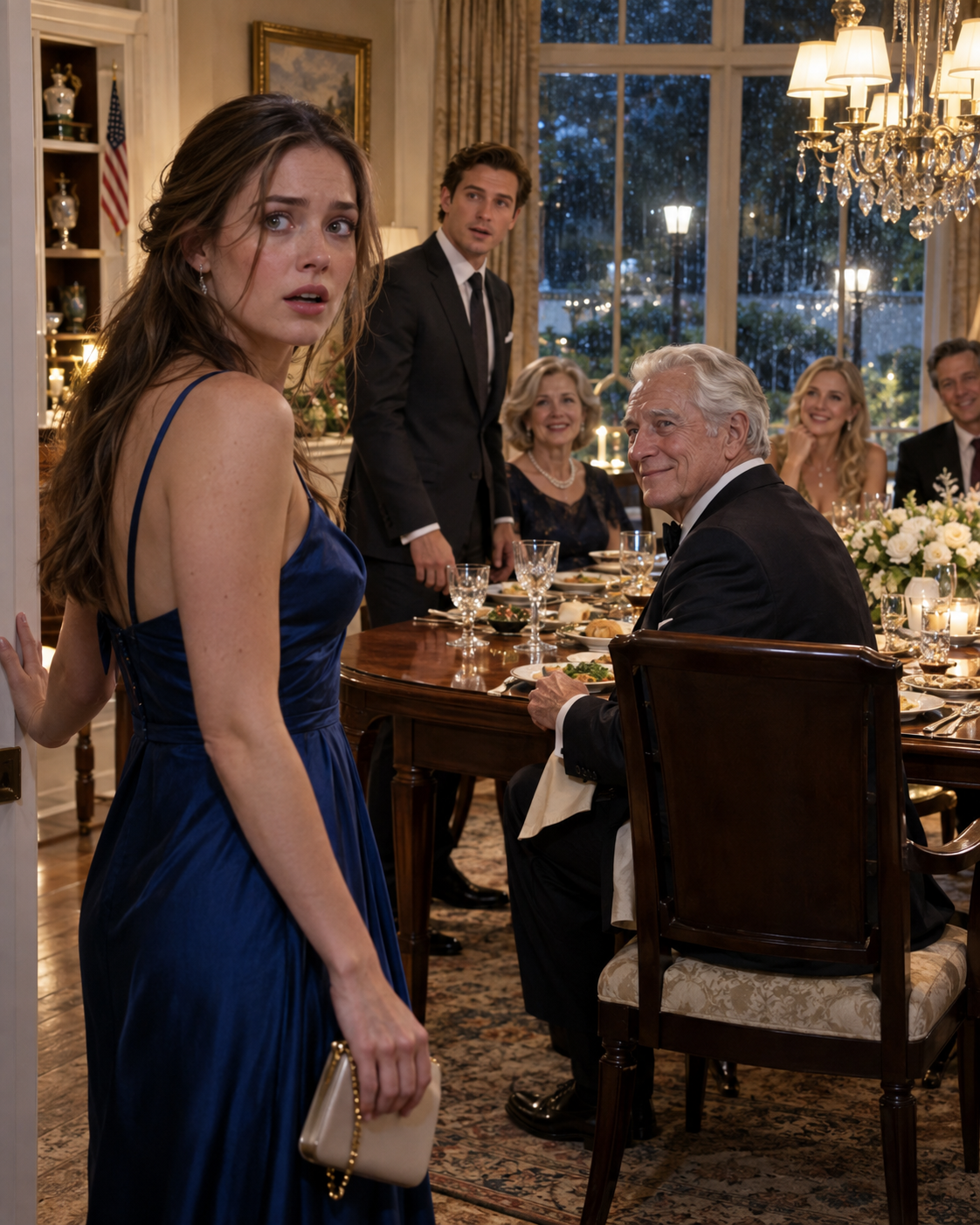
I was standing in my fiancé’s spotless dining room when his family stared at me like I had committed a crime
The message stayed on my screen until the letters blurred in my tired eyes.
I read it three times, hoping that somehow the words would rearrange themselves into something harmless.
They didn’t.
I looked toward the hallway where Julian was sleeping, completely unaware that his grandfather had just invited me into a secret that seemed to have nothing to do with the twenty-dollar bill anymore.
I almost woke him.
My hand even reached for the bedroom door.
Then I stopped.
If Arthur wanted me to come alone, there had to be a reason.
The next morning, I barely slept, and by sunrise I had already convinced myself of a dozen possibilities.
Maybe Julian had hidden debts.
Maybe there was another woman.
Maybe Arthur disapproved of our engagement and wanted me gone.
Or maybe the wealthy family I had spent so much time fearing had been hiding something much darker beneath all that polished silver and perfect glass.
At eight-thirty, Arthur called.
“Are you coming?”
His voice was calm.
“I will.”
“Then meet me at the community center on Maple Street.”
I knew the place.
It was one of the shelters Arthur had funded years earlier, although I had never known it belonged to him.
When I arrived, the rain had finally stopped, leaving the sidewalks shining beneath the morning sun.
Arthur was sitting alone on a wooden bench outside the building.
He wasn’t wearing his suit.
He had on an old gray sweater and the same worn boots from the night before.
For a moment, he looked exactly like the man I had seen beside the road.
“Thank you for coming,” he said.
I sat beside him.
“What don’t I know about Julian?”
Arthur looked across the street before answering.
“My grandson has been fighting me for months.”
I swallowed.
“About what?”
“About money.”
That answer surprised me.
Arthur explained that Julian had never been interested in inheriting the family fortune in the way everyone assumed.
Years earlier, Arthur had told his grandchildren that the remaining family wealth would eventually be placed into a charitable trust, with only a modest inheritance going directly to them.
Julian had objected.
Not because he wanted more money.
Because he wanted the money used differently.
“He thinks I have gone too far,” Arthur said.
“Too far how?”
“He believes I am so obsessed with testing people’s character that I sometimes forget people are not experiments.”
I stared at him.
Arthur sighed.
“He may be right.”
For the first time since meeting him, I saw something in his face that looked like regret.
Then he handed me a folder.
Inside were documents, photographs, and letters.
There were pictures of shelters, food banks, scholarship programs, veterans’ housing projects, and small businesses Arthur had quietly financed.
But there were also photographs of Julian.
Not glamorous photographs.
Julian unloading boxes at a food pantry.
Julian repairing a broken wheelchair ramp.
Julian sitting beside an elderly man in a hospital hallway.
Julian working late in an office with a stack of community grant applications beside him.
“He never told me any of this,” I whispered.
“He doesn’t know I kept these,” Arthur said.
I turned another page.
There was a letter written by Julian several years earlier.
It was addressed to Arthur.
The first sentence made my chest tighten.
“You taught me that money can open doors, but you never taught me what happens to the people standing outside them.”
I looked at Arthur.
“What did he mean?”
Arthur leaned back.
“When Julian was twenty-four, he wanted to create a housing program for families who had been priced out of our city.”
He told me Julian had asked Arthur for funding.
Arthur refused.
Julian built the program anyway, starting with his own savings and donations from friends.
Within two years, it had helped dozens of families.
Arthur had secretly funded it afterward.
“But Julian never knew?”
“No.”
“Why?”
Arthur’s eyes lowered.
“Because I wanted to see whether he would keep helping people if nobody rewarded him.”
I thought about the roadside.
Then I thought about myself.
“Is that why you tested me?”
Arthur nodded.
“Partly.”
“Partly?”
He hesitated.
“Because there was another reason.”
The wind moved through the trees.
Arthur’s voice became quieter.
“Three months ago, someone in this family tried to influence Julian’s choice of spouse.”
My stomach dropped.
“Who?”
Arthur didn’t answer immediately.
Instead, he showed me another document.
It was a private letter from one of the family’s financial advisers.
The letter suggested Julian marry someone from a wealthy family because it would strengthen certain business relationships.
I felt cold.
“So this wasn’t just about whether I was kind.”
“No.”
Arthur folded the letter carefully.
“I wanted to know whether you would still be yourself when you walked into a room full of people who had more money, more influence, and more reasons to judge you than anyone you had ever met.”
I remembered the blue dress.
The polished silver.
The enormous chandelier.
The way I had spent the entire drive worrying that I wasn’t enough.
“I thought you were judging me.”
“I was.”
He paused.
“But not for the reasons you think.”
I looked at him.
“And Julian?”
Arthur smiled faintly.
“Julian was being tested too.”
My heart sank.
“What do you mean?”
“Every person he introduced to the family was told a different story about you.”
I stared at him.
“He wanted to see whether Julian would defend you when people tried to make you feel small.”
The pieces began falling into place.
The strange questions at dinner.
The careful silences.
The way Julian had held my hand under the table.
I suddenly remembered one moment when his cousin had glanced at my dress and asked whether I had ever been comfortable around “people like them.”
Julian had immediately said, “Don’t talk to her that way.”
At the time, I had thought he was simply being protective.
Now I understood.
Arthur had been watching everything.
“How many times have you done this?” I asked.
Arthur looked ashamed.
“Too many.”
That answer stayed between us.
I expected him to defend himself.
Instead, he said, “I spent most of my life believing character had to be measured under pressure.”
He looked at his hands.
“Eventually I realized that people deserve dignity even when you are curious about them.”
That was the first time I saw the billionaire grandfather as an old man who had made mistakes.
Not a mysterious judge.
Not a powerful patriarch.
Just a human being trying to understand whether the values he had spent his life teaching had actually survived him.
Then Arthur said something I wasn’t prepared for.
“I changed my will last night.”
I stared at him.
“Because of me?”
“Because of what happened yesterday.”
He explained that the family fortune would no longer be distributed simply according to bloodline or business succession.
A large portion would go into a foundation governed by clear principles, with grants determined by community impact and accountability rather than family preference.
The rest would be divided among the grandchildren with fewer conditions designed around status.
“But why tell me?”
“Because I want you to understand something.”
He leaned toward me.
“That money was never your prize.”
I felt tears forming.
“You were never supposed to earn a place at our table.”
He paused.
“You were supposed to discover that you already deserved one.”
I didn’t know what to say.
For years, I had measured myself against invisible standards.
The right clothes.
The right job.
The right family.
The right accomplishments.
The right people approving of me.
And somehow, a soaked old man holding cardboard on a roadside had cracked something open that no amount of success ever could.
When I returned home, Julian was waiting in the kitchen.
He looked worried.
“Where were you?”
I looked at him for a long moment.
“Your grandfather told me everything.”
His expression changed.
“Everything?”
I nodded.
He sat down.
“I should have told you.”
“Why didn’t you?”
“Because I was afraid.”
That answer hurt more than any explanation could have.
“Afraid of what?”
“That you would think I was part of it.”
I sat across from him.
“Were you?”
“No.”
He shook his head firmly.
“I knew Granddad had a habit of testing people, but I didn’t know he was going to stop you on the road.”
I laughed once, but there was no humor in it.
“So even you didn’t know.”
“No.”
He reached for my hand.
“I found out last night.”
I studied his face.
“What did you think when you saw me sitting there with him?”
He smiled sadly.
“I thought you were going to faint.”
Despite everything, I laughed.
“So did I.”
He squeezed my hand.
“Emma, I don’t care whether you wear that blue dress again.”
I looked down.
“You don’t?”
“I care that you are the person who stopped in the rain.”
My eyes filled.
“And if you had ignored him?”
“I would still love you.”
That sentence broke something inside me.
Because suddenly I understood the difference between being loved and being approved of.
Approval always had conditions.
Love, when it was real, did not need a performance.
A week later, Arthur invited the entire family to a meeting.
We gathered in the same dining room where I had first seen him in the chair of honor.
This time, Arthur stood instead of sitting.
He placed a thick folder on the table.
“I spent my life building a fortune,” he said.
Then he looked around the room.
“And somewhere along the way, I began treating that fortune like a measuring stick for human beings.”
Nobody spoke.
He told the family about the roadside test.
Some relatives looked embarrassed.
One looked angry.
Then Arthur revealed that he had recorded every interaction from that afternoon.
Not secretly through hidden cameras, but through notes made by members of his foundation who had accompanied him from a distance.
He didn’t play the recordings.
He simply read the numbers.
Thirty-seven people had passed.
Twenty-three ignored him.
Eight avoided eye contact.
Four laughed.
One insulted him.
And one person stopped.
I felt every pair of eyes turn toward me.
Arthur shook his head.
“But the lesson isn’t that Emma is better than them.”
His voice hardened.
“The lesson is that every one of us has a chance to become the person who stops.”
That sentence stayed with me.
Because I realized how easy it would have been to turn the story into something flattering.
I could have told myself that I was special.
That kindness made me superior.
But that wasn’t the lesson.
The truth was much more uncomfortable.
I had almost driven past him too.
I had been afraid.
I had been busy.
I had been thinking about my dress, my fiancé, and the wealthy family waiting for me.
I had stopped because something inside me whispered that his dignity mattered more than my schedule.
And maybe that whisper existed inside all of us.
We just didn’t always listen.
Months passed.
The wedding came and went quietly.
There were no extravagant fireworks.
No magazine photographs.
No giant display of wealth.
Instead, Julian and I asked guests to donate to the foundation Arthur had created.
Arthur walked me down the aisle.
Before we reached Julian, he whispered, “You know, I never thought I’d be doing this.”
I smiled.
“Walking someone down the aisle?”
“No.”
He glanced at me.
“Admitting someone else changed my mind.”
I laughed through my tears.
“You’ve changed too.”
He nodded.
“Maybe that’s what love is supposed to do.”
After the wedding, Julian and I moved into a modest house on the other side of town.
It wasn’t an estate.
It didn’t have a chandelier.
The kitchen was small enough that two people couldn’t comfortably open the refrigerator and a cabinet at the same time.
But at three in the morning, when the world was silent and Julian’s breathing came softly from the bedroom, I loved that little kitchen more than any room in Arthur’s mansion.
One winter night, I found an envelope beneath our front door.
There was no return address.
My name was written across the front in Arthur’s handwriting.
I opened it with shaking hands.
Inside was a single photograph.
It showed Arthur standing beside the roadside sign from that rainy night.
But there was someone else in the background.
A man I didn’t recognize.
He was watching Arthur from across the street.
On the back of the photograph, Arthur had written only one sentence.
“Emma, I was not the only person watching that night.”
I stared at the words until my hands went cold.
Then I noticed something else.
A second envelope had been tucked beneath the photograph.
This one was not from Arthur.
There was no name on it.
Inside was a copy of the same financial letter Arthur had shown me at the community center.
Except this copy had one additional page.
At the bottom was a signature.
Someone in Julian’s family had been quietly trying to control more than Julian’s marriage.
They had been moving money through accounts connected to Arthur’s charitable foundation.
And the signature belonged to someone I had trusted at our wedding.
I heard footsteps behind me.
Julian appeared in the doorway.
“Emma?”
I quickly turned.
His eyes moved from my face to the papers in my hands.
“What is that?”
For several seconds, neither of us spoke.
Then I handed him the document.
He read it once.
Then again.
The color drained from his face.
“I know that signature,” he whispered.
“Who is it?”
Julian looked at me.
And for the first time since I had met him, I saw genuine fear in his eyes.
“It’s someone who was standing beside us when we said our vows.”
Outside, rain began tapping softly against the kitchen window.
I looked toward the dark glass.
For a second, I remembered the old man beneath the streetlight, the cardboard sign trembling in his hands, and the twenty-dollar bill disappearing between his fingers.
Back then, I thought I had stopped to change his night.
I never imagined that one small act would change mine.
And as Julian reached for his phone, I realized Arthur’s final test might never have been about who deserved the family fortune.
Maybe it was about what we would do when kindness finally forced us to confront the truth.
I folded the photograph and held it against my chest.
Somewhere in the darkness outside, a car slowed near our house.
Its headlights swept across the kitchen wall.
Then disappeared.
And neither of us knew who had been watching us.