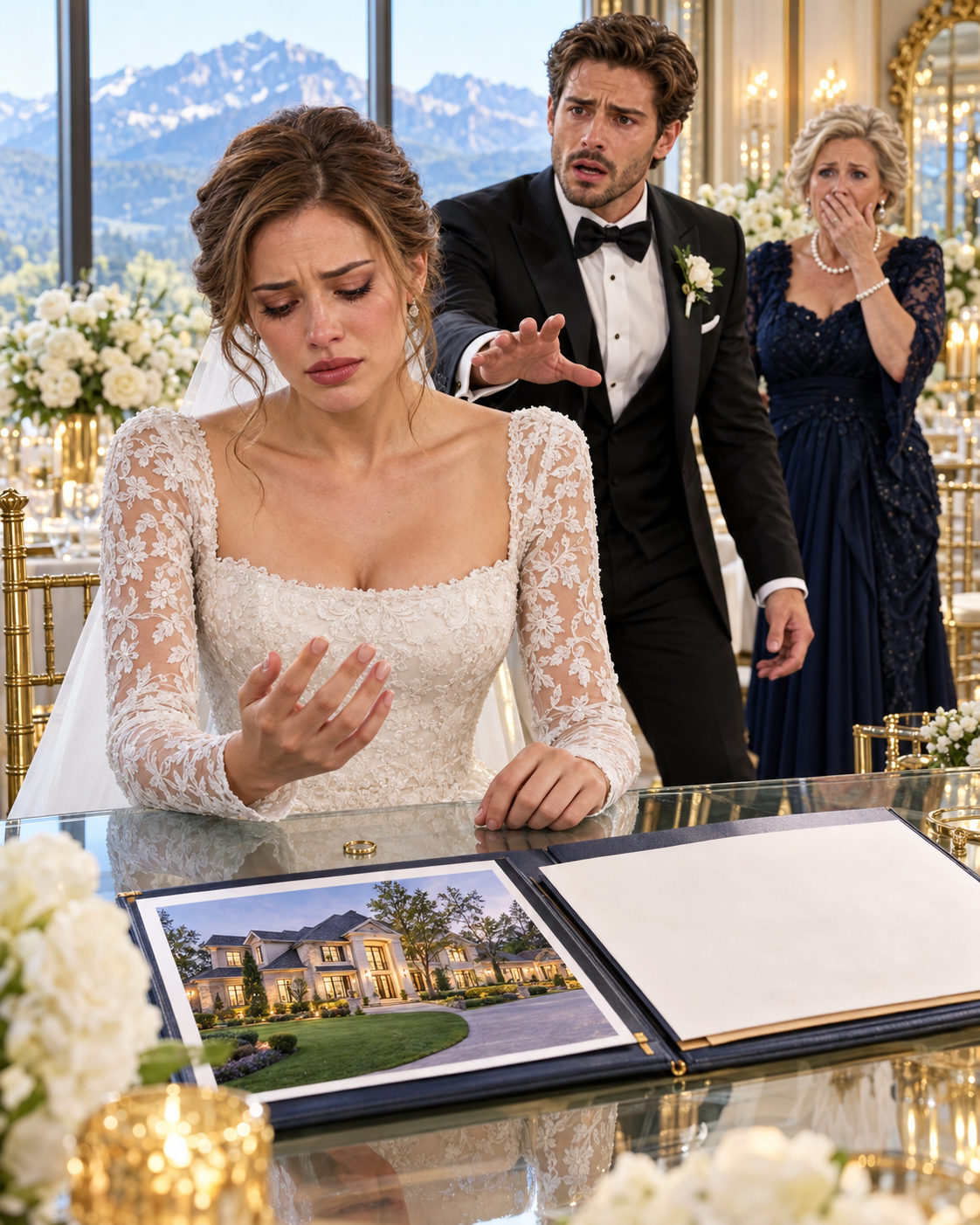
I was standing in a waterfront bridal suite near Seattle when my future mother-in-law dropped a $1.28 MILLION property
Part 2
My aunt Martha opened the front door before I even reached the porch.
She had been waiting.
One look at my face, and she didn’t ask what happened.
She simply opened her arms.
I collapsed into them.
The sound that came out of me wasn’t graceful.
It was ugly, exhausted crying that seemed to come from somewhere beneath my ribs.
Martha held me while I shook.
“I didn’t marry him,” I whispered.
“I know.”
“They wanted my parents’ house.”
She tightened her arms around me.
“Then they wanted something they had no right to ask for.”
That night, I slept in my parents’ bedroom.
I hadn’t done that since the funeral.
Moonlight fell across the old dresser.
My mother’s perfume bottle was still there.
My father’s reading glasses sat beside a stack of books.
I lay beneath their quilt and stared at the ceiling until sunrise.
I expected regret to arrive.
It didn’t.
What arrived was grief.
Not only for the wedding.
Not only for Lucas.
But for the version of myself who had spent four years believing that being easy to love meant being easy to pressure.
The next morning, my phone was full of messages.
Lucas had called seventeen times.
His first text said, “Please let me explain.”
The second said, “I know I handled everything wrong.”
The third said, “I was scared of losing my mom.”
I stared at that one for a long time.
Then I put the phone down.
A few hours later, another message arrived.
“I thought once we were married, things would settle down.”
That sentence told me more than any apology could.
He hadn’t planned to respect my boundaries.
He had planned to move me into a marriage where my boundaries would become negotiations.
He believed commitment would make me easier to pressure.
He believed the wedding would make saying no more expensive.
He had been wrong.
The vendors were the next problem.
There were flowers that had already been delivered.
A photographer who had blocked out the entire weekend.
A caterer who had prepared food for one hundred and eighty people.
A band that had traveled from Portland.
A venue with cancellation terms.
I could have fought.
I could have blamed everyone.
I could have disappeared and let Lucas deal with the mess.
Instead, I called each vendor myself.
I apologized.
I paid what I owed.
Where refunds were available, I accepted them.
Where deposits were nonrefundable, I didn’t demand special treatment.
I had lost enough control that day.
I didn’t need to lose my integrity too.
Chloe came over every evening.
Sometimes we talked.
Sometimes we ate takeout on the floor.
Sometimes she sat beside me while I cried without saying anything.
One night she asked, “Do you miss him?”
I stared at the kitchen window.
“Yes.”
She nodded.
“Do you want him back?”
I took a long time to answer.
“No.”
Saying it hurt.
But it also felt clean.
Lucas started therapy.
He sent me updates about it.
He told me he was learning about conflict avoidance.
He admitted that he had spent most of his life managing his mother’s emotions.
He admitted that he had mistaken peace for silence.
He admitted that he had expected me to absorb the discomfort so he wouldn’t have to.
Those admissions mattered.
They simply didn’t change my decision.
One evening, he wrote, “I’m finally understanding why you left.”
I read the message three times.
Then I typed, “I’m glad.”
Nothing more.
His family reacted differently.
Eleanor told relatives that I had humiliated Lucas.
She said I had embarrassed both families.
She called the canceled wedding “a dramatic overreaction.”
I heard about those comments through people who didn’t know whether to tell me.
I told them it was fine.
Not because it didn’t hurt.
Because I was learning that someone else’s version of me didn’t require my defense.
Arthur called me once.
He apologized again.
He said he should have questioned the plan sooner.
He said he had been so accustomed to letting Eleanor organize everything that he hadn’t stopped to ask whether everyone involved had actually agreed.
I thanked him.
Then I told him I wasn’t reopening the relationship with Lucas.
There was a long pause.
“I understand,” he said.
That was enough.
A month after the wedding that never happened, Lucas came to collect his remaining things.
I stood by the front door while he packed.
His old running shoes were under the stairs.
A sweatshirt was still hanging in the hallway closet.
A book he had been reading sat face-down on the coffee table.
Ordinary objects.
Strangely painful objects.
When he was finished, he stood in the doorway.
“I loved you,” he said.
I looked at him.
“I know.”
“I still do.”
“I know.”
He looked down.
“I wish I’d protected you.”
I almost cried.
Instead, I said, “You needed to learn how to protect your own choices before you could protect mine.”
He nodded.
There was no dramatic final kiss.
No screaming.
No last-minute confession.
Just two people standing in a doorway, finally understanding that love could be real and still not be enough.
When he left, I locked the door.
Then I leaned against it and cried.
Not because I wanted him back.
Because I knew I wouldn’t be opening that door again.
Part 3
Winter came quietly to Seattle.
The garden behind my parents’ house turned brown.
Rain tapped against the windows.
For a while, every room felt too large.
I would walk into the kitchen expecting to hear my mother humming.
I would pass the garage and remember my father working on something that never seemed finished.
The house was full of ghosts, but they were not frightening.
They were memories.
And slowly, I began making new ones.
Chloe came over on Friday nights with groceries.
Martha brought soup on Sundays.
We played music while cleaning.
We laughed in the kitchen.
Sometimes the laughter surprised me.
The first time it happened, I stopped in the middle of the room.
Chloe looked at me.
“What?”
I shook my head.
“Nothing.”
But it wasn’t nothing.
I had laughed in my parents’ house.
Not because I had forgotten them.
Because I was beginning to understand that grief did not require me to keep everything frozen.
One Saturday morning, I hired a carpenter to finish something my father had started.
A garden trellis stood half-built beside the back fence.
He had measured the posts.
He had marked the joints.
He had left a pencil line across one piece of cedar.
For two years, I couldn’t touch it.
Now I called someone to finish it.
When the carpenter arrived, he studied the old measurements.
“Your dad knew what he was doing,” he said.
I smiled.
“Yeah.”
By late afternoon, the trellis stood completed against the fence.
I planted climbing roses beneath it.
My mother’s favorite kind.
When the first new leaves appeared, I stood there with my hands in the soil and cried.
Not the way I had cried at the wedding.
Not from panic.
Not from betrayal.
This time, the tears felt like release.
Months passed.
Lucas still sent occasional messages.
Some were apologies.
Some were reflections from therapy.
Once, he wrote that he had finally told his mother no without explaining himself for twenty minutes afterward.
I smiled when I read it.
I was genuinely glad for him.
Then I deleted the message.
Because his growth no longer belonged to me.
That was another boundary I had to learn.
I didn’t need to punish him.
I didn’t need to hate Eleanor.
I didn’t need to prove that I had been right.
I only needed to remain honest about what I could and could not accept.
There were nights when I wondered what would have happened if I had said yes.
Maybe we would have argued about the house.
Maybe I would have sold it.
Maybe Eleanor would have moved in.
Maybe there would have been another boundary.
Then another.
Then another.
Maybe each compromise would have been small enough to justify.
Until one morning, years later, I would wake up and realize I couldn’t remember where my own life had gone.
That possibility frightened me more than the loneliness ever did.
The truth was, I hadn’t canceled a wedding because of real estate.
The house was simply where the truth became impossible to ignore.
The real question had been much smaller and much more important.
When I said no, would Lucas stand beside me?
He didn’t.
He stood beside the person he was most afraid to disappoint.
And that was the answer.
One spring afternoon, I sat beneath the completed trellis with a cup of coffee.
The roses had started climbing.
A breeze moved through the branches.
For the first time since my parents died, the house didn’t feel like a place where I was preserving the past.
It felt like a place where I was allowed to have a future.
I thought about the woman who had walked into a waterfront bridal suite with a financial assessment covering her wedding dress.
She had believed that losing the wedding meant losing the life she had planned.
She had been wrong.
She hadn’t lost her life that September afternoon.
She had saved it.
I finally understood that boundaries are not walls built to keep love out.
They are doors that teach people how to enter your life with respect.
And the people who truly love you may disagree with you, disappoint you, or even make mistakes, but they cannot ask you to betray yourself just to keep them comfortable.
I looked at the house my parents had left me.
The walls were still the same.
The hallway still carried their photographs.
My mother’s blue mug was still in the cabinet.
My father’s unfinished measurements were still penciled into the wood.
But the silence was different now.
It no longer sounded like an ending.
It sounded like room.
Room for grief.
Room for laughter.
Room for mistakes.
Room for people who could knock before entering.
Room for a life that belonged to me.
I took a slow breath and looked at the roses climbing toward the light.
For years, I had thought love meant holding on when things became difficult.
Now I knew there was another kind of courage.
Sometimes love means letting go before you disappear inside someone else’s expectations.
Sometimes the hardest promise you can keep is the one you make to yourself.
And sometimes the wedding you cancel is the life you finally choose to save.