I was standing beside Roman’s birthday cake when Serena blocked our car outside the Orion Club
I didn’t answer Roman’s message.
I stood outside the airport with Luke beside me, the old photograph trembling between my fingers, while traffic moved behind us as if the world had no idea that eight years of my life had just changed shape.
Luke looked at the picture.
“Who is that?”
I turned it over.
On the back was a date.
Eight years earlier.
And beneath it, in Roman’s handwriting, were four words.
“I never forgot her.”
My stomach tightened.
“Luke, I need to tell you something.”
He didn’t interrupt.
That alone almost broke me.
Eight years before Roman became the man who paid my rent, chose my restaurants, and introduced me at private dinners, he had been a stranger sitting across from me in a hospital hallway.
My grandfather was dying.
I was eighteen.
I had no money, no parents to call, and no idea how I was going to pay for another night of treatment.
A classmate who barely knew me had heard what happened.
His name was Roman.
He asked how much I needed.
“Four thousand dollars.”
He transferred it without asking for a contract.
When I protested, he said, “Don’t repay me.”
But I had promised myself I would.
My grandfather survived another eleven months.
Those eleven months were the hardest and most precious months of my life.
I learned how to wash his hands when they became too weak.
I learned how to make soup he could swallow.
I learned that grief could begin long before someone actually died.
When he finally passed, I kept one promise.
I would find Roman and repay him.
Years later, I saw him at an art patron’s dinner.
He didn’t recognize me.
I recognized him immediately.
He was older, more confident, surrounded by people who laughed too loudly at his jokes.
I approached him.
At first, I told myself I was only keeping a promise.
Then I fell in love.
That was the part I had never told anyone.
Not Roman.
Not Luke.
Not even myself, completely.
I hadn’t entered Roman’s life to trap him.
I had entered because I remembered the boy who had helped me when nobody else could.
But somewhere along the way, the debt disappeared beneath love.
Or at least, I thought it had.
Luke listened quietly.
“You should have told me.”
“I was afraid.”
“Of what?”
“That you would think our relationship started with a debt.”
He looked at me for a long moment.
“Did it?”
“No.”
“Then why are you carrying it like one?”
I had no answer.
That night, Luke drove me back to Wild Light Hollow.
He didn’t ask me to forget Roman.
He didn’t ask me to choose him.
He simply said, “You don’t owe anyone your future because they helped you survive your past.”
I cried in the passenger seat.
Not because Roman had hurt me.
Not because Luke had saved me.
Because for the first time, I understood that surviving something did not mean I had to spend the rest of my life repaying it.
The next morning, Roman called.
I answered.
“Why now?”
His voice was quiet.
“Because Serena showed me the photograph.”
My chest tightened.
“What does she have to do with it?”
“She found it through someone at the Orion Club.”
Roman paused.
“She wanted to know who you were before me.”
“And you told her?”
“No.”
His voice cracked slightly.
“I told her I didn’t know.”
That answer hurt more than I expected.
“You did know.”
“I knew you as Avery.”
He stopped.
“I didn’t know the girl in that photograph was the woman who stood beside me every day.”
I looked toward the pond.
The sunrise was turning the water gold.
“Would it have changed anything?”
He didn’t answer.
That was enough.
Roman had loved the woman I became.
He had respected the woman who could stand beside him at expensive dinners.
He had not understood the girl who had survived without him.
Maybe that was why Serena’s photograph had shaken him.
It proved that I had existed before him.
And that I could exist without him.
“I want to see you,” he said.
“No.”
“Please.”
“No, Roman.”
“I need to explain.”
“You already did.”
“How?”
“You chose her.”
Silence.
Then he whispered, “I was wrong.”
“That doesn’t change the choice.”
“I know.”
I hung up.
For three days, I believed that was the end.
Then Roman came to Bellweather.
His black SUV stopped outside Wild Light Hollow.
Luke was repairing the pond filter when he saw him.
Roman stepped onto the property wearing a cashmere coat completely unsuited for mud.
“Avery.”
Luke walked toward me.
Roman stopped several feet away.
“I came to return something.”
He opened his car.
Inside was a portfolio.
My drawings.
Hundreds of them.
Sketches of Roman asleep on airplanes.
Roman reading.
Roman cooking.
Roman standing at windows.
A book I had made for his birthday but never given him.
Roman held it out.
“You made this?”
“Yes.”
“You loved me.”
“I did.”
His eyes filled.
“Then why can you look at me like this?”
“Because loving you stopped being enough.”
He flinched.
Luke remained behind me.
Roman noticed.
“This is him.”
“This is Luke.”
“You replaced me quickly.”
“No.”
I looked directly at him.
“I ended our relationship that night.”
“Six weeks later you were with him.”
“Six weeks later I was alive again.”
Roman looked at Wild Light Hollow.
“This is what you built?”
“Yes.”
“With what I gave you?”
I almost laughed.
“The money came from the gift I made for you.”
He looked confused.
“The compass.”
“The one you sold?”
“Yes.”
He stared at the cottages, the barn, the pond.
“You turned my birthday gift into this.”
“No.”
I shook my head.
“I turned my heartbreak into this.”
He had no answer.
Then he said something I would remember for the rest of my life.
“I chose wrong.”
I looked at him.
“No, Roman.”
His face tightened.
“You chose what you wanted at the time.”
That distinction mattered.
Because regret often pretends to be wisdom after the damage is done.
Roman left before sunset.
Luke waited until the SUV disappeared.
“Are you okay?”
“I don’t know.”
“Do you want to be alone?”
“No.”
He opened his arms.
I stepped into them.
But three days later, Roman returned.
This time, he wasn’t asking for forgiveness.
He was angry.
He called Luke a distraction.
He called Wild Light Hollow a fantasy.
Then his voice dropped.
“I can hurt him.”
The threat was quiet.
That made it worse.
Luke wanted to come with me when I agreed to meet Roman.
I told him I needed to go alone.
“Then share your location.”
“I will.”
“Call me when you arrive.”
“I will.”
“And if he makes you uncomfortable?”
“I leave.”
Luke nodded.
He trusted me.
That trust became important later.
Roman was waiting in a hotel suite.
He looked exhausted.
“You changed.”
“No.”
I sat across from him.
“You’re seeing me outside the life you arranged.”
He stared at me.
“Come home.”
“No.”
“We can start again.”
“No.”
“I love you.”
The words finally arrived.
Years too late.
I felt nothing.
Not triumph.
Not satisfaction.
Just sadness.
“I spent three years waiting to hear that.”
“I know.”
“Now I don’t need it.”
He stood.
“You can’t just switch love off.”
“I didn’t.”
I looked at him.
“You starved it.”
He moved closer.
I stepped back.
“Don’t.”
His face changed.
For one second, I thought he understood.
Then he grabbed my wrist.
“Roman, let go.”
He didn’t.
“You’re upset.”
“I am asking you to let me go.”
“You’ll thank me when we get home.”
That sentence destroyed whatever pity remained inside me.
Because suddenly I wasn’t speaking to the man who had once helped an eighteen-year-old girl.
I was looking at a man who believed his regret gave him permission.
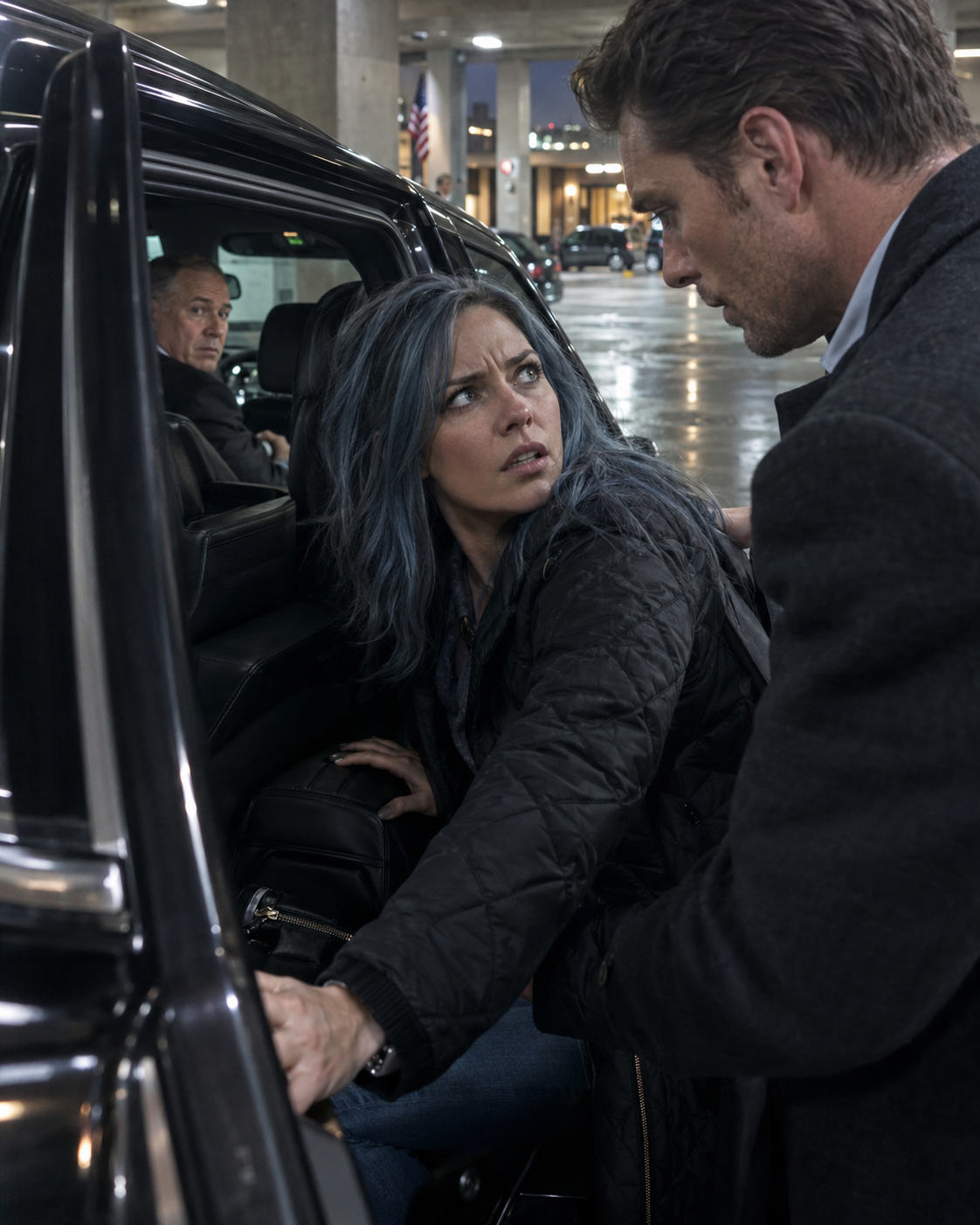
He dragged me toward the elevator.
I fought.
He forced me into the SUV waiting downstairs.
The doors locked.
“Drive.”
I pressed the emergency feature on my phone before he noticed.
My location went to Luke.
Then my attorney.
I kept the phone hidden beneath my coat.
“Roman, I do not consent to this.”
“You’ll calm down.”
“I want to get out.”
“You don’t mean that.”
I repeated myself.
“I want to get out.”
The SUV accelerated toward the highway.
Minutes later, red and blue lights appeared ahead.
Roman’s face changed.
The road was blocked.
County vehicles surrounded the SUV.
Luke stood beyond the barricade with Commissioner Boon.
The chauffeur stopped.
I shoved open the door and ran.
Luke caught me.
“Are you hurt?”
“My wrist.”
He looked at the red marks.
His entire expression went still.
Roman stepped out.
“You called the police?”
“Yes.”
“Against me?”
The question revealed everything.
He still believed this was a disagreement between lovers.
It wasn’t.
It was a crime.
The deputies arrested him for unlawful restraint and assault.
My recording preserved his words.
His chauffeur gave a statement.
My attorney handled the rest.
Roman was released on bond under a strict no-contact order.
That night, Luke sat on the bathroom floor while I soaked my wrist in cold water.
“I should have come with you.”
“No.”
“I hate that I respected your decision and he used it.”
I touched his shoulder.
“Don’t turn your respect into a mistake.”
He looked at me.
“Protecting me doesn’t mean preventing every bad thing.”
I swallowed.
“It means believing me afterward.”
He nodded.
We sat there until dawn.
For the first time, I understood the difference between protection and possession.
One creates safety.
The other creates a cage.
Roman’s legal case continued for months.
His grandfather refused to call it a misunderstanding.
“You were told no,” Charles Hail told him.
“Everything after that was your decision.”
Roman accepted responsibility.
He entered a court-ordered program.
He stayed away from me.
He lost direct control of parts of his family’s business.
Serena, meanwhile, launched her own version of the story online.
She claimed Roman had promised her marriage.
She implied I had manipulated him.
Then she published an old photograph of me and information about my grandfather’s hospital records.
That was the moment the story stopped being gossip.
It became evidence.
My attorney acted.
The university investigated how protected information had been obtained.
The Orion Club terminated Serena’s access.
Her publicist dropped her.
Then evidence surfaced that the famous Vancouver ultimatum had been staged.
She had never booked the flight.
The boarding pass had been fabricated.
The anonymous messages had come from a prepaid phone connected to someone she had hired.
She called me one night.
“You took everything.”
“I took nothing from you.”
“He loved me first.”
“Then ask yourself why that love required you to hurt me.”
Silence.
“You built your life from my leftovers,” she whispered.
I almost felt sorry for her.
Almost.
“No,” I said.
“I spent three years being myself.”
Then I hung up.
The court proceedings ended without the dramatic collapse Serena had imagined.
Roman accepted a reduced charge, probation, community service, and behavioral intervention.
He paid my legal and medical expenses.
The no-contact order remained in place.
For months, I still panicked when a black SUV slowed near me.
I hated locked doors.
I woke whenever Luke shifted in bed.
So I went to therapy.
The counselor refused to let me turn everything into a beautiful metaphor.
“What did you feel?” she asked.
“I felt like a bird in a cage.”
“That’s a metaphor.”
“I hate this process.”
“That’s a feeling.”
Eventually, I learned to name what had happened without letting it define me.
Wild Light Hollow continued growing.
The barn became a gallery.
The old tool shed became a cafe.
The pond became a place where children fed koi.
Eli became our first paid media intern.
Mrs. Boon organized volunteer planting days.
Luke’s restaurant donated food.
Neighbors brought tools, curtains, dishes, and opinions.
Nothing happened quickly.
A pipe burst.
A roof leaked.
Contractors made mistakes.
Six goats escaped and ate two thousand dollars worth of landscaping.
“This goat is wearing my project schedule,” I shouted.
Luke laughed until he had to sit down.
“You’ve finally met middle management.”
We opened in stages.
The first family to visit included a little girl who used a wheelchair.
Her father touched the ramp and said, “You’d be surprised how many places forget families like ours.”
I looked at Luke.
He raised one eyebrow.
Civilization had expenses.
That night, after everyone left, Luke found me in the unfinished glass studio.
There were two folders on the table.
I opened the first.
It was a partnership agreement protecting my ownership of Wild Light Hollow.
The second was a cohabitation agreement.
Then Luke opened a small wooden box.
Inside was a pale blue sapphire ring.
“I love you,” he said.
“I want to marry you.”
My eyes filled.
“But I want you to know exactly what marriage changes before you answer.”
He waited.
“You can say no.”
He waited again.
“You can say not yet.”
I touched his face.
“You brought paperwork to a proposal.”
“I find accurate contracts romantic.”
I laughed through my tears.
“Then negotiate.”
He finally dropped to one knee.
“Avery Quinn, will you marry me and continue making unreasonable amendments for the rest of my natural life?”
“Yes.”
He slid the ring onto my finger.
We didn’t announce it that night.
We ate leftover cake instead.
For the first time in my life, a promise didn’t feel like a trap.
It felt like two people standing beside an open door.
We married the following spring beneath the maples at Wild Light Hollow.
There were forty-three guests, three dogs, one escaped goat, and absolutely no press.
I wore an ivory dress with pockets.
Luke’s mother cried.
His father checked the soup every seven minutes.
Eli handled the music and rejected Luke’s first song choice for being “emotionally middle-aged.”
The wedding was small.
The life afterward was not.
We finished the glass studio.
I started an artist residency for people who had paused their careers for caregiving, illness, or financial survival.
Luke expanded the cafe.
Eli earned a scholarship.
He used his first stipend to buy his mother a new washing machine.
When she protested, he told her, “I wanted to.”
Not “I owed you.”
Not “I caused this.”
Just, “I wanted to.”
That distinction changed me.
My paintings changed too.
I stopped painting rooms with half-open doors.
I began painting fields.
Roads.
Water.
Skies that didn’t end at the frame.
A critic called the new collection a study in recovered scale.
Luke read the review and said, “I think they mean the paintings got bigger.”
I threw a pillow at him.
Nearly two years after Roman left me at that birthday table, the power went out during dinner.
Luke lit candles.
I looked at the table.
Shrimp.
Roasted potatoes.
Green beans.
A cake leaning slightly to one side.
The scene was almost identical to that terrible night.
For a moment, my chest tightened.
Luke noticed.
“Want to stop?”
I looked at him.
“No.”
He held out his hand.
“I’m here.”
I placed my hand in his.
We ate by candlelight.
The shrimp was overcooked.
The potatoes were perfect.
The cake was too sweet.
I laughed.
“You hate frosting.”
“I hated waiting alone.”
He looked at me.
Then he understood.
That was the difference.
It had never been about shrimp.
It had never been about cake.
It had never even been about Serena.
It was about the terrible moment when I finally realized I had been trying to become so valuable that no one would ever choose to leave me.
But love was never supposed to be a reward for perfect service.
It wasn’t something I could earn by being beautiful enough, patient enough, useful enough, or loyal enough.
Love was a choice made freely by two people who were allowed to walk away.
And that was why, when Luke reached across the table that night, I knew I could trust the hand reaching for mine.
Because the door was unlocked.
Because neither of us needed to hold the other inside.
And because, after everything I had survived, I finally understood the most important truth of all.
Nobody had rescued me.
Roman had helped me once.
Luke had helped me later.
Neighbors had helped me build.
Eli had helped me remember what survival looked like.
But I had chosen every door.
I had walked through every one.
And when the lights of Wild Light Hollow came back on, one window after another, I looked around the home I had built and realized something that would have terrified the woman sitting alone beside Roman’s birthday cake.
I was no longer waiting for someone to come home.
I was already home.