I was standing beside a cattle trailer in the middle of a crowded county fair when my father called my ranch a waste of potential
It turned out the place they sent me to get rid of me had been chosen for a reason.
And Virginia had known why from the beginning.
I stared at the faded ink until the letters blurred.
The date was from the summer before my parents first dropped me at the ranch.
Underneath it, Virginia had written a sentence in handwriting I recognized from every grocery list, every feed order, every note she had ever left on my desk.
“Your father asked me to take her.”
I read it again.
Then again.
For a long time, I didn’t move.
Outside my office window, the evening light stretched across the pasture, turning the fence posts black against the orange sky.
I could hear Dale somewhere near the barn, checking the water lines.
Everything around me looked exactly the same.
But suddenly, nothing felt the same.
My father had never simply decided that the ranch was a convenient place to send me.
He had asked Virginia.
I picked up the phone and stared at her number.
I almost called immediately.
Then I remembered how old she was, how tired she had sounded the last time we spoke, and how carefully she had chosen not to tell me something for all these years.
I drove to Alpine the next morning.
Virginia was sitting on her porch when I arrived, wrapped in a gray sweater despite the warmth.
She looked at my face and didn’t ask why I was there.
She just sighed.
“You found it.”
I stopped halfway up the steps.
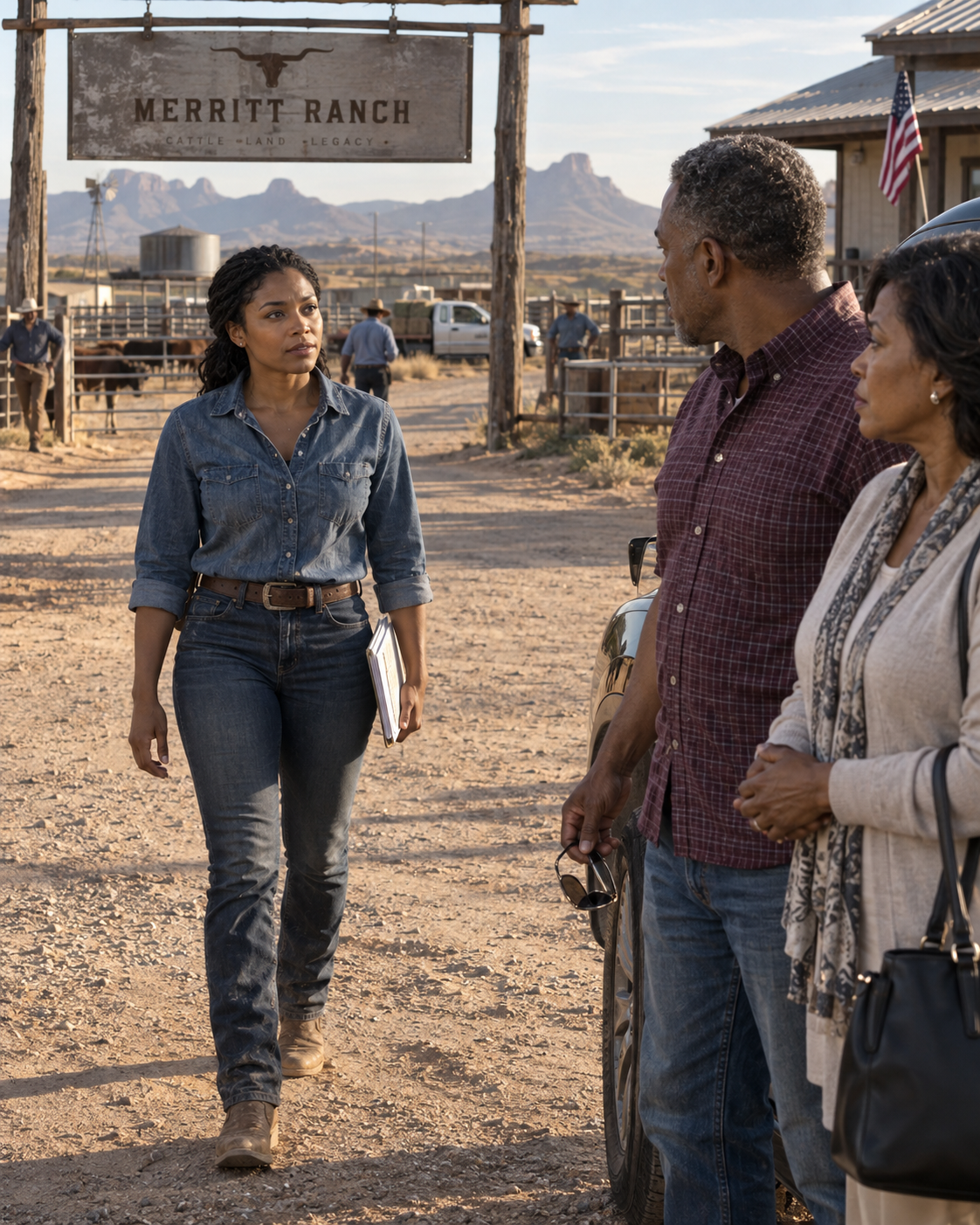
“You knew I’d find it?”
“Eventually.”
I held out the postcard.
“Why did my father ask you to take me?”
Virginia looked toward the mountains.
For several seconds, she said nothing.
Then she motioned for me to sit.
“Your father called me the spring before your first summer,” she said.
“He told me he was worried about you.”
I almost laughed.
“Worried about me?”
“He said you were becoming withdrawn.”
“I was nine.”
“I know.”
“He said you were struggling with confidence.”
I looked down at my hands.
My father had never once told me that.
Not directly.
Virginia continued.
“He asked whether I would let you spend the summer here because he thought working outdoors might help you.”
“That’s not the whole story.”
“No.”
She looked at me.
“It isn’t.”
I waited.
She folded her hands in her lap.
“He also asked me not to tell you something.”
My stomach tightened.
“What?”
“He said your mother had become extremely concerned about your scar.”
I stared at her.
Virginia’s expression didn’t change.
“She had been asking doctors whether there was anything they could do to make it less visible.”
The porch suddenly seemed too small.
I remembered the cardigans.
The long sleeves.
The way my mother used to answer questions before I could.
The way she would sometimes look at my arm and then look away.
“She thought it was ugly?”
Virginia shook her head.
“No.”
“Then what?”
“She was afraid.”
“Of what?”
Virginia took a breath.
“Of what other people would think.”
I felt something inside me loosen and hurt at the same time.
It was almost worse than hatred.
My mother hadn’t hated my scar.
She had feared it.
She had feared the world seeing something imperfect on the daughter she already struggled to understand.
And instead of teaching me that I could survive other people’s opinions, she had taught me that I should hide.
I looked at Virginia.
“Why didn’t you tell me?”
“Because you were nine.”
“Then why didn’t you tell me later?”
“Because every year you came back stronger.”
She smiled faintly.
“I watched you stop covering your arm.”
I looked down.
She was right.
At some point, without realizing it, I had stopped wearing long sleeves during the summer.
I had stopped checking whether strangers were looking.
I had stopped explaining the scar.
Virginia had noticed.
My parents hadn’t.
“I thought the ranch was where they sent me because they didn’t want me,” I said.
Virginia shook her head.
“Partly.”
That answer hurt more than anything else.
She leaned back.
“Your father believed you needed something your sister didn’t.”
“What?”
“Something that belonged to you.”
I stared at her.
“He told me Cleo had a natural gift, and he wanted to protect it.”
She paused.
“He said you were different.”
“Different how?”
“He said you were observant.”
I almost smiled.
“That’s a nice word for being ignored.”
Virginia didn’t argue.
“He also said something else.”
“What?”
“He said you didn’t need applause.”
I looked away.
The sentence stayed between us.
It explained too much.
My father had mistaken my silence for strength.
He had mistaken my adaptability for lack of ambition.
He had mistaken the fact that I didn’t demand attention for proof that I didn’t need it.
And because he believed that, he had given me less.
Then less became normal.
I drove back to Marfa before sunset.
I didn’t call my parents.
For the next several days, I worked.
There were contracts to review, cattle to move, payroll to approve, and equipment repairs that couldn’t wait for emotional revelations.
Work had always been my safest language.
Numbers didn’t ask whether I was enough.
Cattle didn’t care what my parents had expected.
A broken irrigation line didn’t care whether I had a scar.
It just needed fixing.
Then, two weeks later, my mother called.
I almost let it go to voicemail.
Instead, I answered.
“Hi, Mom.”
She was quiet.
“Your father told me you went to see Virginia.”
“I did.”
“Did she tell you?”
I looked through the office window.
“Yes.”
My mother exhaled.
“I thought she might.”
“What exactly did Dad tell you?”
Another silence.
Then she said, “That he was afraid you would always believe we preferred Cleo.”
I closed my eyes.
“Did you?”
“No.”
“Then why did it feel exactly like that?”
“I don’t know.”
That was the first honest thing she’d said to me in years.
I sat down.
She continued.
“We were scared when you were six.”
“Because of the scar?”
“Because of everything.”
I didn’t understand.
She started crying.
I had never heard my mother cry like that.
Not the elegant tears she shed at Cleo’s recitals.
Not the quiet tears at airports.
This was different.
Messy.
Uncontrolled.
“We thought something had happened to you because of us.”
“What?”
“The accident.”
I frowned.
“You mean the stove?”
“Your father had been angry that night.”
I remembered almost nothing beyond the oil splattering my arm.
“He had been arguing with me about money,” she said.
“You were trying to help because you heard us.”
I felt my throat tighten.
“You don’t remember?”
“No.”
“You walked into the kitchen because you wanted to make us laugh.”
My mother’s voice cracked.
“You climbed onto that stool, and when the oil hit you, I thought I had ruined you.”
I stared at the wall.
“For years, I blamed myself.”
“You didn’t ruin me.”
“I know that now.”
She cried again.
“But I didn’t know it then.”
I didn’t answer.
She whispered, “Your father thought sending you away would give you confidence.”
“And Cleo?”
“He thought her music needed protecting.”
I laughed once, but there was no humor in it.
“So she got Europe, and I got cattle.”
“Yes.”
At least she didn’t deny it.
“Do you regret it?”
“I regret that we didn’t see what we were doing.”
“That’s not the same thing.”
“I know.”
We sat in silence.
Then she said, “Your father wants to see you.”
I looked toward the pasture.
“Why?”
“He says he wants to apologize.”
I wanted to say no.
Instead, I said, “Tell him he can come.”
He arrived three days later.
Alone.
He stood outside my office holding a paper bag from one of his diners.
It was almost funny.
My father had always brought food when he didn’t know what to say.
“I brought lunch.”
“Okay.”
He set the bag down.
We sat across from each other.
For the first few minutes, he talked about the ranch.
The expansion.
The distributor.
The new equipment.
The land.
He knew more about my business than he had ever known about my childhood.
Finally, he looked at me.
“I was wrong.”
I waited.
He rubbed his hands together.
“I thought I was preparing you.”
“For what?”
“Life.”
I almost smiled.
“You prepared Cleo for a career.”
He nodded.
“I prepared you to survive.”
The words landed harder than I expected.
Because that was exactly what he had done.
And survival was not nothing.
But it wasn’t the same as being believed in.
“I survived,” I said.
“I know.”
“No, Dad.”
I looked directly at him.
“You don’t.”
He looked confused.
“I didn’t just survive.”
I pointed toward the window.
“I built this.”
He swallowed.
“I know.”
“And I built it because Virginia asked me what I wanted.”
He looked down.
“Nobody had asked me that before.”
“I should have.”
“Yes.”
He nodded.
“I should have.”
There was no argument.
No excuse.
Just two words from a man who had spent most of my life turning everything into something measurable.
For some reason, that hurt more than an excuse would have.
He reached into his jacket and pulled out an envelope.
“I brought you this.”
I opened it.
Inside was a photograph.
It was old.
I was nine years old, standing beside Virginia at the ranch gate.
I was skinny, sunburned, and angry.
My left arm was visible.
I wasn’t smiling.
But Virginia was.
On the back, my father had written the date.
Under it were four words.
“I hope she stays.”
I looked up.
“What does this mean?”
He stared at the photograph.
“I took that picture before I left.”
“You never showed me.”
“I couldn’t.”
“Why?”
“Because you looked happy.”
I didn’t understand.
He continued.
“You were miserable when I dropped you off.”
He rubbed his eyes.
“But when I came back that night, Virginia sent me this picture.”
I looked at it again.
“She said you’d asked when you could feed the calves.”
I almost laughed.
“That sounds like me.”
“She told me you had spent three hours asking questions.”
He smiled faintly.
“And I realized you’d found something.”
“What?”
“Yourself.”
The room went quiet.
He looked at me.
“I should have brought you home.”
I waited.
“I should have changed everything.”
I nodded slowly.
“Yes.”
He stood.
“I know I can’t fix it.”
“No.”
“I know I don’t get to ask you to forgive me.”
I looked at him.
“That’s true.”
He nodded.
Then he did something I’d never seen him do.
He hugged me.
Not a quick fatherly pat.
Not the awkward embrace he’d given me at graduations.
He held on.
I stood there for a moment before putting my arms around him.
I didn’t forgive him that day.
But I stopped carrying the need for him to understand everything.
Sometimes that is the closest thing to peace you can get.
Months passed.
My mother began visiting occasionally.
Not often.
Never announced.
She would bring coffee, sit on the porch, and ask questions.
Real questions.
How was the herd?
Was Dale still arguing with me about pasture rotation?
Was Tamson still terrifying suppliers with spreadsheets?
What did I want to do next?
The first time she asked that last question, I almost cried.
Not because the question was extraordinary.
Because it should have been ordinary.
Cleo came once, too.
She had left the conservatory circuit and was teaching music in Boston.
She said she had finally understood something.
“I spent my whole childhood thinking you were the lucky one.”
I looked at her.
“Why?”
“Because you didn’t have to perform.”
I smiled sadly.
“Neither did you.”
She shook her head.
“I did.”
We sat together in silence.
For the first time, I saw her not as the favored daughter, but as another child shaped by the expectations of our parents.
She had been given more.
But more could become its own kind of cage.
She had spent years proving she deserved what they had invested.
I had spent years proving I didn’t need what they withheld.
Neither of us had been entirely free.
“I wish we’d talked,” she said.
“So do I.”
She reached across the table and touched my scar.
I didn’t pull away.
“I always thought Mom hated this.”
“She was afraid of it.”
“Of what?”
“Of people seeing something imperfect.”
Cleo looked at my arm.
Then she smiled.
“I think it’s the best part.”
I laughed.
“Don’t get sentimental.”
“I’m serious.”
“So am I.”
She squeezed my hand.
“You know what I remember about you?”
“What?”
“Every summer, when you came home, you smelled like dirt and diesel.”
I laughed.
“That’s what you remember?”
“And you were always talking about some cow you thought was interesting.”
“Some cows are interesting.”
“I know that now.”
She smiled.
Then she said, “You looked happier.”
I stopped laughing.
She was right.
I had been happier.
Not because the ranch was easy.
It wasn’t.
It was hard, exhausting, unforgiving work.
But for the first time, my usefulness had not been confused with my worth.
Years later, I still kept Virginia’s postcard in the top drawer of my desk.
She passed away quietly one winter morning.
Dale called me before anyone else.
I drove to Alpine through rain that turned into sleet.
At the funeral, there were ranchers, buyers, neighbors, former employees, and people I had never met who came because Virginia had helped them once.
Everyone had a story.
Everyone remembered something she had taught them.
I stood near the back and listened.
When it was my turn to speak, I didn’t talk about the land.
I didn’t talk about the money.
I didn’t talk about what the ranch had become.
I talked about a nine-year-old girl who arrived with one duffel bag and a scar she thought she needed to hide.
I talked about an old woman who never once asked her to hide it.
Then I said the thing Virginia had taught me without ever saying it directly.
“People will tell you what they think you’re worth.”
I looked at the people sitting in front of me.
“Sometimes they’ll be wrong.”
My voice shook.
“Sometimes they’ll be the people who love you.”
The room was silent.
“But their mistake doesn’t become your destiny unless you let it.”
After the funeral, I walked alone to Virginia’s old house.
The porch was empty.
The ranch was no longer hers.
But the mountains still stood exactly where they had always stood.
I opened the drawer where she had kept her papers.
Inside was one final envelope with my name on it.
My hands shook as I opened it.
There was no long letter.
Only a single sentence.
“You were never the child they sent away, Faye.”
I turned the paper over.
Nothing else.
I stood there until the sunlight disappeared.
For years, I had believed my story began with rejection.
It didn’t.
It began with a door closing behind me.
And somewhere in the dust of that Texas road, I had found another one opening.
I went back to Marfa the next morning.
The ranch was waiting.
The cattle needed feeding.
The employees needed answers.
The contracts needed signatures.
Life had never paused for my family wounds, and it wasn’t going to pause now.
But something inside me had changed.
I no longer looked at the ranch as proof that I had survived my parents.
It was proof that I had listened to myself.
That mattered more.
One evening, years later, I found a little girl standing outside the main barn.
She was the daughter of one of our employees.
She was nine.
Her father had brought her to work because childcare had fallen through.
She was holding a notebook against her chest.
I asked what she was doing.
She looked embarrassed.
“Nothing.”
I smiled.
“That’s usually what people say when they’re doing something interesting.”
She hesitated.
Then she opened the notebook.
Inside were pages of numbers, drawings of cattle, pasture maps, and questions about how much money the ranch made.
I recognized the handwriting of a child trying to understand a world that adults had assumed was beyond her.
I crouched beside her.
“What’s your question?”
She pointed to a column of numbers.
“Why does this one change every month?”
I looked at her.
Then at the notebook.
And suddenly, I was nine again.
Standing in the dust.
Waiting for someone to tell me whether I belonged.
I smiled.
“That’s a very good question.”
She looked relieved.
I sat beside her in the dirt.
For the next hour, we worked through the numbers together.
When her father came looking for her, she was still talking.
“Can I come back tomorrow?”
I looked at her notebook.
“Absolutely.”
She ran toward the truck.
I watched until the dust settled.
Then I looked down at the scar on my arm.
For the first time, I didn’t see the mark my mother had tried to hide.
I saw the beginning of a life that no one else had been able to design for me.
And I understood something Virginia had known before I did.
Sometimes the place where people leave you is not the place where your story ends.
Sometimes it is simply the first place where you finally learn who you are.
That night, I locked the office, stepped outside, and looked across the pasture.
The same wind moved through the grass.
The same stars stretched over the land.
And somewhere beyond the gate, my past still existed.
But it no longer owned me.
I had spent eight summers being sent away.
It took me thirty-one years to understand that I hadn’t been abandoned into nothing.
I had been given a beginning.