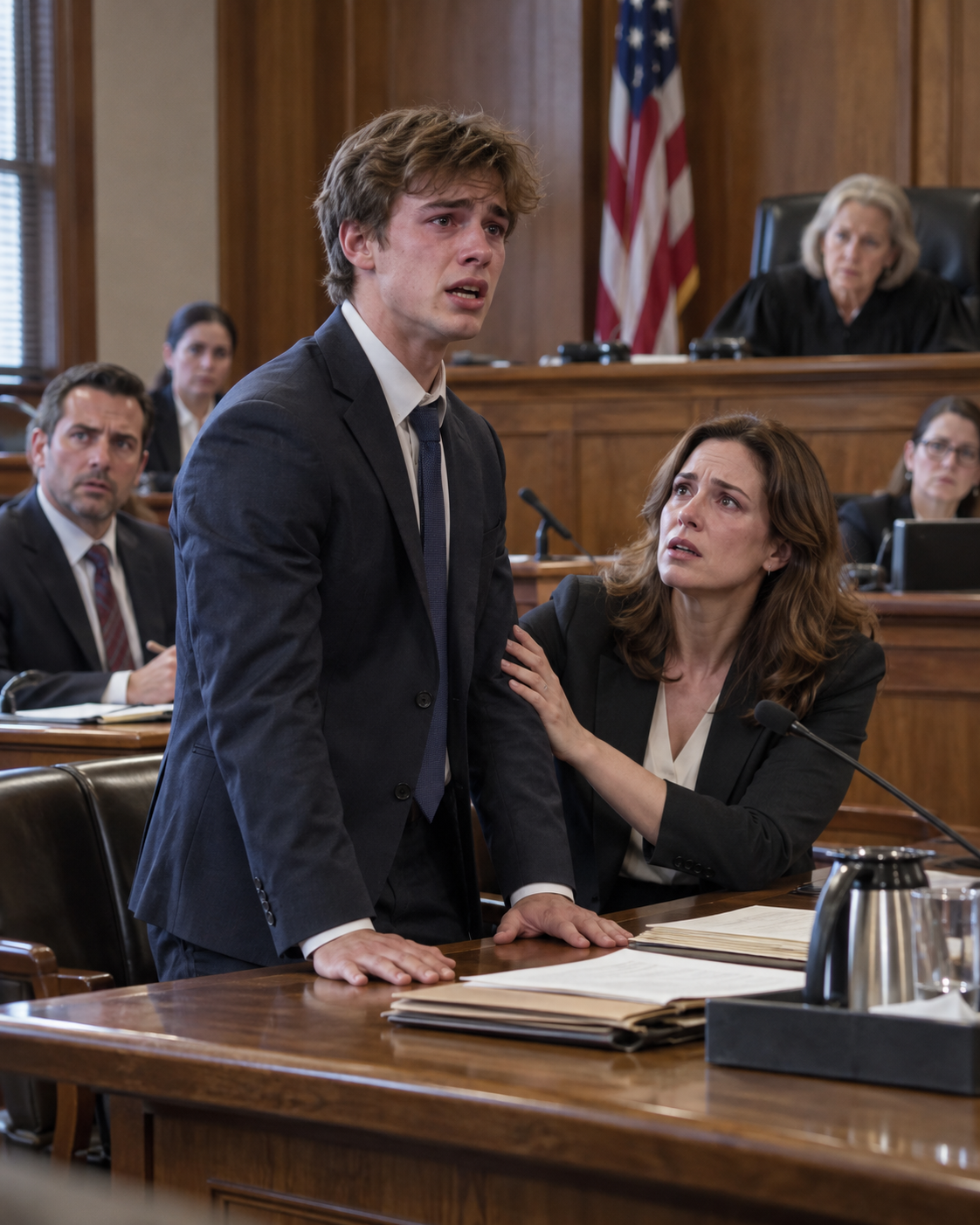
I was sitting beneath the harsh courtroom lights when my four-year-old son suddenly stood beside the witness chair
The words on Leo’s drawing stayed on my kitchen table for three days.
I couldn’t bring myself to put it away.
Every time I walked past it, I saw the same things: a black bottle, my little girl, Julian standing behind her, and four crooked words that had somehow survived everything my son had been too frightened to say.
“Don’t tell Mom about this.”
I finally asked Leo where he had heard those words.
He was sitting cross-legged on the living-room rug, carefully lining up his toy cars.
He didn’t answer immediately.
Instead, he pushed the red car against the blue one and whispered, “Daddy said it.”
My heart began pounding.
“When did Daddy say it?”
Leo shrugged.
“I don’t know.”
I sat beside him but didn’t touch him.
“What happened next?”
He looked toward Maya’s bedroom.
“She was sleeping.”
The room seemed suddenly too quiet.
I asked him whether Maya had been sick.
He shook his head.
“Daddy made her sleepy.”
Those four words were enough to make me call my attorney.
She told me not to question him further and arranged for a child specialist to speak with him in a safe, neutral setting.
I hated every second of waiting.
I wanted answers immediately.
I wanted to know how many times it had happened, how much medication Julian had given her, why he had done it, and why I had never seen the danger sitting directly in front of me.
But the truth, I learned, sometimes arrives slowly because children’s memories are not courtroom transcripts.
They are fragments.
Sounds.
Faces.
Fear.
And sometimes a single sentence buried beneath months of silence.
The specialist eventually confirmed that Leo’s drawing was consistent with memories he had been trying to communicate, but she cautioned that he could not reliably establish exact dates or doses.
That distinction mattered.
It also made the situation more heartbreaking.
Leo hadn’t been trying to build a case against his father.
He had simply been trying to protect his sister.
Meanwhile, the investigation widened.
The daycare director provided a written statement describing the afternoon Maya had returned from Julian’s apartment barely responsive.
She remembered calling my phone twice before I answered.
At the time, I had been at work and had assumed Maya was exhausted from a long weekend.
The director had asked Julian what Maya had been given.
He had laughed and said, “She’s just a heavy sleeper.”
I remembered that sentence.
I had heard it myself.
I just hadn’t known what it meant.
The medical records were worse.
The urgent-care physician had documented severe drowsiness, unusual lethargy, and difficulty waking Maya.
Julian had reported possible food poisoning.
There was no mention of medication.
There was no mention of me being contacted.
There was no mention that another adult had been present.
That other adult was Vanessa Cole.
My attorney obtained messages between Vanessa and Julian through the legal process.
The messages weren’t dramatic at first.
They were disturbingly ordinary.
They discussed dinner.
They complained about traffic.
They joked about Julian needing more time away from the children.
Then came the messages about Maya.
“She won’t stop crying.”
“Give her a little.”
“Are you sure?”
“She’ll sleep.”
Hours later, Vanessa wrote, “I barely gave her anything. She finally slept.”
Then another message appeared after the urgent-care visit.
“We need to get our stories straight.”
Julian replied, “It was the food.”
Vanessa answered, “What if they test her?”
I read those messages with shaking hands.
For months, I had wondered whether I had missed some obvious sign that my marriage was falling apart.
I had blamed myself for being distracted.
For working too much.
For trusting him.
For assuming that a father who kissed his children goodnight could not be the person they needed protection from.
Now I understood that trust had not made me foolish.
It had simply been exploited.
Vanessa eventually agreed to cooperate fully.
She told investigators Julian had complained that Maya’s crying made his overnight visits difficult.
He wanted uninterrupted evenings.
He wanted to watch television, drink, and spend time with Vanessa without having to constantly respond to a tired four-year-old.
According to Vanessa, Julian began talking about medication as though it were a harmless shortcut.
He knew his mother had once been prescribed sedating medication.
He found an old bottle and later obtained additional medication through means investigators continued to examine.
Vanessa said the first time she realized the situation was dangerous was when Maya became so difficult to wake that she panicked.
“I told him we needed an ambulance,” Vanessa said.
“He told me I was overreacting.”
That sentence stayed with me.
Not because it surprised me.
Because it sounded exactly like the Julian I had known for seven years.
The man who could turn your fear into embarrassment.
The man who could make you apologize for asking a reasonable question.
The man who could smile while quietly convincing you that you were imagining things.
During one supervised visit, Julian asked Leo why he had told the judge about Maya.
Leo refused to answer.
The supervisor immediately ended the interaction.
Julian later claimed Leo had been coached.
My attorney showed the court that I had been instructed not to interrogate either child and that the first disclosure had come spontaneously in open court.
Julian’s legal team then changed strategies.
They suggested Maya might have been given an allergy medication.
The medical experts disagreed.
The substance found in the bottle was not consistent with the medication Julian claimed.
More importantly, the dosage and circumstances raised serious concerns about intentional sedation.
The court did not rely on a single piece of evidence.
It considered the laboratory results, the medical records, the daycare testimony, Vanessa’s statements, the recovered messages, and the children’s disclosures through appropriate professionals.
Piece by piece, the story became impossible to dismiss as one misunderstanding.
Julian had spent months insisting that I was emotional.
He had called me suspicious.
He had told relatives that I was trying to destroy his relationship with the children.
But the evidence did not depend on my anger.
It existed without me.
That was what finally broke something inside him.
During a hearing, Julian looked across the courtroom at me.
For the first time since he had asked for the divorce, he didn’t look calm.
He looked frightened.
“You know I would never hurt them,” he said.
I stared at him.
There was a time when hearing those words would have made me question myself.
Instead, I thought about Maya asleep in her pink pajamas.
I thought about Leo standing in court with his tiny hands trembling.
And I said quietly, “I believed you.”
I paused.
“That’s why I didn’t see it.”
The judge ultimately ordered that Julian have no unsupervised contact with the children.
Any visitation would take place under professional supervision, with strict conditions designed around the children’s safety.
The criminal investigation continued separately from the custody case.
I learned that some consequences move slowly.
Paperwork moves slowly.
Hearings move slowly.
Investigations move slowly.
But every morning, my children still woke up.
That became enough.
Maya recovered fully.
Her laughter returned first.
Then her appetite.
Then the little habit she had of crawling into my bed before sunrise and whispering, “Mommy, I’m hungry.”
I began crying the first time she did it.
She looked confused.
“Why are you crying?”
I hugged her.
“Because I’m happy you’re here.”
She accepted that answer without understanding it.
Children should not have to understand the things adults do to them.
They should only have to be protected from them.
Leo changed too.
For a while, he refused to sleep unless his bedroom door remained open.
He checked on Maya several times each night.
Sometimes I found him standing beside her bed, watching her breathe.
I gently told him, “You don’t have to protect her anymore.”
He looked at me.
“Who’s going to?”
I swallowed hard.
“I am.”
He nodded slowly.
Then he climbed into bed.
Months passed.
The divorce became less about the marriage and more about rebuilding a life that no longer revolved around Julian.
I found a smaller house.
I painted Maya’s room yellow.
Leo chose blue for his.
We planted tomatoes in the backyard.
On Saturdays, we made pancakes badly and laughed when the first batch burned.
There were still nights when I woke up terrified.
There were still moments when an unfamiliar medication bottle at a pharmacy made my stomach turn.
Healing was not forgetting.
It was learning that fear did not have to make every decision for me.
One evening, almost a year after Julian had asked for the divorce, Leo sat beside me on the porch.
He was older by only a few months, but somehow he looked years older.
He held another drawing.
My chest tightened immediately.
“What’s this?”
He handed it to me.
This time, there was no black bottle.
There was a house.
Maya was standing in the doorway.
I was beside her.
Leo had drawn himself holding both our hands.
And far away, almost at the edge of the page, stood Julian.
Alone.
I asked Leo why he had drawn his father so far away.
He thought for a moment.
“Because that’s where Daddy is now.”
I didn’t know what to say.
So I kissed his forehead.
He leaned against me.
For a while, we listened to the wind moving through the trees.
Then he whispered, “Mommy?”
“Yes?”
“Was Daddy bad?”
I looked at the darkening sky.
I knew the easy answer.
I also knew it wasn’t mine to give him.
“Your dad made choices that hurt people,” I said.
“Adults are responsible for their choices.”
Leo nodded.
“Was it my fault?”
My heart cracked.
“No.”
I turned toward him.
“None of it was your fault.”
He stared at the drawing.
“I was scared.”
“I know.”
“I thought if I told, Daddy would be mad.”
“I know.”
He looked at me again.
“But I wanted Maya to wake up.”
I pulled him into my arms.
And for the first time, he cried without trying to hide it.
Not the quiet crying children do when they are afraid of getting in trouble.
Real crying.
Deep, exhausted sobs that seemed to come from somewhere he had been holding shut for far too long.
I held him until his breathing slowed.
Then Maya opened the back door and called, “Mommy, movie night!”
Leo wiped his face.
I smiled.
“Coming.”
That night, both children fell asleep on the couch during an old animated movie.
I carried Maya to bed.
Then Leo.
Before turning off the hallway light, I stood between their rooms and listened.
Two little people breathing peacefully.
No panic.
No footsteps checking whether someone was awake.
No whispered promises that everything would be okay.
Just sleep.
The following spring, our divorce was finalized.
Julian’s access remained strictly supervised.
Vanessa was no longer part of our lives.
The apartment where so many terrible things had happened had become someone else’s address.
But sometimes, when I passed it, I remembered the woman I had been when Julian first said, “I want a divorce.”
She had sat silently at that table.
She had thought silence meant she was losing.
She had believed she was watching her family disappear.
She had not known that beneath that silence, something was already beginning to surface.
The truth.
Not loudly.
Not dramatically.
Just steadily.
One piece at a time.
A bottle.
A medical record.
A daycare report.
A message.
A frightened child’s voice.
A drawing.
And finally, the courage to believe what the evidence was saying.
I used to think strength meant knowing when to fight.
Now I think sometimes strength means being quiet long enough to see what is actually happening.
It means listening when a child says something that makes no sense at first.
It means taking fear seriously without letting fear control you.
And most of all, it means remembering that love is not proven by promises.
It is proven by what someone does when nobody is watching.
A few weeks after the divorce, I found Leo’s old courtroom drawing tucked inside a box.
I almost threw it away.
Instead, I framed it and placed it in the back of a closet where the children couldn’t see it.
Not because I wanted to remember what happened.
Because I never wanted to forget how close we had come to missing it.
That night, I checked on the twins before bed.
Maya was asleep beneath her unicorn blanket.
Leo was curled beneath his blue comforter.
I kissed them both and started toward the door.
Then Leo stirred.
His eyes opened halfway.
“Mommy?”
“I’m here.”
He smiled sleepily.
“I know.”
I stood there for another moment.
Then I turned off the light.
For the first time in almost a year, I walked down the hallway without looking back.
I thought the story was finally over.
I thought the last secret had already been uncovered.
But the next morning, when I opened the closet to put away a winter coat, something fell from the shelf.
It was an envelope.
My name was written across the front in Julian’s handwriting.
And underneath my name were three words that made my hands go cold.
“We need to talk.”