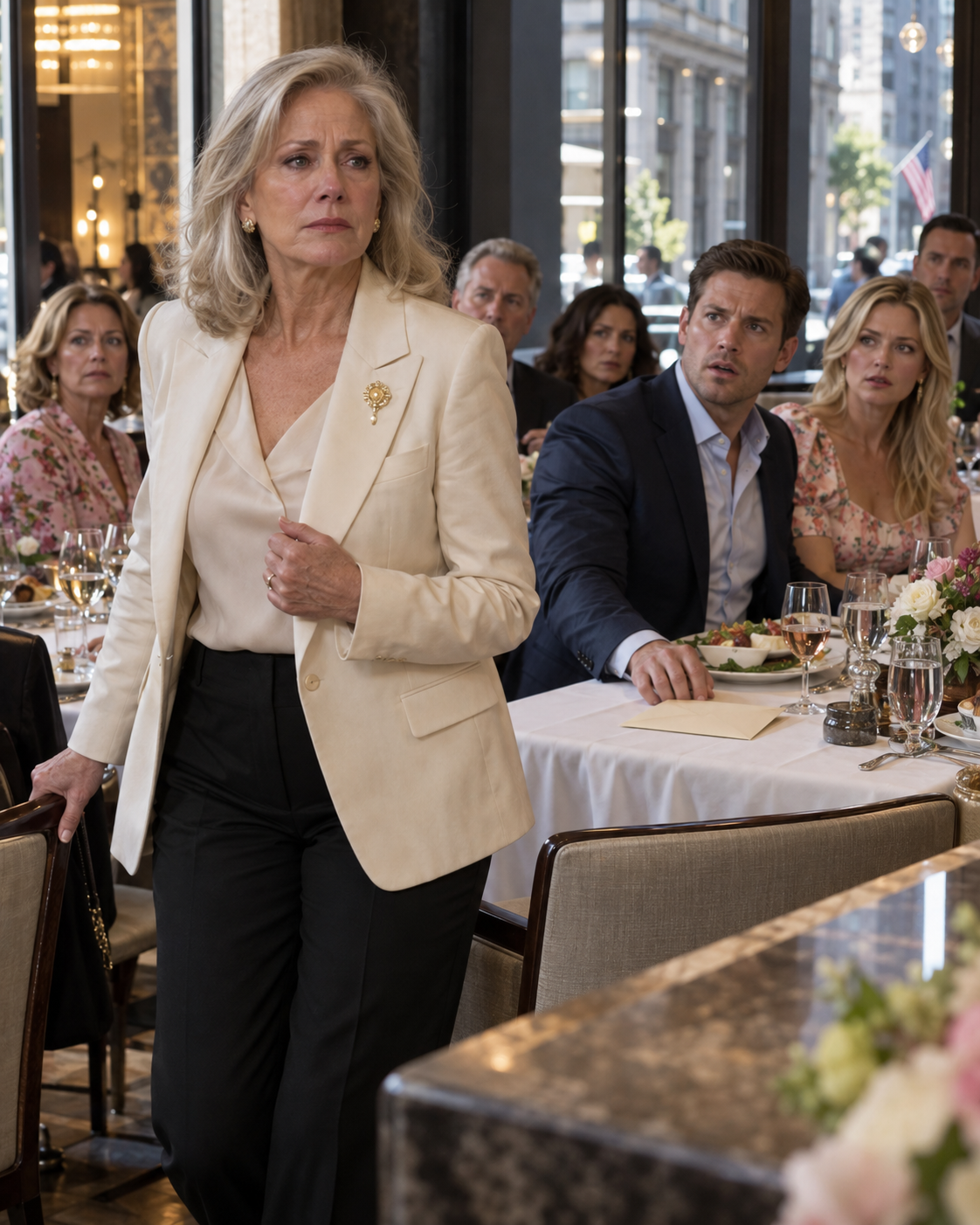
I was seated at a Mother’s Day lunch when my son slid a place card reading “THE BURDEN” toward me
I read the first sentence three times before I could make sense of it.
My husband, Daniel, had been gone for seven years.
Yet there I was, kneeling in the garden he had planted with me, holding an envelope containing words he had apparently written for a future I had never imagined.
I sat on the damp ground and unfolded the letter carefully.
“Miriam, if you’re reading this, something has happened that I couldn’t protect you from while I was alive.”
My throat tightened.
“Julian has always known how much you love him.”
I stopped reading.
A breeze moved through the trees.
For a moment, I could almost hear Daniel’s voice.
“That is his greatest strength and your greatest weakness.”
I wiped my eyes and continued.
“Don’t mistake his need for you with his love for you.”
My hands began to tremble.
There were several pages.
Daniel had written them during the last year of his illness, when he had become too weak to discuss certain things without worrying about how I would react.
“I have watched Julian become increasingly dependent on you.”
“He asks for money, then calls it help.”
“He creates emergencies, then expects you to solve them.”
“He makes you feel guilty whenever you say no.”
“And every time you forgive him, he learns that there are no consequences.”
I lowered the letter.
I suddenly remembered things I had spent years pushing out of my mind.
Julian at nineteen, demanding money for a car.
Julian at twenty-five, asking Daniel to co-sign a loan.
Julian at thirty, telling me his marriage problems were somehow my fault.
Daniel had seen the pattern before I did.
The final page was different.
There was an attached bank statement.
My eyes moved across the numbers.
Then I saw the date.
Two years before Daniel died, he had created a separate savings account in my name.
The account contained enough money to pay off the remaining mortgage on my house.
I stared at it.
I had never known it existed.
Beneath the statement was one final sentence.
“I put this aside because I wanted you to have a place no one could take from you.”
I covered my mouth.
For years, I had believed the house was simply an old property we had struggled to maintain together.
Daniel had secretly protected it for me.
And I had nearly allowed our son to take it over.
I cried that morning.
Not because Julian had hurt me.
Because I finally understood how long someone had been trying to teach me that I mattered.
The next day, I called the bank.
The account was real.
The money was untouched.
And Daniel had left specific instructions that it belonged entirely to me.
I paid off the remaining mortgage within the month.
For the first time in my life, the house was completely mine.
No bank.
No son.
No husband.
No one.
Just me.
But there was another surprise waiting.
When I went through the old files Daniel had stored in his office, I found a folder labeled “Julian.”
Inside were copies of emails, loan applications, unpaid bills, and handwritten notes.
Daniel had documented everything.
He had even written dates beside incidents I had forgotten.
It was almost as if he had been building a map of a road he feared I would eventually have to walk alone.
At the bottom of the folder was a letter addressed to Julian.
I almost threw it away.
Instead, I opened it.
“Son, your mother will forgive you many things because she believes forgiveness is part of loving you.”
I swallowed.
“But one day, she may learn that forgiveness without boundaries becomes permission.”
I sat back.
Daniel had known.
Not everything.
Not the future.
But enough.
Enough to understand that Julian didn’t need another rescue.
He needed a boundary.
I kept the letter.
I didn’t send it.
I didn’t need to.
The following week, Julian called.
His voice sounded different.
Less confident.
“Mom, we found an apartment.”
“Okay.”
“It’s not very nice.”
“I’m sorry.”
There was a long silence.
Then he said, “You really meant it, didn’t you?”
“Yes.”
“About the house?”
“Yes.”
“About everything?”
I looked around my quiet kitchen.
“Especially about everything.”
He exhaled.
Then, unexpectedly, he said, “I thought you’d eventually give in.”
I closed my eyes.
“That’s exactly why I didn’t.”
He didn’t respond.
Before hanging up, he said something I didn’t expect.
“I don’t know what I’m supposed to do now.”
For once, I didn’t solve the problem for him.
“You’ll have to figure that out.”
Then I ended the call.
It hurt.
Of course it hurt.
There is no version of motherhood where watching your child struggle feels satisfying.
But there was a difference between helping someone stand and carrying them forever.
I had finally learned it.
A month later, Julian came back alone.
He stood on my porch holding a cardboard box.
“I found some of Dad’s things.”
I opened the door.
He handed me the box.
Inside were old photographs, Daniel’s watch, a baseball glove, and several letters.
Julian looked around the house.
“It’s different.”
“No,” I said softly.
“It was always like this.”
He looked at me.
“I just couldn’t see it.”
For the first time in years, my son looked less like an entitled adult demanding something and more like the frightened boy I remembered.
I wanted to hug him.
I almost did.
Then I remembered that love without boundaries had brought me to this exact place.
So I stepped forward and hugged him anyway.
But when he asked, “Can I move back in if things don’t work out?” I pulled away.
“No.”
His face fell.
“But I love you.”
“I love you too.”
“Then why won’t you help me?”
“I am helping you.”
He stared at me.
“By making you responsible for your own life.”
He didn’t understand immediately.
Maybe he wouldn’t for a long time.
But he nodded.
Before leaving, he said, “Mom, I’m sorry.”
I believed that he was sorry.
I just didn’t know whether he was ready to change.
That part had to belong to him.
After he left, I carried the box into the garden.
The flower beds were ready.
I had spent weeks clearing the weeds.
I bought roses.
Lavender.
Hydrangeas.
And a small Japanese maple for Daniel.
I planted it beneath the kitchen window where he used to sit with his coffee.
Months passed.
The house became mine in ways I had forgotten were possible.
I painted the guest room.
I turned the old master bedroom into a reading room.
I invited friends over without asking anyone’s permission.
I bought a ridiculous yellow chair because I loved it.
Nobody complained.
Nobody rolled their eyes.
Nobody told me it was a waste of money.
I could finally hear my own thoughts.
One Sunday afternoon, I received a letter from Chloe.
I almost threw it away.
Instead, I opened it.
She didn’t apologize.
She didn’t ask for money.
She simply wrote that Julian had started working two jobs and was struggling.
She said he had finally admitted that he had treated me badly.
Then she wrote something that surprised me.
“I thought you would always rescue us.”
I stared at that sentence for a long time.
Because that was the truth.
They hadn’t only taken advantage of my money.
They had taken advantage of my certainty that a good mother never says no.
I folded the letter and put it away.
I wasn’t responsible for fixing them.
But I could hope they learned.
One year after Mother’s Day, I hosted dinner in my backyard.
The garden was blooming.
The little maple tree had grown taller.
There were candles on the table and music drifting through the warm evening air.
Julian arrived alone.
He brought flowers.
Not expensive ones.
Just wildflowers from a roadside stand.
He handed them to me.
“These are for you.”
I smiled.
“Thank you.”
We sat beneath the maple tree.
For the first hour, we talked about ordinary things.
His work.
My garden.
The weather.
Then he finally said, “Dad was right.”
My heart tightened.
“About what?”
“About me.”
I looked at him.
He stared at his hands.
“I thought if you loved me, you’d always save me.”
I didn’t interrupt.
“I didn’t realize I was making you smaller so I could stay comfortable.”
That sentence broke something open inside me.
Not because everything was suddenly forgiven.
But because accountability had finally entered the room.
I reached across the table.
“I don’t need you to be perfect, Julian.”
He looked at me.
“I need you to be responsible.”
He nodded.
“I know.”
We sat quietly.
Then he asked, “Can I help you with the garden?”
I smiled.
“Tomorrow.”
He laughed.
“Okay.”
The next morning, my son showed up with gardening gloves.
He worked for three hours.
He didn’t ask for money.
He didn’t ask for favors.
He didn’t complain.
He simply dug holes while I planted flowers.
And somewhere between the roses and the lavender, I realized something I had never understood before.
A boundary is not a wall built because you stop loving someone.
Sometimes it is the fence that finally teaches love how to survive.
That evening, I stood alone beneath the porch light and looked across the garden.
For thirty-four years, I had believed being a mother meant keeping every door open.
Now I knew some doors had to close so that people could learn how to knock.
I touched Daniel’s old gold pin, still attached to my jacket.
Then I smiled.
My house was quiet.
My garden was alive.
And my son was finally learning how to stand on his own feet.
I thought that was the end of the story.
Then, just before I went inside, I noticed something beneath the maple tree.
A small envelope had been placed beside the trunk.
There was no stamp.
No name.
Only three words written across the front.
“Mom, read this.”
I picked it up.
And when I saw the handwriting, my heart stopped.
It wasn’t Julian’s.
It wasn’t Daniel’s.
It belonged to someone I had never met.
I opened the envelope anyway.
Because after everything I had survived, I had finally learned the difference between being afraid of the truth and being strong enough to face it.
And whatever waited inside that letter, I knew one thing for certain.
This time, nobody was going to take my life away from me.