I was publicly humiliated beside Trauma Room Three when Dr. Harrison Vance yanked my sleeve down
For seven years, I had carried one sentence inside me like shrapnel.
I had never known whether Lieutenant Daniel Mercer meant it as an order, a warning, or forgiveness.
Now Senior Chief Brett Lawson was lying beneath fluorescent lights, fighting his way back from death, and somehow he was the only man alive who could tell me what Mercer had said after I disappeared into the smoke.
The operating-room doors swallowed Brett before I could ask again.
I stood there with my hands trembling, staring at the blood still drying along my knuckles.
Master Chief Raymond Vance came to stand beside me.
“You heard him,” he said.
I nodded.
“Did you know Mercer?”
Raymond looked toward the operating room.
“I knew him better than I knew myself.”
His voice cracked on the last word.
Then he looked at the tattoo on my forearm.
“The six stars?”
I swallowed.
“Six men I carried out.”
“And the anchor?”
“My promise to come home.”
Raymond studied me for a long moment.
“You did come home.”
“No,” I whispered.
“I survived.”
He didn’t argue.
For the first time in seven years, somebody understood the difference.
The security team dragged the captured gunman past us.
He was handcuffed, bleeding from the forehead, and still wearing the identification badge of a federal munitions inspector.
One of the SEALs ripped the badge from his neck.
“Fake,” he said.
Raymond’s jaw tightened.
“What was he trying to do?”
The younger SEAL shook his head.
“He won’t talk.”
I looked at the man’s face.
He looked terrified, but not of us.
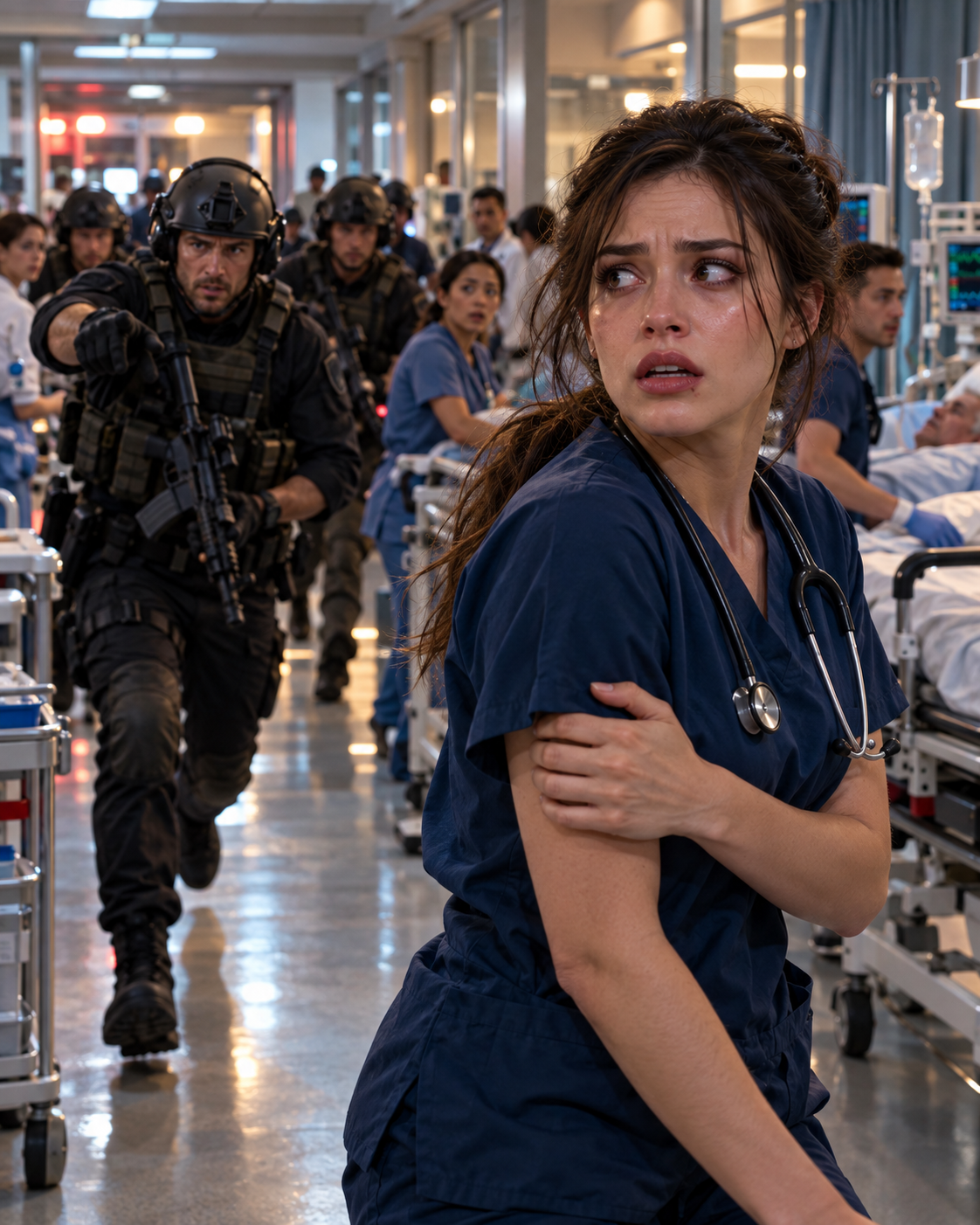
He kept glancing toward the hallway where Harrison Vance had disappeared.
That detail stayed with me.
Twenty minutes later, an FBI agent arrived with hospital security and began questioning everyone who had been near the trauma bay.
When he asked about Vance, the nurses exchanged uneasy looks.
“He left,” one said.
“Left where?”
Nobody knew.
Then my phone buzzed.
A message appeared from an unknown number.
STOP ASKING ABOUT THE MUNITIONS.
I stared at it until the letters blurred.
Another message arrived.
YOU SAVED SIX MEN ON THAT MOUNTAIN.
DON’T MAKE SEVEN.
I felt cold all over.
Raymond saw my face.
“What is it?”
I handed him the phone.
His expression hardened.
“You’re staying with me.”
“I don’t need protection.”
“This isn’t about whether you need it.”
He pointed toward the operating room.
“It’s about whether they know what Brett knows.”
I looked through the glass.
Brett was still alive.
Barely.
And somewhere inside his memory was the missing piece of my life.
The piece I had been too afraid to look for.
Three hours passed before the surgeon finally came out.
“He’s stable,” she said.
My knees almost gave way.
“Can I see him?”
“In a few minutes.”
Raymond put a hand on my shoulder.
“There’s something you need to understand.”
I turned toward him.
“The explosion that injured Brett wasn’t an accident.”
My stomach dropped.
“What?”
“The training charge was altered.”
“How do you know?”
“Because the same batch was supposed to be used during an exercise tomorrow.”
I stared at him.
“How many people?”
“Forty-two.”
The hallway seemed to tilt.
Someone hadn’t just tried to kill Brett.
Someone had been testing a failure designed to look accidental.
And Brett had discovered it.
That was why the gunman came.
That was why the texts had started.
That was why someone had been so desperate to silence him.
Then Raymond said the name that made everything click.
“Harrison Vance.”
I shook my head.
“No.”
“I didn’t say he built the device.”
“You think he was involved?”
“I think he knew something.”
The next morning, investigators searched Vance’s office.
They found folders full of contracts, photographs from military facilities, and a private communications device hidden inside a medical equipment case.
But the most damaging discovery was a video archive.
For years, Vance had built his reputation around stories of battlefield medicine.
In one video, he described treating wounded Marines under enemy fire.
In another, he claimed to have performed emergency surgery in a field hospital during a deployment.
The problem was simple.
Military records showed he had never been anywhere near those events.
His entire public identity had been constructed from other people’s courage.
And someone had been paying him to repeat the stories.
When the investigators showed me the footage, I felt something unexpected.
Not anger.
Pity.
He had spent years pretending to be the man I was terrified to admit I had once been.
But then they showed me a document bearing Vance’s signature.
It connected his consulting company to a contractor supplying the defective training charges.
I stared at the page.
“Why would a doctor care about munitions?”
The investigator answered quietly.
“He wasn’t the doctor who designed the contract.”
He turned another page.
“He was the doctor hired to make certain certain injuries would be described as unavoidable accidents.”
My blood went cold.
Vance hadn’t caused the explosion.
He had been preparing to explain it away.
And if Brett had died, nobody would have challenged the story.
I finally entered Brett’s room that afternoon.
His face looked thinner.
His breathing was assisted by a machine.
But when he saw me, he smiled.
“Angel Six.”
I sat beside him.
“You owe me an explanation.”
He gave a weak laugh.
“Still bossy.”
“I learned from the best.”
His eyes filled with tears.
For a moment, neither of us spoke.
Then he reached beneath his pillow and pulled out a small waterproof envelope.
My name was written across it.
My hands began shaking.
“Where did you get that?”
“Mercer gave it to me.”
Seven years disappeared in an instant.
The smoke.
The screaming.
The ridge.
Mercer’s blood-covered face.
My own hands trying to reach him.
I couldn’t open the envelope.
Brett noticed.
“He told me to keep it until I found you.”
“Why didn’t you find me?”
“I tried.”
I looked at him.
“What?”
“After the evacuation, your records were sealed.”
“Why?”
“Because someone changed the report.”
My chest tightened.
“Who?”
Brett looked toward the door.
“An officer who wanted the whole incident buried.”
I opened the envelope.
Inside was a folded sheet of paper, stained brown along one edge.
The handwriting was unmistakably Mercer’s.
I recognized it immediately.
My eyes filled before I even reached the first sentence.
He had written only a few lines.
He knew he was dying.
He knew I was still trying to reach him.
And he had left instructions for Brett.
I read the final words twice.
Then I couldn’t see anymore.
Mercer had not blamed me.
He had never believed I abandoned him.
He wrote that I had saved six lives while knowing I might not survive myself.
He wrote that if I lived, I was never to let guilt turn my hands against the living.
And then came the sentence that broke something open inside me.
He wrote, “Angel Six, you didn’t leave me behind.”
I pressed the paper against my chest.
Brett reached for my hand.
“He said something else.”
I looked up.
“What?”
“He said you would spend years believing the mountain took you from yourself.”
Brett swallowed hard.
“Then he said, ‘Tell her the mountain didn’t win.'”
I started crying.
Not the quiet tears I had hidden in bathroom stalls.
Not the silent tears I had swallowed beneath blankets.
I cried like a soldier finally putting down a weapon.
Brett squeezed my fingers.
“He was proud of you.”
I shook my head.
“I wasn’t there.”
“You were.”
“I should have reached him.”
“You reached six others.”
“That wasn’t enough.”
Brett’s eyes sharpened.
“Don’t you dare make his sacrifice smaller just because you survived it.”
The words landed harder than any reprimand.
For seven years, I had measured my worth against one person I couldn’t save.
I had forgotten the six people who were still alive because I refused to stop moving.
That evening, the FBI arrested three people connected to the contractor.
Vance was taken into custody the following morning.
The gunman eventually confessed that Brett had discovered internal test reports showing the defective charges were being knowingly shipped to military training facilities.
The planned exercise would have created dozens of casualties.
Brett had been targeted because he intended to expose it.
Vance had agreed to help bury the medical evidence.
His camera had never been about medicine.
It had been about manufacturing credibility.
The hospital held a press conference.
I refused to attend.
For once, I didn’t want cameras.
I didn’t want applause.
I wanted my scrubs.
I wanted the quiet beeping of monitors.
I wanted the simple privilege of standing beside someone who was afraid and telling them they weren’t alone.
A week later, administration called me into the same conference room where they had stripped my badge.
The chief executive stood when I entered.
“I owe you an apology.”
I said nothing.
“We all do.”
My badge sat on the table.
Beside it was a letter restoring my position permanently.
There was also an offer from the Navy.
Instructor.
Senior medical training advisor.
A chance to teach combat medicine to the next generation.
It was everything I had once believed I wanted.
I looked at the paperwork for a long time.
Then I pushed it back.
“Thank you.”
The room went quiet.
“But I’m staying here.”
“At Mercy General?”
I nodded.
“Why?”
I looked at my hands.
“Because I spent seven years thinking healing meant saving everyone.”
I smiled sadly.
“Now I know sometimes healing means staying beside the person you couldn’t save.”
Nobody tried to change my mind.
That night, I walked through the emergency department with my sleeves rolled above my elbows.
For the first time, the tattoo was visible.
The anchor.
The six stars.
And the empty space beside them.
A young nurse noticed it.
“Are those people you saved?”
I looked down.
“Yes.”
“All six?”
“All six.”
She smiled.
“Then why do you look sad?”
I touched the seventh space.
“Because there was someone else.”
She waited.
I told her his name.
Daniel Mercer.
She didn’t know him.
But she listened.
Sometimes that is all a dead person needs.
A witness.
A name spoken aloud.
A story that refuses to disappear.
Months later, Brett returned to Mercy General for a follow-up.
He walked slowly.
He complained about hospital coffee.
He insulted my choice of shoes.
It felt ordinary.
And ordinary had never felt so beautiful.
Before he left, he handed me a small metal pin.
Mercer’s unit insignia.
“I found this in my gear.”
I stared at it.
“Why are you giving it to me?”
“Because he wanted you to have it.”
I closed my fingers around the pin.
“What if I can’t let go?”
Brett smiled.
“Then don’t.”
He pointed toward my forearm.
“Just don’t confuse carrying someone with carrying their guilt.”
After he left, I stood alone in the hallway.
The emergency department doors opened.
Another ambulance arrived.
Another patient.
Another frightened family.
Another life hanging between one heartbeat and the next.
I pulled on my gloves.
Then I looked at the tattoo one last time.
For years, I had hidden those stars because I thought they proved how much I had lost.
Now I understood what they really meant.
They were not six reminders of war.
They were six reasons I was still here.
Six people who had gone home.
Six families who still heard familiar voices at dinner.
Six lives that continued because, once upon a time, I had refused to give up.
I walked into Trauma Room Three.
My sleeve stayed rolled up.
And just before the doors closed behind me, I heard a voice from the waiting area.
A little girl was asking her mother why the nurse had stars on her arm.
Her mother whispered something I couldn’t hear.
I smiled.
Because for the first time in seven years, I wasn’t afraid of the answer.
The mountain had taken Daniel Mercer.
It had taken a part of me with him.
But it had not taken everything.
And somewhere deep inside me, beneath the scars, beneath the guilt, beneath the six stars and the empty seventh space, I finally understood what Daniel had been trying to tell me all along.
Survival was never the betrayal.
Giving up on the living would have been.
So I kept walking.
I kept healing.
And I kept his name.
Because some people are not meant to disappear when they die.
Some are meant to become the reason someone else chooses to stay.