I was publicly humiliated beside an F-35 at Nellis when Captain Travis Sterling laughed at my worn duffel bag and called me a quota pilot
For several seconds, neither of us spoke.
The officers’ club had begun to empty, leaving only the muted clink of glasses behind the bar and the distant hum of an air-conditioning unit fighting the Nevada heat.
Travis sat across from me with his hands folded on the table.
The same hands that had pointed at me that morning were now completely still.
I looked at the scar across his right knuckles.
“Where did you get that?”
His eyes dropped.
“Afghanistan.”
“That wasn’t my question.”
He looked back at me.
Something changed in his face.
Not fear.
Recognition.
“I know.”
I closed the manual.
“You saw the crash report.”
He didn’t answer.
“Didn’t you?”
“Yes.”
The word came quietly.
I had spent three years hearing that report described as a miracle.
A miracle was what people called survival when they didn’t want to talk about the person who had almost died.
I remembered the night clearly.
The test aircraft had been at twenty-five thousand feet when everything went wrong.
The prototype entered a flat spin so violent that the horizon became a blur of black desert and white stars.
Every warning light in the cockpit turned red.
The aircraft was supposed to be unrecoverable.
The engineers had calculated seconds.
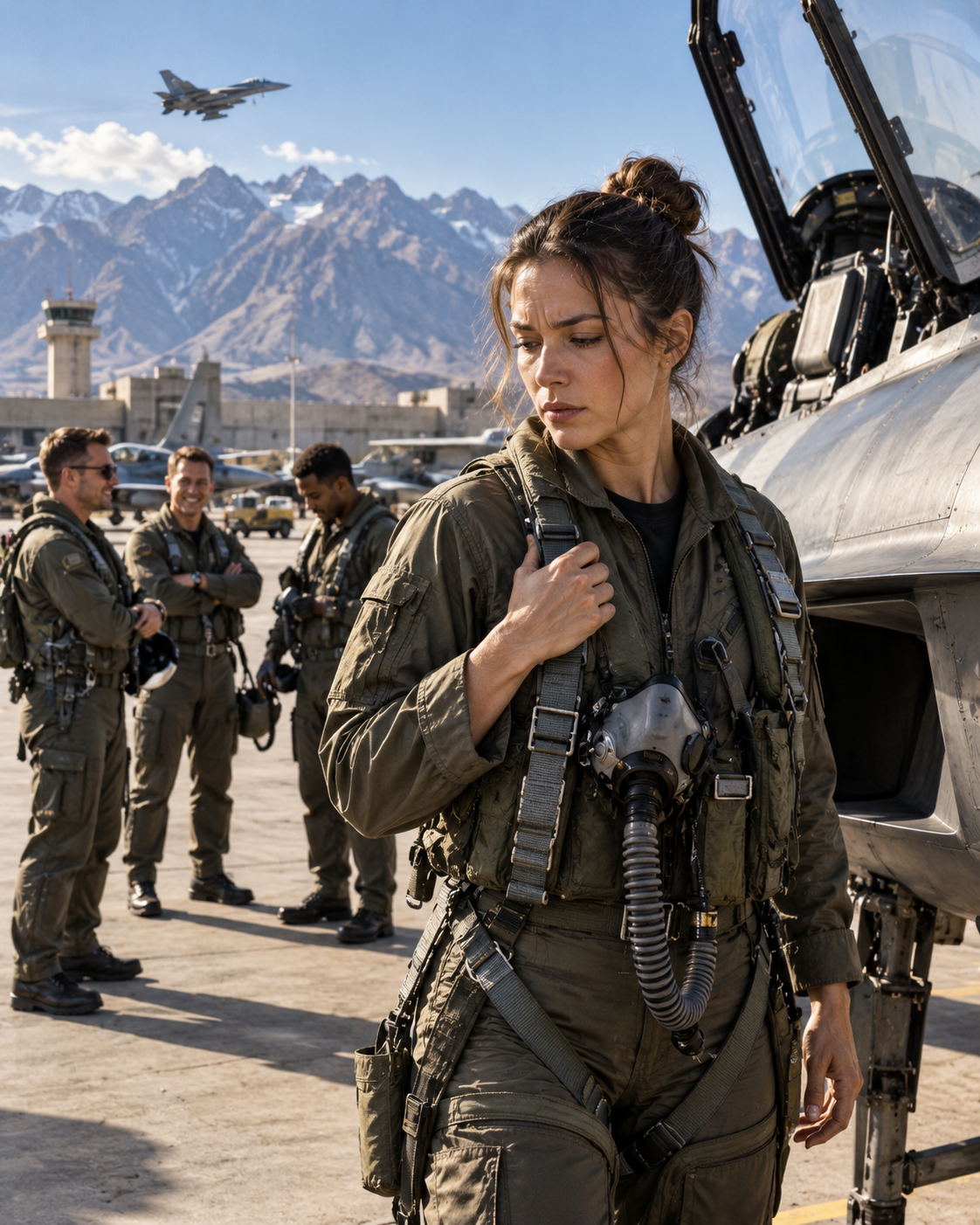
The safety team had prepared for impact.
I had thirty-seven seconds to prove all of them wrong.
The official report said I recovered the aircraft through an experimental control technique.
It did not say what happened immediately afterward.
It did not say who had been watching.
It did not say why I never flew publicly again.
Travis rubbed his thumb against the scar.
“I was there that night.”
My chest tightened.
“You weren’t supposed to be.”
“I was an evaluator.”
“You were a lieutenant.”
“I was still there.”
I studied him.
For the first time since meeting him, I didn’t see Razor Sterling.
I saw a young pilot standing behind a glass wall, watching someone else fight for her life.
“What did you see?”
He hesitated.
“Everything.”
Outside, a jet roared across the darkness.
The sound rattled the windows.
Travis didn’t flinch.
“I saw your aircraft disappear into the spin,” he said.
“I saw the telemetry fail.”
“I heard the engineers say you were gone.”
I said nothing.
“And then I watched you pull out.”
His voice cracked slightly.
“Nobody understood how.”
“I did.”
He looked at me.
“I know.”
I opened the manual again.
“Then why did you call me a quota pilot?”
He stared at the table.
“Because I was scared.”
That answer landed harder than an insult.
“Scared of me?”
“Scared of being irrelevant.”
For once, there was no swagger in his voice.
He told me his father had been a decorated fighter pilot.
His older brother had become an instructor.
His entire childhood had been built around one expectation.
Be the best.
Never hesitate.
Never look weak.
Never let anyone see you afraid.
“And then you walked into that ready room,” he said.
“You didn’t care whether anyone respected you.”
I gave him a tired smile.
“I cared.”
He looked surprised.
“I just stopped needing it.”
The room became quiet again.
That was the difference between confidence and arrogance, though I didn’t say it aloud.
One needed witnesses.
The other didn’t.
Travis leaned forward.
“Teach me the turn.”
I took a pen and drew a rough circle on the page.
“First, forget the turn.”
He frowned.
“You don’t win a high-AOA fight by forcing the aircraft to do something impossible.”
“Then what do you do?”
“You make the other pilot believe you’ve done something impossible.”
His eyebrows lifted.
“You create the wrong expectation.”
I pointed to the circle.
“The aircraft isn’t the trick.”
“What is?”
“Timing.”
We stayed there for almost two hours.
I explained energy management, lift, nose authority, rudder coordination, and the tiny moment when an opponent becomes committed to the geometry he thinks he understands.
Travis listened.
He didn’t interrupt.
He didn’t brag.
He didn’t once mention his kill count.
When we finally stood, he said, “I owe you more than an apology.”
“Probably.”
He almost smiled.
“Will you fly with me tomorrow?”
I considered it.
“Maybe.”
“That’s not an answer.”
“It is when you’re asking me.”
He laughed softly.
It was the first genuine laugh I had heard from him.
The next morning, Major Vance paired us for another sortie.
Word had spread.
Everyone wanted to know whether the arrogant golden boy could survive a flight with the quiet woman he had mocked.
I didn’t care.
I only cared about the sky.
We launched just after sunrise.
The Nevada mountains glowed orange beneath us.
Travis flew wing.
For the first twenty minutes, everything was quiet.
Then the aggressors appeared.
Three contacts.
Then four.
“Razor, you’ve got bandits at your three o’clock,” I said.
“I see them.”
His voice was calm.
The old Travis would have chased immediately.
This time he waited.
“Your call.”
I smiled inside my helmet.
“Let them commit.”
They did.
The first F-16 dove.
Travis held.
The second followed.
He held again.
The third tried to bracket him.
“Now.”
He broke exactly when I told him.
The formation collapsed.
One simulated kill.
Then another.
The fourth aircraft escaped.
Travis could have pursued.
Instead, he turned toward the bombers.
“Protect the package.”
I felt something loosen inside me.
That was the lesson.
Not how to defeat someone.
How to know what mattered.
When we landed, nobody said much.
Major Vance simply looked at Travis.
“Good discipline.”
Travis nodded.
Then he looked at me.
“She taught me.”
The words surprised everyone.
They surprised me too.
That afternoon, Lieutenant Colonel Douglas Sterling found me near the hangar.
He handed me a sealed folder.
“I should have given you this three years ago.”
I stared at it.
“What’s inside?”
“The part of the report they never released.”
My stomach tightened.
“Why?”
“Because someone altered the telemetry.”
The desert seemed suddenly silent.
I opened the folder.
There were photographs.
Flight data.
A maintenance log.
And a name.
My eyes stopped moving.
I knew that name.
It belonged to the engineer who had signed off on the aircraft before my test flight.
The same engineer who had later disappeared from the program.
“Why are you showing me this now?”
Douglas looked toward the runway.
“Because someone has started asking for the prototype again.”
My fingers tightened around the folder.
“Who?”
He didn’t answer immediately.
Then he said, “The same people who wanted you blamed for losing it.”
I felt the old night return.
The spin.
The alarms.
The impossible pressure.
But beneath all of it, there had always been one detail that never made sense.
The aircraft had not simply lost control.
Someone had changed the flight-control parameters before I entered the test envelope.
I had suspected it.
I had never been able to prove it.
Now, after three years, the proof might be sitting inside the folder in my hands.
That night, I didn’t go to the officers’ club.
I went back to my room and spread the documents across the bed.
At 2:13 a.m., I found the discrepancy.
One line of code.
One authorization.
One timestamp.
My heartbeat stopped.
The authorization belonged to a classified test division that officially did not exist.
Then my phone rang.
Unknown number.
I answered.
Nobody spoke.
I waited.
Finally, a man’s voice whispered, “You should have stayed retired.”
The call ended.
I sat perfectly still.
For the first time in three years, I felt afraid.
Not because someone had threatened me.
Because someone knew exactly what I had been investigating.
The next morning, I found Travis waiting outside my hangar.
He took one look at my face.
“What happened?”
I handed him the folder.
He read the first page.
Then the second.
His expression hardened.
“Who else knows?”
“Douglas.”
“Anyone else?”
“No.”
He closed the folder.
“Now me.”
I looked at him.
“You don’t have to get involved.”
He shook his head.
“I already am.”
“Why?”
He looked toward the runway.
“Because three years ago, I watched you save an aircraft everyone else had abandoned.”
He paused.
“I’ve spent three years wondering why I was so impressed by that.”
“And?”
“And I finally understand.”
He looked back at me.
“It wasn’t because you were fearless.”
I waited.
“It was because you were terrified and did the right thing anyway.”
Those words stayed with me.
We spent the next several days quietly tracing the authorization chain.
Douglas used his command channels.
I used my old test connections.
Travis used something I never expected.
His reputation.
People trusted him.
The same arrogance that had once made him unbearable had built a network of pilots and engineers who answered his calls.
But this time he didn’t ask them to follow him.
He asked them to look.
Piece by piece, the truth emerged.
The prototype’s altered parameters had not been an accident.
Someone had wanted the test to fail.
The purpose was to bury the program and redirect funding toward another classified platform.
The pilot’s death would have been considered an acceptable consequence.
My survival had ruined the plan.
I felt sick when I realized that.
For three years, I had believed surviving was the end of the story.
It wasn’t.
It was the reason the story had been hidden.
The investigation eventually reached people far above our squadron.
There were interviews.
There were sealed hearings.
There were names I was never allowed to repeat.
The engineer who had disappeared was found alive under federal protection.
He confirmed what the data had already shown.
And suddenly, the woman everyone had called lucky became the witness everyone needed.
Months later, I stood in the same hangar where Travis had first mocked me.
The sun was setting behind the Nevada mountains.
Travis approached with two coffees.
He handed me one.
“Still hate coffee?”
“Still hate bad coffee.”
He smiled.
“Fair.”
We stood quietly for a while.
Then he said, “I’ve been thinking about something.”
“That’s dangerous.”
He laughed.
“I deserved that.”
He looked toward the runway.
“I used to think being a great pilot meant never letting anyone see weakness.”
“And now?”
“Now I think it means knowing when someone else sees the sky more clearly than you do.”
I looked at him.
He had changed.
Not completely.
People rarely change completely.
But enough.
“You’re getting better,” I said.
“At flying?”
“At being human.”
He smiled.
“That’s harder.”
“It usually is.”
A jet climbed through the evening clouds.
Its afterburner left a brief orange streak against the darkening sky.
Travis watched it disappear.
Then he turned toward me.
“One question.”
“What?”
“That night at the club, when I insulted you…”
“Yes?”
“You knew I’d eventually ask you to teach me, didn’t you?”
I smiled.
“No.”
He looked surprised.
“I thought you’d hate me.”
“I did.”
He laughed.
“Then why help me?”
I looked at the runway.
“Because somebody once helped me.”
He waited.
“Who?”
I didn’t answer.
There are some debts that don’t disappear simply because the person who gave you the gift is gone.
Some lessons arrive through fear.
Some through failure.
And some through a stranger who refuses to let you become the worst version of yourself.
Travis seemed to understand that I wasn’t going to explain.
He didn’t push.
That was another thing he had learned.
We stood together until the last light disappeared.
Then my phone vibrated.
One message.
No name.
Only a photograph.
It showed the prototype I had saved three years earlier.
Beneath it was a single sentence.
“We know you kept the original flight data.”
I stared at the screen.
Travis noticed my expression.
“What is it?”
I locked the phone.
“Another lesson.”
His face tightened.
“Are we in trouble?”
I looked toward the black Nevada sky.
“Not yet.”
I handed him the phone.
He read the message.
Then he looked at me.
“What do we do?”
For the first time, I didn’t feel alone.
I smiled faintly.
“We fly.”
And somewhere beyond the mountains, another aircraft engine came alive.
The sound rolled across the desert like a warning.
I had spent three years believing the hardest part of surviving was learning how to come down.
I was beginning to understand that sometimes the harder part was deciding what you were willing to protect after you landed.
And this time, whatever was waiting in that sky was coming for both of us.