I was publicly dragged out of Sterling Dynamics at 7:59 a.m. while a $4.7 MILLION machine began melting down behind me
The machine screamed.
Not like metal breaking, but like something enormous waking up inside the walls.
Every light in the engineering basement turned red.
The floor trembled beneath my boots.
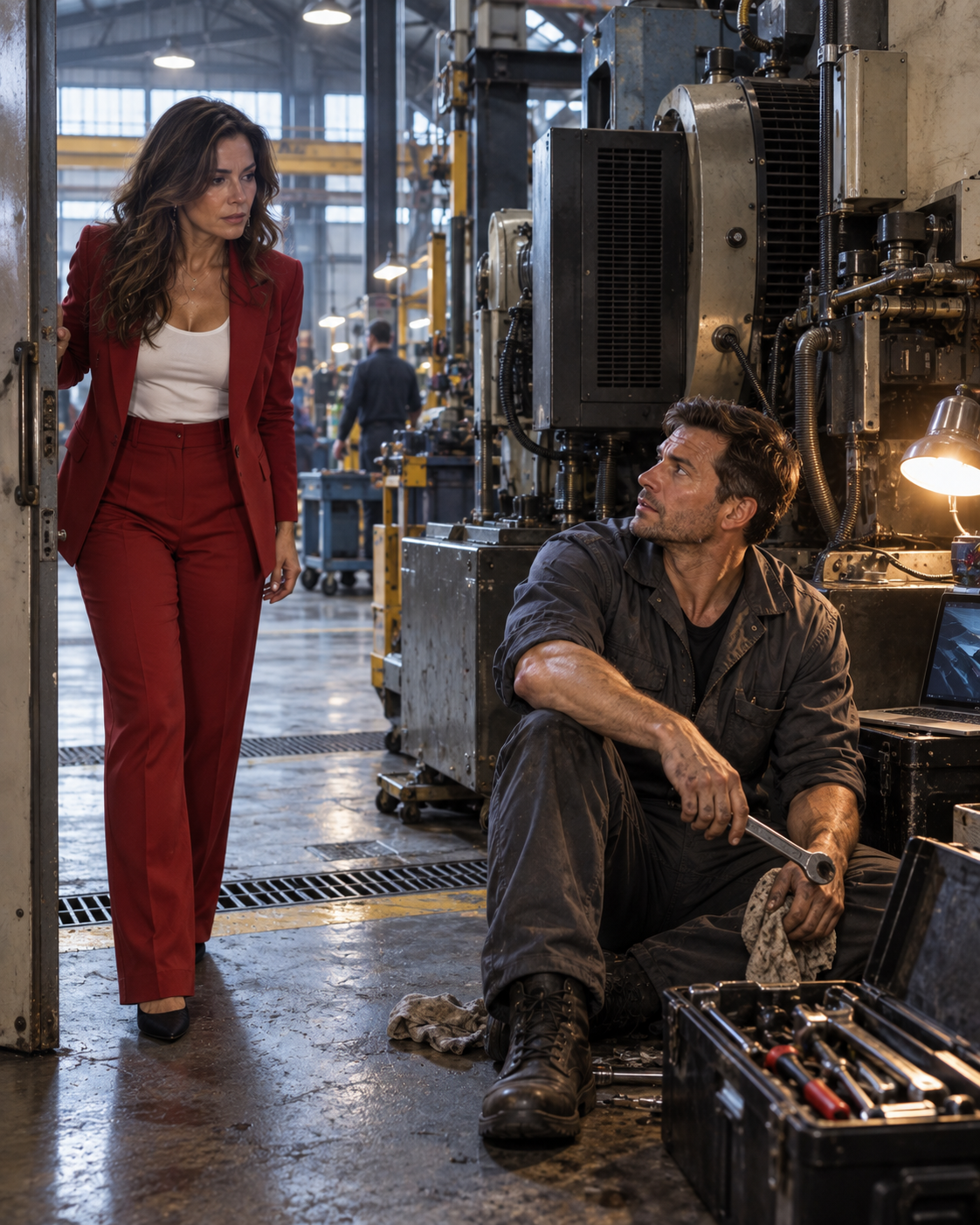
Evelyn looked at the control console.
“Why aren’t the emergency cutoffs responding?”
I didn’t answer.
I was already looking at Jonathan.
He stood beside the security officers with his arms crossed, but the confidence in his face had changed.
He knew.
He knew exactly what I had discovered.
The machine was now locked into the startup sequence.
And there was no automatic way to stop it.
“Everyone out,” I said.
Jonathan shook his head.
“You don’t give orders here.”
I ignored him.
“Evelyn, get the engineers upstairs.”
She didn’t move.
“What are you going to do?”
“Fix it.”
“You said the emergency system was compromised.”
“It is.”
“Then how are you going to stop a machine you can’t shut down?”
I looked at the old mechanical panel beneath the primary console.
“There’s one circuit they forgot.”
Jonathan suddenly stepped forward.
“She’s guessing.”
I turned toward him.
“No.”
My voice was quiet.
“I’m remembering.”
Six years earlier, I had stood in another basement watching another machine do exactly this.
Different company.
Different building.
Same architecture.
Same hidden weakness.
And the same kind of men standing behind me, telling everyone not to panic.
I had been twenty-nine then.
Young enough to believe that evidence protected people.
Young enough to believe that if I found something dangerous, telling the truth would automatically matter.
I had spent four months warning the technical director that the control architecture had a fatal vulnerability.
Every report had been signed.
Every simulation had been documented.
Every warning had been acknowledged.
But the launch date had been moved forward.
The client was waiting.
The investors were impatient.
The executives wanted the contract.
So they told me the risk was acceptable.
Then, three days before launch, the system failed.
Three technicians were injured.
The prototype was destroyed.
And my report disappeared.
Two weeks later, I was fired for “procedural negligence.”
The company survived.
The executives kept their bonuses.
My career disappeared almost overnight.
For six years, I never spoke about it.
I learned something more valuable than any engineering degree could teach me.
When powerful people are determined to protect a lie, they don’t need everyone to believe it.
They only need everyone to be afraid of questioning it.
I looked at Evelyn.
“I need sixty seconds.”
She nodded.
“Take them.”
Jonathan stepped toward her.
“You cannot trust her.”
Evelyn turned.
“Seventeen engineers trusted you for six weeks.”
Her voice was cold.
“They couldn’t find a one-centimeter misalignment.”
Nobody spoke.
She pointed toward the door.
“Get everyone out.”
The security officers hesitated.
Jonathan’s face tightened.
“You’re making a mistake.”
Evelyn didn’t look at him.
“Move.”
They left.
Jonathan stayed.
For a moment, he and I were alone on opposite sides of the machine.
He lowered his voice.
“You don’t understand what you’re interfering with.”
“I understand enough.”
“No, you don’t.”
He stepped closer.
“Do you know what happens if this demonstration fails?”
“The company loses money.”
“More than money.”
His eyes were strangely calm.
“The board has already committed billions.”
I stared at him.
“That’s why you disabled the emergency cutoffs.”
He said nothing.
“You needed a catastrophic failure.”
His silence answered me.
The plan was simple.
The machine would fail publicly during the client demonstration.
Sterling Dynamics would announce that the prototype had reached the limits of its current architecture.
Then Jonathan’s allies would push through an emergency replacement contract using a different supplier.
They would profit from the failure.
And because the machine was supposed to be autonomous, everyone would blame the technology.
Nobody would ask why the safeguards had been disabled.
Nobody would ask why a counterfeit circuit had been installed.
Nobody would ask why the maintenance records had been altered.
Except someone had.
Me.
Jonathan looked at the machine.
“You should have taken the severance.”
“I wasn’t offered one.”
“You were offered silence.”
I looked at him.
“And that’s what you think people should be paid for?”
He didn’t answer.
The temperature climbed again.
I moved to the lower access panel.
My hands were shaking.
Not from fear.
From memory.
I could still remember the smell of smoke from six years ago.
The screaming alarms.
The engineers running.
The sound of someone shouting my name as the machine collapsed.
I had survived that night.
But part of me had stayed there.
Until now.
I removed the panel.
Inside was a narrow compartment containing three circuits.
The counterfeit one was easy to identify.
Its casing was slightly darker.
Its connector had been altered.
But the real problem was deeper.
Someone had rerouted the backup circuit.
The manual override would trigger the wrong sequence.
I stared at it.
Jonathan watched me.
“Problem?”
“Yes.”
I pointed at the wiring.
“Whoever built this knew our emergency architecture.”
He smiled faintly.
“Maybe you’re finally realizing how little you know.”
I looked at him.
“Actually, I’m realizing how much you know.”
I pulled out my phone.
He frowned.
“What are you doing?”
“Recording.”
His expression changed.
I held the phone toward the wiring.
“You just admitted you knew the system was compromised.”
“I didn’t say that.”
“You don’t have to.”
The machine gave a deep metallic groan.
The temperature jumped again.
There were twenty-eight seconds before the thermal threshold.
I reached inside.
The manual backup circuit was almost impossible to access without shutting the system down.
But shutting it down was exactly what we couldn’t do.
I remembered the old machine.
I remembered the design flaw.
Then I remembered something nobody else knew.
The engineers who designed the original system had included a redundant circuit for a condition they considered statistically impossible.
A human-controlled failover.
No software.
No network.
No digital command.
Just a mechanical switch.
I searched beneath the housing.
My fingers found a metal tab.
There.
I pulled.
Nothing happened.
The temperature climbed.
Twenty degrees past safe operating range.
Jonathan laughed.
“You were wrong.”
I pulled harder.
Still nothing.
Then I remembered the six-year-old report.
My own handwriting.
“Apply pressure while rotating clockwise.”
I did.
The switch moved.
The machine screamed.
Every light went black.
For one terrifying second, there was absolute silence.
Then the backup system activated.
A low hum passed through the room.
One screen came back.
Then another.
The temperature began dropping.
Green appeared across the main display.
72%.
81%.
94%.
100%.
READY.
I exhaled.
Evelyn came running back downstairs.
She stopped when she saw the screen.
“Is it stable?”
“For now.”
Jonathan stepped backward.
Evelyn looked at him.
“You knew.”
He didn’t answer.
“You knew the cutoffs had been disabled.”
Still nothing.
“You knew about the counterfeit circuit.”
His jaw tightened.
“I was protecting the company.”
“No,” Evelyn said.
“You were protecting yourself.”
He looked at me.
“You think this ends here?”
I didn’t respond.
He smiled.
“You’re not the only one with enemies.”
Security entered.
This time, they weren’t there for me.
Jonathan was arrested before noon.
Three procurement executives were detained by federal investigators that afternoon.
The subcontractor’s offices were searched.
Financial records were frozen.
And within forty-eight hours, the board discovered that Jonathan had moved millions through shell companies connected to the replacement contract.
But the worst discovery came later.
My old report wasn’t simply buried.
Someone had deliberately altered the original archive to make it appear as though I had never submitted it.
The recovered version proved otherwise.
My warnings had been there all along.
The company had simply chosen not to see them.
The board member whose signature appeared at the bottom of my dismissal had no defense.
He resigned before the investigation reached him.
For the first time in six years, my name appeared beside the words “technical report” without the word “negligence” attached to it.
The report became public.
Engineers across the industry read it.
Some wrote to me.
Some apologized.
Some told me they had experienced the same thing.
That part hurt more than I expected.
Because I realized my story wasn’t unusual.
It was simply one of the few that had finally been exposed.
Three weeks later, Evelyn called an all-hands meeting.
Every engineer, technician, supervisor, and executive was there.
She stood beside the machine.
Then she called me forward.
“I want to offer you the position of Chief Systems Architect.”
The room applauded.
I looked at the title printed on the contract.
Six years earlier, I would have given almost anything for someone to offer me something like that.
Now it felt strangely small.
I handed the contract back.
Evelyn looked surprised.
“You’re declining?”
“Yes.”
“Why?”
“Because I don’t want a title.”
I looked around the room.
“I want authority to stop this from happening again.”
The room became quiet.
“I want engineers to be able to shut down a project without being threatened.”
I continued.
“I want technical reports preserved exactly as written.”
“No altered logs.”
“No hidden failures.”
“No executive override when safety is involved.”
I looked at Evelyn.
“And if someone discovers a flaw, I want the truth to matter more than the launch date.”
Evelyn studied me for several seconds.
Then she tore the contract in half.
“Done.”
That was how I ended up rebuilding the engineering division without becoming its chief.
I hired people who had been ignored.
I promoted technicians who had spent years being treated as invisible.
I created an independent failure-review board.
Every engineer could trigger an emergency review without asking permission from management.
The first time someone used it, the entire company stopped.
The project was delayed.
It cost millions.
Nobody was fired.
Six months later, the project launched successfully.
That was when I finally understood what had changed.
The machine had never been the real thing I was trying to repair.
It was the culture around it.
Machines fail because components fail.
Organizations fail because people become afraid to tell the truth.
And fear is much harder to replace than a circuit.
One evening, almost a year after the incident, I stayed late in the same basement where everything had started.
The $4.7 million machine was running quietly.
Its lights were green.
Its systems were stable.
Evelyn walked in carrying two coffees.
“You still work too late.”
I accepted one.
“You still bring terrible coffee.”
She smiled.
“Some things never change.”
We stood beneath the machine.
For the first time, I didn’t feel like a contractor.
I didn’t feel like the woman whose career had been erased.
I didn’t feel like someone trying to prove she had been right six years ago.
I simply felt like an engineer.
Then Evelyn looked at me.
“I found something in the old archive.”
My smile disappeared.
“What?”
She handed me a sealed envelope.
I opened it.
Inside was a copy of a six-year-old internal memo.
At the bottom was a handwritten note.
Three words.
“She knew too much.”
I stared at it.
Evelyn’s voice became quiet.
“That handwriting doesn’t belong to Jonathan.”
I looked at her.
“Who does it belong to?”
She didn’t answer.
Outside, the machine continued humming.
Perfectly stable.
Perfectly silent.
And for the first time since I had returned to engineering, I understood something that frightened me more than any alarm ever had.
Jonathan hadn’t created the original problem.
He had inherited it.
Someone had been protecting that secret long before I walked into Sterling Dynamics.
I folded the note and slipped it into my pocket.
Then I looked at Evelyn.
“Looks like we still have work to do.”
She nodded.
The machine behind us continued running.
Green.
Quiet.
Alive.
And somewhere inside the company, someone who had remained invisible for six years had just realized that I had finally started looking back.