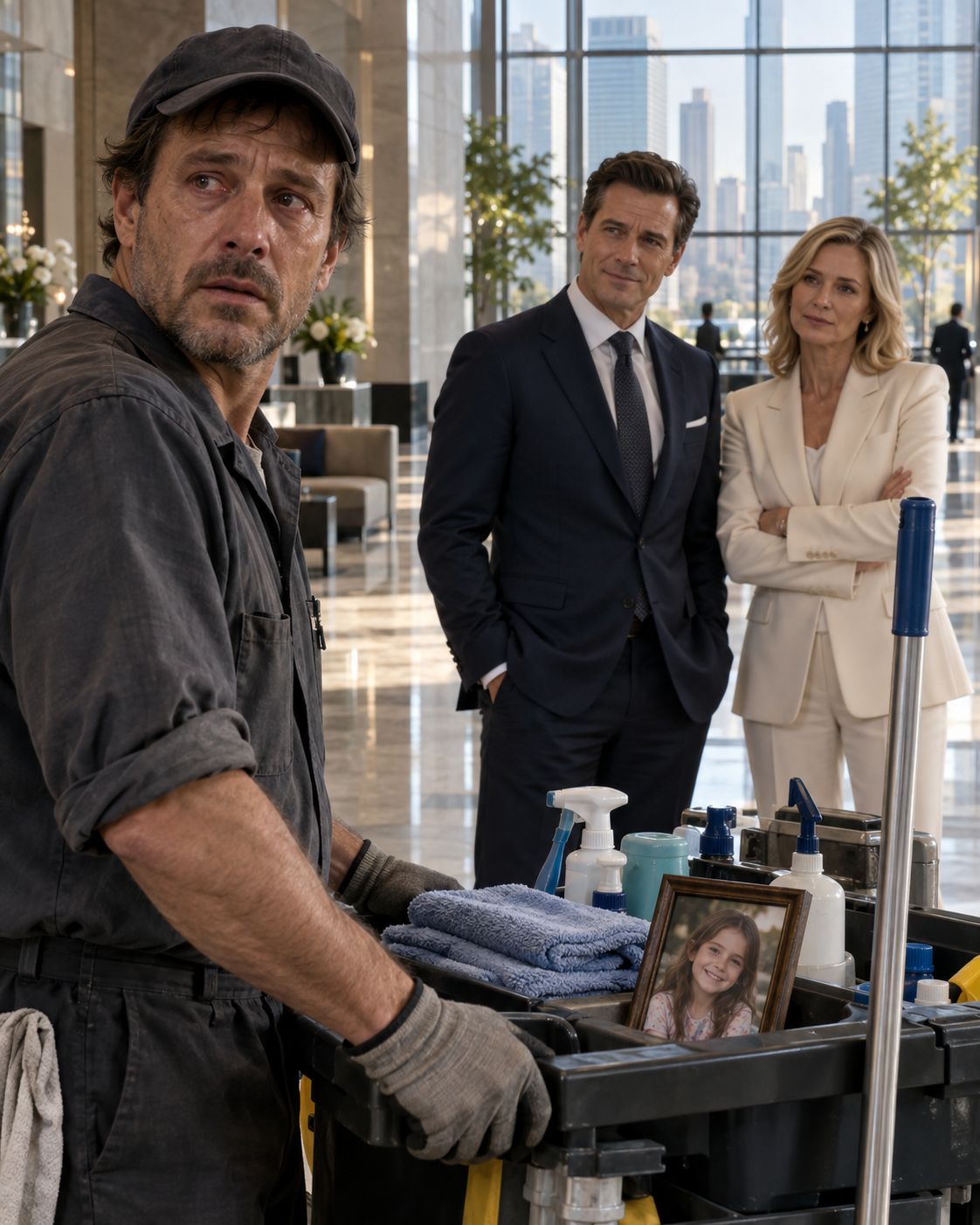
I was mopping the marble floor outside the executive offices when Nathan laughed at my daughter
I stared at the note beneath the reception desk until the elevator doors disappeared from view.
Four words.
YOU MISSED ONE PERSON.
For several seconds, I heard nothing except the soft hum of the lobby and Chloe asking whether we were going upstairs or going home.
I folded the note and slipped it into my pocket.
“Upstairs,” I said.
She smiled and ran ahead toward the elevator buttons.
I followed, but my mind stayed in the lobby.
The handwriting was ordinary.
Black ink.
No signature.
No date.
But whoever wrote it knew about the investigation.
More importantly, they believed I had missed someone.
That bothered me because the entire purpose of my undercover operation had been to find the people hiding behind polished smiles.
Nathan and Laura had been obvious once I knew where to look.
But I had spent three weeks listening.
Watching.
Cross-checking.
My security team had reviewed hundreds of hours of footage.
My investigator had interviewed employees privately.
The ethics committee had examined every complaint we could locate.
If someone had been overlooked, I wanted to know who.
That evening, after Chloe went to bed, I sat alone in my office.
Sarah’s photograph stood beside my laptop.
She was smiling in the picture, the same smile Chloe had inherited.
I looked at her and whispered, “I thought I fixed it.”
The next morning, I called Marcus Reed, my head of security.
“Pull every piece of footage from the final month before the investigation,” I said.
He paused.
“Everything?”
“Everything.”
“Even footage we’ve already reviewed?”
“Especially that.”
He arrived two hours later with a hard drive.
We began with the lobby.
Nothing.
Loading docks.
Nothing.
Break rooms.
A few arguments, but nothing that explained the note.
Then Marcus stopped the video.
“Wait.”
On the screen, a woman stood near the reception desk at 6:42 p.m.
She was an employee named Evelyn Carter.
I knew her name.
She had worked at Apex for nine years.
Her title was executive assistant to the chief financial officer.
I had spoken to her maybe six times in nine years.
Marcus zoomed in.
Evelyn looked around before sliding something beneath the desk.
The note.
“Why would she leave that?” Marcus asked.
“I don’t know.”
We called her into my office.
She entered cautiously.
When she saw the note on my desk, her face changed.
“I didn’t mean for you to find it so quickly,” she said.
I leaned back.
“Then you knew I would find it.”
She looked down.
“I hoped you would.”
“Why?”
Evelyn took a slow breath.
“Because Nathan wasn’t the only one.”
The room became very still.
She told me about a private group of managers who had learned how to manipulate the company’s internal systems without technically breaking policy.
Nathan had been one of them.
Laura had protected them.
But there was someone above them who understood the system better than either of them.
Someone who knew exactly which complaints disappeared.
Someone who knew how to make a hostile manager look productive.
Someone who had been quietly steering promotions, transfers, and performance ratings for years.
“Who?” I asked.
Evelyn hesitated.
Then she said the name.
“Richard Cole.”
I knew Richard.
Everyone did.
He was our chief financial officer.
He had been with Apex almost as long as I had.
He was the man who stood beside me during investor meetings and told people that culture was one of our greatest assets.
He was also the man who had signed off on several of the performance reports I had recently questioned.
I felt a strange chill.
“Why didn’t you tell me?”
“Because people who questioned Richard stopped getting promoted.”
“Did he threaten you?”
“No.”
She looked at me.
“That’s what made him dangerous.”
Richard never had to threaten anyone.
He simply made consequences appear.
An employee would suddenly be transferred.
A promotion would mysteriously vanish.
A complaint would be labeled “unsubstantiated.”
A difficult manager would receive a glowing evaluation.
Nobody could prove anything.
And because the company kept growing, the numbers made everyone comfortable.
Evelyn handed me a folder.
Inside were copies of emails, scheduling records, performance changes, and internal notes.
There was one spreadsheet with dozens of names.
Some had resigned.
Some had been transferred.
Some were still working at Apex.
Beside several names were short comments.
“Too outspoken.”
“Not management material.”
“Family conflict.”
“Potential liability.”
I read those words twice.
Family conflict.
That was how they described employees who needed predictable schedules to care for children.
I thought about Chloe.
I thought about all the nights I had rushed home because she had a school event, a fever, or simply needed her father.
What kind of company would punish someone for having a family?
Apparently, mine had become one.
But there was something else in the folder.
A memo dated three years earlier.
It concerned an employee named Melissa Grant.
Melissa had been one of Apex’s best engineers.
She had requested a temporary schedule adjustment after her husband died.
The request had been denied.
Her performance rating dropped the following quarter.
She resigned three months later.
At the bottom of the memo was Richard’s electronic approval.
My stomach turned.
I remembered Melissa.
I remembered telling myself she had probably found a better opportunity.
I had never asked why she left.
That realization hurt more than anything Nathan had said.
I had built a company large enough to hide my own failures from me.
I spent the next week digging.
Not publicly.
Not dramatically.
Quietly.
Our investigators reconstructed years of decisions.
Richard had never personally written the cruelest messages.
He didn’t need to.
He created incentives.
He taught managers that retention was less important than keeping difficult employees quiet.
He rewarded departments that produced numbers even when turnover was high.
He approved bonuses for leaders whose teams were collapsing.
He turned human beings into statistics.
And I had let him.
Not knowingly.
But responsibility doesn’t disappear simply because you didn’t see the damage.
One evening, I drove home late.
Chloe was sitting at the kitchen table doing homework.
She looked up.
“You’re quiet.”
“I’m thinking.”
“About work?”
I nodded.
She closed her notebook.
“Mom used to say people tell you who they are by what they do when nobody is watching.”
I froze.
“She said that?”
“All the time.”
Chloe smiled.
“She said titles don’t make people good.”
I sat across from her.
For a moment, I could almost hear Sarah’s voice.
Not as a ghost.
As a memory.
A lesson I had forgotten.
The next morning, I called Richard into my office.
He arrived carrying coffee.
“Big meeting?” he asked.
“Just us.”
He sat down.
I placed Melissa’s memo on the table.
His expression barely changed.
“I don’t remember that.”
“I do.”
He looked at me.
“You weren’t involved in the review.”
“Neither were you supposed to be.”
He said nothing.
I placed another document on the table.
Then another.
Then another.
His calm expression finally cracked.
“Where did you get these?”
“Does it matter?”
Richard leaned back.
“You have no idea how complicated this company became.”
“Then explain it.”
He sighed.
“After Sarah died, you disappeared into the business.”
The sentence hit harder than I expected.
“You were grieving,” he continued.
“You wanted Apex to survive. Someone had to make decisions.”
“Decisions like ruining Melissa’s career?”
“Decisions that protected the company.”
“No,” I said.
“They protected the system.”
He looked at me for a long moment.
Then he said something I would never forget.
“People like Melissa were always going to leave.”
I stood.
“People like Melissa didn’t leave.”
He stared at me.
“We pushed her out.”
Richard’s lawyer arrived before lunch.
By evening, he was suspended pending an independent investigation.
But the story didn’t end there.
Because the investigation revealed something I hadn’t expected.
Richard had not acted alone.
Several senior managers had knowingly participated.
Some were afraid.
Some were ambitious.
Some convinced themselves they were simply following the rules.
Others had benefited.
I faced the hardest decision of my career.
If I fired everyone who had touched the system, I could destroy the very company I was trying to save.
If I protected everyone who claimed ignorance, I would teach the same lesson that created the problem.
So I changed the question.
I stopped asking, “Who is guilty?”
I started asking, “Who knew, who acted, who benefited, and who tried to stop it?”
The answers were uncomfortable.
Some people were dismissed.
Some resigned.
Some stayed and accepted accountability.
Others became part of rebuilding the system they had once tolerated.
We reopened old complaints.
Employees who had been ignored were contacted privately.
Some were angry.
Some cried.
Some didn’t want to speak to us at all.
I understood.
Trust doesn’t return because the CEO gives a speech.
Trust returns one interaction at a time.
Months passed.
The company became quieter.
Not happier immediately.
Just quieter.
People stopped pretending everything was perfect.
Managers began admitting mistakes.
Employees started challenging decisions without fearing retaliation.
The ethics committee published anonymous summaries of investigations so people could see that complaints no longer vanished into locked drawers.
And every quarter, I attended a meeting where someone could criticize my own decisions without knowing whether I would punish them.
At first, nobody spoke.
Then one employee raised her hand.
“Can I be honest?”
I smiled.
“That’s why we’re here.”
She looked nervous.
“I don’t think you should have to be here.”
I frowned.
“What do you mean?”
“Because if this culture only works when you’re watching, then we haven’t fixed anything.”
Nobody moved.
She continued.
“We need to be decent when the CEO is in another building.”
I felt something loosen inside me.
She was right.
The real test wasn’t whether people behaved when I appeared.
It was whether they behaved when they thought nobody important was looking.
A year after the undercover investigation, I brought Chloe to Apex again.
She had grown taller.
Her hair was longer.
She still carried the same worn backpack Sarah had bought her before she died.
We walked through the lobby together.
A custodian dropped a stack of supplies near the elevator.
Before he could bend down, an executive stepped forward.
“Let me help.”
He crouched beside him.
No cameras.
No announcement.
No audience.
Just two people picking up boxes.
Chloe watched.
“Is that what you wanted?” she asked.
I looked at the scene.
“No.”
She looked surprised.
“I wanted something better.”
“What?”
I smiled.
“I wanted it to become normal.”
The elevator arrived.
The doors opened.
As we stepped inside, Chloe reached for my hand.
Then she noticed something taped beneath the control panel.
Her smile disappeared.
“Dad.”
I looked down.
Another note.
This time, it contained only one sentence.
“Sarah knew about Apex before she died.”
My heart stopped.
For five years, I had believed Sarah’s death had taken everything except her memories.
Now I was holding a message suggesting she had known something about the company I had never discovered.
I looked at Chloe.
She looked back at me, confused.
I folded the note slowly.
The elevator began to rise.
And for the first time since Sarah died, I wondered whether the biggest secret I had uncovered at Apex had never been about my employees at all.
Maybe it had been waiting for me inside my own family.
… THE STORY CONTINUES IN THE COMMENTS! 👇