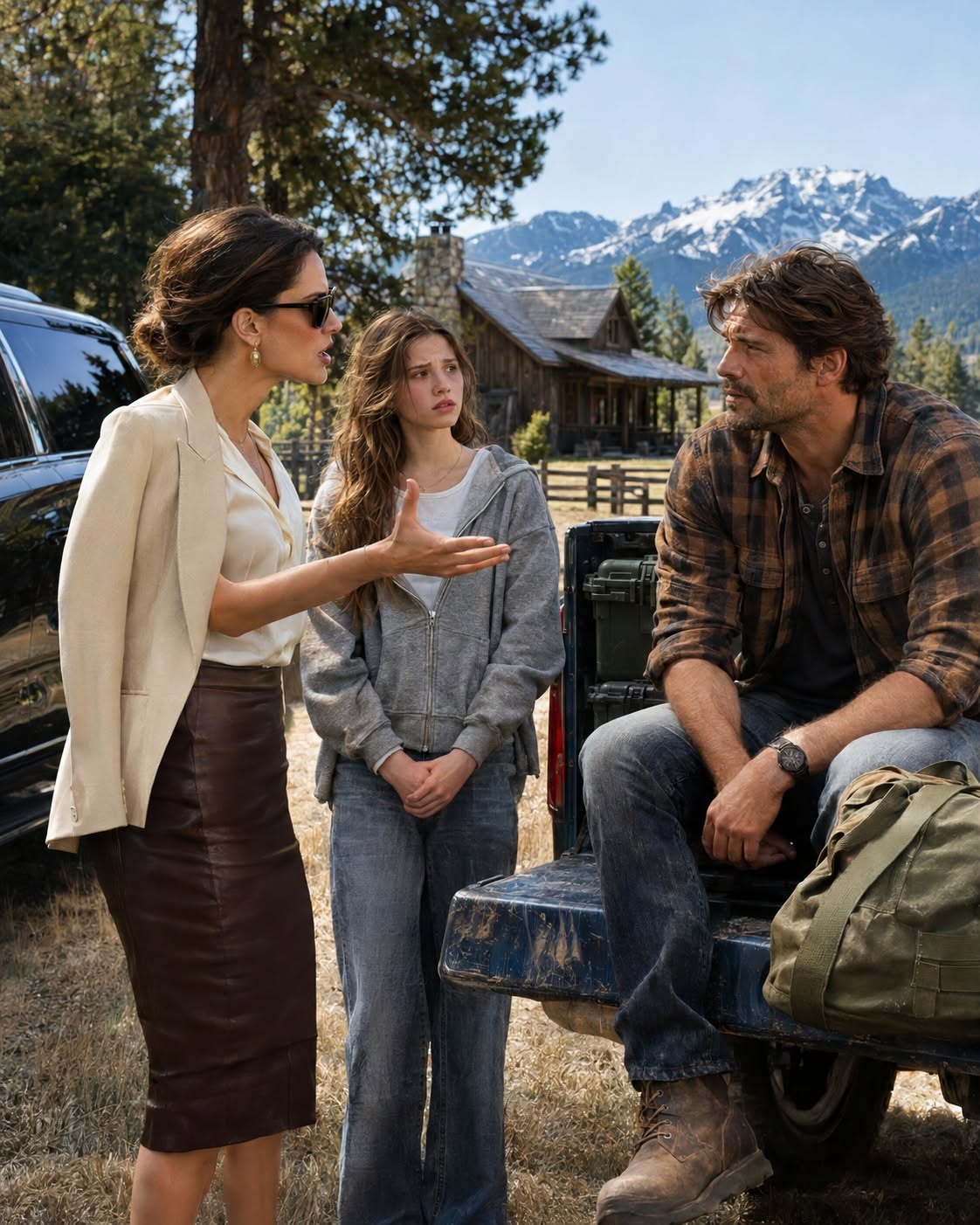
I was loading the last box into my truck when a black SUV pulled up outside the Montana ranch I’d just been ordered to leave.
The first time Meredith Vance asked me to lie, she didn’t actually use the word.
She placed a financial report on my desk, pointed to a number highlighted in yellow, and said, “Daniel, I need you to tell the board this is manageable.”
I looked at the number.
Forty-six million dollars.
That was how much Vance Land Holdings stood to lose if we abandoned the original development plan and protected the underground water system.
I read the report twice.
Then I looked up.
“Meredith, this isn’t manageable.”
She folded her arms.
“That’s not what our consultants are saying.”
“Your consultants have never stood knee-deep in that spring during snowmelt. They’re working from models that don’t account for the underground connections.”
She stared at me.
“Are you telling me we can’t build anything?”
“I’m telling you that if you build what your investors want, you could destroy the very thing that makes this land valuable.”
For several seconds, neither of us spoke.
Outside my office window, the Montana mountains rose against a gray November sky.
Three months earlier, I’d been loading my belongings into a truck, preparing to leave the only home my daughter had known since her mother died.
Now I was sitting across from the woman who’d saved that home, telling her something that could cost her company millions.
And I was about to discover that Julian Beck had left behind a problem far more dangerous than stolen research.
It began with a phone call from Arthur Doyle.
“Daniel, I need you to come to the eastern boundary.”
“What’s going on?”
“I found something that doesn’t belong there.”
Arthur rarely sounded frightened.
He’d spent thirty years working on complicated federal resource investigations. I’d seen him calmly explain catastrophic engineering failures to rooms full of angry officials.
But that morning, his voice shook.
I grabbed my coat and drove toward the eastern ridge.
Arthur was standing beside a narrow drainage ditch, holding a handheld water-quality meter.
He didn’t say hello.
He handed me the instrument.
I checked the readings.
Then checked them again.
“Where did you take this sample?”
“About a hundred yards upstream.”
The conductivity was unusually high. Other preliminary measurements suggested something was entering the groundwater that shouldn’t have been there.
I knelt beside the ditch.
The water looked perfectly clear.
That was what bothered me most.
People imagine contaminated water always looks dirty.
Sometimes the most dangerous problems are invisible.
“Could be natural mineralization,” I said.
Arthur nodded.
“Could be. But look at this.”
He pulled out an old geological survey.
A narrow access road crossed the eastern boundary and disappeared into a heavily wooded section of the neighboring property.
The road wasn’t on our current maps.
And beneath it, marked in faded pencil, were three words.
Abandoned extraction site.
I felt something tighten in my chest.
“Who owns that parcel?”
Arthur looked at me.
“An investment company registered in Delaware.”
“Which company?”
“Silver Basin Resources.”
The name meant nothing to me.
Until Arthur turned the page.
One of Silver Basin’s former directors was Brett Tanner.
Julian Beck’s brother-in-law.
I stood slowly.
“Tell me this is a coincidence.”
Arthur shook his head.
“I stopped believing in coincidences about twenty years ago.”
We spent the next two days reviewing historical records.
The property had once been part of a small mineral exploration operation that shut down in the late 1980s.
Officially, the site had been reclaimed.
But the available records were incomplete.
Several monitoring wells had been abandoned without clear documentation.
And the original closure report referred to underground storage areas that no longer appeared on modern property maps.
Arthur contacted the appropriate environmental authorities.
I arranged for independent laboratory testing.
Then I called Meredith.
She arrived at the ranch that evening.
Hannah and Camille were in the barn preparing Rusty for winter.
Meredith stepped into the kitchen, took one look at my face, and stopped.
“How bad?”
“I don’t know yet.”
I spread the maps across the table.
“But we may have a contamination problem moving toward the ranch’s spring system.”
She studied the documents.
“From Julian’s property?”
“From land connected to his brother-in-law. We don’t know who’s responsible for anything yet.”
She closed her eyes.
“Of course.”
I almost felt sorry for her.
Since taking over the company, Meredith had spent months cleaning up decisions made by people she’d trusted.
Every time she thought she’d reached solid ground, another problem appeared beneath her feet.
“Daniel, what do you need?”
“Access to every historical environmental report your company has. And I need authority to halt any development activity near the eastern watershed.”
She hesitated.
“The board won’t approve another delay without evidence.”
“Then tell them we’re collecting it.”
“And if they refuse?”
I looked directly at her.
“Then we stop anyway.”
Meredith stared at me for a long moment.
Then she nodded.
“All right.”
I thought that settled it.
It didn’t.
Three days later, a man named Richard Caldwell arrived at the ranch.
He was chairman of Vance Land Holdings’ investment committee and represented the company’s largest private investors.
He wore an expensive coat, polished boots, and the expression of someone who expected every room to become quieter when he entered.
Meredith introduced us in the ranch office.
Richard didn’t offer his hand.
“So you’re the engineer who’s been delaying our project.”
“I’m the engineer trying to keep your project from becoming a disaster.”
He smiled without warmth.
“I’ve reviewed your preliminary findings. They’re speculative.”
“They’re preliminary. That’s why we’re testing.”
“Testing costs money.”
“So does cleaning up contaminated groundwater.”
Richard leaned forward.
“Mr. Mercer, I understand you’ve had a difficult personal history. But we can’t allow emotional attachments to interfere with sound business decisions.”
I felt my jaw tighten.
He continued.
“This ranch has become very important to you and your daughter. I would hate to see that arrangement affected by unnecessary conflict.”
Meredith stood.
“Richard, that’s enough.”
But I was already looking at him differently.
I’d spent years in environments where people used threats without saying anything that could be quoted later.
Richard Caldwell was very good at it.
I gathered my papers.
“Then you’ll understand why everything I recommend will be in writing.”
His smile disappeared.
That night, Hannah found me in the barn.
I was checking the old water pump when she appeared carrying two mugs of hot chocolate.
“Camille says her mom had a fight with some rich guy.”
I accepted a mug.
“That’s one way to describe it.”
“Are they going to make us leave again?”
I wanted to tell her no.
I wanted to promise that nothing could take this place away.
But I’d made enough promises in my life to know how dangerous they could become.
“I don’t know, sweetheart.”
She looked down.
“I hate that answer.”
“Me too.”
She sat on a hay bale.
For a while, we listened to Rusty chewing quietly in his stall.
Then Hannah said something that surprised me.
“Mom used to say you couldn’t protect people from everything.”
I looked at her.
“She said that?”
“Yeah. When I was little and you were away working. She said being brave didn’t mean knowing everything would be okay.”
I swallowed.
“What did she say it meant?”
Hannah looked at me.
“Doing what matters even when you’re scared.”
I turned away before she could see my eyes.
Tessa had always been better at explaining courage than I was.
The laboratory results arrived the following Monday.
Arthur called me before sunrise.
“Daniel, sit down.”
I didn’t.
“Tell me.”
The samples showed elevated concentrations of several metals and chemical indicators consistent with historical industrial activity.
The results didn’t establish the source.
But they were serious enough to warrant immediate investigation and protective measures.
The eastern spring was affected.
So were two monitoring points closer to the proposed construction area.
And one of those points was hydraulically connected to the shallow aquifer beneath the ranch house.
I looked toward the hallway where Hannah was sleeping.
“Is our drinking water affected?”
“We don’t have enough information to say. Until we do, don’t use the well for drinking or cooking.”
Within an hour, I’d arranged bottled water and additional testing.
By noon, I’d notified Meredith and the county health department.
By evening, the entire development project was suspended.
The next morning, Richard Caldwell called an emergency board meeting.
Meredith asked me to attend.
When I entered the conference room, eleven people were seated around a polished table.
Richard stood at the far end.
He didn’t waste time.
“Mr. Mercer, your actions have created substantial financial exposure for this company.”
I placed my folder on the table.
“My actions didn’t put contaminants in the groundwater.”
He ignored that.
“Our independent advisors believe the affected area can be isolated without disrupting the primary development.”
“Then I’d like to see their data.”
Richard gestured toward a consultant seated beside him.
The man opened a presentation showing groundwater movement across the property.
I studied the first diagram.
Then the second.
Something was wrong.
The model treated the eastern ridge as a continuous barrier.
But my mapping had shown fractured rock and connected springs running beneath it.
The consultant had used the old survey.
The one Julian Beck had submitted.
I raised my hand.
“Your model is based on incorrect geology.”
Richard sighed.
“Here we go again.”
I walked to the screen.
“You’re assuming this ridge prevents groundwater movement. It doesn’t. Water passes through fractures beneath it and emerges near the western pasture.”
The consultant frowned.
“Those connections aren’t established in the approved dataset.”
“They’re established in field measurements, tracer studies, and three years of monitoring.”
Richard leaned back.
“Measurements performed by you.”
“Yes.”
“On property where you have a personal interest.”
The room became silent.
I understood what he was doing.
He wasn’t challenging the science.
He was challenging whether anyone should trust me.
I opened my folder.
“Then don’t take my word for it. Commission independent verification. Until then, the uncertainty is a reason for caution, not permission to build.”
Richard looked around the table.
“Every additional month of delay costs this company approximately two million dollars.”
I met his eyes.
“And how much does a poisoned water supply cost?”
Nobody answered.
The board voted to suspend construction for thirty days while independent specialists reviewed the findings.
It wasn’t the decision I wanted.
But it bought us time.
I should have been relieved.
Instead, I felt a growing sense that someone was watching us.
Two nights later, our motion-activated security camera recorded headlights near the eastern fence.
The vehicle stopped for several minutes.
Then disappeared.
I called the sheriff’s office and filed a report.
The deputy who responded suggested it might be hunters using the old access road.
Maybe he was right.
But the next morning, Arthur discovered that one of our monitoring wells had been damaged.
The protective cap was missing.
The sampling equipment had been disturbed.
And fresh tire tracks crossed the muddy ground.
I photographed everything.
We reported the damage and arranged to preserve the site for inspection.
That afternoon, an anonymous email arrived.
The subject line contained four words.
LEAVE THE WATER ALONE.
There was no message inside.
Only a photograph.
It showed Hannah walking toward the barn.
Taken from beyond our fence.
For a moment, I couldn’t breathe.
I had faced armed men in places most Americans would never visit.
I’d survived operations that still woke me at night.
But nothing had ever frightened me like seeing my daughter through the eyes of someone who wanted to intimidate me.
I called the sheriff immediately.
Then Meredith.
Within an hour, deputies were at the ranch.
Meredith arrived with Camille, both of them visibly shaken.
“We’re not staying here tonight,” she said.
I looked at Hannah.
She was sitting beside Rusty, stroking his neck.
I wanted to protect her from the fear.
But she deserved to understand why things were changing.
I showed her the photograph.
Her face went pale.
“Someone was watching me?”
“Yes.”
“Because of your work?”
“I think so.”
She stared at me.
Then she said quietly, “Don’t stop.”
I looked at her.
“Hannah—”
“Dad, if somebody’s doing something wrong, you can’t let them win because they scared us.”
I pulled her into my arms.
And I realized something painful.
I’d spent years trying to shield my daughter from the world.
But somewhere along the way, she’d become stronger than I knew.
We moved temporarily to a small guesthouse on Meredith’s family’s property outside Missoula.
Camille insisted Hannah share her room.
The girls spent evenings watching movies, arguing about music, and making elaborate plans for a future horse sanctuary.
Their friendship had become the one uncomplicated thing in our lives.
Meredith and I worked from her home office.
The independent investigation continued.
And then Arthur found the document that changed everything.
It was an old insurance assessment from the abandoned extraction site.
The report described a buried containment structure installed decades earlier.
It had never been included in the property’s final closure documentation.
More importantly, the assessment identified a possible drainage pathway toward the ranch’s eastern aquifer.
Arthur laid the document on the desk.
“Daniel, somebody knew this was here.”
I studied the signatures.
The report had been commissioned by a predecessor company later absorbed into an investment group associated with Richard Caldwell’s family.
That didn’t prove Richard knew about the contamination.
But it gave investigators a reason to examine what records had been available during the land transactions.
We sent the document to the authorities.
Then I called Meredith.
She was in a board meeting.
When I explained what we’d found, she went silent.
“Daniel, Richard is sitting across from me.”
“Don’t confront him alone.”
“I’m not going to.”
She paused.
“But I think we finally understand why he wanted construction started so quickly.”
I wasn’t ready to make that conclusion.
There were still too many unanswered questions.
But I understood the possibility.
If construction proceeded before a proper environmental investigation, critical evidence could be disturbed, and responsibility for existing conditions might become harder to establish.
The next forty-eight hours moved quickly.
Investigators requested additional records.
The company preserved relevant communications and suspended access to certain development files.
Richard stepped aside from the investment committee pending review.
Then the weather changed.
A powerful early-winter storm moved into western Montana.
Temperatures dropped.
Snow fell for nearly eighteen hours.
And just before midnight, Arthur called.
“Daniel, we’ve got a problem at the eastern site.”
“What kind?”
“The monitoring system shows a sudden change in water levels. We need to verify whether runoff is entering the old workings.”
I looked outside.
Snow was blowing sideways across the road.
“Can it wait until morning?”
“I don’t think we should assume that.”
I called the county emergency management office and explained the readings.
Then I contacted the environmental response team.
Officials arranged to assess the site when conditions allowed and advised keeping people away from the drainage area.
I drove to the ranch to retrieve equipment and check the automated monitors.
Luis, the ranch’s longtime maintenance contractor, met me near the gate.
The wind nearly tore the door from my truck.
“Bad night to be out here,” he shouted.
“Couldn’t agree more.”
We checked the remote readings from the barn.
Water levels were rising faster than expected.
A blocked culvert near the eastern access road appeared to be diverting runoff toward the old excavation.
If the containment area was compromised, contaminated water could spread through surface drainage and shallow groundwater pathways.
I radioed the emergency coordinator.
They ordered the nearby access roads closed and began notifying affected property owners.
Then my phone rang.
Hannah.
“Dad, where are you?”
“At the ranch. I’m okay.”
There was a pause.
“Camille’s gone.”
My stomach dropped.
“What do you mean, gone?”
“She left a note. She said she wanted to get the horses out before the storm got worse.”
I closed my eyes.
Camille had been worrying about Rusty and the other animals all evening.
She’d heard us discussing possible flooding near the lower pasture.
“Is she alone?”
“I think so.”
I looked toward the barn.
The lights were on.
But the side door stood open.
I ran.
Inside, Rusty was missing.
So was Camille.
For one terrible second, I couldn’t move.
Then training took over.
I called the sheriff’s office, reported a missing teenager, and gave them the last known location.
I told Luis to remain at the barn and stay in contact with emergency responders.
Then I followed the fresh tracks leading toward the lower pasture.
The snow was deep enough to swallow my boots.
Wind erased the tracks almost as quickly as I found them.
I called Camille’s name.
Nothing.
Then, somewhere beyond the cottonwoods, I heard a horse whinny.
I followed the sound.
Camille was standing beside Rusty near a flooded drainage crossing.
The horse had become frightened by the rushing water and refused to move.
Camille was crying.
“Mr. Mercer!”
I approached slowly.
“Camille, stay where you are.”
“The water came up so fast!”
“I know. We’re going to get you out.”
The crossing was unsafe.
I wasn’t going to risk taking a teenager and a frightened horse through moving water.
I radioed our location to the deputies.
Then I guided Camille and Rusty uphill toward a stand of trees, away from the drainage channel.
She was shaking uncontrollably.
“I’m sorry,” she whispered.
“You’re safe. That’s what matters.”
“I thought if I moved him, nobody would have to worry.”
I wrapped my spare jacket around her shoulders.
“Sometimes helping means asking for help before you do something dangerous.”
She nodded through her tears.
A deputy and two volunteer responders reached us twenty minutes later.
They helped escort Camille back to the ranch while an experienced horse handler took Rusty.
When Meredith arrived, she ran straight to her daughter.
I watched her hold Camille with the desperate relief of a parent who’d spent twenty minutes imagining the worst.
I knew that feeling.
Too well.
By dawn, the storm had weakened.
Emergency crews had secured the affected area.
The culvert was cleared under controlled conditions, and temporary barriers helped redirect surface runoff away from the most vulnerable drainage route.
Nobody was injured.
But the incident revealed how quickly the old site could become unstable during severe weather.
The following week, investigators confirmed that the buried containment structure had deteriorated and that contaminants were migrating beyond the former extraction property.
A formal remediation process began.
The investigation also uncovered internal records indicating that concerns about the historical site had been raised during earlier land acquisitions.
Richard Caldwell and several associated parties became subjects of further regulatory and financial scrutiny.
I didn’t celebrate.
The land was still damaged.
Families nearby needed answers about their wells.
And restoring the watershed could take years.
There was no easy victory waiting at the end of this story.
Then came the board’s final decision.
Vance Land Holdings could proceed with a drastically reduced project after satisfying environmental requirements.
Or it could abandon the luxury retreat and sell the ranch to help offset its losses.
The board favored selling.
Meredith called me into her office.
She looked exhausted.
“Daniel, I fought for the conservation plan.”
I sat across from her.
“I know.”
“But the investors won’t support it. They want to recover what they can and move on.”
I looked at the papers.
A buyer had already expressed interest.
A private investment group wanted to acquire the property and hold it for future development.
“What happens to the ranch?” I asked.
“Eventually? I don’t know.”
“And the springs?”
“They’d remain subject to environmental protections, but beyond that, I can’t promise what a future owner would do.”
I leaned back.
For three years, I’d believed the ranch was the place where Hannah and I could begin again.
Now I understood that a home wasn’t secure just because someone powerful promised to protect it.
Ownership could change.
Markets could shift.
People could lose jobs.
And the land would remain vulnerable long after we were gone.
That evening, I drove back to the ranch alone.
The snow had melted from the lower pasture.
Rusty stood beside the fence, looking at me as if nothing important had happened.
I walked to the cottonwoods.
The springs were still flowing.
Clear water emerged from beneath the rocks, winding through the grass toward the creek.
I knelt beside one.
For years, I’d studied water because I believed that understanding something gave me the power to control it.
But water had taught me a different lesson.
You couldn’t command it.
You had to respect where it came from, where it traveled, and what depended on it.
I thought about Tessa.
About Hannah.
About the people who lived downstream.
And suddenly, I knew what I had to do.
The next morning, I called Arthur.
“How much would it take to buy the ranch?”
He laughed.
“Daniel, unless you’ve been hiding a fortune from me, considerably more than you’ve got.”
“I know.”
“Then what are you thinking?”
“I’m thinking we shouldn’t be the only people who care what happens to this place.”
For the next six weeks, we worked harder than I had during any federal assignment.
Arthur helped assemble the environmental documentation.
Meredith arranged discussions with the board and potential conservation partners.
I contacted local ranchers, watershed organizations, community foundations, and land trusts.
We proposed a different future for the property.
Not a luxury resort.
Not a private estate.
A protected working landscape.
The ranch would remain partly agricultural, with its most sensitive water systems placed under permanent conservation restrictions.
A small education and research center would support groundwater monitoring, land stewardship training, and community access programs.
The contaminated eastern area would remain under a regulated cleanup plan, with independent oversight.
And the ranch house would become part of a caretaker and research facility.
It sounded impossible.
Some days, it felt impossible.
We needed money.
Legal agreements.
Long-term management.
And a board willing to accept a complicated sale instead of the fastest offer.
Then something extraordinary happened.
Robert Hale, a rancher whose family had lived downstream for four generations, attended one of our community meetings.
He stood near the back of the room, listening quietly.
When the discussion ended, he approached me.
“My grandfather used to water cattle from that creek,” he said.
I nodded.
“He always told me the land doesn’t belong to us the way a truck or a tractor does.”
I smiled.
“What did he mean?”
“He said we’re just borrowing it from the people who come after.”
Robert handed me an envelope.
Inside was a check for twenty-five thousand dollars.
I stared at it.
“Mr. Hale, I can’t accept this.”
“You’re not accepting it for yourself.”
He pointed toward the map.
“You’re accepting it for my grandchildren.”
Within days, other donations arrived.
Small ones.
Large ones.
A hundred dollars from a retired teacher.
Five hundred from a local mechanic.
Ten thousand from a family whose well depended on the watershed.
A regional conservation foundation offered matching funds.
A land trust began negotiating a conservation easement.
And Meredith did something that surprised everyone.
She agreed to invest a portion of her personal holdings into the nonprofit acquisition effort.
When I asked why, she smiled.
“Because my daughter finally cares about something besides whether I’m home for dinner.”
I laughed.
Then she added quietly, “And because I realized I should have been home for dinner more often.”
Three months later, the board approved a conditional sale to the conservation partnership.
It wasn’t charity.
The company received a negotiated purchase price, and the agreement addressed its financial obligations.
The conservation partners accepted strict responsibilities for stewardship and ongoing environmental coordination.
It took another five months to finalize everything.
But on a bright September morning, the deed was transferred.
The ranch was no longer controlled by Vance Land Holdings.
It belonged to a nonprofit land stewardship trust.
And the springs would be protected for generations.
The day we celebrated, Hannah and Camille stood beside Rusty under the cottonwoods.
Both girls had grown taller.
Camille had started volunteering with a local equine therapy program.
Hannah had decided she wanted to study environmental science.
She said she wanted to understand the things people couldn’t see beneath their feet.
I told her that sounded familiar.
She rolled her eyes.
“Dad, not everything is about you.”
I laughed.
“Fair enough.”
Meredith stood beside me watching the girls.
“You know,” she said, “a year ago I thought this ranch was a failed investment.”
“And now?”
She looked across the pasture.
“Now I think it might be the best thing I’ve ever been part of.”
I nodded.
“Even without the luxury cabins?”
“Especially without the luxury cabins.”
We stood quietly for a moment.
Then she asked, “Do you ever regret leaving federal work?”
I thought about the question.
There were days I missed the intensity.
The sense of purpose.
The certainty that my work mattered.
But then I looked at Hannah.
She was laughing with Camille, her hair blowing in the wind.
For the first time since Tessa died, that laughter didn’t sound temporary.
It sounded like a life continuing.
“No,” I said.
“Not anymore.”
That evening, after everyone left, Hannah found me sitting on the porch.
She carried an old wooden box.
“What’s that?” I asked.
“Something I found in Mom’s things.”
She sat beside me and opened it.
Inside were photographs, a few pieces of jewelry, and a folded letter.
My name was written across the front.
I recognized Tessa’s handwriting immediately.
My hands trembled as I opened it.
“Daniel,
If you’re reading this, I hope you’ve finally stopped trying to carry the whole world by yourself.
I know you.
You’ll try to fix everything.
You’ll think that if you work hard enough, plan carefully enough, and protect everyone fiercely enough, nothing bad can happen.
But life doesn’t work that way.
Sometimes things break.
Sometimes people leave before we’re ready.
And sometimes the bravest thing you can do is trust someone else to help you rebuild.
Please don’t teach Hannah that strength means never needing anyone.
Teach her that strength means knowing what matters and being willing to stand beside others to protect it.
And when you find a place where she can laugh again, don’t spend all your time guarding the gates.
Go inside.
Laugh with her.
Live.
Love,
Tessa.”
I read the letter twice.
Then I handed it to Hannah.
She read it silently.
When she finished, tears were running down her cheeks.
“She knew,” Hannah whispered.
I put my arm around her.
“Your mom knew a lot of things.”
We sat together until the sun disappeared behind the mountains.
A week later, the conservation trust held its first official planning meeting.
Arthur became the volunteer technical advisor.
Meredith joined the stewardship board.
Local ranchers helped establish agricultural management guidelines.
And I accepted the position of director of watershed research and education.
The salary was considerably smaller than what Vance Land Holdings had offered.
The office was an old converted tack room.
The equipment budget required more creativity than I cared to admit.
But the work was honest.
And the mission was clear.
We weren’t trying to make the land produce the greatest possible return.
We were trying to make sure it remained healthy enough to give something back.
The following spring, the trust welcomed its first group of students.
Twenty-four seventh graders arrived in a yellow school bus.
They spent the morning learning how groundwater moved through rock, how springs connected to rivers, and why a single contaminated site could affect communities miles away.
At the end of the tour, one boy raised his hand.
“Mr. Mercer, did you save this ranch?”
I looked toward Hannah, who was helping Camille prepare the horses for an afternoon demonstration.
Then I looked at Arthur.
At Meredith.
At the volunteers who’d spent months making the project possible.
“No,” I said.
“We saved it together.”
The boy frowned.
“But weren’t you the one who found the problem?”
“I found part of it.”
“Then why didn’t you just fix it yourself?”
I smiled.
“Because some problems are too big for one person. And knowing when to ask for help is part of being good at your job.”
He considered that.
Then nodded as if I’d explained something obvious.
Maybe I had.
Later that afternoon, after the school bus disappeared down the gravel road, Hannah joined me beside the eastern fence.
The contaminated site remained restricted, but the cleanup was progressing under regulatory supervision.
New monitoring wells had been installed.
The water-quality data was publicly available.
And the trust had committed to reporting the results, even when they weren’t encouraging.
Hannah looked toward the ridge.
“Do you think the water will ever be completely clean again?”
“I don’t know.”
She smiled faintly.
“You still hate saying that.”
“Every time.”
She slipped her hand into mine.
“But you’re getting better at it.”
I laughed.
“I guess I am.”
We walked toward the ranch house.
The porch light was on.
Dinner was waiting.
And for once, I wasn’t thinking about the next emergency.
I was thinking about how far we’d come.
A year earlier, I’d been standing beside a packed truck, convinced that losing this ranch meant losing the last safe place Hannah and I had.
I thought I needed to fight harder.
Control more.
Trust fewer people.
But the truth was almost the opposite.
The ranch survived because I finally allowed other people to care about it as much as I did.
Meredith risked her position.
Arthur gave his time.
Neighbors gave their money.
Volunteers gave their labor.
And Hannah gave me the courage to stop confusing protection with control.
I used to believe that my greatest responsibility as a father was making sure nothing could hurt my daughter.
Now I understand that isn’t possible.
The world is unpredictable.
People make mistakes.
Good things can disappear.
And even the strongest walls can’t keep every storm outside.
But I can teach Hannah how to recognize danger.
How to tell the truth when silence would be easier.
How to stand beside people who need help.
And how to build a life that doesn’t collapse when one person can no longer hold it together.
That night, Hannah made dinner.
Pasta.
Too much garlic.
Not enough salt.
She insisted it was perfect.
I agreed.
Afterward, we sat on the porch watching the stars appear above the mountains.
Rusty was grazing near the barn.
The creek murmured through the cottonwoods.
And somewhere beneath the earth, water continued moving through the ancient channels I’d spent years trying to understand.
Hannah leaned against my shoulder.
“Dad?”
“Yeah, sweetheart?”
“Do you think Mom would like what we’ve done here?”
I looked toward the mountains.
For a moment, I could almost hear Tessa laughing.
Almost feel her hand resting on mine.
“Yeah,” I said quietly.
“I think she’d love it.”
Hannah smiled.
Then she asked, “Are we finally home?”
I looked at the ranch house.
The old barn.
The protected springs.
The lights glowing warmly through the windows.
And I thought about all the people who’d helped us get here.
“Yeah,” I said.
“We’re home.”
But this time, I understood something I hadn’t known when we first arrived.
Home isn’t simply the place you fight to keep.
It’s the place where you learn you don’t have to fight alone.
And the greatest legacy you can leave your children isn’t land, money, or even a name worth remembering.
It’s the example of a life built on courage, honesty, and the willingness to protect something you may never personally own.
Because sometimes the most important things we save aren’t the things that belong to us.
They’re the things that belong to everyone who comes after.
THE END.