I was humiliated in my own kitchen when Garrett coldly told me to move my father’s drafting table because a STRANGER
I read the message three times before I realized I had stopped breathing.
The river moved beside me in a sheet of gray beneath the evening sky, and somewhere behind me a cyclist rang a bell twice, impatiently asking me to move.
I stepped aside without looking up.
My thumb hovered over the number.
Who are you?
I typed it, deleted it, then typed it again.
Before I could send it, another message arrived.
“Ask Fiona what happened the night your father died.”
My stomach tightened.
My father had died seven years earlier.
A heart attack.
That was what every document said.
That was what Garrett had told me.
That was what I had accepted because grief had made questions feel cruel.
I called the number.
It went straight to voicemail.
I tried again.
Nothing.
Then I noticed the strangest detail.
The message had been sent from a Portland number.
I stood beside the river until the sky turned dark, remembering every version of that night I had ever been given.
My father had been working late at his drafting table.
Garrett had been with me at a restaurant.
My father had complained of chest pain earlier that evening, but he refused to go to the hospital.
By midnight, he was gone.
There had never been a mystery.
At least, I had never allowed there to be one.
I went home and pulled the old box from the back of my closet.
Inside were photographs, insurance papers, condolence cards, and the leather notebook my father had carried everywhere.
I had not opened it in years.
Most pages contained measurements and sketches.
Near the end, several pages were missing.
I stared at the torn binding.
My father had never torn pages from his notebooks.
I knew that because he used to lecture me about preserving every revision.
I called Judith.
She answered immediately.
“Claire?”
“I need to ask you something about my father.”
There was a silence long enough to make my heart begin pounding.
“What about him?”
“Did you ever know Garrett before I married him?”
Another silence.
“Yes,” she said.
My throat went dry.
“How?”
“Your father asked me to look into a development proposal when you were still in college.”
“What proposal?”
Judith exhaled.
“The Cascade project.”
I sat down.
“The same project?”
“Yes.”
The project I was now leading had existed in an earlier form nearly a decade ago.
My father had worked as an independent architectural consultant before retiring.
He had objected to part of the original development plan because he believed the foundation work was unsafe.
He had documented his concerns.
Then the project changed ownership.
The company changed contractors.
And my father stopped talking about it.
“Why didn’t you ever tell me?”
“Because your father asked me not to.”
“Why?”
“Because he thought you were in love with Garrett, and he didn’t want to destroy your marriage before it began.”
I closed my eyes.
There it was again.
The same old pattern.
Everyone deciding what I could handle.
Everyone protecting me by keeping me uninformed.
“Judith,” I whispered, “what did Garrett have to do with it?”
“I don’t know everything.”
“But you know something.”
“I know your father believed Garrett had access to documents he shouldn’t have had.”
My hand tightened around the phone.
“Which documents?”
“Engineering revisions.”
The room seemed to tilt.
Garrett had studied civil engineering for two years before switching majors.
He always joked that he had left the field because he hated numbers.
But he had never hated numbers.
He had hated being questioned.
I opened my father’s notebook again.
The remaining pages suddenly looked different.
On one page, beneath a sketch of a support column, my father had written a sentence.
Do not trust the version they give you.
I had seen it dozens of times.
I had simply never understood it.
My phone vibrated.
This time, it was Fiona.
“I think you received a message,” she said.
I froze.
“How do you know?”
“Because the person who sent it contacted me first.”
I stood so quickly the chair scraped backward.
“Who?”
“I don’t know his name.”
“Fiona, what happened with Garrett?”
She was silent.
Then she said, “He didn’t choose me because I was helpless.”
The words landed heavily.
“What does that mean?”
“I knew Garrett in college.”
“I know.”
“No, Claire.”
Her voice softened.
“You know the story he told you.”
I closed my eyes.
“Then tell me yours.”
She took a long breath.
“Garrett and I were working on the same research team.”
“What kind of research?”
“Structural safety.”
My skin went cold.
“There was a bridge inspection project outside Portland,” she continued.
“One of the reports had been altered.”
“By Garrett?”
“No.”
She paused.
“By someone who paid him to make it disappear.”
I couldn’t speak.
“Who?”
“I never saw the person directly.”
“But you knew?”
“I knew enough to confront Garrett.”
“And then?”
“There was an accident.”
My fingers went numb.
“What accident?”
“The night I became disabled.”
She told me the story slowly.
A car had struck hers at an intersection during a storm.
The official report said the driver lost control.
But Fiona believed the crash had been arranged because she had threatened to expose the altered report.
Garrett had arrived at the hospital hours later.
He told her he could make the problem disappear.
He told her no one would believe her.
And then he disappeared from her life.
Until six days before he moved her into my home.
“Why now?” I asked.
“Because he found out the old files still existed.”
My heart pounded.
“Where?”
“In your father’s archive.”
I looked toward the windowsill where his drafting tools rested.
“Why would Garrett think they were there?”
“Because your father had copied everything.”
I didn’t sleep that night.
At six the next morning, I drove to the storage facility where my father’s remaining professional files had been kept.
The manager opened the unit after verifying my identification.
Dust floated through the narrow beam of the overhead light.
There were blueprints, rolled plans, old invoices, tax records, and three locked metal boxes.
I knew the first two.
I had never seen the third.
The lock was old.
I broke it with a hammer.
Inside was a folder marked CASCADE.
Underneath it was a photograph of Garrett standing beside two men I didn’t recognize.
On the back, my father had written a date.
Six months before my wedding.
My hands shook as I turned the next page.
There were copies of engineering revisions.
Payment records.
Emails.
And a handwritten statement from my father.
Garrett did not create the falsification, but he knowingly helped conceal it.
I sat on the concrete floor until the words stopped looking like language.
Then I found one final envelope.
My name was written across it.
Claire, if you are reading this, I am probably gone, and I hope I was wrong about the man you chose.
Inside was a letter.
My father explained that he had discovered Garrett’s involvement before our wedding.
He had confronted Garrett.
Garrett denied everything.
But instead of exposing him publicly, my father demanded that he stay away from the Cascade project and leave me out of it.
Garrett agreed.
My father believed the matter was finished.
It wasn’t.
The final paragraph made my hands tremble.
If Garrett ever tries to control where you live, what work you accept, or whom you trust, understand that control is not protection.
I read the sentence until tears blurred the ink.
My father had known.
Not everything.
But enough.
He had seen the shape of the man Garrett could become.
And I had spent five years calling that shape love.
I called Fiona.
“I found the files.”
She was quiet.
“Then you understand why he brought me into your house.”
“He wanted access.”
“Yes.”
“But why involve me?”
“Because your father’s archive was connected to your firm.”
I suddenly understood.
My current leadership of the Cascade development had put me in possession of the very project Garrett had once helped bury.
He hadn’t simply been trying to rescue Fiona.
He had been trying to position himself close to the information.
And when I refused to abandon my career for him, he had lost control of the one person standing between him and the past.
I called Garrett.
He answered on the first ring.
“I was wondering when you’d find it.”
The calmness in his voice made my blood run cold.
“You knew.”
“Yes.”
“You knew about my father’s files.”
“Yes.”
“You used Fiona.”
He said nothing.
“That woman trusted you.”
“I was trying to fix what I had done.”
“No.”
My voice shook.
“You were trying to fix what you were afraid would happen to you.”
He exhaled.
“I didn’t know how else to reach the documents.”
“So you moved her into my home.”
“I needed a reason to be there.”
“And you expected me to become her caretaker.”
“I thought you’d do the right thing.”
I laughed once, but there was nothing funny in it.
“You always use that phrase when you mean the thing you want.”
Silence.
Then he said something that changed the shape of the whole story.
“Your father wasn’t the only person who kept copies.”
I stopped breathing.
“Who else?”
“Fiona.”
I called her immediately.
No answer.
Again.
Nothing.
Then a text arrived from her.
“I am safe.”
A second message followed.
“Meet me at the old Cascade site tomorrow.”
I didn’t tell Judith.
I didn’t tell Nolan.
I went alone.
The old construction yard had been abandoned for years, but the skeletal structure still stood against the winter sky.
Fiona was waiting in a wheelchair near the entrance.
She held a small black box in her lap.
“You knew Garrett would come after the files,” I said.
“I knew he would eventually.”
“Why didn’t you tell me?”
“Because I needed you to leave him without me becoming the reason.”
I stared at her.
“You could have told me everything.”
“Yes.”
She looked down.
“But you might have stayed to save him.”
The words hurt because they were true.
For years, I had mistaken endurance for loyalty.
I had believed love meant absorbing every crisis someone else created.
Fiona handed me the box.
Inside was a small digital recorder.
“My original statement,” she said.
“And the person who paid Garrett.”
I looked at her.
“Who?”
She pressed the button.
A man’s voice filled the cold air.
The recording was old, distorted, but unmistakable.
It belonged to a former executive of the development company.
He admitted paying Garrett to alter the paperwork.
He admitted knowing the foundation problems could become dangerous.
And then came the part neither of us expected.
He named Garrett’s father.
Garrett had not invented the scheme.
He had inherited it.
But he had chosen to protect it.
For years.
I turned off the recorder.
“What will you do?”
Fiona looked toward the unfinished structure.
“Tell the truth.”
I nodded.
“So will I.”
The following months were ugly.
Lawyers became involved.
The old company was investigated.
Records were reopened.
Garrett cooperated eventually, but cooperation did not erase responsibility.
He lost the life he had spent years constructing around control.
Fiona received compensation after a long legal process, though she said money could never buy back the years she had lost.
My own career accelerated.
The senior partnership vote came on Friday.
Judith called me afterward.
“You got it.”
I stood beside the river with tears in my eyes.
“What did I get?”
She laughed.
“Everything you were afraid to ask for.”
That night, Nolan came over with takeout.
He didn’t ask me whether I was ready to trust someone again.
He didn’t tell me I should.
He simply sat beside me on the floor while I showed him my father’s old drafting tools.
“You know,” he said, “he must have been proud of you.”
I touched the worn edge of the drafting ruler.
“I hope so.”
Nolan looked at me.
“I think he would have wanted you to stop measuring your life against what other people needed from you.”
I smiled.
For once, someone had said exactly what I needed without deciding anything for me.
Months later, I walked along the river again.
The city lights trembled across the water.
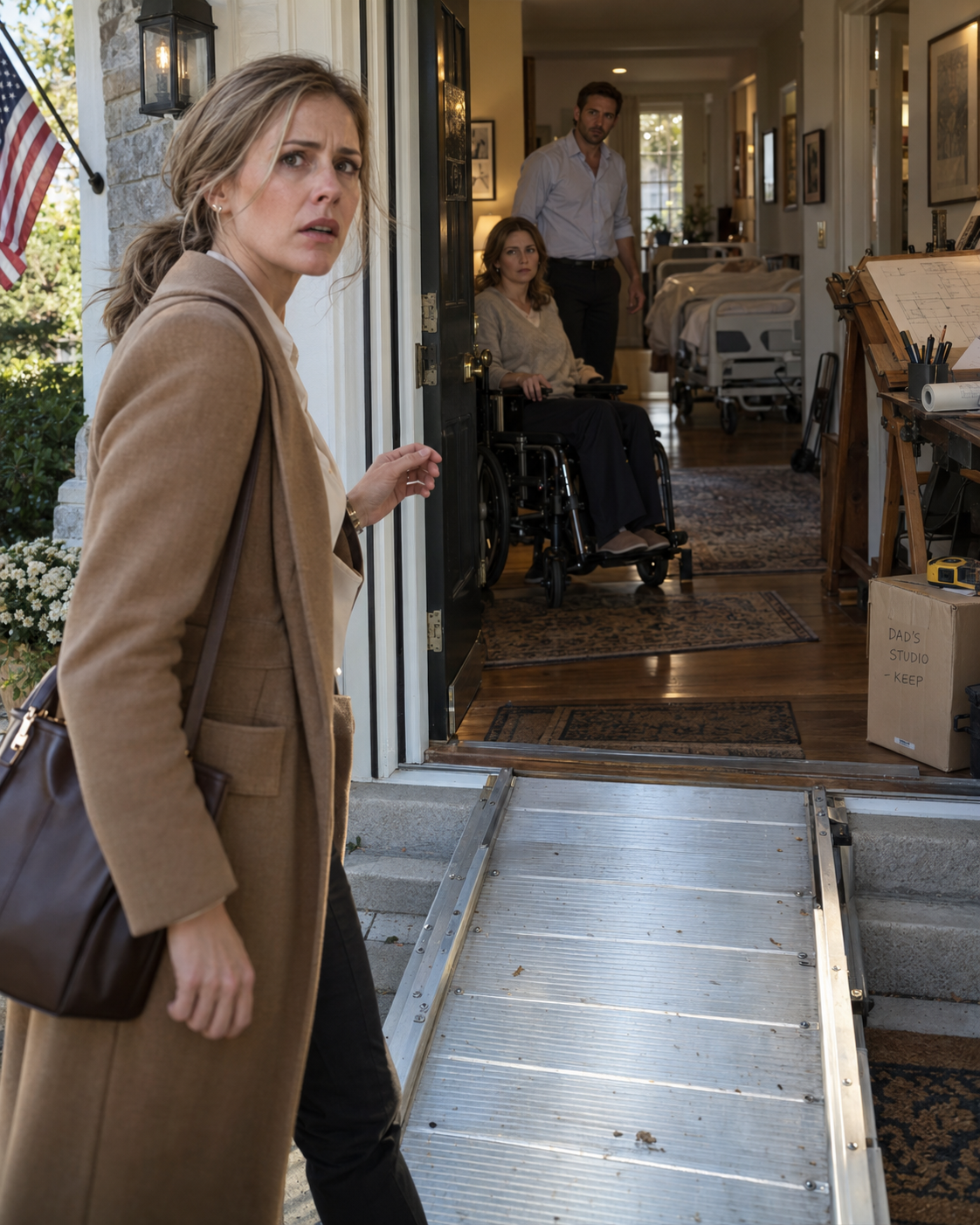
I thought about the aluminum ramp on my old porch.
For a long time, I had believed that was the moment my marriage broke.
It wasn’t.
The marriage had been breaking every time I surrendered a little piece of myself and called it compromise.
The ramp was only the first physical evidence.
I had spent years thinking love meant making room for someone else’s fear.
Now I understood that real love could make room for two people without requiring either one to disappear.
At home, my father’s drafting tools rested on the windowsill.
The floorboards beneath my feet were still imperfect.
Some creaked.
Some didn’t line up perfectly.
I loved them anyway.
My phone buzzed.
A message from Fiona.
“I found one more file.”
I stared at the screen.
Then another message appeared.
“This one has your father’s signature.”
I stood very still in the quiet apartment.
Outside, the river kept moving.
Inside, I opened the message.
The attachment had only one photograph.
It showed my father standing beside Fiona’s hospital bed years before I had ever met her.
On the back of the photograph were four words.
He knew she would survive.
I looked at the date.
It was two years before the accident.
My heart began pounding.
For the first time, I wondered whether my father had not merely discovered the truth about Garrett.
Maybe he had been preparing for something none of us had understood.
And somewhere beneath the grief, beneath the betrayal, beneath all the years I thought I had finally escaped, one question remained waiting for me.
What had my father known about Fiona before the accident ever happened?
I set the photograph beside his drafting tools and turned off the light.
Tomorrow, I would find out.
And this time, nobody was going to decide what I was allowed to know.