I was holding my eight-week-old daughter at our Chicago charity gala when my ex-husband stared at my wedding ring and sneered
I stared at the envelope in Vance’s hand, suddenly aware of the music, the laughter, and the hundreds of conversations happening behind us.
Everything seemed to fade into the background.
My father’s handwriting had always been unmistakable.
Sharp.
Precise.
Almost severe.
I hadn’t seen it in years.
“What is that?” I asked.
Vance looked over his shoulder before answering.
“I don’t know.”
That frightened me more than if he had said he did.
I took the envelope from him but didn’t open it.
My fingers had already begun to tremble.
“What do you mean you don’t know?”
“I found it in a locked drawer at my father’s office.”
He swallowed.
“After the divorce.”
I looked at him carefully.
“Why was it in your father’s office?”
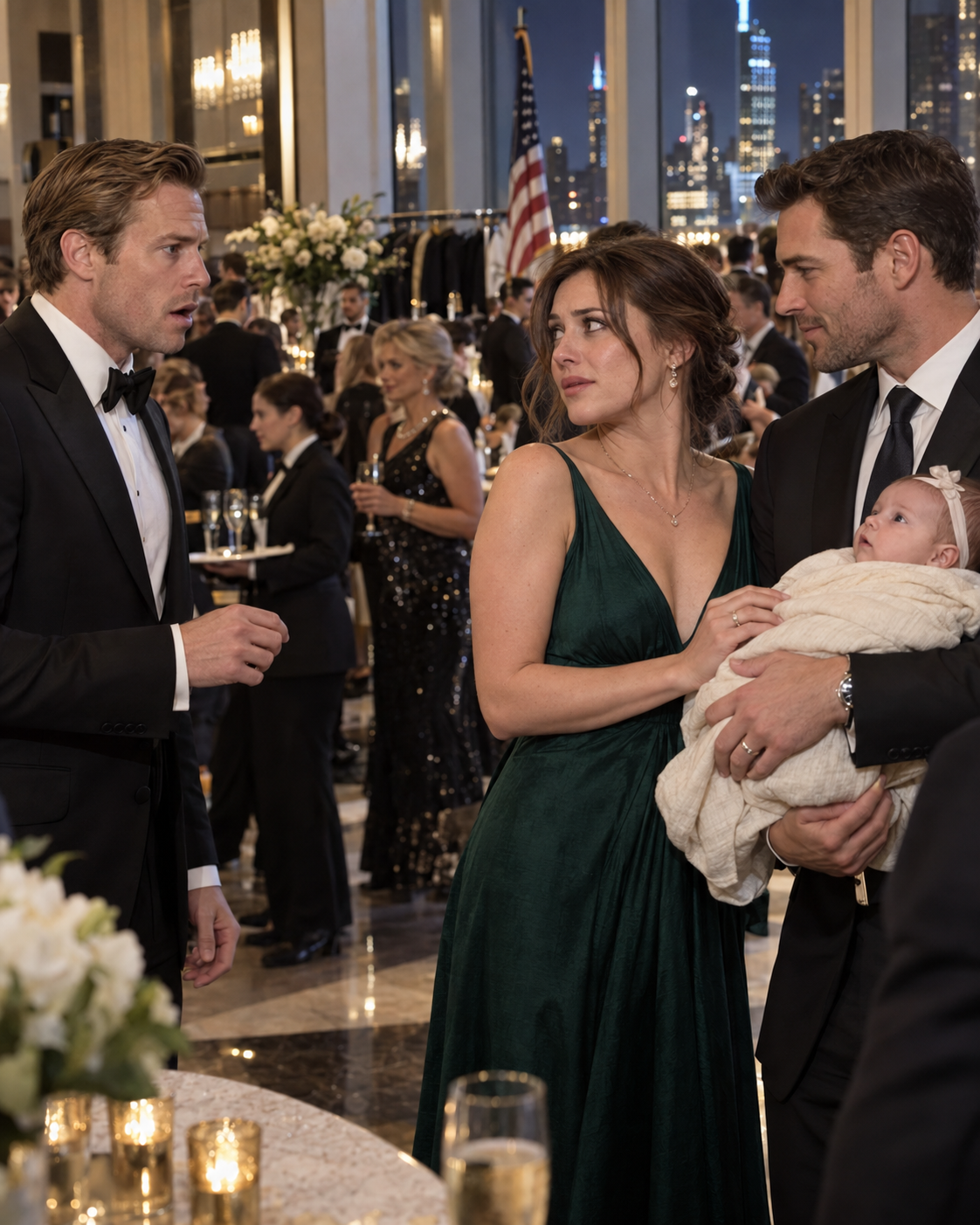
“That is what I have been trying to figure out.”
For years, I had thought the worst thing my father had ever done to me was arranging my marriage to Vance.
Suddenly, I wasn’t sure anymore.
Julian noticed my expression from across the room.
He handed Clara carefully to my sister, then walked toward us.
“Everything okay?”
I looked at Vance.
Then at the envelope.
Then back at Julian.
“I need to read this.”
Julian didn’t ask questions.
He simply took my hand.
We left the ballroom through a side corridor and entered a quiet conference room overlooking the Chicago River.
I locked the door.
For several seconds, none of us spoke.
Then I opened the envelope.
Inside was a single sheet of paper.
My father’s handwriting covered the page.
My heart began pounding before I finished the first sentence.
“If you’re reading this, then the marriage between you and Vance has already ended.”
I stopped.
Julian moved closer.
I continued.
“I owe you an explanation I was too afraid to give you while I was alive.”
My throat tightened.
My father had died eighteen months earlier.
I had spent that entire time believing we had left everything unresolved.
Apparently, we had.
“The partnership between our families was never simply about architecture and development.”
I looked at Julian.
“What does that mean?”
He didn’t answer.
I kept reading.
“Five years ago, Vance’s father approached me because his company was facing a serious financial crisis.”
I felt the room tilt.
The multimillion-dollar partnership that had been presented as a brilliant business opportunity had actually been a rescue operation.
Vance’s family needed our firm’s capital, reputation, and project pipeline.
But there was more.
“Your marriage was intended to make the relationship permanent.”
My eyes burned.
Not because I was surprised.
Because I had spent years wondering whether I had ever been more than a signature on a contract.
Now I knew.
But then I reached the next paragraph.
“There was a condition I never told you.”
I stopped breathing.
“Your grandfather had placed restrictions on the family trust.”
I read the sentence twice.
“The architectural firm could not be transferred, sold, or pledged without your independent consent.”
Julian frowned.
I continued.
“By marrying Vance, I believed you would become the person capable of protecting the firm if our partnership failed.”
My hands went cold.
My father had not simply married me off.
He had placed me in the middle of a financial battlefield.
But why?
The final paragraph was worse.
“I was wrong to make that choice for you.”
I stared at those words until they blurred.
For the first time, my father wasn’t speaking like the head of our family.
He was speaking like a man who knew he had failed his daughter.
“I believed Vance’s family could stabilize the firm.”
He had written.
“I didn’t know how much of the truth they were hiding.”
Then the page ended.
There was no signature.
No explanation.
No answer to the question suddenly screaming inside my head.
What had Vance’s family hidden?
Vance sat across from me.
“My father knew about the trust,” he said.
I looked at him.
“How?”
“He knew because your father told him.”
“And you?”
“I didn’t.”
I studied his face.
For once, there was no arrogance in it.
Only exhaustion.
“Then why did you marry me?”
He looked down.
“Because I was told it would save both families.”
The answer should have made me furious.
Instead, I felt strangely empty.
Five years of my life reduced to a business strategy neither man had trusted me enough to explain.
Julian reached for my hand.
“You don’t have to solve everything tonight.”
I nodded.
Then Vance said something that made me look up.
“There is another document.”
“What document?”
“The original partnership agreement.”
I stared at him.
“My lawyers reviewed every agreement.”
“Not this one.”
He reached into his jacket again.
“This was kept separately.”
He placed another envelope on the table.
This one wasn’t from my father.
It carried the seal of Vance’s family company.
I opened it.
Inside was a copy of a contract dated three weeks before our wedding.
I read the first page.
Then the second.
Then the third.
My stomach tightened.
There was a clause I had never seen.
If our marriage ended before five years, certain development rights would revert to my family’s firm.
If the marriage continued beyond five years, however, those rights could be transferred under specific conditions.
I looked at the date.
We had divorced only months before the five-year mark.
I suddenly understood why Vance’s father had been so desperate for us to remain married.
And why my father had been desperate to make sure I could leave.
Neither man had trusted the other.
But both had underestimated me.
I placed the contract on the table.
“Why are you giving me this?”
Vance’s expression hardened.
“Because my father is trying to destroy the evidence.”
Silence filled the room.
Julian’s jaw tightened.
“What evidence?”
Vance looked at him.
“The financial records.”
He turned back to me.
“My father moved money through several development entities before the marriage.”
I felt a chill crawl across my skin.
“How much?”
“I don’t know.”
“Then why come to me?”
“Because your name appears in the records.”
I stared at him.
“What?”
“Not as someone who received money.”
He paused.
“As someone they intended to use.”
The words stayed in the air.
I thought about every meeting.
Every contract.
Every dinner where men twice my age discussed my future as if I weren’t sitting at the table.
I thought about my father’s careful warnings.
I thought about Vance’s coldness.
And suddenly, another memory surfaced.
A night three years earlier when I had walked into Vance’s office unexpectedly.
He had been arguing with his father.
I remembered only one sentence.
“She’ll never sign it.”
At the time, I had assumed they were talking about some business document.
Now I wasn’t so sure.
“What did they want me to sign?” I asked.
Vance looked away.
“I don’t know exactly.”
“Then find out.”
His eyes met mine.
“You’re not angry?”
“I am.”
I stood.
“But I’m not confused anymore.”
That night, I took the documents home.
Julian stayed awake with me until sunrise.
We spread contracts across the dining table while Clara slept upstairs.
For the first time, our home looked less like a newlywed apartment and more like a war room.
By morning, I had identified seven companies connected to the original partnership.
Three had dissolved.
Two had changed ownership.
One was still operating.
And one didn’t appear to exist at all.
That last company was registered to an address in downtown Chicago.
I knew the address.
It belonged to one of our firm’s old project offices.
My stomach dropped.
Someone had been using my family’s property without our knowledge.
I called our attorney.
Within hours, she arrived.
She reviewed the documents in silence.
Then she looked at me.
“You need to understand something.”
“What?”
“If these records are authentic, this isn’t just a failed business partnership.”
“What is it?”
She closed the folder.
“Potential fraud.”
The word sounded impossibly heavy.
I looked at Clara’s photograph on my phone.
For years, I had believed I was protecting my family.
Now I realized I might have been protecting my daughter from something I hadn’t even known existed.
Our attorney began tracing the financial records.
Within days, the picture became clearer.
Money had been moved between companies connected to Vance’s family.
Some payments had been disguised as consulting fees.
Others were buried inside construction contracts.
The amounts weren’t enough to attract attention individually.
Together, they formed a pattern.
Then we found my signature.
A scanned copy appeared on a document authorizing a transfer I had never approved.
I stared at it in disbelief.
“That isn’t my signature.”
My attorney zoomed in.
“It isn’t.”
Someone had copied it.
My blood went cold.
“Can we prove it?”
“We can prove the original document was never signed by you.”
She looked at me.
“But whoever created this expected nobody to question it.”
That night, Vance called.
I almost ignored him.
Then I answered.
“What happened?”
His breathing was uneven.
“My father knows I gave you the documents.”
My heart sank.
“What did he say?”
“He told me I was making a mistake.”
“What else?”
A long silence followed.
Then Vance whispered, “He said your father knew everything.”
I closed my eyes.
“That’s impossible.”
“He said your father agreed to it.”
I felt something inside me crack.
Not because I believed him.
Because I was suddenly terrified that part of it might be true.
My father had left me a letter.
But perhaps he had left me only the part he wanted me to know.
The next morning, I went to his old office.
It had been nearly two years since I had entered that room.
His books were still there.
His drafting table remained beneath the window.
Even the old brass lamp sat exactly where he had left it.
I opened drawers.
Nothing.
Then I remembered something from childhood.
My father had always kept important documents in places nobody would think to search.
I ran my fingers along the underside of the drafting table.
There was a small metal latch.
I pressed it.
A compartment opened.
Inside was a black notebook.
My father’s handwriting covered the first page.
I read until my hands went numb.
He had known about the financial transfers.
He had suspected Vance’s father was using our partnership to conceal losses.
But he hadn’t known everything.
He had been gathering evidence quietly.
Then I reached the final entry.
It was dated four months before his death.
“I believe my daughter is being watched.”
I stopped.
Julian, standing beside me, went silent.
The next line was worse.
“If anything happens to me, the person I fear most is not Vance.”
I looked at the page.
The name beneath it belonged to someone I knew.
Someone who had attended our family dinners.
Someone who had hugged me after my father’s funeral.
Someone who had stood beside me while I cried.
My uncle.
For several minutes, I couldn’t move.
Julian took the notebook from my hands.
“Don’t confront him.”
“I wasn’t going to.”
But I knew I was lying.
The next evening, my uncle called.
His voice sounded warm.
Almost affectionate.
“I heard you’ve been looking through your father’s things.”
My heart stopped.
“How did you know?”
He laughed softly.
“Family talks.”
I said nothing.
Then his voice changed.
“You should let the past stay buried.”
The call ended.
I stared at the phone.
Julian was standing in the doorway.
He had heard everything.
“He knows,” he said.
I nodded.
“What do we do?”
I looked upstairs toward Clara’s room.
Then at the notebook.
Then at the life I had fought so hard to build.
“We stop running.”
The next week became a blur of lawyers, investigators, interviews, and sealed records.
Vance eventually agreed to cooperate.
Not because I forgave him.
Not because we were friends.
Because for once, we were both forced to look at the consequences of trusting people who had treated our lives like pieces on a board.
The investigation eventually revealed that my uncle had helped conceal financial losses from several projects.
Vance’s father had participated in the scheme.
Penelope had known some of it.
Whether she knew everything remained unclear.
The fake signature had been created to make it appear that I had authorized one of the transfers.
If the scheme had collapsed earlier, I could have been blamed for it.
My father had spent his final months collecting evidence because he feared the truth would destroy the firm and leave me exposed.
He had been trying to protect me.
He had simply waited too long to tell me.
Months later, the case was still moving through the courts.
Some questions remained unanswered.
Some people denied everything.
Some memories would never be repaired.
Vance eventually sold his stake in the family company.
Penelope disappeared from the social circles where she had once been celebrated.
And my uncle stopped calling.
As for me, I went back to work.
Not as someone’s wife.
Not as my father’s daughter.
Not as the woman who had once been trapped inside a marriage designed by other people.
I became the partner who had earned her place at the table.
One evening, I stood in our office after everyone had gone home.
Chicago glittered beyond the windows.
Julian called to tell me Clara had fallen asleep holding one of his fingers.
I smiled.
For years, I had thought freedom would feel like triumph.
It didn’t.
It felt quieter than that.
It felt like coming home to myself.
I looked at my father’s old notebook sitting on my desk.
There was one final page I had never been able to understand.
A single sentence was written there.
“If my daughter ever discovers the truth, she must know that the greatest mistake I made was believing protection meant making her choices for her.”
I touched the page.
Then I closed the notebook.
I finally understood what he had meant.
Love cannot be proven by how much someone controls your future.
It is proven by whether they trust you enough to choose it yourself.
Vance had given me a marriage without love.
My father had given me a future without asking.
But Julian had given me something neither man had understood.
A choice.
Upstairs, Clara began crying through the baby monitor.
I smiled and reached for my coat.
Then my phone buzzed.
An unknown number had sent a photograph.
It showed my father’s office on the night before he died.
And in the corner of the photograph stood a man I had never expected to see there.
I stared at the image until my smile disappeared.
Because beneath the photograph was a message containing only six words.
“Your father never told you everything.”