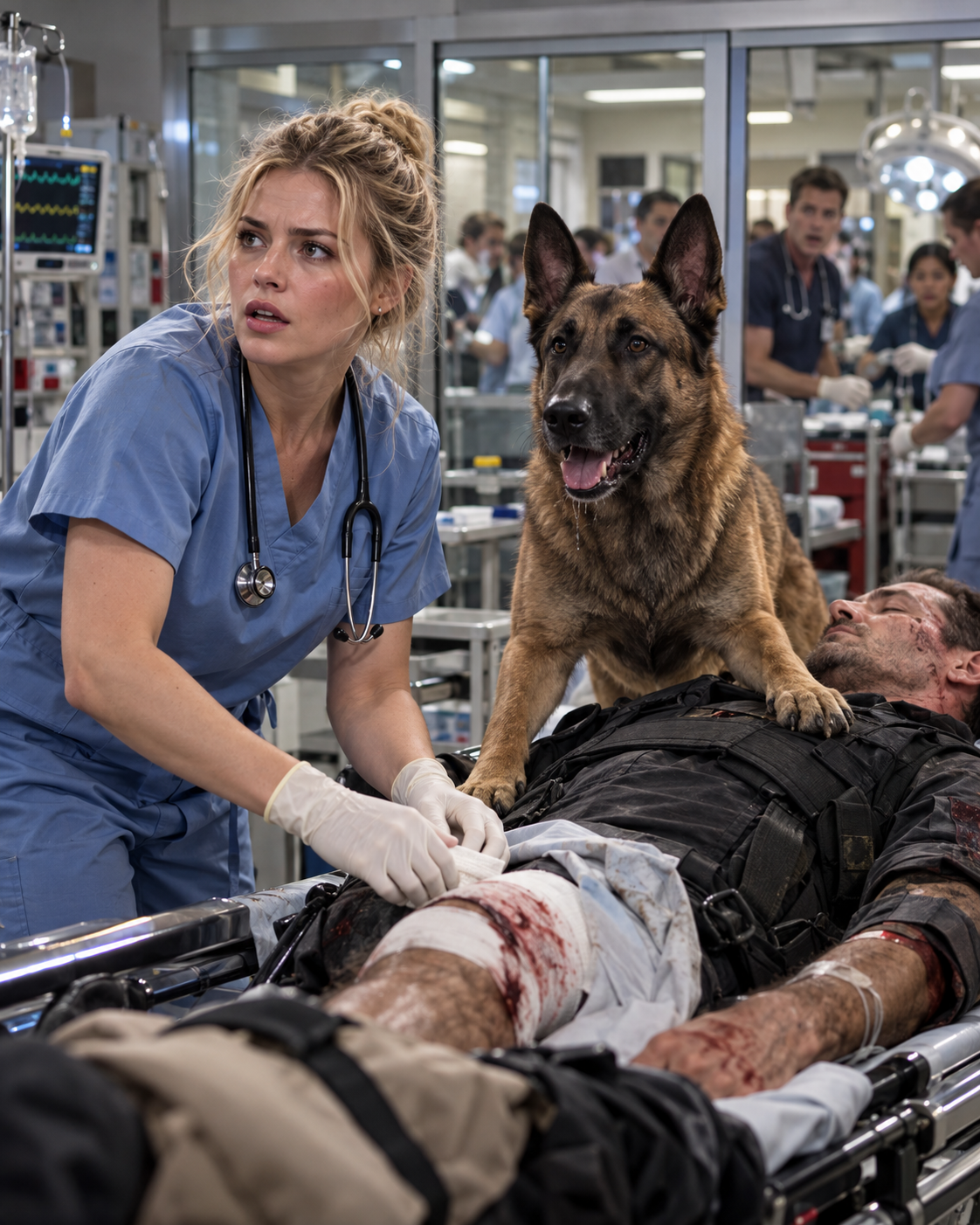
I was holding a dying man’s femoral artery shut with both hands when his dog finally stopped trying to bite me
The femoral artery had retracted deep into the torn muscle, and every heartbeat was pushing another pulse of blood into Reyes’s thigh.
I didn’t have time to be horrified.
I went straight in.
Warm blood filled my gloves so quickly I could barely see what I was doing. My fingers searched through torn tissue until I found the vessel, slippery and hard to hold.
“There you are,” I whispered, though I wasn’t sure whether I was talking to the artery, Donald, or myself.
The dog stayed pressed against the bed.
His entire body trembled.
I had spent the first minute believing he was the most dangerous thing in the room.
Now I understood that he was the only reason Donald was still alive.
Outside the glass, Dr. Vance was pounding on the door.
“Claire! Step away from the animal!”
“My name is Claire,” I said, absurdly, to the dog. “You’re going to have to trust me.”
His eyes flicked toward mine.
Then back to Donald.
I tightened my grip around the artery.
“He’s helping,” I shouted toward the glass.
Dr. Vance couldn’t hear me through the alarm.
The tactical officer raised his firearm again.
I turned and screamed.
“Put the gun down!”
This time, Dr. Vance heard me.
His face changed.
The officer hesitated.
I pointed at Donald’s thigh.
“He’s compressing an arterial bleed!”
The room outside went still.
Even through the glass, I could see Dr. Vance processing the sentence.
He looked at the dog.
Then at Donald.
Then at me.
The security indicator suddenly changed from red to green.
The doors released.
Dr. Vance came through first with a tranquilizer gun in his hand.
“Don’t!”
He stopped.
I was on my knees beside the bed, both hands buried in Donald’s thigh, blood soaking my forearms.
“Drop it,” I said.
“Claire—”
“Drop it.”
He lowered the weapon.
“Femoral artery,” I said. “Massive hemorrhage. The dog has been compressing it.”
Dr. Vance stared at the animal.
For a second, nobody moved.
Then he said, very quietly, “Get me a vascular clamp.”
The room exploded back into motion.
A surgical resident climbed onto the other side of the bed. Another nurse hung the second unit of O-negative. Respiratory therapy pushed in with a chest decompression kit.
Dr. Vance cut deeper into the wound.
“Needle.”
The needle went into Donald’s chest.
Air hissed out.
His oxygen saturation climbed by four points.
Then his pressure disappeared.
“He’s arresting.”
The monitor flattened into a rhythm that made every person in the room move faster.
“Compressions.”
I climbed onto the stool.
Someone took over the arterial pressure.
Someone else started the transfusion.
Dr. Vance called for defibrillation.
The first shock lifted Donald’s body off the mattress.
Nothing.
“Again.”
The second shock.
Nothing.
For a terrible few seconds, I could hear only the rain against the windows and the mechanical rhythm of compressions.
Then the monitor changed.
A narrow complex.
Another.
“Pulse!”
Nobody celebrated.
Not yet.
We had bought him seconds, not safety.
The vascular team took him upstairs, and they operated for seven hours.
Seven.
I remember sitting on the floor of the staff bathroom at 6:20 in the morning, still wearing blood-stiffened scrubs, staring at my hands.
I kept seeing the dog’s paws.
Not his teeth.
His paws.
The way he had placed them directly over the wound.
The way he had known exactly where to press.
I had seen trained service dogs before. I had seen police dogs apprehend suspects. I had seen bomb dogs work through airports.
I’d never seen a dog perform what looked like casualty care.
By noon, Donald was alive.
Barely.
The vascular surgeon came down and told us the artery had been reconstructed with a graft. His leg was viable. His lungs had responded to decompression. His brain had survived the arrest without obvious catastrophic injury.
The dog was still outside the ICU.
Nobody knew what to do with him.
His name, we eventually learned, was Atlas.
He was six years old.
He belonged to Donald.
And he had been trained by Donald.
Not just for apprehension.
For tactical casualty care.
The training record was found in Donald’s department file.
Atlas had been conditioned to respond to specific commands and physical cues during field injuries. He had been taught to apply pressure to bleeding wounds and remain in place until relieved.
There was one problem.
Donald had never given him the command.
He hadn’t been conscious.
Atlas had recognized the injury anyway.
That fact unsettled me more than anything else.
Because it meant what we’d witnessed hadn’t been obedience.
It had been recognition.
For the first two days, Donald remained unconscious.
Atlas was kept in a kennel in a secured room because administration was afraid he’d become aggressive.
I visited him after every shift.
He would stand whenever I entered.
Then he would sit.
Always watching me.
“Your manners are terrible,” I told him the second night.
His ears lifted.
“You nearly got shot.”
His tail moved once.
“And you nearly got me bitten.”
Another tail movement.
I sat on the floor outside the kennel.
“I owe you one.”
He rested his chin on his paws.
For the first time since the trauma room, I cried.
Not because Donald was still unconscious.
Because I kept thinking about what would have happened if that tactical officer had fired.
A bullet through the glass could have ricocheted.
It could have killed Atlas.
It could have killed me.
It could have hit Donald.
And all because we had mistaken loyalty for aggression.
On the third morning, I was called into Dr. Vance’s office.
He closed the door.
“I owe you an apology.”
I sat down.
“For what?”
“For not listening to you sooner.”
I shook my head.
“You were trying to keep everyone safe.”
“So was the dog.”
That silenced me.
Dr. Vance rubbed his forehead.
“There’s another issue.”
He slid a folder across the desk.
Inside was the preliminary report from the dockyard.
Donald and Atlas had been responding to a call involving a suspected weapons transfer at Pier 18.
The ambush hadn’t been random.
Someone had known exactly which unit was coming.
I read the report twice.
“Was Donald targeted?”
“We don’t know.”
“Does Atlas know?”
Dr. Vance gave me a tired look.
“Claire, he’s a dog.”
“I know.”
“Then stop asking questions as if he can testify.”
I smiled faintly.
“I’ve learned not to underestimate him.”
The investigation continued quietly.
No dramatic arrests.
No television helicopters.
Just detectives reviewing radio logs, camera footage, access records, and the movements of everyone assigned to the operation.
Donald remained unconscious.
Atlas remained beside him.
On the fifth day, administration made an exception.
They allowed Atlas into the ICU.
He walked beside me without a leash.
When he saw Donald, he stopped.
The monitor beeped steadily.
Donald looked smaller than he had in the trauma room.
Without the tactical gear, he seemed almost young.
Atlas approached the bed.
He sniffed Donald’s hand.
Then he placed his chin against the mattress.
For several minutes, nothing happened.
Then Donald’s fingers moved.
Just once.
Atlas lifted his head.
The monitor continued its slow rhythm.
I leaned closer.
“Donald?”
His eyelids fluttered.
Atlas whined.
Donald opened his eyes.
They were unfocused at first.
Then they found the dog.
His face crumpled.
“Atlas?”
It was barely a sound.
But it was enough.
The dog made a noise I’d never heard from him before, half whimper and half cry, and tried to climb onto the bed.
“Easy,” I said, laughing through my tears. “You’re going to get both of you kicked out.”
Donald looked at me.
His lips moved.
“What happened?”
I told him.
Not everything.
Just enough.
“You lost a lot of blood,” I said. “Your chest collapsed. Your heart stopped.”
He stared at the ceiling.
Then at Atlas.
“Did he…”
“Yes.”
Donald closed his eyes.
A tear ran sideways into his hair.
“He remembered.”
That sentence stayed with me.
Not because it was mysterious.
Because it wasn’t.
He remembered training.
He remembered the sound Donald made when something was wrong.
He remembered what Donald had taught him.
And somewhere beneath all that training was something no manual could explain.
Trust.
Donald spent another three weeks in the hospital.
He had infections, another procedure on his leg, and more bad days than good ones.
Atlas was there for most of them.
Sometimes Donald slept while Atlas rested beneath the window.
Sometimes Donald woke confused and angry.
Once, after a painful physical therapy session, Donald snapped at me.
“I don’t need help.”
“You can’t stand by yourself.”
“I said I don’t need help.”
I stepped back.
Atlas watched him.
Donald saw the dog’s face and immediately looked ashamed.
“I’m sorry.”
I shook my head.
“You don’t have to apologize for being angry.”
“I don’t want him seeing me like this.”
I looked at Atlas.
“He already saw you bleeding to death.”
Donald swallowed.
“He saved me.”
“You saved each other.”
He didn’t answer.
Months earlier, before the dockyard call, Donald had apparently been considering retiring Atlas.
That was another detail we learned later.
Atlas was aging out of active service.
Donald had argued that he deserved a quieter life.
A backyard.
A couch.
Too many treats.
No gunfire.
No sirens.
Donald had planned to finish his own contract and leave the unit with him.
Instead, Atlas had gone into the worst night of their careers.
The irony hurt.
One afternoon, Donald asked me to sit down.
“There’s something you should know.”
I waited.
“The ambush wasn’t supposed to happen.”
I frowned.
He looked toward the window.
“Someone leaked our route.”
“How do you know?”
“I heard them.”
He took a slow breath.
“Before I went down, one of the men said something. They knew Atlas’s name.”
I felt cold.
“What did they say?”
Donald looked at the dog.
“They said, ‘Take the dog first.'”
I sat very still.
For weeks, I’d thought Atlas’s behavior had been entirely about saving Donald.
Now a different possibility opened.
Maybe he’d also been protecting Donald from something he had sensed before any of us knew there was danger.
The investigation suddenly felt much closer.
Detectives were called.
Donald gave a statement from his hospital bed.
There was no cinematic confrontation.
No confession.
Just evidence.
A radio transmission.
A vehicle logged near the pier.
A maintenance badge used after hours.
And eventually, an arrest.
The person involved wasn’t a stranger.
It was a logistics contractor who had access to dispatch schedules.
He had been selling information.
Donald had been one of several targets.
Atlas hadn’t known the man’s name.
He hadn’t needed to.
Dogs notice things we miss.
Movement.
Scent.
Tone.
Fear.
We never learned exactly what Atlas understood that night.
Maybe he understood only that Donald was hurt.
Maybe he understood more.
I stopped trying to decide.
Eight weeks after the ambush, Donald walked out of the hospital.
Not normally.
Not yet.
He used crutches.
His right leg was heavily braced.
His hair had grown back unevenly around the surgical sites, and he complained that the hospital coffee had permanently damaged his soul.
But he walked.
Atlas walked beside him.
The lobby was packed.
Nurses came out from behind the desk. Respiratory therapists stopped what they were doing. Two surgeons came down from the operating floor.
Someone started clapping.
Then everyone did.
Donald looked embarrassed.
Atlas didn’t care.
He looked at Donald.
Donald looked at him.
Then he bent as far as his healing body allowed and wrapped both arms around the dog’s neck.
Atlas pressed his face into Donald’s shoulder.
I stood several feet away.
Dr. Vance came up beside me.
“You saved his life,” he said.
I shook my head.
“No.”
He watched them.
“Neither did I.”
He smiled.
“Fair enough.”
Donald eventually returned to the department in a training role.
Atlas never went back into active tactical work.
He retired officially.
His new job was much harder.
He had to learn how to sleep on a couch while Donald watched football.
He had to tolerate children feeding him under the table.
He had to accept that retirement came with an unreasonable amount of peanut butter.
And every few months, Donald brought him back to the hospital to see me.
The first time they came, Atlas recognized me immediately.
He walked straight over.
I crouched down.
“Hey, trouble.”
He licked my cheek.
Donald laughed.
“He never does that.”
I wiped my face.
“Maybe he remembers who saved his partner.”
Donald shook his head.
“No.”
He looked at Atlas.
“I think he remembers who finally listened.”
I didn’t have an answer for that.
I still don’t.
What I remember most about Trauma Room Three isn’t the defibrillator.
It isn’t the blood.
It isn’t the seven-hour surgery or the gun pointed through the glass.
It’s the moment I stopped seeing a dangerous animal and started seeing a terrified partner doing the only thing he knew how to do.
For years, I thought medicine was about knowing exactly what to do when someone was dying.
That night taught me something quieter.
Sometimes the first lifesaving thing you can do is stop long enough to ask why the person—or the animal—standing in front of you is refusing to let go.
And sometimes, if you’re lucky, the answer is still holding on.