I was halfway through boarding at Frankfurt Airport when my former commander publicly called me a washed-up hero
Part 2
I stared at the folded paper for several seconds before touching it.
There was no name on the outside.
No handwriting.
Nothing that explained how it had gotten inside a book that had been in my hands since boarding.
I opened it.
There was one sentence.
“YOU WERE NEVER SUPPOSED TO BE ON THIS FLIGHT.”
My throat tightened.
I read it again.
Then again.
The paper shook slightly between my fingers.
For the first time since the fighters appeared outside the window, my instincts told me the danger might not have been outside the aircraft at all.
I looked toward the aisle.
Everyone still seemed normal.
The woman across from me was watching a movie.
The businessman beside the window was asleep.
A flight attendant was collecting empty cups.
I turned the paper over.
Nothing.
Then I noticed a small sequence of numbers written near the bottom.
23B.
My seat.
I felt the cold move through me.
Someone had known exactly where I would sit.
I closed the paper and slipped it into the back of my novel.
Then I looked at the cover.
My novel was called “Viper’s Edge.”
It was fiction.
At least, that was what everyone believed.
The truth was uglier.
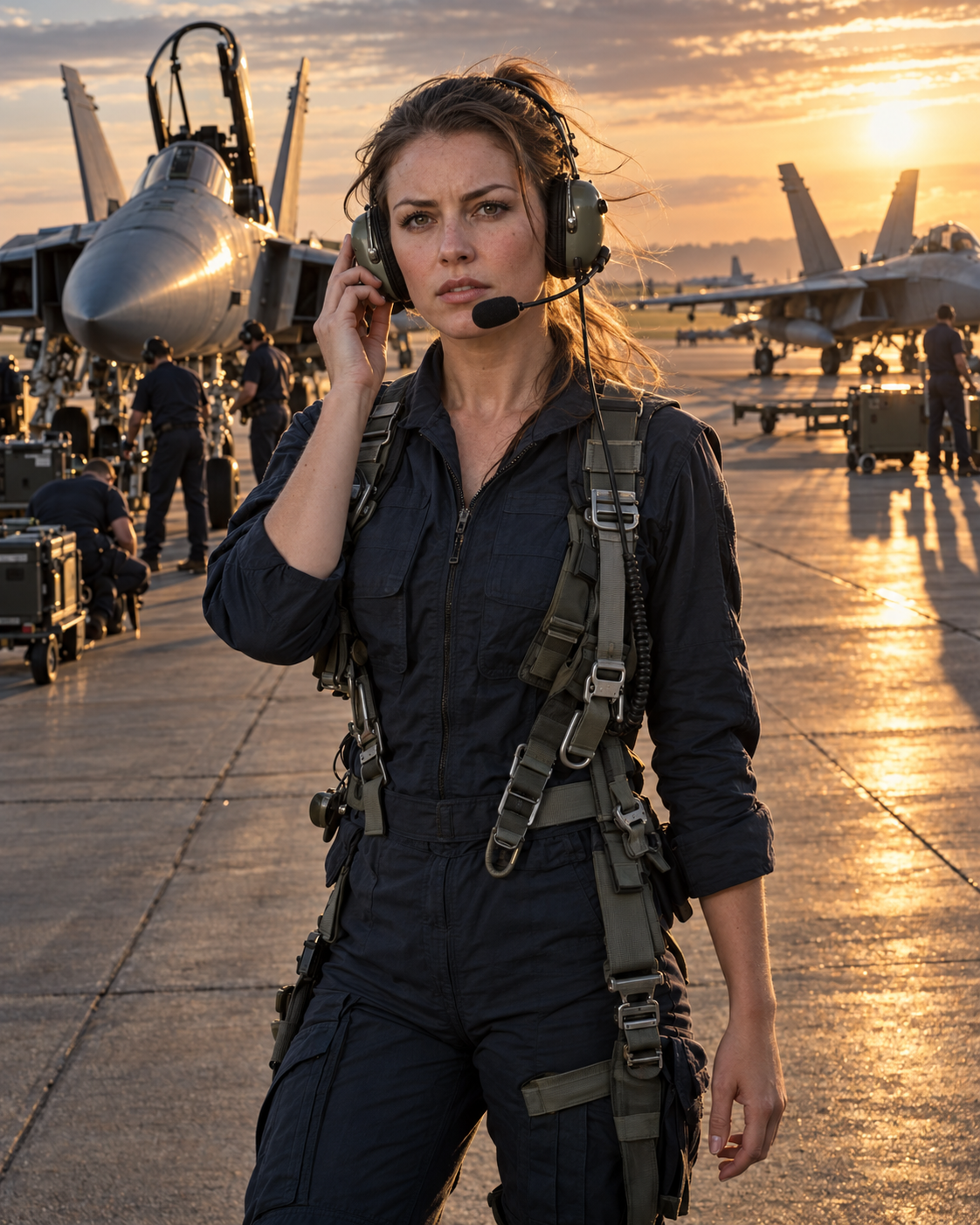
The book had been inspired by things I had witnessed during my military career.
Names changed.
Locations changed.
Details changed.
But the procedures were real.
The decisions were real.
The consequences were real.
And the final chapter contained something I had never explained publicly.
A scenario involving a commercial aircraft accidentally entering restricted airspace while fighter aircraft were ordered to intercept.
Most readers thought it was imagination.
It wasn’t.
I had written it because I had seen a similar situation years earlier.
Only that time, the aircraft never made it home.
I had spent years wondering whether the accident could have been prevented.
Then I had written the book.
Then I had retired.
Then I had tried to forget.
A shadow crossed the aisle.
I looked up.
A man in a dark jacket was standing beside my seat.
He was not a flight attendant.
“Colonel Vance?”
My heart stopped.
I looked at him.
He smiled without warmth.
“May I speak with you?”
“No.”
His smile disappeared.
“That’s unfortunate.”
I closed my book.
“Who are you?”
He glanced toward the front of the cabin.
“Someone who knows why the aircraft changed course.”
My mouth went dry.
“You caused it?”
“No.”
“Then who did?”
He leaned closer.
“That’s what you’re going to help me find out.”
I studied his face.
There was something familiar about him.
Not his features.
His posture.
Military.
But not American.
At least not anymore.
I lowered my voice.
“Are you security?”
“No.”
“Federal agent?”
“No.”
“Then sit down.”
He did not move.
Instead, he placed a photograph on my tray.
I looked at it.
It showed a younger version of me standing beside an F-15.
Beside me stood another officer.
Ryan Hayes.
The photograph had been taken seventeen years earlier.
On the back was a handwritten date.
And beneath it were four words.
“THE FIRST TIME FAILED.”
I looked up.
The man was gone.
I scanned the aisle.
Nothing.
Then the seatbelt sign chimed.
The flight attendant announced our descent toward New York.
I should have handed the photograph to the crew.
I should have told someone.
But experience had taught me another lesson.
When something feels wrong, do not immediately tell everyone.
First, determine who already knows.
I opened my book.
The final chapter was still there.
But something had changed.
The folded paper had been placed between two pages.
Those pages contained the exact fictional scenario I had written years ago.
Commercial aircraft.
Navigation failure.
Restricted airspace.
F-15 intercept.
Thirty-second warning.
A captain afraid to move.
A retired instructor taking the radio.
Every detail.
Not similar.
Identical.
I felt sick.
Someone had not merely predicted what happened.
Someone had built the situation around my book.
I looked toward the cockpit door.
Then my phone vibrated again.
This time the screen lit up.
One incoming message.
Unknown number.
“YOU SAVED THEM ONCE.”
A second message appeared.
“NOW SAVE YOURSELF.”
Then the phone went dark.
I looked out the window.
New York was emerging beneath the clouds.
Millions of people.
Traffic.
Bridges.
Buildings.
Life continuing as though nothing had happened.
And somewhere below us was the person who had engineered a near disaster just to force me into revealing something.
I suddenly understood why the fighter pilot had hesitated when he heard my call sign.
Someone had expected him to recognize it.
Someone had expected me to take the radio.
Someone had expected me to behave exactly as I had been trained to behave.
This had not been an accident.
It had been a test.
The aircraft touched down at JFK with a soft jolt.
Applause broke out from somewhere near the rear of the cabin.
People laughed.
Someone cheered.
I remained still.
The man in the dark jacket appeared again near the exit.
This time he did not approach me.
He simply looked at me.
Then he raised two fingers to his forehead.
A military salute.
I followed his gaze.
Ryan Hayes was standing outside the aircraft near a service vehicle.
He had somehow been there before us.
He looked up at the cabin.
Our eyes met through the glass.
Then he gave me the same salute.
I understood.
He had found something.
I walked off the aircraft.
Ryan was waiting beyond the security line.
He looked older than I remembered.
So did I.
“Colonel.”
“Lieutenant Colonel.”
He smiled faintly.
“You still hate being called Samantha.”
“Only by people who knew me when I was young.”
He glanced around.
“Walk with me.”
We moved through the terminal.
“What happened up there?” I asked.
“Your aircraft was not the intended target.”
I stopped.
“What?”
Ryan turned.
“The restricted airspace alert was real.”
“But?”
“But someone manipulated the navigation data.”
My blood ran cold.
“Why?”
He looked directly at me.
“Because they needed you to take control of the cockpit.”
I said nothing.
“They knew you would recognize the intercept pattern.”
He handed me a thin folder.
Inside were flight logs, radar traces, and a photograph.
I knew the photograph immediately.
It showed the wreckage of an aircraft in a desert.
My chest tightened.
“Where did you get this?”
Ryan’s expression changed.
“That was the flight I wrote about.”
I looked at him.
“No.”
“Yes.”
I remembered that accident.
I remembered the investigation.
I remembered being told it was pilot error.
Ryan shook his head.
“It wasn’t.”
The world seemed to tilt.
“Then why did you let them blame the crew?”
“Because I was twenty-nine.”
His voice cracked.
“I was afraid.”
He looked away.
“They told me the truth would destroy the squadron.”
I stared at the wreckage photograph.
“How many died?”
“Thirty-seven.”
I closed the folder.
“And you carried that for seventeen years?”
“Every day.”
I finally understood the note.
The first time failed.
The second attempt had been built to force the truth into the open.
Ryan had not known the full plan.
But he had recognized the pattern.
He had realized someone was recreating the conditions of the old disaster.
And when he heard my voice on the radio, he had known exactly who they were trying to reach.
Me.
Part 3
We spent the next three hours in a quiet federal office at the airport.
The man in the dark jacket was waiting there.
His name was Daniel Brooks.
Former Air Force intelligence.
He had been investigating the old crash for eleven years.
He placed a stack of documents on the table.
“Someone inside the aviation system has been altering navigation data,” he said.
“How long?”
“At least six months.”
“How many flights?”
“We don’t know.”
I looked at Ryan.
“Why me?”
Daniel answered.
“Because you wrote the only public account that described the exact failure chain.”
I shook my head.
“That book was fiction.”
“No,” he said.
“You disguised classified material as fiction.”
I looked down.
He was right.
Not completely.
But enough.
I had changed the names.
I had changed the aircraft.
I had changed the locations.
But I had never changed the lesson.
The lesson was simple.
Technology can fail.
Orders can fail.
People can fail.
But the final decision always belongs to the human being willing to say, “Wait.”
Ryan sat across from me.
“I almost fired today.”
I looked at him.
“I know.”
“I had thirty seconds.”
“I know.”
“My wingman had weapons armed.”
“I know.”
He looked down at his hands.
“When I heard your voice, I remembered something you told me during training.”
I waited.
“You said the most dangerous pilot isn’t the one who is afraid.”
His eyes met mine.
“It’s the one who is too proud to admit he’s afraid.”
I smiled sadly.
“I said that?”
“After I nearly made a bad decision.”
“You were twenty-two.”
“I was stupid.”
“We all were.”
Silence settled over the room.
For the first time that day, I felt the weight of the years behind me.
The people I had trained.
The people I had lost.
The mistakes I had survived.
The decisions I had made correctly.
The decisions I wished I could make again.
I looked at Ryan.
“Why did you safe the weapons?”
He answered without hesitation.
“Because you reminded me that a warning is not a verdict.”
Those words stayed with me.
A warning is not a verdict.
Fear is not proof.
And sometimes the bravest thing a person can do is refuse to make an irreversible decision while uncertainty still exists.
The investigation continued for months.
The people responsible were eventually identified.
The navigation manipulation was traced to a small network of contractors who had been exploiting vulnerabilities for years.
The old crash was reopened.
The official report changed.
Thirty-seven families finally received an answer.
There was no dramatic courtroom confession.
No perfect revenge.
No single villain standing beneath a spotlight.
Real life rarely gives us endings that clean.
Instead, there were hearings.
Documents.
Interviews.
Apologies.
And long nights when people who had spent seventeen years believing one story were forced to learn another.
Ryan never became famous.
Neither did I.
That was fine.
One afternoon, months later, I returned to the same seat on the same aircraft model for another flight.
23B.
I opened my novel.
The pages looked different now.
Not because the words had changed.
Because I had.
A young flight attendant stopped beside me.
“Is that your book?”
I looked at the cover.
“Yes.”
“Is it good?”
I smiled.
“Depends on whether you like stories about people making difficult choices.”
She laughed.
“I do.”
Then she walked away.
I looked out the window.
The sky was enormous.
Blue.
Quiet.
For years, I had believed survival was about being faster than danger.
Then I became an instructor and learned it was about judgment.
Later, I learned it was about humility.
And after Flight 9042, I finally understood something deeper.
Sometimes we survive because someone notices the smallest thing.
A strange vibration.
A wrong shadow.
A half-degree turn.
A voice on the radio that refuses to panic.
A person willing to stand between fear and an irreversible decision.
The passengers on that flight never knew what happened.
Most of them never would.
The child who slept against the window never knew that two fighters had once been descending toward us.
The businessman with the laptop never knew how close his ordinary afternoon had come to becoming the last afternoon of his life.
The woman watching a movie never knew that someone in 23B had been handed a piece of paper telling her she was never supposed to be there.
Maybe that was the strangest part.
Their ignorance was not a failure.
It was the privilege of being protected by someone else’s vigilance.
I turned to the final page of my book.
There was a sentence I had written years before.
I had always thought it was about war.
Now I knew it was about life.
“Sometimes courage is simply refusing to become certain too soon.”
I closed the book.
The aircraft continued west.
The engines hummed steadily.
No warning tones.
No fighters.
No alarms.
Just thousands of miles of open sky.
I rested my hand on the cover and thought about Ryan.
I thought about the thirty-seven people whose families had waited seventeen years for the truth.
I thought about the 284 strangers behind me who had gone home that night, hugged their children, called their spouses, ordered dinner, complained about jet lag, and never once realized how close the world had come to taking everything from them.
Then I looked through the window one last time.
The horizon was exactly where it should be.
And for the first time in years, I did not need to check it twice.
I simply breathed.
Because sometimes the people who save us are never introduced.
Sometimes they never receive applause.
Sometimes they quietly return to seat 23B, open a book, and let the world believe nothing happened.
And maybe that is the most meaningful kind of heroism there is.
To carry the weight alone, so someone else can keep living as if the sky was always safe.