I was halfway out of the farmhouse driveway when a woman I’d never met threw herself in front of my truck
The brass mountain keychain lay in Eleanor’s palm, dark with age and greasy around the edges.
I didn’t say anything.
Neither did Maya.
Outside, the flatbed driver was waiting for me to finish signing the paperwork, and somewhere in the shop a fluorescent light buzzed like an irritated insect.
Eleanor turned the keychain over.
There was a tiny engraving on the back.
C.B.V.
“Charles Benjamin Vance,” she whispered.
“Your dad?”
She nodded.
“He gave me this when I was seventeen.”
Her thumb moved over the initials.
“He said we’d go west together someday. Colorado. Maybe Montana. Somewhere with mountains and no cell service.”
Maya looked up from the homework she’d spread across my counter.
“Did you?”
Eleanor gave a tired little laugh.
“No.”
“Why?”
Eleanor looked at me.
“Because I thought I had time.”
There are moments when a child asks a simple question and an adult suddenly has nowhere to hide.
I had learned that after my wife died.
Maya had learned it too, though I hated that she had.
“Put it somewhere safe,” I told Eleanor.
She slipped the keychain into her coat pocket.
Then she looked at the truck.
“Can you really fix it?”
“I can make it safe.”
“That’s not what I asked.”
I glanced at her.
“You want me to make it like your father’s?”
“No.”
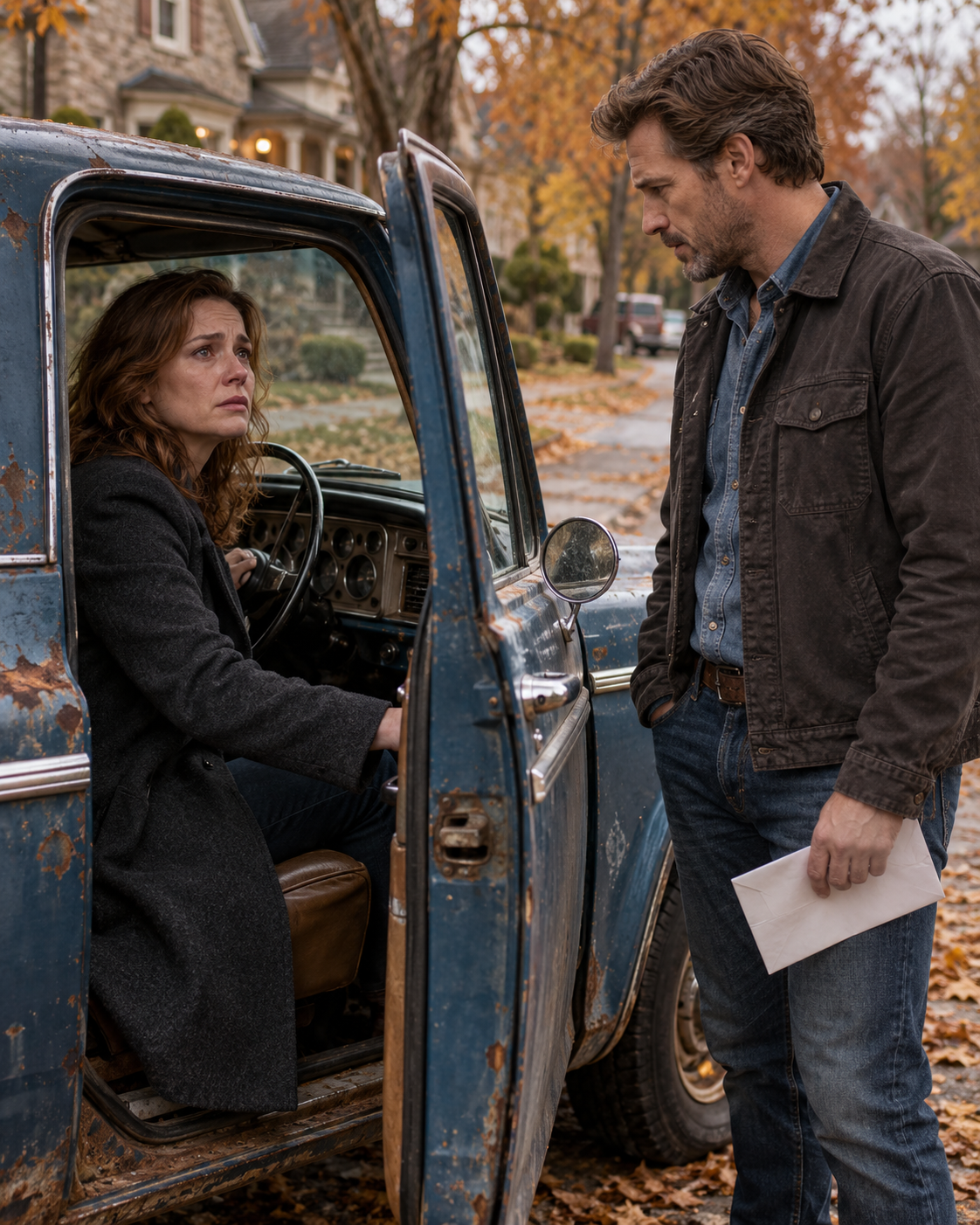
She took a breath.
“I want it to still be his.”
That was different.
So we left the dents.
We left the faded paint.
We left the cigarette burn in the bench seat and the shallow crease along the passenger-side fender.
I replaced what could hurt somebody.
I didn’t replace what could tell a story.
The fuel line had deteriorated almost to the point of splitting. The brake hoses were cracked. The rear cylinders were seized, one wheel bearing sounded like gravel in a coffee can, and the wiring had been modified by at least three different owners who apparently believed electrical tape was a substitute for engineering.
Eleanor stayed.
At first, she was terrible.
She held a ratchet backward.
She nearly dropped a socket into the oil pan.
She asked whether torque specifications were “more like guidelines.”
But she listened.
That mattered.
By the second afternoon, she had learned how to loosen a stubborn fastener without rounding it.
By the third, she was wearing old jeans and a gray sweatshirt she’d bought at a gas station because she’d ruined her coat with grease.
Maya sat nearby doing fractions.
Sometimes she asked Eleanor questions.
Sometimes Eleanor answered.
Sometimes neither of them spoke.
The shop became strangely peaceful.
I hadn’t realized how much I missed having another adult around until I heard someone humming while I worked.
On the fourth night, after Maya had gone home with my neighbor to finish a school project, Eleanor and I sat on overturned buckets beside the truck.
She held the brass keychain.
“Can I tell you something awful?”
“You don’t have to.”
“I know.”
She rubbed the mountain with her thumb.
“My father called me at 8:17 p.m. on October ninth.”
I waited.
“I was in a board meeting. We were negotiating a twelve-million-dollar acquisition.”
“You didn’t answer.”
“No.”
“Did you call back?”
“Twenty-three minutes later.”
She looked at the concrete floor.
“He didn’t pick up.”
I said nothing.
“He left a voicemail.”
Her voice broke.
“I deleted it.”
I looked at her.
“Why?”
“Because I was angry.”
She laughed once, without humor.
“We’d fought two days before. He wanted me to come to the house. I told him I was too busy.”
She pressed her lips together.
“Then he died.”
The shop seemed to get quieter.
“I kept thinking the voicemail would be in some backup somewhere. For weeks. I called the phone company. I searched old devices. Nothing.”
“What did he want?”
“I don’t know.”
“You never heard it?”
“I heard the first three seconds.”
She closed her eyes.
“His voice said, ‘Ellie, I found something you need to see.’”
I looked at the truck.
“Maybe that’s why you’re here.”
She shook her head.
“No. I’m here because I’m selfish.”
I didn’t agree.
She looked at me.
“You know what I hated most about my father?”
“What?”
“He made me feel guilty for leaving.”
I thought about that.
“My wife used to do something similar.”
Eleanor waited.
“She’d ask me to take a Saturday off. Go somewhere. Eat lunch. Nothing big.”
I smiled faintly.
“I always said next weekend.”
“What happened?”
“Cancer.”
Her expression changed.
“I’m sorry.”
“She died before next weekend came.”
Eleanor looked down.
“So you understand.”
“I understand the part where you replay ordinary decisions until they become crimes.”
She stared at the truck.
“Do you still do that?”
“Yes.”
“Does it stop?”
“No.”
That answer seemed to surprise her.
“What does change?”
I leaned back against the workbench.
“You stop trying to make the past obey you.”
She didn’t answer.
The next morning, she brought coffee.
The morning after that, apple pie.
“I can’t cook,” she admitted.
“It’s from the bakery.”
“I figured.”
Maya loved it.
The truck was nearly finished when Eleanor found the first real surprise.
It wasn’t hidden in a secret compartment.
It wasn’t tucked behind the dashboard.
It was written in pencil beneath the old seat.
Three words.
ROAD TRIP, ELLIE.
Underneath them was a date.
June 14.
Eleanor stared at it for a long time.
“June 14 was next week,” she said.
I looked at the calendar.
She was right.
Her father had died three weeks earlier.
“Maybe he planned a trip,” I said.
“He didn’t tell me.”
“Maybe he was going to.”
She sat down.
Then she started crying.
Not dramatically.
Not loudly.
She just bent forward, covered her face, and let herself cry in a way that seemed unfamiliar to her.
I didn’t touch her.
Maya came into the shop carrying a pencil cup.
She saw Eleanor and stopped.
“Dad?”
I shook my head.
Maya understood.
She walked over, put the pencil cup down, and quietly sat beside Eleanor.
A ten-year-old’s hand found an adult woman’s hand.
Neither of them said anything.
That was the moment something changed.
Not between Eleanor and me.
Between Eleanor and herself.
The next day, she told me she wanted to visit the house.
Her father’s estate had already been cleared.
The realtor was preparing it for sale.
She had avoided going back because she couldn’t stand seeing empty rooms.
I asked if she wanted me to come.
She nodded.
“And Maya?”
“If she wants.”
Maya did.
So we drove the F-100 through the Pennsylvania hills.
The truck wasn’t fast.
It rattled over potholes.
The new brakes squeaked slightly.
The steering had enough play to make you work for every curve.
But the engine settled into a steady V8 rumble, and for the first time Eleanor sat beside me without looking like she was afraid of what she’d find.
We followed a road that climbed through wooded hills until she pointed left.
“There.”
I pulled over.
It was a narrow overlook above the valley.
An old wooden bench faced the mountains.
Eleanor got out.
“My father brought me here when I was little.”
Maya wandered toward the fence.
Eleanor stood beside me.
“He’d bring sandwiches. We’d sit for hours.”
“Sounds like he loved you.”
“He did.”
She swallowed.
“I just wish love had made me answer the phone.”
I looked at her.
“Maybe love is why you came back.”
She didn’t respond.
Instead, she walked to the F-100 and opened the glove box.
Inside was the owner’s manual, a faded registration card, and a folded piece of paper.
She opened it.
Her father’s handwriting filled the page.
Not a letter.
A list.
Four things.
Call Ellie.
Change oil.
Fix porch step.
June 14 — drive west.
Eleanor stared at the last line.
Then she laughed through her tears.
“He really was going to do it.”
“Looks like it.”
“He was going to call me.”
“Looks like that too.”
She folded the paper carefully.
That should have been the end of the mystery.
It wasn’t.
Because when we returned to the estate, Eleanor asked the realtor to open the old office.
She searched through drawers for almost an hour.
Finally, she found a small envelope taped beneath the bottom drawer.
Her name was written on it.
ELLIE — IF YOU FIND THIS.
Her hands shook.
Inside was a photograph of Eleanor at seventeen, standing beside the F-100.
Her father had written on the back:
You were always going to leave.
I was always going to miss you.
Neither of those things means we failed.
There was another line underneath.
I need you to know that.
Eleanor sat down.
For a long time, she simply held the photograph.
Then she looked at me.
“I thought he was disappointed in me.”
“Maybe he was.”
She looked startled.
I continued.
“And maybe he was proud of you too.”
She stared at the photograph.
“That sounds unfair.”
“Families usually are.”
She laughed softly.
It was the first genuine laugh I’d heard from her.
We returned to my shop the following morning.
The truck was finished.
I handed her the keys.
She didn’t take them.
Instead, she reached into her bag and pulled out a cashier’s check.
Fifty thousand dollars.
I stared at it.
“No.”
“You haven’t even seen the number.”
“I can guess.”
“Please.”
“No.”
Her eyes hardened.
“This isn’t charity.”
“I know.”
“You saved something my father loved.”
“I repaired a truck.”
“You gave me something back.”
I shook my head.
“No. Your father did.”
She looked down at the check.
“I want you to have it.”
“I don’t.”
“Why?”
“Because you offered me fifty thousand dollars when you were scared. I don’t want to profit from that.”
She was quiet.
“What if I need to give you something?”
“Pay for the parts and labor.”
She shook her head.
“You don’t understand.”
“Then explain it.”
Her eyes filled.
“I’ve spent my whole life solving problems with money.”
I didn’t answer.
“This is the first one money can’t solve.”
She tore the check in half.
Then into quarters.
She placed the pieces on my workbench.
“How much?”
I gave her the invoice.
She stared at it.
“You charged me two thousand one hundred and fourteen dollars?”
“Parts aren’t free.”
She laughed.
“I’ll pay it.”
“You’ll pay it.”
“And the truck?”
“You already bought it.”
She held up the key.
“I think I want you to keep the original keychain.”
I shook my head.
“No.”
“You’re sure?”
“Yes.”
She slipped it into her pocket.
“Then you and Maya are coming with me.”
“Where?”
“West.”
The trip didn’t happen that June.
There were work schedules.
Maya had school.
Eleanor had a company that apparently continued functioning even when its owner discovered she had feelings.
But the following weekend, she showed up at my shop in jeans with two coffees and a newspaper folded under her arm.
“I found something,” she said.
It was an advertisement for used trucks.
“You need a new one.”
“I need a roof.”
“You need both.”
“I can’t afford both.”
She leaned against the workbench.
“Then we’re going truck shopping.”
“I thought you were a real estate developer.”
“I am.”
“Then why are you shopping for my truck?”
“Because you repaired mine.”
“That doesn’t mean—”
“It does to me.”
Maya came running from the office.
“Are we getting a truck?”
I looked at Eleanor.
She smiled.
“Apparently.”
We found a used Silverado two towns over.
Nothing fancy.
No leather.
No giant screen.
Just four-wheel drive, a solid frame, and enough room for lumber.
I bought it myself.
Every dollar.
Eleanor didn’t contribute a cent.
She only stood beside Maya while I signed the paperwork.
When I came outside, Maya was sitting behind the wheel.
“Dad,” she said, “this one has cup holders.”
“Luxury.”
Eleanor laughed.
Months passed.
The F-100 became part of Eleanor’s life.
She took it to the overlook.
She drove it to the farmhouse once, though she didn’t go inside.
She eventually sold the estate and kept only a few things: the photograph, the handwritten list, the mountain keychain.
She never found the voicemail.
For a while, she kept searching.
Then one afternoon she told me she had stopped.
“Why?”
“Because I finally heard what I needed to hear.”
I raised an eyebrow.
She tapped the steering wheel.
“Not literally.”
“I figured.”
“My father’s last message isn’t in a phone anymore.”
She looked toward the hills.
“He left it everywhere.”
I understood.
The dent in the tailgate.
The road map in the glove box.
The bench at the overlook.
The way he’d written her name.
The fact that he’d still planned a trip.
People leave pieces of themselves in ordinary places.
You just don’t know what they mean until you’re ready to look.
Eleanor became a regular fixture around the shop.
Sometimes she brought apple pie.
Sometimes she brought coffee.
Sometimes she brought nothing but a pair of work gloves and an hour to kill.
Maya adored her.
They argued over music.
They traded mystery novels.
Eleanor taught Maya how to change a tire.
Maya taught Eleanor how to use a phone without accidentally calling somebody in London.
I watched them from the garage door one Saturday afternoon as the two of them struggled with a stubborn bolt.
“Dad!” Maya yelled.
“What?”
“Eleanor says I’m holding the wrench wrong!”
“You are.”
“I knew it!”
Eleanor laughed.
“You’re terrible at taking sides.”
“I’ve been married. I learned survival.”
The words came out before I could stop them.
For half a second, the air changed.
Eleanor looked at me.
I expected sadness.
Instead, she smiled.
“I think your wife would have liked this.”
I nodded.
“Yeah.”
Maya finally got the bolt loose.
She threw both hands into the air.
“I did it!”
Eleanor clapped.
I stood there listening to their laughter.
And for the first time in years, remembering my wife didn’t feel like reopening a wound.
It felt like opening a window.
A year after the estate sale, Eleanor asked if I would drive with her to Colorado.
I looked at the F-100.
Then at her.
“Your father’s trip?”
She nodded.
“You want to finish it?”
“No.”
She smiled.
“I want to start my own.”
Maya overheard.
“Can I come?”
Eleanor looked at me.
I looked at Maya.
“Depends.”
“On what?”
“How much homework you’re willing to bring.”
She groaned.
Eleanor laughed.
We never made that trip exactly as planned.
Life rarely gives you the clean ending you imagined.
But we did drive west together the following summer.
Three trucks.
Three people.
Pennsylvania disappearing behind us mile by mile.
Eleanor drove the F-100.
Maya sat beside her.
I followed in my newer truck, watching that faded blue tailgate bounce gently over the highway.
The brass mountain keychain hung from the ignition.
One afternoon, somewhere beyond the Mississippi, Eleanor pulled over.
Maya jumped out.
I parked behind them.
Eleanor stood beside the old Ford, looking at the mountains ahead.
She touched the keychain.
Then she turned toward us.
“I think he would’ve liked this.”
Maya slipped her hand into Eleanor’s.
“I think so too.”
Eleanor looked at me.
For a moment, none of us spoke.
Then she smiled and said, “Come on. We have somewhere to be.”
I started my truck.
The F-100 rumbled ahead of us.
Its exhaust floated into the evening air, thin and blue against the mountains.
I thought about that morning at the estate sale, about a woman in an elegant coat standing in front of my hood, willing to pay anything to buy back a piece of the past.
She hadn’t needed the truck.
Not really.
Neither had I.
What we needed was the courage to stop treating love like something we could preserve exactly as it had been.
Some things have to be repaired.
Some things have to be left dented.
And some things, if you’re lucky, can carry you somewhere you never expected to go.
Maya’s voice crackled over the radio.
“Dad?”
“Yeah?”
“Are we almost there?”
I glanced at the F-100 disappearing around the next curve.
“No.”
And for once, that didn’t feel like a problem.
It felt like a promise.