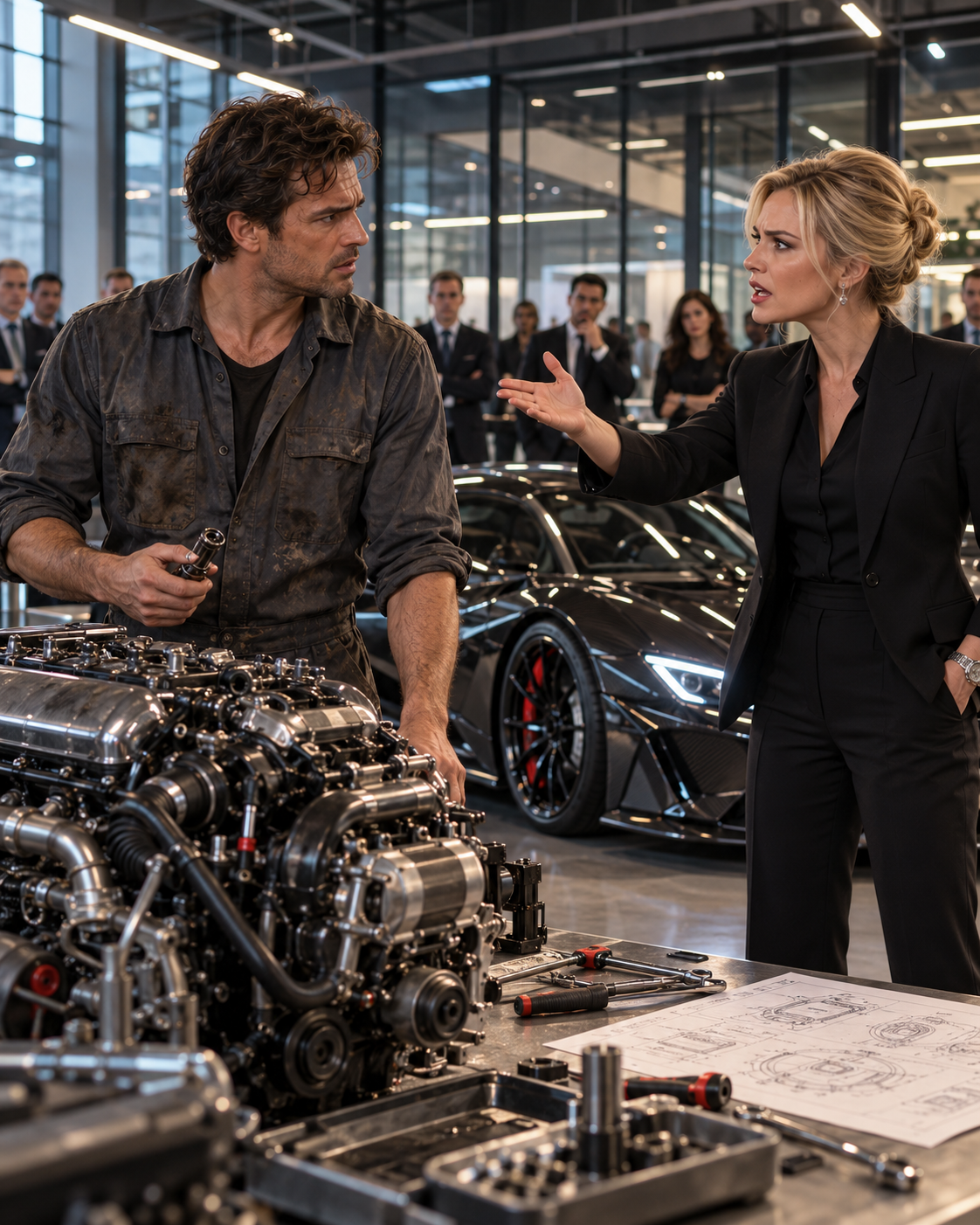
I was fired beside the prototype at Vance Engineering while Claire Vance watched me like a trespasser
The photograph stayed on my screen long after the message disappeared.
I zoomed in until the pixels blurred, searching for something my eyes could recognize.
The fire cabinet was exactly where Hank had left it.
The lock hung broken.
The journal was gone.
But there was something else in the corner of the photograph.
A reflection in the glass.
A man’s shoulder.
A dark sleeve.
And on the wrist, a silver watch with a narrow black face.
I knew that watch.
I had seen it across conference tables, in factory corridors, beside racetracks and private elevators.
Richard Caldwell wore it every day.
But Richard had been fired.
His access had been revoked.
His accounts were frozen.
At least, that was what Claire had told me.
I called her.
She answered on the second ring.
“Are you awake?”
“I am now.”
I sent her the photograph.
There was a long silence.
Then she said, “Don’t come to the office.”
That sentence frightened me more than anything else could have.
“Why?”
“Because someone just tried to access the foundational systems archive.”
My hand tightened around the phone.
“Using whose credentials?”
“Yours.”
I looked toward Lily’s bedroom.
For a moment, the entire apartment seemed too small.
The refrigerator hummed.
A dryer rattled somewhere downstairs.
Rain whispered against the window.
Normal sounds.
Safe sounds.
Yet something had entered the life I had fought so hard to rebuild.
Claire continued quietly.
“The attempt was blocked, but whoever did it knew exactly which files to request.”
“What files?”
“The original architecture.”
I closed my eyes.
“The car?”
“Not just the car.”
“What else?”
“The next generation.”
My stomach dropped.
There had never been a public next generation.
At least, not one I knew about.
Years ago, before Rachel died, I had begun designing a new thermal management system that could allow endurance cars to operate at higher output without pushing the engine beyond its physical limits.
I abandoned it after her death.
Or I thought I had.
“Claire,” I whispered, “who knows about that?”
She hesitated.
“That’s what I’m trying to find out.”
The next morning, Hank called me before sunrise.
He did not say hello.
He only said, “Come alone.”
I drove to the old workshop with my headlights cutting through fog.
Hank was waiting beside the workbench.
He looked older than he had a week earlier.
“Close the door.”
I did.
He reached beneath the bench and pulled out a battered metal box.
“I should have shown you this years ago.”
Inside were copies of documents I had never seen.
My original employment agreement.
Early design drafts.
Patent applications.
And a photograph of me standing beside the first prototype frame.
Rachel was beside me.
She was laughing.
I had forgotten the photograph existed.
I touched the edge with one finger.
“Where did you get these?”
Hank looked at the floor.
“Rachel gave them to me.”
I stopped breathing.
“When?”
“Two weeks before the accident.”
I stared at him.
“Why?”
“She said you were becoming distracted.”
He swallowed.
“She said you were working too many nights, staying too late, and forgetting that machines could wait while family couldn’t.”
That sounded exactly like Rachel.
Then Hank pulled out a sealed envelope.
My name was written across it in her handwriting.
I could not open it.
Not immediately.
My hands had started shaking.
Hank waited.
Finally, I tore the envelope.
Inside was a single sheet of paper.
“If you’re reading this, you’re probably angry with me for leaving you a message instead of saying it myself.”
I had to stop.
The words blurred.
I wiped my eyes and continued.
“Your work matters, but it is not allowed to become more important than Lily’s childhood.”
I laughed through the tears.
Even dead, Rachel was still telling me what to do.
Then I reached the final paragraph.
“There are people around your company who know how valuable your architecture is, and I don’t trust all of them.”
My breath caught.
“Don’t let them convince you that being needed is the same as being loved.”
I lowered the page.
Hank watched me carefully.
“Did she know about Richard?”
“No,” he said.
“She knew there was pressure around your work.”
“Why didn’t you tell me?”
“Because she asked me not to.”
I looked at him.
“She wanted you home.”
Those four words hurt more than anything.
For years I had believed I had lost Rachel because life had simply turned cruel.
Now I wondered whether the final months of our marriage had contained warnings I had been too obsessed with work to hear.
I drove home with her letter on the passenger seat.
Lily was eating cereal when I walked in.
She looked at my face.
“Dad?”
“I’m okay.”
She narrowed her eyes.
“That’s what grown-ups say when they’re not okay.”
I smiled.
“Your mother used to say that.”
Lily looked down at Barnaby.
“Do you miss her?”
Every answer felt wrong.
“Every day.”
She nodded.
“Me too.”
Then she pushed a chair toward me.
“Sit.”
I sat.
She placed Barnaby on the table.
“The button is loose.”
I examined it.
She was right.
One of Rachel’s old stitches had started to unravel.
“I’ll fix it tonight.”
Lily shook her head.
“You always say tonight.”
I froze.
It was a small sentence.
A child’s sentence.
But it went straight through me.
“I’ll fix it now.”
I found a needle and thread.
Lily watched me carefully as I repaired the brass button.
For the first time, I understood what Rachel had meant.
Machines could wait.
Children couldn’t.
That afternoon, Claire arrived at the apartment.
She brought no security detail and no assistant.
Just a folder.
“I found something,” she said.
Inside was an internal audit from twelve years earlier.
Richard had created a shell company shortly after my first architecture review.
But he wasn’t the founder.
There was another name.
Thomas Vance.
Claire’s father.
I looked at her.
She went pale.
“My father?”
“He didn’t steal your design,” I said slowly.
“Not exactly.”
Claire’s jaw tightened.
“What does that mean?”
“It means Richard may have inherited a system rather than invented one.”
We went through the records together.
Thomas Vance had authorized a private development group to explore licensing my architecture before the first prototype was even built.
Richard had later taken control of the group.
But there was a missing year.
One year of accounting records had vanished completely.
The same year Rachel had warned me.
The same year the first offshore entity appeared.
Claire whispered, “My father knew.”
“I don’t know.”
“But you think he did.”
“I think we need proof.”
That night, we returned to the original factory.
The building had been mostly abandoned after the new headquarters opened.
Dust covered the corridors.
Old fluorescent lights flickered overhead.
Hank had kept the original mechanical archive in a basement room that corporate never digitized because the documents were too old and too expensive to catalog.
We searched until two in the morning.
Then Hank found a ledger hidden behind a false wall.
There were signatures inside.
Richard’s.
Thomas Vance’s.
And mine.
Except the signature beside my name wasn’t mine.
It was forged.
I knew immediately.
The slant was wrong.
The pressure was wrong.
The final stroke was too clean.
Someone had signed my name to transfer rights I had never surrendered.
Claire stared at it.
“Can you prove it?”
“I can prove what my handwriting looked like that year.”
I opened my notebook.
The evidence was unmistakable.
But then Hank pointed to another line.
There was a payment.
A private payment.
Made to a consulting firm.
The firm had one director.
Evelyn Caldwell.
Richard’s wife.
Claire sat down.
“He’s been planning this for twelve years.”
“No,” I said.
“He was planning something for twelve years.”
The distinction mattered.
Because if Richard had built everything around stealing my architecture, then why had he waited so long to move it offshore?
The answer came three days later.
The international endurance federation announced a new technical regulation.
Our prototype’s architecture had suddenly become extremely valuable.
Every manufacturer wanted the thermal system.
Every major racing organization wanted the data.
And the offshore licensing agreement Richard had arranged would have transferred the rights just before the regulation changed.
He hadn’t been trying to steal an old invention.
He had been waiting for the world to make it priceless.
The pressure exploded inside Vance Engineering.
Lawyers arrived.
Investigators arrived.
Executives stopped returning calls.
Reporters waited outside the gates.
Claire stood in the center of it all, surrounded by people who had spent years telling her what she wanted to hear.
Then Tyler came into my office.
“Something’s wrong with the car.”
I looked up.
“What kind of wrong?”
“The telemetry says everything is fine.”
I smiled grimly.
“That’s not what I asked.”
He hesitated.
“The left side feels different under sustained load.”
“When?”
“High temperature.”
“How different?”
“Enough that I don’t trust it.”
I stood.
“Then we don’t run it.”
The chief operations manager objected immediately.
“We’re forty-eight hours from qualifying.”
Tyler looked at me.
I looked at Claire.
She didn’t hesitate.
“No track time until systems signs off.”
That decision cost Vance millions in lost testing.
It also saved us from disaster.
During inspection, we found a hairline fracture near the same induction assembly that had nearly killed the prototype weeks earlier.
It had not triggered a single software warning.
Tyler stared at the broken component.
“That could’ve ended badly.”
I nodded.
“It almost did.”
Then I noticed something.
The fracture wasn’t random.
Someone had modified the assembly.
The part had been weakened deliberately.
The room went silent.
Claire called federal investigators.
Within hours, the factory became a crime scene.
Security footage revealed a contractor entering the restricted workshop the previous night.
He had used an expired access card.
When investigators tracked the card, it led to a storage unit registered under a company connected to Evelyn Caldwell.
Richard was no longer simply a corporate thief.
He had been sabotaging the very machine he claimed to own.
The reason became clear when investigators recovered encrypted correspondence.
If Vance’s prototype failed catastrophically, the company would be forced to abandon the architecture.
The offshore entity could then purchase the distressed intellectual property for almost nothing.
Richard intended to profit from the collapse he had engineered.
Claire read the evidence in silence.
Then she asked me to meet her outside.
We stood behind the factory where the first prototype had once been assembled.
“I trusted him,” she said.
“I know.”
“I thought my father built this company on loyalty.”
“Companies are buildings.”
She looked at me.
“People decide what happens inside them.”
She looked away.
“I nearly fired you again.”
“I know.”
“You never blamed me.”
“I wanted to.”
She smiled sadly.
“You should have.”
“I was too tired.”
She laughed softly.
Then she asked the question I had been avoiding.
“Why did you accept being erased for so long?”
I looked through the fence toward the track.
“Because Rachel died, and after that, proving I was right felt smaller than getting Lily home every night.”
Claire nodded.
“Maybe that’s why they got away with it.”
“Maybe.”
“No.”
She turned toward me.
“They got away with it because decent people are taught to tolerate unfairness when fighting back seems expensive.”
I didn’t answer.
Because she was right.
The investigation lasted months.
Richard was eventually charged with fraud, intellectual-property theft, and conspiracy related to the sabotage scheme.
Other executives resigned.
The offshore licensing network collapsed.
My name was restored to every foundational record.
But the strangest part was what happened afterward.
The company changed.
Not because a policy document demanded it.
Because people had seen what silence could cost.
We created a direct safety channel that went outside normal management.
Every mechanic could use it.
Every engineer.
Every driver.
Nobody could be punished for reporting a genuine safety concern.
The first report came from a nineteen-year-old apprentice.
He had noticed a vibration nobody else considered important.
We shut the car down.
He was right.
I promoted him six months later.
Not because he saved a race.
Because he had the courage to speak before anyone knew he was right.
One evening, years after everything began, I found Lily sitting at the kitchen table doing homework.
Barnaby was beside her.
The brass button was still there.
Older now.
Scratched.
Dull.
But secure.
She looked up.
“You know what Mom’s letter said?”
I froze.
She had never seen it.
“How?”
“You left it on the table.”
I sat beside her.
“What did you think?”
She shrugged.
“She was right.”
“About what?”
“You work too much.”
I laughed.
“Your mother would be proud.”
Lily smiled.
Then she pushed a small envelope toward me.
“What is this?”
“Something I found in Barnaby.”
I opened it.
Inside was a tiny piece of paper folded four times.
The handwriting was Rachel’s.
But the message wasn’t old.
It was a note I had never seen before.
“Some things are worth protecting even when nobody knows they’re in danger.”
I stared at it.
“Where did you find this?”
Lily pointed to Barnaby’s back seam.
“The button was loose again.”
My heart stopped.
I turned the bear over.
Inside the lining was something hard.
A tiny brass key.
Neither Lily nor I recognized it.
There was a number stamped into its side.
17.
I knew that number.
My original engineering notebook had a missing page seventeen.
The page I had always assumed was lost.
I looked at Lily.
She looked back at me.
“What does it open?”
I didn’t know.
But after everything I had learned, I knew better than to dismiss a mystery simply because a computer said it didn’t exist.
The next morning, I took the key to the old Vance facility.
Hank was waiting outside.
When he saw it, the color drained from his face.
“You found it.”
I stopped.
“You knew?”
He nodded slowly.
“Rachel gave that to me the night before she died.”
My chest tightened.
“Why didn’t you tell me?”
“Because she made me promise.”
“What did she say?”
Hank looked toward the abandoned factory.
“She said if you ever got your name back, then you were ready to know the rest.”
I looked at the key in my palm.
For eleven years, I had believed Rachel’s last gift was a brass button on a stuffed bear.
Maybe it wasn’t.
Maybe that button had been carrying a secret all along.
Hank walked toward the old building.
I followed.
At the basement door, he stopped beside a wall I had passed hundreds of times.
He pressed the brass key into a hidden lock.
Something clicked.
A section of concrete shifted.
Behind it was a narrow room.
Inside sat a single metal desk.
On top was a cassette recorder, a photograph of Rachel, and a folder with my name written across it.
My hands trembled as I reached for the recorder.
Hank whispered, “Whatever is on that tape, she wanted you to hear it when you were ready.”
I pressed play.
Static filled the room.
Then Rachel’s voice came through the speaker.
Soft.
Familiar.
Alive.
“If you’re hearing this, then somehow you made it back to the life I always wanted for you.”
I closed my eyes.
For the first time in eleven years, I wasn’t remembering Rachel.
I was listening to her.
Her voice continued.
“There is something about your work you never understood.”
The tape crackled.
“And something about the night I died that I never told you.”
I opened my eyes.
Hank looked at me.
Neither of us moved.
Rachel’s next words came through the darkness.
“Before you decide what really happened, you need to know who was following me.”
The tape stopped.
I stared at the machine.
Outside, somewhere beyond the concrete walls, the factory lights flickered on one by one.
And for the first time since Rachel’s death, I understood that perhaps the hardest part of getting my life back was not recovering the work they had stolen from me.
It was discovering what had been taken from me that night on the highway.
Because sometimes the truth doesn’t disappear when people bury it.
Sometimes it waits.
Quietly.
Patiently.
Inside the smallest things we refuse to throw away.
And sometimes, after all those years, it finally finds its way home.