I was digging through my wallet to pay for my son’s hot chocolate when the woman behind the pastry counter said something that made me stop.
“I can give you honesty,” I said. “I can give you time. I can show up when I say I’ll show up, and if something changes, I won’t disappear without telling you why. I can let you and Owen get to know me without expecting either of you to make room for me before you’re ready.”
Audrey studied my face.
“And what about Leo?”
“He’s my priority. Always will be. But I’d like him to have people in his life who care about him. People who don’t make him feel like he’s losing someone every time he loves someone new.”
Audrey looked toward the window.
“That’s what I want for Owen, too.”
I took a breath.
“I don’t know where this leads, Audrey. But I’d like to find out.”
She was quiet for a long moment.
Then she nodded.
“Coffee next Saturday?”
I smiled.
“Coffee next Saturday.”
It wasn’t a grand declaration. There was no kiss, no dramatic embrace, and no promise that everything would work out.
But when we walked back into the coffee shop, Audrey’s hand brushed mine.
Neither of us pulled away.
And sometimes, after years of regret, that’s where a new beginning has to start.
**THE FIRST PROMISE**
The following Saturday, I arrived fifteen minutes early.
Leo had insisted on wearing his favorite blue dinosaur sweatshirt, and he’d spent the entire drive asking whether Owen would be there.
“Do you think he’ll want to play soccer?”
“Probably.”
“What if he wants to draw dinosaurs again?”
“Then you can draw dinosaurs.”
“What if he doesn’t like me anymore?”
I glanced at him in the rearview mirror.
“Why would you think that?”
He shrugged.
“Sometimes kids say they’re your friend, and then they don’t talk to you anymore.”
I knew he wasn’t talking about Owen.
He was talking about his mother. About the relatives who had stopped calling after the funeral. About the friends we’d left behind every time the military transferred me.
I reached over and squeezed his shoulder.
“Someone not being around doesn’t mean you weren’t worth staying for, buddy.”
He looked out the window.
“Okay, Dad.”
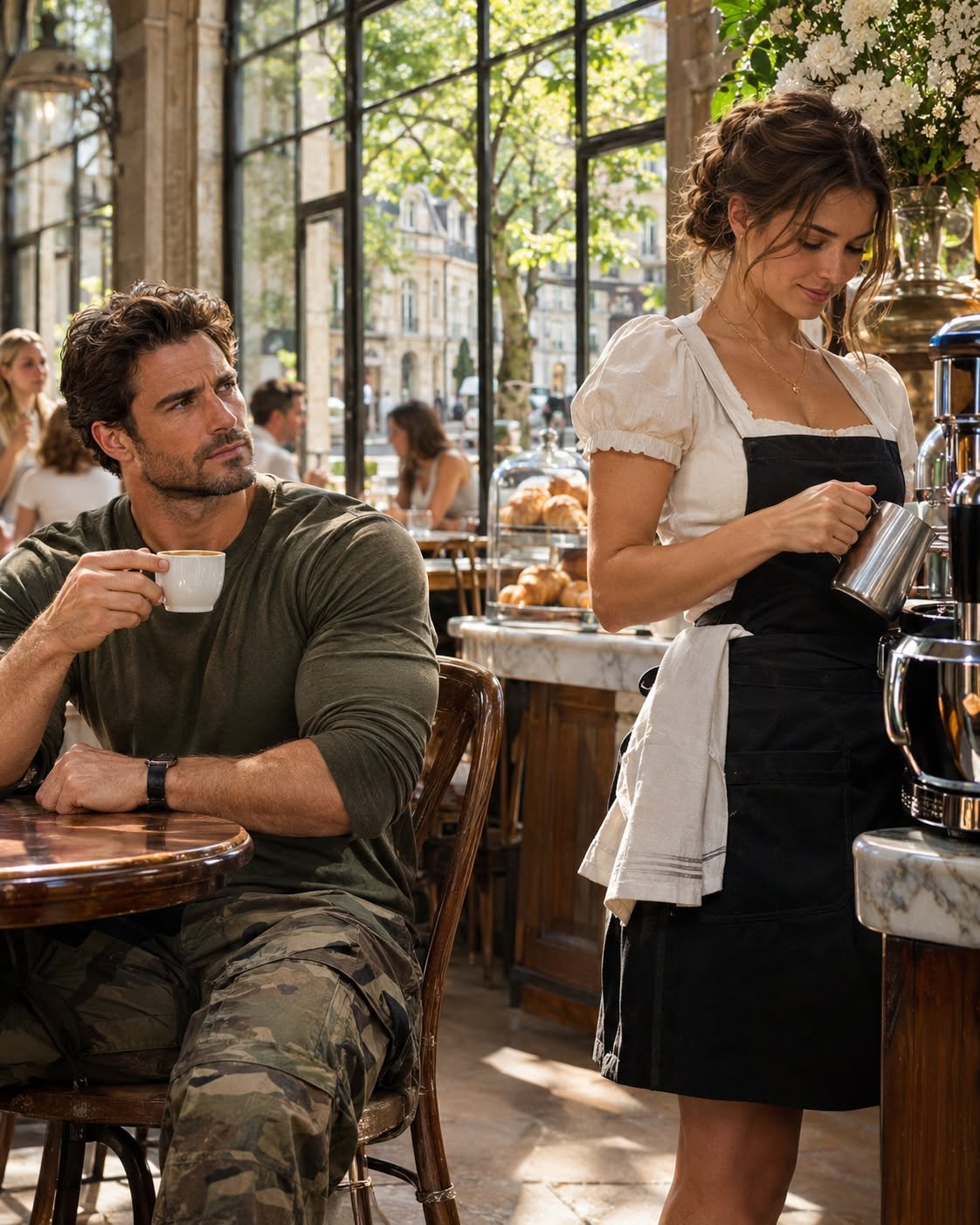
Audrey was waiting outside the coffee shop when we arrived. Owen ran toward Leo, and the two disappeared inside before either adult could say hello.
Audrey smiled.
“Looks like we don’t have to worry about them.”
“That’s what I thought until Leo asked me seventeen questions on the way here.”
She laughed.
We ordered breakfast and talked for nearly two hours.
Nothing extraordinary happened. We discussed school, work, the weather, and the ridiculous price of groceries. But there was something comforting about being able to sit across from her without pretending we were strangers.
Before we left, Audrey handed me a small paper bag.
“Your coffee was on me.”
Inside was a cinnamon roll.
I recognized the smell immediately.
“My mother used to make those,” Audrey explained. “This was her recipe.”
I took a bite.
It tasted like warm butter, cinnamon, and a memory I hadn’t known I needed.
“That’s incredible.”
Audrey smiled.
“She always said the secret ingredient was patience.”
I looked at her.
“Sounds like something you could teach me.”
“Maybe.”
For the next few weeks, Saturday mornings became our little tradition.
Sometimes we met at the coffee shop. Sometimes the boys played at the park while Audrey and I walked around the lake.
We didn’t rush anything.
I told her about the difficult nights after my wife’s death, when Leo would wake up crying and ask why his mother couldn’t come home.
She told me about the first night Owen had arrived at her house with a backpack, two stuffed animals, and a photograph of his mother.
Neither of us tried to offer solutions.
We just listened.
And slowly, the four of us began building something that didn’t have a name yet.
Then, six weeks after we’d reopened the door to Audrey’s mother’s bakery, everything changed.
**THE LETTER IN THE FLOUR TIN**
Audrey called me on a Thursday evening.
Her voice was unsteady.
“Can you come over?”
“Is Owen okay?”
“He’s fine. It’s something else.”
I arrived twenty minutes later.
The bakery’s lights were on, and Audrey was sitting at one of the old wooden tables with a metal flour tin in front of her.
She looked as though she’d been crying.
“What happened?”
She pushed a folded envelope toward me.
“I found this behind the old recipe books.”
The envelope had her name written across it in her mother’s handwriting.
The date was almost four years earlier.
Audrey opened it carefully.
Inside was a letter.
She read the first few lines silently, then stopped.
“Would you read it?” she asked.
I unfolded the paper.
My dearest Audrey,
If you’re reading this, it means I’ve probably left you with more questions than answers. I wish I could sit beside you and tell you everything myself.
I know you have been thinking about selling the bakery. I also know you’ve been afraid to walk through its doors without me.
But I need you to understand something.
This bakery was never just mine. It was built by people who needed a place to belong.
When your father left, we couldn’t afford much. Some mornings, I opened the shop with barely enough flour to make a dozen rolls. People came anyway. Some paid. Some couldn’t. We fed them because a warm meal should never depend on how much money someone has in their pocket.
I want you to remember that.
I also want you to know that I was proud of you long before you became successful.
You don’t have to save everything, sweetheart. You don’t have to keep this building standing just because I loved it.
If the bakery makes you happy, open its doors.
If it makes you miserable, let it go.
Just don’t spend the rest of your life trying to prove that you can carry everything alone.
Love,
Mom.
Audrey lowered her head.
For a long time, she couldn’t speak.
I placed the letter on the table.
“She knew you were struggling.”
Audrey nodded.
“I thought keeping the bakery closed was a way of protecting what she left me.”
She looked around the room.
“But maybe I’ve been protecting myself from remembering how much I miss her.”
I sat beside her.
“Maybe you don’t have to decide tonight.”
She looked at me.
“What if I can’t run it?”
“Then we figure out what it could become.”
“What if it fails?”
“Then at least it fails while the doors are open.”
She gave a small laugh through her tears.
“You’re still terrible at giving comforting advice.”
“I’ve gotten better at repairing cars.”
“That’s debatable.”
We laughed.
Then she folded her mother’s letter and tucked it into her pocket.
The next morning, Audrey made a decision.
She was going to reopen the bakery.
Not as a full-scale business. Not yet.
She would start small, selling coffee, cinnamon rolls, and a few homemade pastries on weekends.
Owen insisted on designing the sign.
Leo volunteered to help paint it.
The result was crooked, colorful, and absolutely perfect.
They called it Bennett’s Corner.
**THE DAY EVERYTHING ALMOST FELL APART**
For the next month, the bakery became the happiest place in town.
Neighbors came in to see the old building open again. Some remembered Audrey’s mother and shared stories about her. Others simply wanted coffee and something sweet.
Audrey was exhausted, but she smiled more than I’d seen her smile in years.
I helped with the shelves, fixed a leaking sink, and replaced two broken electrical outlets.
The boys became unofficial employees.
Leo took orders.
Owen drew pictures for the walls.
They even invented a special pastry called the Dinosaur Tail, which was essentially a cinnamon roll with too much icing.
Business was better than Audrey expected.
Then came the storm.
It happened on a Tuesday afternoon in late October.
Heavy rain had been falling since morning when my phone rang.
It was Audrey.
“Jack, there’s water coming through the ceiling.”
I was at the base with my unit, preparing for an upcoming training assignment.
“How bad?”
“Pretty bad. It’s coming into the kitchen.”
“Get everyone out. Don’t touch anything electrical.”
“The ovens—”
“Audrey, listen to me. Get out first. I’ll call you back.”
By the time I arrived, water was pouring through a damaged section of the roof.
The bakery’s ceiling had partially collapsed.
A wooden beam lay across the counter. Boxes of ingredients were soaked, and water had spread across the kitchen floor.
Audrey stood outside beneath the awning, holding Owen’s backpack.
She looked devastated.
“My mother’s recipes,” she whispered. “Everything was in there.”
I looked at the damaged building.
“Are you hurt?”
She shook her head.
“Then we’ll figure out the rest.”
But it wasn’t that simple.
The insurance company later informed her that the damage wasn’t covered under the policy she had inherited. A previous roof repair had never been properly documented.
The estimated restoration cost was far beyond anything she could afford.
A contractor warned that if the structural damage was worse than expected, the building might need to be closed permanently.
Audrey sat in her kitchen that evening, staring at the paperwork.
“I can’t do this again,” she said.
I sat across from her.
“We’ll find a way.”
She shook her head.
“Jack, I don’t want you fixing everything for me.”
“I’m not trying to.”
“Then why are you always here when something goes wrong?”
The question caught me off guard.
“Because I care about you.”
“That’s not what I mean.”
She looked directly at me.
“You have Leo. You have your military responsibilities. You have an entire life. I don’t want to become another responsibility you feel obligated to carry.”
I leaned back.
“Do you think that’s why I’m here?”
“I don’t know.”
Her voice cracked.
“Sometimes I look at you and remember the boy who left without saying goodbye. I remember how much I trusted you. And then I wonder whether you’re going to disappear again the moment things become difficult.”
I had no defense against that.
Because she was right to wonder.
I had spent years convincing myself that my silence had been justified. That leaving without explaining myself had been easier for everyone.
But I had never considered what it had cost her.
I reached into my jacket and pulled out my phone.
“There’s something I need to tell you.”
She waited.
“My unit received orders this morning. I’ve been assigned to a six-month training rotation. I’ll be leaving in three weeks.”
Audrey’s expression changed.
“Six months?”
I nodded.
“Possibly longer, depending on the assignment.”
She stood up and walked toward the window.
“Of course.”
“Audrey—”
“No. I understand. It’s your job.”
“I wanted to tell you earlier.”
“But you didn’t.”
I stood.
“I was trying to figure out how to say it.”
She turned toward me.
“That’s exactly what you said when we were twenty.”
I felt the words land like a punch.
She wasn’t angry because I had orders.
She was hurt because I had once again waited until the truth became impossible to avoid.
“I should have told you the moment I found out,” I admitted.
She nodded.
“Yes. You should have.”
I wanted to tell her that I could make it work, that six months wasn’t forever, that I could call every night.
But I stopped myself.
I’d promised her honesty.
So I gave her the truth.
“I don’t know how this will work. I don’t want to ask you to wait for me. But I also don’t want to pretend I don’t care about what we’re building.”
Audrey looked down.
“I need time, Jack.”
“I understand.”
I left that evening without asking her to forgive me.
And for the first time, I understood that keeping a promise sometimes meant allowing someone the space to decide whether they still wanted you in their life.
**THE BOY WHO WOULDN’T SAY GOODBYE**
The next morning, Leo noticed something was wrong.
“Are you and Audrey fighting?”
I looked up from making breakfast.
“Why do you ask?”
“Because Owen said Audrey was crying.”
I set the frying pan down.
“Sometimes grown-ups have difficult conversations.”
“Are we still going to see them?”
“I hope so.”
Leo frowned.
“People always say that when they don’t know.”
I stared at him.
He was right.
I knelt beside his chair.
“Remember when we moved away from your old school?”
He nodded.
“You were scared you’d never see your friends again.”
“Yeah.”
“And I told you we’d stay in touch. But then I got busy, and some of those friendships faded.”
Leo looked at me.
“I don’t want you to do that again.”
I swallowed.
“Neither do I, buddy.”
That afternoon, I drove him to the bakery.
Audrey was there with Owen, sorting through damaged boxes.
The boys ran toward each other.
Leo hugged Owen.
“Are you still my friend?”
Owen looked offended.
“Obviously.”
Leo smiled.
Then he looked at Audrey.
“Can I still come over?”
Audrey crouched down.
“Of course you can, sweetheart.”
I stood by the door, uncertain whether I should say anything.
Audrey finally looked up.
“Jack, can we talk?”
We stepped outside.
She folded her arms against the cold.
“I’ve been thinking.”
I waited.
“I don’t want you to give up your career. I know how important your service is.”
“Thank you.”
“But I also can’t build a relationship around uncertainty and last-minute explanations.”
“I know.”
“So here’s what I need. No promises you can’t keep. No disappearing. If you’re going to be away, tell me when you can call. If plans change, tell me. And don’t make Leo and Owen believe something is permanent when neither of us knows.”
I nodded.
“That’s fair.”
She took a breath.
“And I need you to understand that I might not be ready to call this a relationship.”
I looked at her.
“Then we won’t call it one.”
A small smile appeared on her face.
“You’re learning.”
“I’m trying.”
She glanced back through the window.
“Owen needs stability. So does Leo. We can be friends. We can spend time together. We can see where life takes us.”
I held out my hand.
“One honest day at a time?”
She took it.
“One honest day at a time.”
**THE SIX MONTHS**
Three weeks later, I left Virginia.
The goodbye wasn’t dramatic.
Leo hugged Owen in the bakery parking lot. The boys exchanged drawings and promised to write letters.
Audrey handed me a paper bag.
Inside were six cinnamon rolls.
“For the road,” she said.
I smiled.
“Your mother would be proud.”
Her eyes softened.
“Come back safely.”
I wanted to kiss her.
But I didn’t.
Instead, I told her the truth.
“I care about you, Audrey. More than I know how to explain. And I’m going to do my best not to make you regret trusting me again.”
She looked at me for a long moment.
“Then start by calling when you arrive.”
I nodded.
And I did.
The first month was difficult.
Military training was demanding, and my schedule changed constantly. There were days when I couldn’t call until late at night.
But I sent messages whenever I could.
Sometimes I called Audrey.
Sometimes I spoke with Owen about dinosaurs.
Most evenings, Leo and I video-called, and he told me about school.
One night, he showed me a picture Owen had sent.
It was a drawing of four people standing outside a bakery.
Underneath, Owen had written:
“OUR PEOPLE.”
I saved it.
Then I noticed a message from Audrey.
She had sent a photograph of the bakery’s damaged ceiling.
Beneath it, she’d written:
“Still standing. Just like us.”
I smiled.
But halfway through my assignment, something happened that tested everything.
My unit received an unexpected change in orders.
Our rotation was being extended by another two months.
I called Audrey immediately.
She answered on the second ring.
“Hey.”
“I need to tell you something.”
Her voice grew serious.
“What’s wrong?”
“My assignment has been extended. Two more months.”
There was silence.
Then she sighed.
“Thank you for telling me.”
“I know it’s not what we planned.”
“We didn’t plan anything, Jack.”
I laughed softly.
“Fair enough.”
She paused.
“How are you holding up?”
That question surprised me.
Not because she asked, but because she didn’t make the conversation about herself.
“I’m tired,” I admitted. “I miss home.”
“We miss you, too.”
I closed my eyes.
For the first time, I allowed myself to say something I’d been afraid to say.
“I miss you, Audrey.”
She was quiet.
Then she answered.
“I miss you, too.”
It wasn’t a promise.
But it was enough to get me through the night.
**THE CALL AT 2:17 A.M.**
Three weeks before I was scheduled to return, my phone rang in the middle of the night.
It was Audrey.
I answered immediately.
“What’s happened?”
“It’s Owen.”
Her voice was trembling.
“He’s at the hospital.”
I sat upright.
“What happened?”
“He had a bad asthma attack. The doctors are treating him, but he’s frightened. He keeps asking for you and Leo.”
I was already reaching for my boots.
“Put him on the phone.”
A moment later, I heard a small, shaky voice.
“Jack?”
“I’m here, buddy.”
“Are you coming back?”
My throat tightened.
“Not tonight. But I’m coming home as soon as my assignment ends. You hear me?”
“Promise?”
I hesitated.
The old version of me would have said yes without thinking.
But I had learned something.
“I promise I’ll do everything I can to get back as soon as I’m allowed. And I’ll call you tomorrow. No matter what.”
Owen sniffled.
“Okay.”
I stayed on the phone with Audrey until the doctors confirmed that Owen was stable.
The next morning, I called again.
And the morning after that.
Leo sent Owen a video of himself making the worst dinosaur impression in recorded history.
Owen laughed so hard that Audrey sent me a message saying she’d never seen him so happy in days.
Then, unexpectedly, my commanding officer approved an earlier return date after our training requirements were adjusted.
I called Audrey.
“I’m coming home.”
She went quiet.
“When?”
“Friday.”
I heard her laugh.
Then she began crying.
“Okay,” she whispered. “We’ll be here.”
**THE RETURN**
When I arrived in Virginia, Leo was waiting at the airport with a handmade sign.
WELCOME HOME DAD.
Owen stood beside him holding another sign.
WELCOME HOME JACK.
Audrey stood behind them.
She was wearing a dark blue sweater, and her hair was tucked behind her ear.
Exactly the way I remembered.
Leo ran into my arms.
I lifted him and held him tightly.
“I missed you, buddy.”
He buried his face in my shoulder.
“I missed you more.”
Owen approached next.
I knelt and hugged him.
“How are you feeling?”
“Better.”
“Good.”
Then I looked at Audrey.
She smiled through tears.
“Welcome home.”
I stepped closer.
“Thank you.”
For a moment, neither of us moved.
Then she wrapped her arms around me.
I held her carefully, as if I understood that this embrace wasn’t a reward for returning.
It was a chance to begin again.
**THE LAST BOX**
Two weeks after my return, Audrey called me to the bakery.
She had finally hired a contractor to inspect the building properly.
The news wasn’t good.
The roof could be repaired, but the supporting beams were badly damaged. The estimate was almost twice what she’d expected.
She had enough money for a partial restoration, but not enough to reopen safely.
She sat at the counter with a stack of papers.
“I think I need to sell it.”
I pulled out a chair.
“Is that what you want?”
She stared at the paperwork.
“I don’t know anymore.”
I looked around the bakery.
The old cake stands were covered with sheets. The chalkboard still had the prices her mother had written years ago.
“What if you don’t have to keep it exactly as it was?”
She looked at me.
“What do you mean?”
“What if you sell the building but keep the recipes? What if you find another space and build something new?”
Audrey shook her head.
“That feels like giving up.”
“Or it feels like choosing what matters most.”
She looked at her mother’s letter, which she kept in a small frame near the register.
I continued.
“Your mother said you didn’t have to save everything. Maybe she was giving you permission to let the building go.”
Audrey began to cry.
“I wanted her to have something to come back to.”
I took her hand.
“You still have what she gave you.”
She looked around the room.
Then she nodded.
The following week, Audrey put the property up for sale.
It was the hardest decision she’d made since her mother’s death.
But it turned out to be the right one.
A local couple bought the building and planned to restore it as a small community bookstore and café.
They offered Audrey a deal.
She could rent the kitchen space at a much lower rate if she wanted to continue baking.
She accepted.
Bennett’s Corner would move into a smaller storefront two blocks away.
The new place wouldn’t have the old wooden floors or the original windows.
But it would have a bright kitchen, a small reading corner, and enough room for six tables.
Most importantly, it would be hers.
On the day she signed the lease, Audrey invited me and the boys to celebrate.
Owen and Leo brought a box of decorations.
One of them was a little wooden sign they’d made together.
It read:
“GOOD THINGS TAKE TIME.”
Audrey hung it above the counter.
Then she turned toward me.
“Thank you for helping me see that letting go doesn’t mean losing everything.”
I smiled.
“You figured that out yourself.”
She shook her head.
“Maybe. But I needed someone to stand beside me while I did.”
**THE QUESTION**
A few months later, spring arrived.
The new bakery was thriving.
Audrey had introduced a Saturday baking class for children. Owen and Leo attended every week, usually leaving the kitchen covered in flour.
My military schedule had settled into a more predictable routine.
I still had responsibilities, and there would always be uncertainty.
But Audrey and I had learned to talk about it instead of pretending it didn’t exist.
One evening, after closing, she asked me to stay.
The boys were in the back room playing a board game.
She placed two cups of coffee on the table.
“I’ve been thinking about us.”
I smiled nervously.
“That sounds serious.”
“It is.”
She sat opposite me.
“I don’t want to spend the rest of my life being afraid of what happened when we were young.”
I listened.
“And I don’t want to pretend that the years apart didn’t hurt. They did. I had to learn how to live without you.”
She reached across the table.
“But I’ve also learned that people can change. Not because they say they have, but because they keep showing you.”
I took her hand.
“I wish I could go back and explain everything.”
“You can’t.”
“I know.”
“But you can decide what happens next.”
I looked into her eyes.
“Then I’d like to ask you something.”
She raised an eyebrow.
“Go ahead.”
“Would you let me take you on a real date?”
She laughed.
“After all these months of coffee and cinnamon rolls?”
“I wanted to make sure you liked me first.”
“That’s a very slow strategy.”
“I’ve been told patience is important.”
She smiled.
“Yes, Jack. I’d like that.”
I leaned forward and kissed her.
It wasn’t like the kisses we’d shared when we were young.
Those had been full of urgency, excitement, and the belief that love could conquer anything.
This one was quieter.
It carried grief, forgiveness, uncertainty, and the knowledge that love wasn’t enough unless you were willing to show up.
When we pulled apart, she rested her forehead against mine.
“Don’t make me regret this.”
“I won’t stop trying.”
She smiled.
“Good answer.”
From the back room, Leo shouted.
“ARE YOU GUYS DONE TALKING?”
Audrey burst out laughing.
Owen followed.
“THE GAME IS OVER!”
I called back.
“Then clean up your mess!”
Leo appeared in the doorway.
“Can we have cinnamon rolls?”
Audrey shook her head.
“You’re both impossible.”
But she went into the kitchen anyway.
And for the first time, I could picture a future that didn’t feel like something I was running toward or away from.
It felt like a place we were building together.
**THE CHRISTMAS LIGHTS**
Almost a year after the day I walked into Audrey’s coffee shop, the four of us stood outside Bennett’s Corner on a cold December evening.
The bakery was decorated with white lights and evergreen branches.
A small Christmas tree stood in the window.
Leo and Owen had hung paper dinosaurs from its branches.
Audrey’s mother would probably have laughed at that.
We had invited several families from town to a holiday gathering.
There was hot chocolate, fresh cinnamon rolls, and a table covered with donated winter coats.
Audrey had started a small tradition.
Anyone who couldn’t afford a warm drink or something to eat could simply come inside.
No questions.
No explanations.
No embarrassment.
She called it Mom’s Table.
Above it hung a framed copy of her mother’s letter.
I watched Audrey talking with an elderly man who had recently lost his wife.
She poured him coffee, wrapped two cinnamon rolls in a paper bag, and quietly told him he was welcome to sit as long as he liked.
I recognized the expression on his face.
It was the expression of someone who hadn’t realized how much he needed a little kindness until someone offered it.
Leo approached me.
“Dad?”
“Yeah?”
“Are you happy?”
I looked at him.
“Very.”
He nodded.
“Me too.”
Then he glanced toward Audrey and Owen.
“Do you think we’re a family?”
I considered the question.
Families were complicated.
Some were connected by blood. Others were built through years of shared memories. Some were broken by loss, and some were rebuilt by people brave enough to try again.
I crouched beside him.
“I think we’re becoming one.”
He smiled.
“Can Owen be my brother?”
I looked toward the boys.
“That sounds like something you should ask him.”
Leo ran off.
A few seconds later, I heard Owen shout.
“YES! But I’m still better at dinosaurs!”
I laughed.
Audrey walked over and slipped her hand into mine.
“Everything okay?”
I nodded.
“More than okay.”
She rested her head against my shoulder.
“Do you ever think about what would’ve happened if you hadn’t walked into that coffee shop?”
“Sometimes.”
“And?”
I looked through the window at the four cups sitting on the table.
“I think we would have kept living our separate lives. Maybe we would have been fine. Maybe we would have always wondered.”
She squeezed my hand.
“I’m glad you came in.”
“So am I.”
A little later, after the guests had gone and the boys were asleep upstairs, Audrey and I stood in the kitchen cleaning the last baking trays.
She handed me a dish towel.
“You’re still terrible at drying dishes.”
“I’ve improved.”
“Not enough.”
I laughed.
Then she grew quiet.
“Jack?”
“Yeah?”
“Thank you for coming back.”
I set down the towel.
“Thank you for letting me.”
She looked at me.
“I didn’t let you come back because I forgot what happened.”
“I know.”
“I let you come back because you finally understood that being sorry isn’t the same as being reliable.”
I nodded.
“That’s something I wish I’d learned years ago.”
She smiled.
“Maybe we both needed the years in between.”
I pulled her into my arms.
Outside, the rain had stopped.
The streetlights reflected on the wet pavement, and the little bakery glowed warmly against the darkness.
I thought about the young man I’d once been.
The one who believed leaving without explanation was easier than facing the consequences of his choices.
I thought about the woman who had spent years building a life without him.
And I thought about two boys who had lost more than children should have to lose, yet somehow found a friendship that neither of us could have planned.
For a long time, I’d believed that love meant never leaving.
But military life, grief, and fatherhood had taught me that life doesn’t always give us that choice.
Sometimes we have to go.
Sometimes circumstances change.
Sometimes promises become impossible to keep.
What matters is whether we tell the truth, whether we respect the people affected by our decisions, and whether we return when we can.
The next morning, I found a small envelope tucked beneath my coffee cup.
It was from Audrey.
Inside was a photograph of the four of us standing in front of the new bakery.
On the back, she’d written:
“We can’t change the years we lost. But we can decide what to do with the years we have.”
I carried that photograph in my wallet.
Not because it reminded me that everything had worked out perfectly.
It hadn’t.
There were still difficult days. There were still military orders, school problems, grief, and moments when fear threatened to make us retreat into ourselves.
But we had learned to face those things together.
And that mattered more than perfection.
**ONE FINAL LESSON**
A few weeks later, Leo came home from school with a writing assignment.
The teacher had asked the class to write about someone who had taught them an important lesson.
He sat at the kitchen table for nearly an hour.
Then he handed me his paper.
The title was:
“THE PEOPLE WHO STAY.”
He had written:
“My dad taught me that being strong doesn’t mean you never cry. It means you keep trying even when things are hard.
Audrey taught me that people can be sad and still be kind.
Owen taught me that a friend doesn’t have to look like you or live in your house.
And I learned that sometimes families are made when people choose to care about each other.”
I read it twice.
Then I looked at him.
“That’s really good, buddy.”
He smiled.
“I got an A.”
I laughed.
“Of course you did.”
He took the paper back and ran upstairs to show Owen.
I remained at the table, staring at the last sentence.
Families are made when people choose to care about each other.
Maybe that was the answer I’d been looking for all along.
Audrey and I hadn’t gone back to being the people we were at twenty.
We couldn’t.
Too much had happened. Too much had been lost. Too much had changed.
But we had become something different.
Something more honest.
Something that had room for the past without allowing the past to decide everything about the future.
And that afternoon, as I watched Audrey teaching Owen and Leo how to make her mother’s cinnamon rolls, I finally understood the real meaning of second chances.
A second chance isn’t an invitation to pretend the first hurt never happened.
It’s an opportunity to do better with the knowledge you gained from it.
It doesn’t erase the past.
It gives the future a chance.
And sometimes, the bravest thing two people can do isn’t promise each other forever.
It’s show up tomorrow.
Then do it again the day after that.
And keep choosing honesty, even when silence would be easier.
Because love isn’t proven by how beautifully someone says goodbye or how dramatically they return.
It’s proven by the quiet, ordinary moments when they decide to stay present.
I once walked away from Audrey because I was afraid I couldn’t give her the life she deserved.
Years later, I came back with a son, a broken heart, and no guarantees.
She didn’t hand me forgiveness.
She gave me something more meaningful.
A chance to earn her trust.
And this time, I understood what to do with it.
**THE END.**