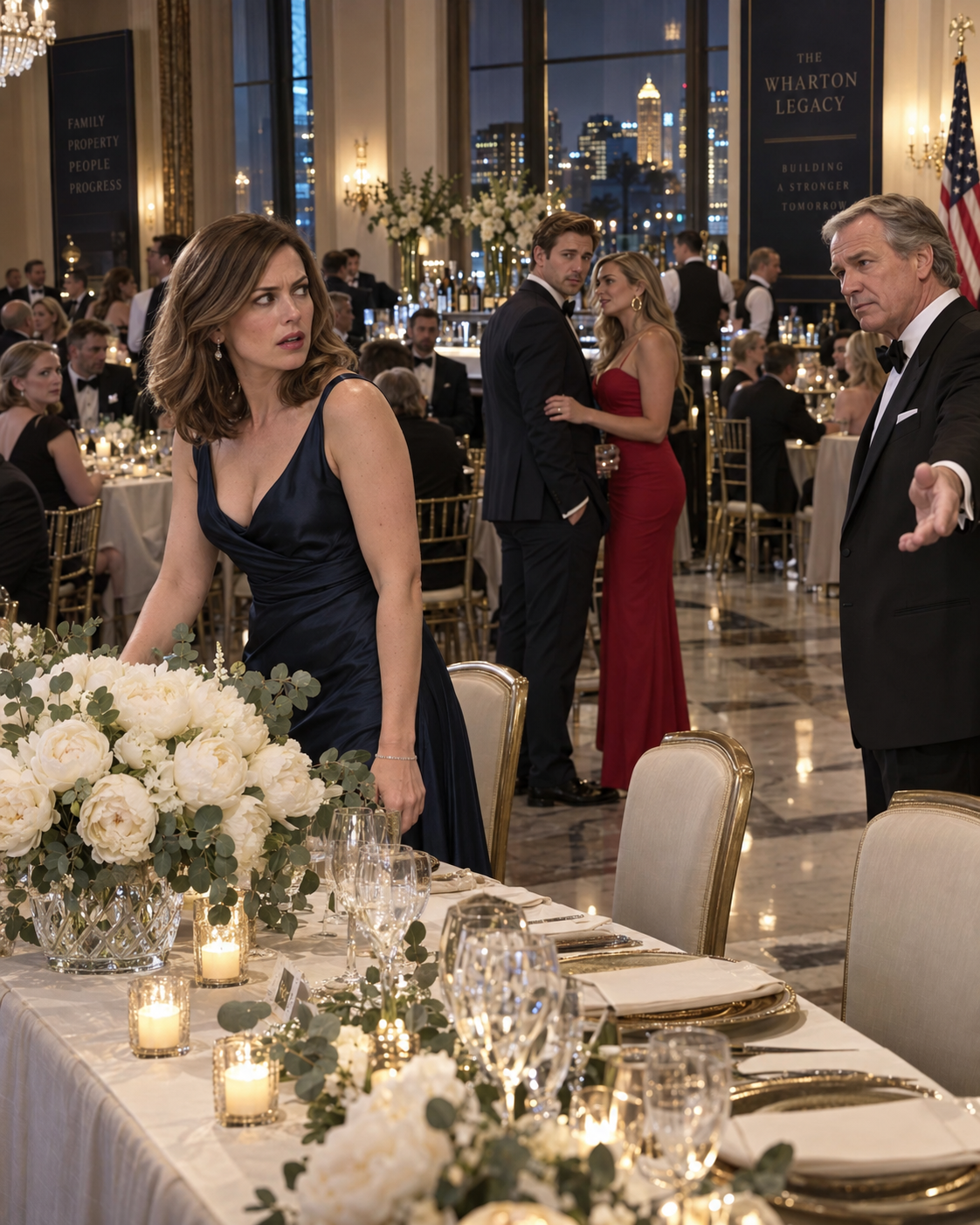
I was carrying a crystal vase of white peonies through a ballroom when my father-in-law pointed me toward the AUXILIARY TABLE
The next morning, I drove to Savannah with the folder on my laptop and the voicemail saved in three different places.
I didn’t play it again.
I didn’t need to.
Some words become permanent the first time you hear them.
By the time I reached my grandmother’s house, the sky had turned pale and the live oaks along the road were throwing long shadows across the pavement.
Matild opened the front door before I knocked.
She looked at me once and said, “You haven’t eaten.”
“I’m fine.”
“That wasn’t what I said.”
I smiled despite myself.
That was my grandmother.
At eighty-one, she could diagnose a lie faster than most doctors diagnosed a fever.
The kitchen smelled like butter, coffee, and something simmering on the stove.
She put a bowl of grits in front of me and sat across the table.
For several minutes, neither of us spoke.
Then she asked, “How many times did he call?”
“Seventeen.”
“From how many numbers?”
“Three.”
She nodded slowly.
“That’s panic.”
“I thought it was regret.”
“No,” she said. “Regret waits for forgiveness. Panic wants the situation controlled.”
I stared down at my bowl.
“The last message said we needed to talk about the Cordell situation before I did anything impulsive.”
Matild’s expression changed.
“Ah.”
“What?”
“He knows what he gave them.”
I looked up.
“He knows exactly what he did.”
The words landed harder than I expected.
I had spent three years translating Leland’s behavior into softer language.
He was busy.
His father was difficult.
Raina was complicated.
The Wharton family had traditions.
I had told myself that marriage meant patience.
I had mistaken patience for permission.
“I want to protect my work,” I said.
Matild leaned back.
“Good.”
“I also want him completely out of my professional life.”
“Better.”
I swallowed.
“And personally…”
She waited.
“I think I’ve known for a long time.”
She didn’t interrupt.
“I think I’ve been cooking the meal and setting the table and telling myself that eventually someone would notice I wasn’t sitting down.”
Matild’s eyes softened.
“Your grandfather did that to me.”
I looked up.
“Grandpa?”
“For thirty years.”
She laughed quietly.
“He sat at the head of the table while I ran the business behind him.”
“You never told me that.”
“I didn’t want to teach you that story.”
“What happened?”
“One day I stopped setting the table.”
I smiled.
“What did he do?”
“He couldn’t find the plates.”
I laughed.
Matild laughed too.
Then her face became serious.
“Three weeks later, he learned where everything was.”
“And you stayed?”
“For a while.”
“Why?”
“Because he changed.”
She reached for my hand.
“But understand something, Dina.”
“What?”
“His change was his responsibility.”
She squeezed my fingers.
“I did not spend the next five years monitoring him to make sure he became the man I needed.”
I looked toward the window.
“What if Leland can change?”
“Then he can change.”
She paused.
“But you don’t owe him the opportunity to practice on you.”
Three days later, Leland came to Savannah.
I watched him through the kitchen window as he stood in the yard holding a paper bag from a bakery in Atlanta.
He was wearing the coat I had given him for his birthday two years earlier.
His hair was messy.
His shoulders looked heavier.
For one dangerous second, I felt sorry for him.
Then I remembered the voicemail.
Matild opened the door.
“You can wait outside.”
He looked surprised.
“I’d like to speak with Dina.”
“You will.”
She closed the door.
I almost laughed.
“Grandma.”
“What?”
“You really sent my husband into the yard.”
“He knows where the door is.”
I went outside twenty minutes later.
Leland stood when he saw me.
“Dina.”
“Sit.”
He sat on the porch step.
I took the wicker chair across from him.
He apologized first.
He apologized for the seating arrangement.
For not correcting his father.
For Raina.
For the gala.
Then he reached the subject I cared about.
“The Cordell work.”
I said nothing.
He rubbed his hands together.
“I thought it would help.”
“You thought my work would help.”
“Yes.”
“Without asking me.”
“I was going to credit you.”
“When?”
He didn’t answer.
“After the contract?”
He looked away.
“Maybe.”
“You told Raina I wouldn’t push back.”
His jaw tightened.
“I know.”
“You told her I always pull myself together.”
“I shouldn’t have said that.”
“No.”
I looked at him.
“You shouldn’t have believed it.”
He stared at me.
I continued.
“You knew exactly what you were counting on.”
He lowered his head.
“I was wrong.”
“Yes.”
“I’ll fix it.”
“Marcia will handle the legal side.”
He looked up.
“You hired a lawyer?”
“Yes.”
“What are you asking for?”
“Correct attribution.”
He nodded.
“And the consulting arrangement?”
“Ended.”
His face changed.
“Dina…”
“I’m not negotiating that.”
He looked toward the garden.
“What about us?”
I took a breath.
“The marriage is ending too.”
For several seconds, he didn’t move.
Then he whispered, “You already decided.”
“I decided the night I heard the voicemail.”
“I can change.”
“Maybe.”
He looked at me.
“You don’t believe me.”
“I believe you want to change now.”
He swallowed.
“But I don’t know if you want to change because you finally understand what you did or because you finally understand that I can leave.”
He had no answer.
I stood.
“Marcia will contact your attorneys.”
“Dina.”
I stopped.
“You loved me.”
It wasn’t a question.
I looked at him.
“I did.”
“Do you still?”
I thought about the three years.
The small breakfasts.
The trips.
The nights we stayed awake talking about houses and cities and future plans.
“I don’t know,” I said.
Then I added, “But I know love isn’t enough when respect is missing.”
I went inside.
The legal process took four months.
Four months of emails.
Documents.
Phone calls.
Arguments between attorneys.
There were moments when I wanted to throw the entire folder away just to stop thinking about him.
But every time I felt that weakness, I remembered the vase.
The white peonies.
The auxiliary table.
The way Clifton had pointed toward it without even considering that I might refuse.
The Whartons had built an entire world around the assumption that certain people belonged at the center and everyone else existed to support the center.
For years, I had mistaken being needed for being valued.
That distinction nearly destroyed me.
Then the lawyers found something.
A developer reviewing the Cordell documentation discovered that one of the original files still contained my company’s watermark in its metadata.
The Wharton team had forgotten to remove it.
My original document was still there.
My name was still there.
The methodology was still connected to my firm.
The evidence was no longer a matter of memory or accusation.
It was sitting inside the project’s own records.
The legal team stopped arguing.
A correction followed.
Raina’s firm publicly credited Colbear Engineering Consulting for the structural methodology behind the feasibility work.
Three firms contacted my attorney afterward.
Then five.
Then more.
They weren’t calling because I had become famous.
They were calling because they had seen what happened when documentation survived a room full of powerful people pretending they didn’t remember who had done the work.
Clifton called me two weeks later.
I didn’t recognize the number.
He said I had embarrassed the family.
I told him I had documented my work.
He said the Whartons had opened doors for me.
I said, “I built the door myself.”
There was silence.
Then he said, “You could have handled this privately.”
I looked out the window of my office.
“I tried privately.”
“You could have spoken to Leland.”
“I did.”
“You could have given him a chance.”
I closed my eyes.
“He had three years.”
That ended the conversation.
He called again.
I didn’t answer.
The divorce was finalized on a Thursday in May.
The courthouse had wide windows and pale carpet.
The judge asked us questions.
We answered.
When it was over, Leland and I stood in the hallway.
Neither of us knew what to say.
Finally he said, “You’ll be fine.”
I looked at him.
“I know.”
He nodded.
Then we walked in opposite directions.
I thought I would feel free.
Instead, I felt tired.
Not sad.
Not relieved.
Just tired.
Like a building after a storm, still standing but waiting for someone to inspect every wall.
I drove to Savannah.
Matild was in the garden.
She didn’t ask how it went.
She looked at my face and knew.
“Tea?” she asked.
“Please.”
That evening, my mother arrived from Charlotte with a car full of things she had apparently been collecting for months.
Three cast-iron pots.
An electric fan.
A framed photograph from the opening day of my engineering firm.
She put the photograph on the kitchen windowsill.
It showed me standing in front of my company’s sign with my arms crossed.
I looked younger.
Angrier.
Certain.
My mother studied it.
“You were ready to fight a building.”
“I was.”
Matild looked over from the stove.
“She still is.”
I laughed.
For the first time in months, the laugh didn’t hurt.
Later that night, everyone went to sleep.
I sat alone on the back porch.
The garden was dark except for the moonlight caught between the trees.
I thought about Leland.
I thought about Raina.
I thought about Clifton.
Then I thought about the woman I had been before any of them.
The woman who had built a company from nothing.
The woman who had learned engineering because she loved the certainty of structures.
The woman who understood that pressure doesn’t always cause a building to collapse immediately.
Sometimes it causes small shifts.
A crack here.
A crooked beam there.
A door that stops closing properly.
A floor that begins to slope.
You notice them.
You explain them away.
You tell yourself the building has always been like that.
Until one day you realize you have been standing underneath something that was never safe.
I finally understood my marriage that way.
It hadn’t collapsed that night at the gala.
The gala had simply exposed the damage.
The real collapse had happened slowly.
Every time Leland let his father speak over me.
Every time I was expected to carry something without being credited.
Every time Raina’s presence was explained away.
Every time I convinced myself that silence was kindness.
I had not lost my marriage in one night.
I had lost it one compromise at a time.
And strangely, realizing that gave me peace.
Because if I had lost it all at once, I might have spent the rest of my life wondering what I could have done differently.
Instead, I could see every place where I had abandoned myself.
And I could choose not to do it again.
The next morning, I went back to Atlanta.
I opened my office before sunrise.
The city was still gray outside the windows.
I made coffee.
Then I walked into the conference room where my old structural drawings were stacked in a cabinet.
I opened the top drawer.
Inside was the original Cordell assessment.
My name was on it.
My company’s name was on it.
My methodology was there.
Untouched.
I ran my fingers across the watermark.
For months, I had thought of that document as evidence of what had been stolen from me.
That morning, I saw something different.
It was proof of what had always belonged to me.
My work.
My judgment.
My name.
No one could take that by pretending not to see it.
A few minutes later, Priya, my new engineer, walked into the office carrying two coffees.
She looked at the drawings.
“Big project?”
“Old project.”
She set the coffee down.
“Bad one?”
I smiled.
“Necessary one.”
She looked at me.
“You okay?”
I considered the question.
“I’m getting there.”
She nodded.
Then she opened her notebook.
“I think your load calculation on page twelve is too conservative.”
I stared at her.
“You think what?”
She pointed at the drawing.
“You’re overestimating the safety margin.”
I laughed.
“You’ve been here three weeks and you’re already arguing with me.”
“You hired me because you wanted good engineering.”
She was right.
I leaned over the table.
“Show me.”
For the next two hours, we argued about numbers.
It was glorious.
No one asked me to smile.
No one told me to sit somewhere else.
No one took my work and put another person’s name on it.
At noon, I received an email from a new client.
They wanted to discuss a major redevelopment project.
The message ended with one sentence.
“We were referred to you because of the Cordell work.”
I sat back in my chair.
For years, I had believed the worst thing that could happen was losing the life I had built with Leland.
I had been wrong.
The worst thing was staying in a life that required me to become smaller every day.
That evening, I returned to Savannah.
Matild was sitting on the porch.
She had a blanket around her shoulders and a book in her lap.
She looked up.
“How was work?”
“Good.”
“Good enough?”
“Better than good.”
She smiled.
I sat beside her.
For a while, we listened to the cicadas.
Then she asked, “Do you miss him?”
I didn’t pretend I didn’t understand.
“Sometimes.”
She nodded.
“That’s allowed.”
“I thought missing someone meant I made the wrong decision.”
“No.”
She closed her book.
“Missing someone means they mattered.”
I looked at her.
“It doesn’t mean they belong in your future.”
The porch went quiet again.
Then I noticed something on the small table beside her.
An envelope.
My name was written across the front.
No return address.
I picked it up.
“What’s this?”
Matild frowned.
“I don’t know.”
My stomach tightened.
I opened it carefully.
Inside was a single sheet of paper.
No letter.
No explanation.
Just a photocopy of an old Wharton Properties document.
At the bottom was a signature.
Clifton Wharton’s.
Above it was a date from nearly four years earlier.
Four months before I married Leland.
I read the first line.
Then the second.
My hands went cold.
The document wasn’t about the Cordell project.
It wasn’t about Raina.
It wasn’t even about my marriage.
It was about me.
Specifically, it described a plan to bring my engineering firm into a future Wharton development partnership.
But beneath the formal language was one handwritten sentence.
“Keep Dina close; her methodology will be valuable to the family.”
I read it twice.
Then a third time.
Matild watched my face.
“What is it?”
I couldn’t answer.
At the bottom of the page was another handwritten note.
This one wasn’t signed.
“She must never know who introduced her to Leland.”
I looked at my grandmother.
For the first time in my life, I saw uncertainty in her eyes.
“Grandma,” I whispered.
She slowly stood.
“Where did you get that?”
“I didn’t.”
She stared at the paper.
Then she looked toward the dark garden.
And after a long silence, she said something that made every piece of the past shift again.
“That handwriting isn’t Clifton’s.”
The night suddenly felt colder.
I looked down at the document.
At the anonymous handwriting.
At the date.
At the sentence that suggested my marriage had never been entirely separate from the Wharton family’s business plans.
And somewhere in Atlanta, inside a family that had spent years deciding who belonged at which table, someone still knew exactly why I had been invited to sit down in the first place.
The next morning, I was going to find out who.