I was braiding my six-year-old daughter’s hair when my attorney called and told me there was still time to change my clothes.
“How much would have to become public?” I asked.
Admiral Brooks studied my face for a moment before answering.
“Enough to establish who you were and what you did. But once we start opening those doors, Daniel, I can’t promise we’ll be able to close all of them again.”
I looked down at the jacket.
Inside its lining were seven names. Seven men who had shared meals with me, laughed with me, argued with me, and trusted me with their lives.
Their families had already suffered enough.
I wasn’t willing to turn their sacrifices into courtroom ammunition just because a wealthy man had decided my daughter was expendable.
“There has to be another way,” I said.
Brooks nodded slowly.
“Then we’d better find it.”
Before he could say anything else, a familiar voice came from behind us.
“Daddy?”
Tessa was standing beside the court-appointed representative, holding a piece of paper covered in colorful drawings.
She walked over and handed it to me.
It was a picture of our little house. There were flowers along the sidewalk, a crooked sun above the roof, and two people standing beside a large brown dog.
We didn’t own a dog.
“That’s the puppy we’re getting someday,” she explained.
Then she pointed to the smaller figure.
“That’s me. And that’s you.”
I smiled.
“It’s beautiful, sweetheart.”
She looked toward the courtroom doors.
“Are they going to make me live somewhere else?”
Something tightened inside my chest.
I knelt so we were eye to eye.
“I’m doing everything I can to make sure we go home together.”
“Did you do something bad?”
“No, honey.”
“Then why are they mad at you?”
I had faced questions under circumstances that would have terrified most people. I’d made decisions that carried consequences I still lived with.
But I had no idea how to answer my six-year-old daughter.
Admiral Brooks turned away and quietly wiped his eyes.
Owen approached us a moment later, carrying his phone.
“Daniel, we have a problem.”
I stood.
“What now?”
“The county’s attorney is requesting that Tessa be placed in temporary protective custody before the end of today’s hearing.”
“On what grounds?”
He hesitated.
“Your behavior in the courtroom. They’re arguing that your refusal to comply with the judge’s instructions, combined with your military background, demonstrates an unpredictable and potentially dangerous temperament.”
I stared at him.
“So protecting people for my country makes me dangerous now?”
“That’s not what I’m saying. That’s what they’re trying to establish.”
Brooks’s expression hardened.
“They’re using his service against him?”
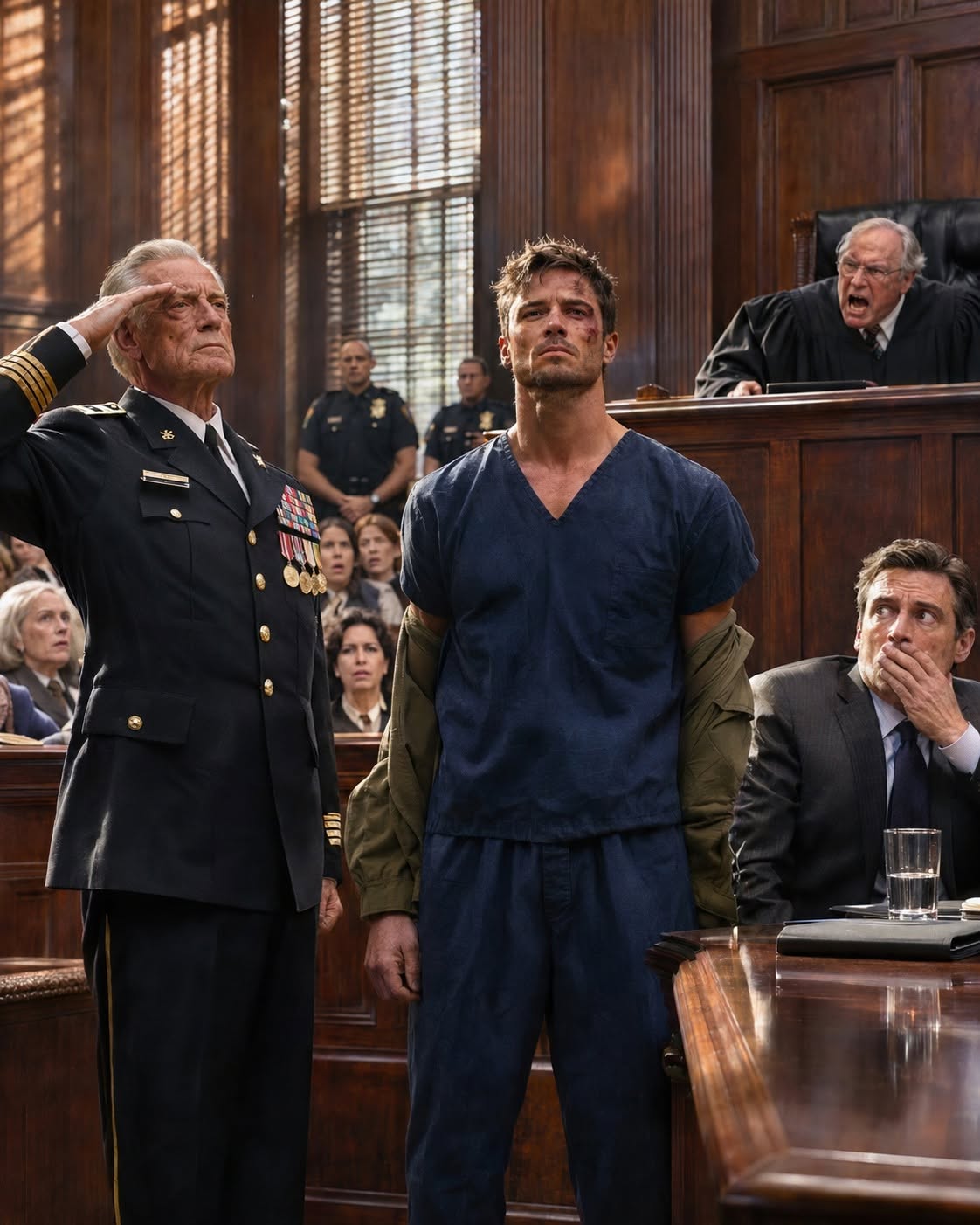
Owen nodded.
“And there’s something else. Howard Hayes submitted a sworn statement this morning claiming Daniel threatened to kill Derek in the parking lot.”
“I never said that.”
“I know. But without the woman you helped or an independent witness, we’re struggling to challenge their version.”
I remembered the woman clearly.
She had been wearing a blue sweater. Her left cheek was swollen, and one of her shoes had come off during the struggle.
After I separated her from Derek, she had grabbed my wrist.
“Please don’t let him follow me.”
Those were the last words she’d spoken to me.
She had disappeared before the police finished questioning everyone.
I’d spent weeks wondering whether she was safe.
Now I wondered whether someone had made sure she stayed silent.
“Find her,” Brooks told Owen.
“We’ve tried. The police report identifies her only as an unidentified female who left the scene. The grocery store’s security footage was supposedly lost because of a recording malfunction.”
“How convenient,” Brooks murmured.
At that moment, Howard Hayes emerged from a conference room down the hallway.
He looked at the admiral, then at me.
“Mr. Carter, may I have a word?”
Owen immediately stepped forward.
“Anything you want to say to my client can be said in my presence.”
Howard smiled.
“Of course.”
He adjusted his expensive watch.
“I think this situation has gotten out of hand. We’re both fathers, Daniel. Surely we can find a reasonable solution.”
“What solution?”
“My son is willing to support a reduction of the criminal charges. I may also be able to persuade certain people that the custody intervention is unnecessary.”
“And what do you want?”
“A written statement acknowledging that you misinterpreted a private disagreement and responded with excessive force.”
There it was.
He wasn’t offering mercy.
He was purchasing innocence for his son.
“You want me to lie.”
“I want you to consider your daughter’s future.”
His eyes moved toward Tessa.
“Children are remarkably adaptable, but being separated from a parent can leave lasting emotional damage.”
I took one step toward him.
Brooks placed a hand against my shoulder.
Howard noticed.
“Think carefully, Mr. Carter. Pride is an expensive luxury for a man on a maintenance worker’s salary.”
He walked away before I could answer.
Owen immediately began typing something into his phone.
“Write down everything you remember about that conversation,” he said. “Every word.”
Brooks was still watching Howard.
“I’ve encountered men like that before,” he said quietly. “They mistake restraint for weakness.”
Twenty minutes later, the hearing resumed.
Judge Caldwell announced that the court would consider the new allegations before deciding whether Tessa could return home with me.
Howard’s attorney called Derek to testify.
He walked to the witness stand wearing a tailored navy suit, his hair neatly combed, his expression carefully arranged into something resembling sadness.
He claimed he’d been having an argument with his girlfriend when I approached without warning.
According to him, I had punched him repeatedly, threatened his life, and continued attacking him after he stopped resisting.
“Did you fear for your safety?” Howard’s attorney asked.
“Absolutely.”
“Did Mr. Carter appear capable of seriously injuring you?”
“He looked like he wanted to kill me.”
I kept my hands folded on the table.
When Owen began his cross-examination, he asked Derek a simple question.
“What is your girlfriend’s name?”
Derek looked uncomfortable.
“I don’t think that’s relevant.”
“She was present during the alleged assault. Her identity is extremely relevant.”
“She’s a private person.”
“Was she injured before Mr. Carter approached you?”
“No.”
“Did you strike her?”
“Absolutely not.”
Owen lifted a photograph from his files.
“This photograph was taken by a responding officer. There appears to be blood on the passenger-side window of your vehicle. Can you explain that?”
Derek looked toward his father.
“I don’t remember.”
“Did you have an injury that could account for that blood?”
“I said I don’t remember.”
Judge Caldwell interrupted.
“Counsel, this is a custody proceeding, not a criminal trial.”
Owen lowered the photograph.
“Your Honor, the petition relies almost entirely on the allegation that my client violently attacked this witness without justification. We have to be allowed to examine that allegation.”
Before the judge responded, the courtroom doors opened.
A young woman stood beside a deputy.
She wore a gray cardigan and held a brown envelope against her chest.
For a second, I didn’t recognize her.
Then I saw her eyes.
It was the woman from the parking lot.
Derek went completely still.
Howard rose halfway from his chair.
“What is she doing here?”
The woman heard him.
Her fingers tightened around the envelope, but she didn’t turn away.
“My name is Emily Warren,” she said.
“And I’m here because somebody finally told me what happened to the man who saved me.”
Owen looked at me.
I looked at Brooks.
The admiral appeared just as surprised as I was.
Emily explained that a former coworker had sent her a social media post about the case that morning.
She hadn’t known I was facing criminal charges.
She certainly hadn’t known that someone was trying to take my daughter away.
Judge Caldwell instructed her to wait outside while the attorneys discussed whether she could testify.
Howard’s attorney objected immediately, arguing that she hadn’t been properly disclosed as a witness.
Owen stood.
“Your Honor, this is the very witness my client has been trying to locate for weeks.”
After several tense minutes, the judge agreed to hear her testimony under oath.
Emily approached the witness stand.
She looked terrified.
But when Owen asked what had happened in the parking lot, her voice became surprisingly steady.
“Derek was angry because I told him I was ending our relationship. He took my phone, grabbed my hair, and hit me. I tried to get into my car, but he wouldn’t let me.”
She glanced at me.
“Mr. Carter told him to release me. Derek swung at him first. Mr. Carter pulled him away and restrained him until I could escape.”
“Did Mr. Carter threaten to kill Derek?”
“No.”
“Did he continue hurting him after the threat had ended?”
“No. He actually told Derek to calm down.”
Derek shook his head.
“She’s lying.”
The judge ordered him to remain silent.
Owen continued.
“Emily, why didn’t you come forward earlier?”
Her eyes filled with tears.
“Because his father told me not to.”
The courtroom fell silent.
Howard stood abruptly.
“That’s outrageous!”
Emily opened the brown envelope.
Inside were printed emails, photographs of her injuries, and screenshots of messages.
She explained that Howard had contacted her the day after the incident.
He had threatened to have her fired from her job at a company that depended heavily on his business contracts.
He had also threatened to pursue legal action against her mother over an outstanding financial agreement.
“He told me nobody would believe someone like me over his son.”
Her voice broke.
“So I left town. I stayed with my aunt.”
Owen accepted the documents and asked that they be preserved as evidence.
But Emily wasn’t finished.
“There’s something else.”
She reached into her bag and removed a small flash drive.
“The security cameras weren’t the only cameras in that parking lot.”
A delivery driver had witnessed the incident from his truck. His dashboard camera had recorded part of it.
He had contacted Emily afterward to make sure she was safe and offered her the recording.
She had kept a copy, afraid that Derek might eventually accuse her of something.
“I never thought they’d blame the man who helped me.”
Owen requested another recess so both sides could review the footage and establish its origin.
Howard’s attorney asked to speak privately with his client.
For the first time, Howard looked genuinely frightened.
During the recess, the court’s technical staff helped the attorneys review the recording.
It wasn’t perfect. There was no clear audio, and another vehicle partially obstructed the view.
But it showed enough.
It showed Derek grabbing Emily.
It showed me approaching with my hands open.
It showed Derek lunging toward me.
Most importantly, it showed me releasing him as soon as Emily reached safety and moving several feet away.
There was no prolonged attack.
No pursuit.
No uncontrolled violence.
Everything Derek had sworn to under oath began collapsing in less than two minutes.
When we returned to the courtroom, Owen requested that the emergency custody petition be denied.
Then something unexpected happened.
Judge Caldwell removed his glasses.
He stared at the documents before him for a long time.
“Before this matter proceeds, I need to disclose something.”
Howard’s attorney looked up.
“Mr. Hayes has participated in fundraising activities for organizations with which I have been associated. We have also attended several private community functions together.”
Owen stood slowly.
“Your Honor, were those connections disclosed before today?”
“No.”
“Then we respectfully request your recusal.”
Caldwell’s face reddened.
“I have not concluded that those associations affected my judgment.”
Admiral Brooks remained silent in the gallery.
So did I.
The judge looked toward Tessa.
Then toward the video evidence.
Finally, he announced that he would step aside and arrange for another judge to review the emergency matter that afternoon.
No one applauded.
There were no dramatic declarations of innocence.
Just paperwork, hurried phone calls, uncomfortable conversations, and another long wait in a courthouse hallway.
By then, Tessa had fallen asleep against my chest.
Her little fingers were wrapped around the frayed sleeve of my jacket.
Brooks sat beside us.
“You could have walked away from that parking lot,” he said.
“I know.”
“Do you ever wish you had?”
I considered the question.
“If I’d walked away, I wouldn’t be sitting here.”
“That’s true.”
“But Emily might not be sitting here either.”
He nodded.
Around four that afternoon, we entered a different courtroom.
Judge Margaret Ellis reviewed the county’s petition, the newly presented evidence, and the recommendations of the court-appointed representative.
She asked Owen several questions about my employment, Tessa’s school attendance, our living conditions, and whether there had ever been previous reports concerning her safety.
There hadn’t.
Then she addressed me directly.
“Mr. Carter, military decorations and distinguished service do not automatically establish that someone is a fit parent.”
“I understand, Your Honor.”
“Similarly, a criminal accusation does not automatically establish that someone is an unfit parent.”
I felt Owen relax beside me.
Judge Ellis continued.
“The relevant question before this court is whether there is credible evidence that your daughter faces an immediate danger in your care. Based on what has been presented today, I find insufficient grounds for emergency removal.”
For a moment, I couldn’t move.
“The emergency petition is denied. The child may return home with her father.”
Tessa climbed down from her chair before anyone could stop her.
“Daddy!”
She ran into my arms.
I held her so tightly that she started laughing.
Owen turned away, pretending to organize his papers.
Admiral Brooks bowed his head.
I had spent the entire day trying not to cry.
I finally stopped trying.
The criminal case took another six weeks to resolve.
Investigators interviewed Emily, located the delivery driver, authenticated his recording, and examined the inconsistencies in the original police report.
A prosecutor from outside the county eventually dismissed the felony assault charge against me.
Derek was subsequently charged in connection with his attack on Emily and his false statements. He later accepted a plea agreement that included a period of incarceration, supervised probation, and a protective order.
Howard became the subject of a separate investigation into possible witness intimidation.
Some of his business associates began distancing themselves from him.
Judge Caldwell’s handling of my hearing was referred for judicial ethics review.
I didn’t follow every development.
I had spent enough of my life surrounded by conflict.
What mattered was getting back to work, paying the bills, packing Tessa’s lunches, and remembering which days she needed sneakers for gym class.
But there was one thing I couldn’t return to.
Being invisible.
Someone who attended the hearing had posted about Admiral Brooks recognizing me.
Within days, reporters began contacting me.
They wanted photographs, interviews, military records, and stories about Ghost Seven.
One producer offered me more money for an exclusive interview than I earned in an entire year.
I declined.
Then, one Saturday morning, Admiral Brooks arrived at my house carrying a wooden box.
Tessa answered the door.
“Are you Daddy’s army friend?”
“Navy friend,” he corrected gently.
“Do you want pancakes?”
“More than you can imagine.”
We ate breakfast together before he asked to speak with me privately.
He placed the box on our kitchen table.
Inside were seven envelopes.
“What are these?”
“Letters.”
“From whom?”
“The families of your teammates.”
I stared at him.
Brooks explained that, after seeing me in court, he had quietly contacted authorized military personnel to determine what information could be shared with the families without compromising classified material.
Many of them had never received meaningful answers about their loved ones’ final mission.
He had been able to tell them that someone from the team had survived.
That someone remembered.
I opened the first envelope.
It was from the mother of a man named Michael Reed.
Michael had been twenty-seven when he died.
He carried a photograph of his mother in his wallet and complained constantly about military coffee.
Her letter was only a page long.
Dear Daniel,
For years, I wondered whether my son died alone. Admiral Brooks told me that he didn’t. I don’t need to know where he was or what happened. I only needed to know somebody was with him. Thank you for being that somebody.
I couldn’t finish reading aloud.
The second letter was from another teammate’s younger brother.
The third was from a widow.
The fourth contained a photograph of a little boy who had grown into a young man without ever meeting his father.
Each family had different questions.
But none asked me to reveal secrets.
They wanted memories.
Ordinary things.
What made their loved ones laugh.
What they talked about when they missed home.
Whether they knew how much they were loved.
Brooks watched me touch the inside of my jacket.
“You’ve carried those men for a long time, Daniel.”
“I promised I would.”
“Keeping a promise doesn’t mean you have to carry it alone.”
A month later, with appropriate arrangements and permission, I met several of the families at a private gathering.
I was more nervous walking into that room than I’d been walking into court.
Michael’s mother approached me first.
She was a small woman with silver hair and gentle hands.
“Did you know my son well?”
“Very well, ma’am.”
“Was he happy?”
I told her about his terrible jokes, his habit of stealing everyone’s hot sauce, and how he used to talk about taking her to Italy when he finally had enough money.
She laughed through her tears.
Then she asked about the jacket.
For years, I had refused to let anyone examine it.
That afternoon, I took it off.
I laid it across a table and carefully unfolded the lining.
Seven names appeared in faded stitching.
One by one, the families reached forward.
Some touched the names.
Others simply stood and cried.
For the first time, the jacket didn’t feel like a burden.
It felt like a bridge between people who had lost something they could never replace.
Tessa stood beside me throughout the gathering.
On our way home, she asked why everyone had been crying.
“Because they missed people they loved.”
“Like we miss Mommy?”
“Exactly like that.”
She thought about it for a while.
“Maybe they’re happy you remember them.”
I reached across the seat and squeezed her hand.
“I think you’re right.”
Several months later, Emily came to our house.
She brought a small bouquet of flowers and a stuffed golden retriever for Tessa.
She had moved into her own apartment, found a new job, and begun volunteering with an organization that supported survivors of domestic abuse.
We sat on the porch while Tessa played in the yard.
“I still feel terrible about disappearing,” Emily admitted.
“You were scared.”
“You almost lost your daughter because of me.”
“No,” I told her. “I almost lost my daughter because someone abused his power. That wasn’t your doing.”
She looked down.
“I wish I’d been braver.”
“You came back when you knew what it could cost you. That’s bravery.”
Before leaving, she hugged me.
“Thank you for stopping that day.”
I watched her drive away, knowing that the decision I had questioned so many times had helped give her another chance at life.
The following spring, Tessa’s school held a family appreciation day.
The children were asked to draw a picture of someone they considered a hero.
Some drew firefighters.
Others drew police officers, doctors, or superheroes wearing brightly colored capes.
Tessa drew me.
Not in a military uniform.
Not standing beside Admiral Brooks.
Not fighting anyone in a parking lot.
She drew me standing in our kitchen, holding a hairbrush in one hand and a pancake spatula in the other.
Underneath, in uneven little letters, she had written:
MY DADDY IS MY HERO BECAUSE HE ALWAYS COMES HOME.
I framed that picture.
It sits beside the wooden box containing the letters from my teammates’ families.
As for the olive-green jacket, I still wear it occasionally.
But it no longer hangs beside my work clothes.
Tessa helped me find a special place for it, where the fabric can be preserved and the seven names will never fade beyond recognition.
And yes, we eventually got that puppy.
A clumsy rescue dog with oversized paws and an unfortunate habit of chewing furniture.
Tessa named him Sunday because that was the day we brought him home.
Sometimes, when I’m sitting on the porch watching my daughter chase him around the yard, I remember the courtroom and Howard Hayes telling me that pride was an expensive luxury.
He was wrong about what I had been protecting.
It wasn’t pride.
It was the belief that a person’s worth shouldn’t depend on the price of his clothes, the size of his bank account, or the importance of the people who recognize his name.
I didn’t deserve justice because I had once been Ghost Seven.
I deserved justice because I was a human being.
And so did Emily.
The greatest lesson I learned wasn’t that powerful people could be defeated.
It was that doing the right thing doesn’t always protect you from suffering, and telling the truth doesn’t always guarantee an immediate victory.
Sometimes courage means stepping between a stranger and danger.
Sometimes it means walking into a courtroom when you’re terrified.
Sometimes it means admitting that you need help.
And sometimes it means finally taking off a jacket you’ve worn for years, not because someone ordered you to, but because you’ve found people you trust enough to share what it carries.
I used to believe the most important promise of my life was the one I’d made to seven men who never came home.
I understand something different now.
Honoring the dead isn’t only about remembering how they died.
It’s about making something worthwhile out of the life you were fortunate enough to keep.
Every morning, I braid my daughter’s hair.
Every evening, I come home to her.
And whenever she asks me what it means to be a good person, I tell her something I hope she’ll remember long after I’m gone.
You don’t need a uniform to protect someone.
You don’t need a title to stand up for what’s right.
And you should never let another person’s cruelty convince you that kindness was a mistake.
Because sometimes, the greatest thing you can do with the life you’ve been given is make sure someone else gets to live theirs.
Those seven men taught me that.
My little girl reminds me of it every single day.