I was being mocked in seat 14B when the flight attendant accused me of panicking during the storm
For a few seconds after the aircraft stopped, I couldn’t move.
My hands remained wrapped around the yoke even though the engines were screaming down and the wheels were half-buried in Nova Scotia mud.
Outside the windshield, red emergency lights flashed through the rain.
Inside the cockpit, hundreds of people were breathing, crying, praying, and trying to understand why they were still alive.
I couldn’t explain it either.
I had expected relief.
Instead, I felt the same cold sensation I had felt six months earlier over the Mediterranean.
Something was wrong.
Something had followed me here.
A firefighter reached the cockpit window and pointed toward the emergency exit.
“Major, are you hurt?”
I almost laughed.
Nobody had called me Major in six months.
I unbuckled myself slowly.
“I’m fine.”
The captain was alive.
The first officer was alive.
Somehow, despite the violence, every passenger was alive.
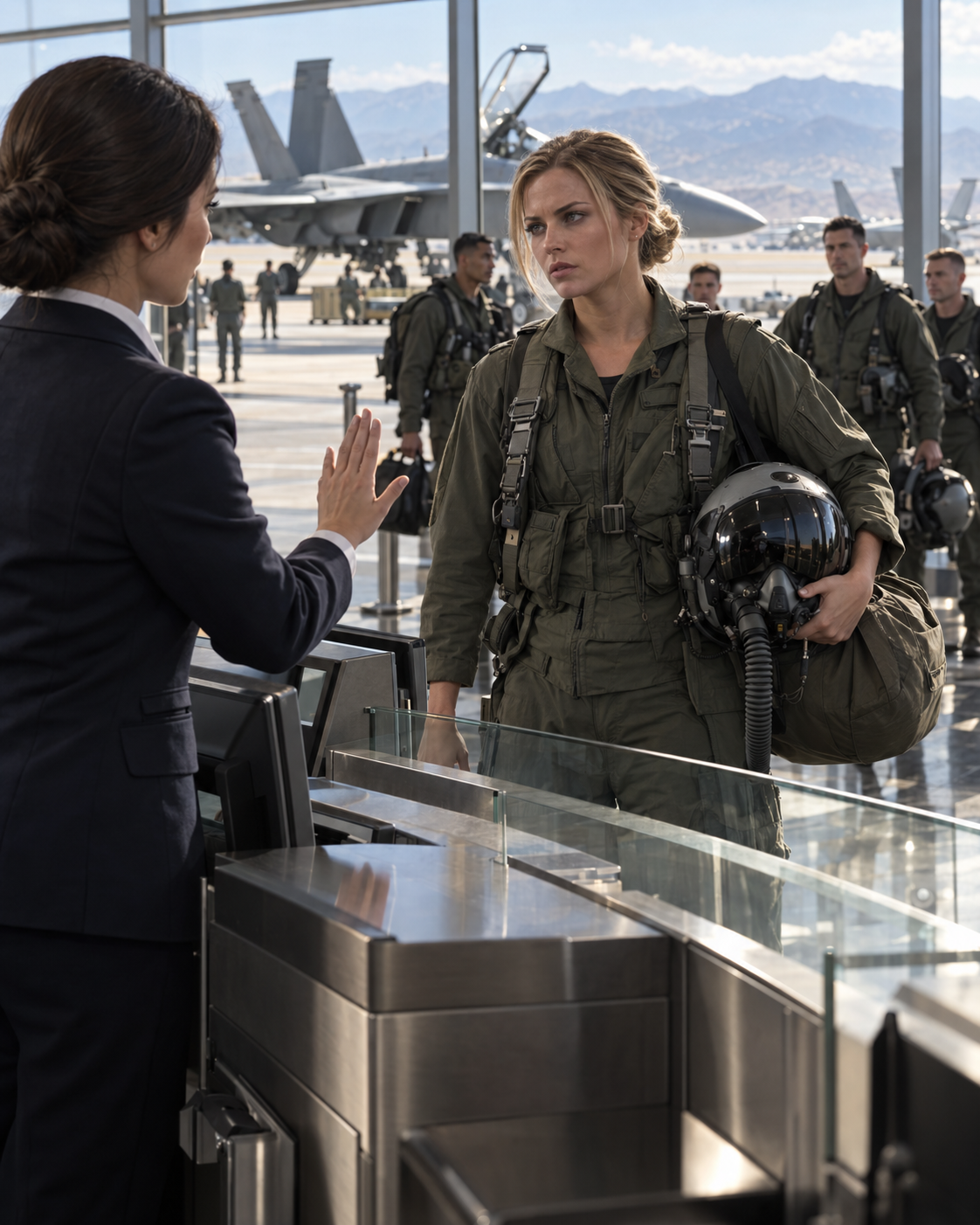
I climbed down from the aircraft into freezing rain.
A paramedic wrapped a blanket around my shoulders, but I barely felt it.
The airport was chaos.
Fire trucks surrounded the runway.
Police were moving passengers into buses.
Medics checked the injured.
And then I saw him.
Raven One.
My former wingman, Daniel Mercer, stood beyond the barricade in a flight suit, helmet tucked under one arm.
He had landed at a nearby military facility after escorting us in.
For a moment, we simply stared at each other.
Then he walked toward me.
“You look terrible.”
I smiled weakly.
“So do you.”
He stopped in front of me.
“You weren’t supposed to be flying today.”
“I wasn’t.”
His expression changed.
“What happened?”
I looked back at the ruined 777.
“Someone brought the Mediterranean with me.”
His smile disappeared.
“What does that mean?”
I reached into my pocket.
My fingers touched the black fragment I had pulled from beneath the cockpit floor.
“Six months ago, I told investigators the failure wasn’t mechanical.”
Daniel stared at the metal.
“You never told me that.”
“I wasn’t allowed to.”
“By who?”
I looked toward the terminal.
“That’s what I still don’t know.”
Before he could answer, a man in a dark government jacket approached us.
His badge identified him as Thomas Hale, a senior investigator with the National Transportation Safety Board.
“Major Cross,” he said.
“Mr. Hale.”
“I need to speak with you privately.”
Daniel stepped forward.
“She’s just survived a catastrophic crash.”
Hale didn’t look at him.
“Then she’ll understand why this can’t wait.”
We followed him into a small airport operations room.
The door closed.
Hale placed a photograph on the table.
It showed the engine of the aircraft after the explosion.
“Engine two suffered an uncontained failure,” he said.
“I know.”
“Do you?”
He slid another photograph across the table.
My stomach tightened.
It showed a tiny fracture inside the engine assembly.
The fracture wasn’t random.
It was a clean, deliberate cut.
Someone had weakened the component before the flight.
I looked up.
“This wasn’t an engine failure.”
“No.”
“It was sabotage.”
Hale nodded.
“And we believe it was connected to your previous incident.”
The room seemed to become smaller.
“Why?”
He reached into a folder and removed an old investigation photograph.
I recognized it immediately.
It was the wreckage from the Mediterranean incident.
Six months earlier, my F-35 had suffered a catastrophic systems failure during a routine training sortie.
I had ejected at low altitude.
The investigation concluded that a maintenance defect had caused the failure.
I had disagreed.
There had been a tiny piece of foreign metal inside a control assembly.
It was dismissed as debris.
Now I understood why that memory had never left me.
It hadn’t been debris.
It had been evidence.
Hale lowered his voice.
“Someone has been testing a method.”
“A method for what?”
“Making aircraft failures look accidental.”
I stared at him.
“How many?”
He didn’t answer.
That was the answer.
My chest tightened.
Daniel swore under his breath.
Hale closed the folder.
“There is one more thing.”
He placed a photograph on the table.
It showed the maintenance hangar at the airport in Miami.
A man stood near the aircraft six hours before departure.
His face was partially hidden.
But I knew the posture.
I knew the way he stood.
I had seen him before.
Not at an airport.
At the Air Force base where I had trained.
“That’s impossible,” I whispered.
“Who is he?” Daniel asked.
I couldn’t answer.
Because the man in the photograph was Colonel Marcus Vale.
My former squadron commander.
The man who had signed the report declaring my Mediterranean crash an accident.
The man who had personally recommended that I be placed on administrative leave.
The man I had trusted.
Hale watched my face.
“You know him.”
“I did.”
“Did?”
“I don’t know him anymore.”
That night, I couldn’t sleep.
The hotel room was quiet except for rain tapping against the glass.
Every time I closed my eyes, I saw the runway disappearing beneath the aircraft.
I saw the right wing.
I heard the tires explode.
But beneath those memories was another image.
A metal fragment.
Small enough to fit beneath a fingernail.
Important enough to connect two crashes.
At 2:13 in the morning, my phone rang.
Unknown number.
I answered.
Nobody spoke.
Then a man’s voice whispered, “You should have stayed in Miami.”
The line went dead.
I sat completely still.
Then the phone rang again.
This time, there was a message.
One photograph.
It showed Daniel.
He was walking toward his military aircraft.
Taken that morning.
A second message appeared.
“Next time, there won’t be 300 people to save you.”
I immediately called Daniel.
He answered on the first ring.
“What happened?”
“Where are you?”
“At the base.”
“Don’t go anywhere.”
Silence.
Then he asked, “Valerie, what did you find?”
“Someone is watching you.”
He exhaled.
“I figured.”
“You knew?”
“I found something after we landed.”
“What?”
“I didn’t want to tell you over the phone.”
Twenty minutes later, Daniel arrived at the hotel.
He looked exhausted.
He placed a small evidence bag on the table.
Inside was a screw.
Ordinary.
Almost worthless.
Except it wasn’t.
“Found this near the fuel control assembly of your aircraft,” he said.
I stared at it.
“That’s military-grade fastener hardware.”
“Exactly.”
“How did it get there?”
Daniel looked at me.
“Someone put it there.”
We spent the next three hours comparing photographs, maintenance records, and fragments.
The pattern finally emerged.
Every incident had one thing in common.
A component had been altered just enough to create a failure under extreme stress.
Not enough to be discovered during routine inspection.
Not enough to leave an obvious fingerprint.
The sabotage was designed to look like bad luck.
And whoever was doing it understood aircraft better than most engineers.
Then Daniel found a name buried inside an old maintenance contract.
Marcus Vale.
He wasn’t merely a commander.
He had quietly become a consultant for a private aerospace contractor after leaving active flight operations.
The company had recently received a massive government contract for autonomous military aircraft.
If conventional aircraft failures could be made to appear inevitable, billions could be redirected toward unmanned systems.
But money wasn’t the worst part.
The worst part was the list.
There were twelve incidents.
Seven military.
Five civilian.
Three had been fatal.
My Mediterranean crash had been number eleven.
Flight 418 was number twelve.
I stared at the page.
“Why me?”
Daniel looked away.
“Maybe because you survived the first time.”
“No.”
I shook my head.
“That’s not enough.”
Then I remembered something.
Six months earlier, before my F-35 failed, I had reported a discrepancy in a maintenance log.
A technician had signed off on a component that hadn’t actually been inspected.
The report disappeared.
I had complained.
Vale had told me to stop digging.
Two weeks later, my aircraft almost killed me.
Suddenly everything connected.
I hadn’t been chosen because I was unlucky.
I had been chosen because I had noticed something.
Someone had been afraid I would keep looking.
The next morning, federal agents arrested Marcus Vale.
At least, that’s what we thought.
The arrest warrant was executed at his home.
He wasn’t there.
His house was empty.
His phone was destroyed.
His passport was gone.
But investigators found one thing.
A photograph taped beneath his desk.
It showed me standing beside my F-35 years earlier.
On the back were four words.
“She always looks twice.”
I couldn’t stop thinking about that sentence.
Because it was true.
Pilots survive by noticing what doesn’t belong.
A sound.
A vibration.
A warning light.
A fraction of a second.
Sometimes survival begins with refusing to accept that something feels normal.
Three days later, I was flown back to Washington.
The Air Force reinstated me pending a full investigation.
The NTSB asked me to testify.
I expected the hearing room to be hostile.
Instead, it was silent.
People listened as I described the crash.
I told them about the hydraulic failure.
The damaged wing.
The stabilizer trim.
The landing gear.
The crosswind.
But I also told them something else.
“I didn’t save that airplane because I was fearless.”
The room remained silent.
“I was terrified.”
I looked down at my hands.
“I saved it because fear doesn’t get to decide what happens next.”
For the first time in months, I felt something inside me loosen.
The investigation eventually exposed the network.
Engineers, contractors, former officers, and corporate executives had manipulated maintenance systems across several aviation programs.
Some had taken money.
Some had been threatened.
Some had convinced themselves they were doing something necessary.
That was the part that haunted me.
People rarely wake up one morning and decide to become monsters.
Sometimes they simply make one compromise.
Then another.
Then another.
Until the terrible thing becomes easier than admitting what they have become.
Months later, I returned to the runway in Sydney.
The 777 had been removed from the mud.
The runway had been repaired.
The scars were still visible if you knew where to look.
I stood alone at the edge of the pavement.
Daniel joined me.
“You ever think about that night?”
“Every day.”
“Regret taking the controls?”
I looked at him.
“No.”
“Not even a little?”
I watched a commercial jet climb into the pale morning sky.
“I regret that someone put us there.”
Then I smiled faintly.
“But I don’t regret choosing to bring everyone home.”
Daniel nodded.
For a while, neither of us spoke.
Then my phone vibrated.
One new message.
No number.
No name.
Just a photograph.
My blood went cold.
It was an image of Flight 418 sitting safely on the runway after the crash.
In the corner of the photograph, someone had circled the cockpit.
Beneath it were five words.
“YOU SAVED THE WRONG PEOPLE.”
I stared at the screen.
Daniel saw my face.
“What is it?”
I handed him the phone.
His expression hardened.
We looked toward the runway together.
The morning was quiet.
Almost peaceful.
But I had learned something that day.
Peace isn’t the absence of danger.
Sometimes it’s simply the moment before you realize the danger has changed its shape.
I put the phone back in my pocket and started walking.
I didn’t know who had sent the message.
I didn’t know what they wanted.
But I knew one thing now.
I would never again mistake survival for the end of the story.
Because sometimes the person who saves everyone on the airplane is the same person who becomes the only witness to what happened inside it.
And somewhere beyond the runway, someone was still watching.
This time, I intended to look back.
… THE END.