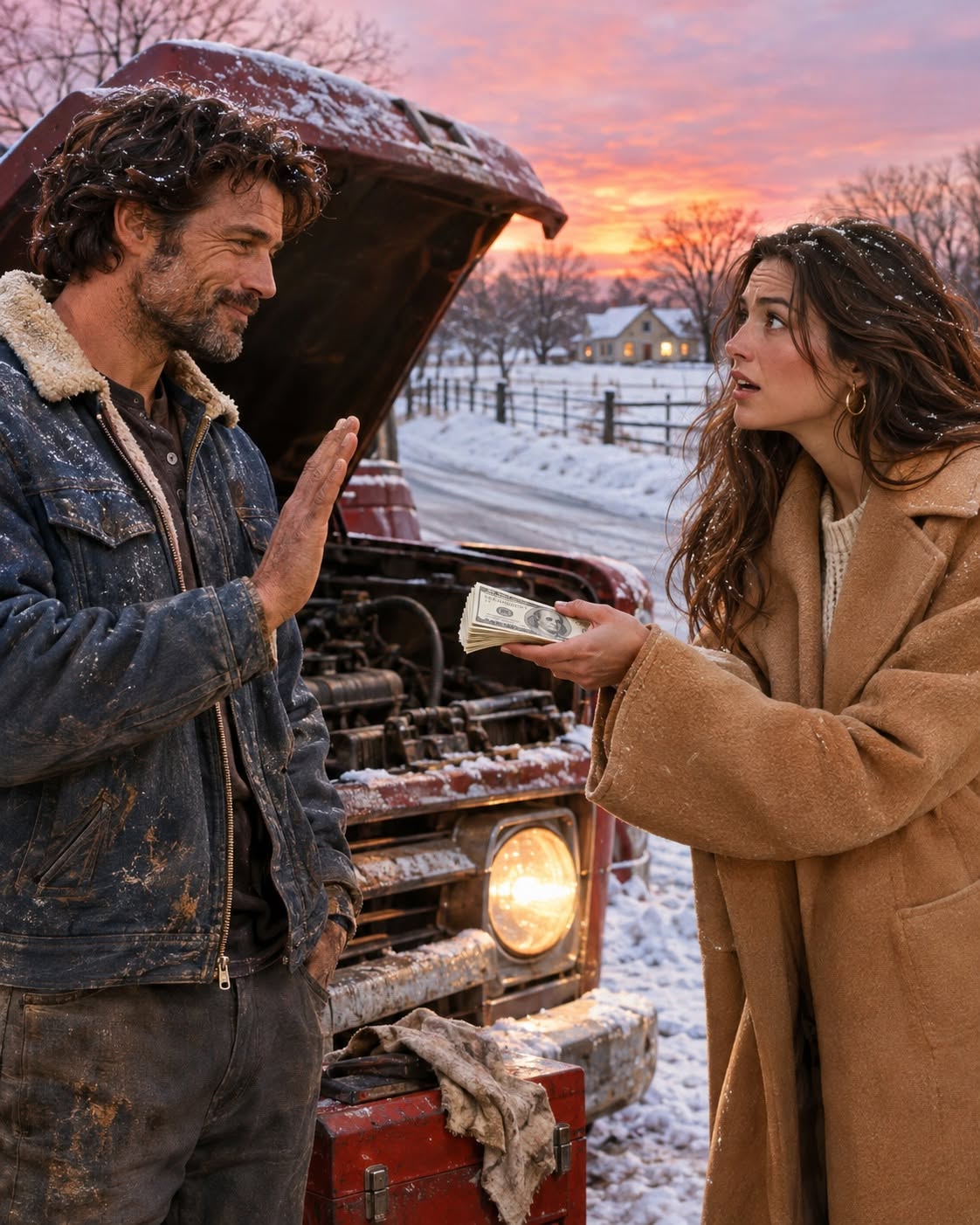
I was already late picking up my seven-year-old daughter when I saw an old pickup truck sitting on the shoulder of a snow-covered road.
The first time I seriously considered expanding Brooks Auto Care, I was standing in the grocery store holding two cartons of milk.
One was the brand Chloe liked. The other was a dollar cheaper.
Six months earlier, that dollar would have mattered.
Now, for the first time in a long while, I could afford not to think about it.
That should have made me happy.
Instead, I found myself wondering how quickly a man could forget what it felt like to have only forty-three dollars in his checking account.
My phone rang before I reached the checkout.
It was Victoria Shaw.
“Daniel, I have a proposition for you.”
I shifted the milk into one hand.
“That sounds expensive.”
She laughed.
“Actually, it could make you a very wealthy man.”
I didn’t know it then, but those words would lead me into the hardest six months of my life.
And before it was over, I would have to choose between saving my father’s business and keeping the promise I’d made to my daughter.
Victoria wanted to meet the following Monday.
When I arrived at Shaw Transportation’s headquarters, Mark Vance was waiting in the conference room.
That surprised me.
After our first meeting, I’d assumed Mark would prefer never to see me again.
But he stood, shook my hand, and offered me coffee.
“Daniel,” he said, “I owe you an apology.”
I looked at him.
“For what?”
“For dismissing your concerns about our maintenance model. You were right.”
It wasn’t the kind of thing I expected from a man who wore a watch worth more than my truck.
“Well,” I said, “I’ve been wrong plenty of times myself.”
He smiled, but there was something carefully measured about it.
Victoria entered carrying a thick folder.
Shaw Transportation was planning to expand its regional operations. The company needed a network of reliable maintenance providers, especially in rural areas where its centralized facilities couldn’t respond quickly enough.
And Victoria wanted Brooks Auto Care to become the foundation of that network.
Not just another contractor.
The lead service provider.
She slid a document across the table.
I opened it.
Then I looked at the number printed on the first page.
$1.8 million.
For a moment, I thought I’d misunderstood.
“That’s the projected value over three years,” Victoria explained. “Assuming the performance targets are met.”
I stared at the document.
My father had spent thirty years building a shop that sometimes struggled to bring in fifteen thousand dollars a month.
Now someone was offering me a contract that could change everything.
There was just one problem.
To meet the requirements, I’d need a larger facility, additional technicians, specialized equipment, and a twenty-four-hour emergency response system.
In other words, I’d have to turn Brooks Auto Care into something my father might not recognize.
“Take your time,” Victoria said. “I don’t expect an answer today.”
Mark leaned forward.
“Opportunities like this don’t come along often, Daniel.”
I nodded.
But I couldn’t stop thinking about the little drawing behind my desk.
My daddy fixes more than cars.
That evening, Chloe was sitting at the kitchen table working on a school project when I got home.
She had glue on her fingers and purple construction paper stuck to her elbow.
“Daddy, if you could have anything in the whole world, what would you want?”
I smiled.
“That’s a pretty big question.”
“Mrs. Patterson says we have to ask our parents.”
I considered telling her I wanted a bigger shop.
Or enough money to pay off the house.
Or a vacation somewhere warm where we wouldn’t have to worry about anything.
Instead, I said, “One more day with your mom.”
Chloe stopped cutting paper.
For a moment, neither of us spoke.
Then she climbed into my lap.
“Me too,” she whispered.
I held her until the kitchen clock struck eight.
Later that night, I read the contract again.
And again.
At two in the morning, I signed the preliminary agreement.
I told myself I was doing it for Chloe.
For her future.
For the security Emily and I had always wanted to give her.
But sometimes the reasons we tell ourselves aren’t the whole truth.
Sometimes success feels so good that we stop asking what it’s costing us.
Within three weeks, everything began moving.
I leased the vacant warehouse beside the shop.
I hired four additional mechanics.
Luis became my service manager, and we purchased two used roadside assistance trucks.
For the first time in years, our parking lot was full before sunrise.
Customers came from counties I’d barely heard of.
Commercial vehicles lined up outside the new service bays.
The phone rang constantly.
And I started missing dinner.
At first, Chloe didn’t complain.
She’d leave little notes in my lunchbox.
“Love you, Daddy.”
“Don’t forget to eat.”
“Can we make pancakes Saturday?”
But Saturdays became busy too.
One night, I came home after ten and found a plate of cold pancakes covered in plastic wrap.
Beside it was a note in Chloe’s handwriting.
“I saved you the biggest one.”
I sat at the table staring at that plate for a long time.
Then I ate every bite.
Even though I wasn’t hungry.
A month later, Luis came into my office carrying a maintenance report.
“We’ve got a problem,” he said.
I looked up.
“How bad?”
“Depends on whether you want the short answer or the expensive one.”
He placed three inspection forms on my desk.
They involved Shaw Transportation vehicles serviced at a different contractor’s facility before arriving at ours.
Each had been marked safe for operation.
Each had serious mechanical issues.
One had badly worn brake components.
Another had a steering linkage problem.
The third had a cracked suspension bracket.
“These trucks shouldn’t have been cleared,” Luis said.
I examined the paperwork.
All three inspections had been approved by a company called Apex Fleet Solutions.
I’d heard the name before.
Apex was a large maintenance contractor with facilities across the Midwest.
They were also the company Mark Vance had originally recommended for Shaw’s centralized maintenance program.
“Could be sloppy work,” I said.
Luis shook his head.
“Three trucks in two weeks? That’s more than sloppy.”
I called Victoria.
She listened carefully and asked me to send the reports directly to her office.
An hour later, Mark called.
His voice was polite.
Too polite.
“Daniel, I understand you’ve raised some concerns about Apex.”
“Yes, sir.”
“I appreciate your attention to detail, but we need to be careful about making accusations.”
“I’m not accusing anyone. I’m documenting what we found.”
“Of course. But Apex is a major strategic partner. We don’t want unnecessary complications.”
I looked through the glass window at Luis inspecting another truck.
“Neither do I,” I said. “Especially the kind that happen when brakes fail.”
There was a pause.
“Just remember, Daniel. You’re building something important here. Don’t lose sight of the bigger picture.”
After he hung up, I sat motionless.
The bigger picture.
I’d heard those words before.
Usually from people who weren’t the ones standing on icy highways when something went wrong.
Two days later, one of our new technicians, a young man named Aaron, asked to speak with me privately.
He looked nervous.
“I think I messed up,” he said.
My stomach tightened.
“What happened?”
He handed me a work order.
A Shaw delivery truck had come in for routine maintenance.
Aaron had found a brake problem and recommended replacing several components.
But the repair had been delayed because the parts weren’t immediately available.
“Who approved releasing the truck?” I asked.
Aaron swallowed.
“The dispatcher said it was needed for an urgent shipment. I told him it wasn’t safe.”
“Did you sign the release?”
“No.”
“Then who did?”
He pointed to a digital authorization at the bottom of the page.
It carried my name.
Daniel Brooks.
I stared at it.
“I didn’t authorize this.”
Aaron looked relieved.
“I didn’t think you would.”
I called the dispatcher.
He claimed the approval had come through Shaw’s fleet management system.
Then I called Mark.
He sounded irritated.
“Daniel, we’re managing hundreds of vehicles. Sometimes paperwork gets routed incorrectly.”
“This isn’t paperwork. Someone used my name to approve an unsafe truck.”
“I’ll look into it.”
“Where’s the vehicle now?”
He hesitated.
“On its scheduled route.”
I stood so quickly my chair hit the wall.
“Mark, that truck needs to be pulled off the road.”
“We’ll address it.”
“Now.”
His voice turned cold.
“Be careful how you speak to me, Mr. Brooks.”
I hung up.
Then I called Victoria.
She didn’t answer.
I left a message.
After that, I called Shaw’s dispatch office and asked for the driver’s number.
They refused to give it to me.
I spent the next hour making calls.
Finally, a dispatcher named Denise quietly told me the truck was heading north on Interstate 71.
The driver was a man named Robert Ellis.
I found his contact information through our previous service records.
When he answered, I explained the situation.
There was a long silence.
“You’re telling me this truck might not stop?”
“I’m telling you I wouldn’t want my daughter riding in it.”
He pulled into a truck stop twenty minutes later.
Our roadside team met him there.
The brake inspection confirmed the problem.
Robert was furious.
But he was alive.
And so was everyone else on the highway.
I thought that would be the end of it.
I was wrong.
The following morning, a formal notice arrived from Shaw Transportation’s legal department.
Brooks Auto Care was being placed under contract review for allegedly interfering with fleet operations and failing to follow authorized maintenance procedures.
Our pending invoices were temporarily frozen.
The amount owed was just over $96,000.
I read the letter three times.
Then I called Victoria.
No answer.
I called Mark.
Straight to voicemail.
By noon, my bank had called about the warehouse loan.
By three, two parts suppliers were asking when they’d be paid.
And by five, I realized something terrifying.
We had grown so quickly that almost every dollar coming into the business depended on Shaw Transportation.
If the payments stopped, I couldn’t cover payroll for more than two weeks.
I’d spent thirty years watching my father protect that little shop.
And in six months, I had put the entire thing at risk.
That evening, Luis found me sitting alone in the office.
He read the notice without speaking.
Then he pulled up a chair.
“What are we going to do?” he asked.
I rubbed my face.
“I don’t know.”
He looked toward the service bays.
The mechanics were finishing their shifts.
Some had families.
Mortgages.
Kids in school.
People who trusted me to make the right decisions.
“Maybe we should’ve stayed small,” I said.
Luis shook his head.
“Growing wasn’t the mistake.”
“Then what was?”
“Thinking a bigger business meant we had to let somebody else decide what kind of people we were.”
I looked at him.
He stood.
“Your dad built this place on trust, Daniel. That’s what we’re going to have left, no matter what happens.”
The next morning, I received a call from an unfamiliar number.
It was Robert Ellis.
The truck driver.
“I heard they’re giving you trouble,” he said.
“Something like that.”
“Well, I wanted you to know I filed a safety report.”
I sat up.
“With Shaw?”
“And with the appropriate transportation safety authorities. I included the inspection records.”
“Robert, you didn’t have to do that.”
“Yeah, I did.”
His voice softened.
“I’ve got two grandkids, Daniel. My youngest just turned five. If those brakes had gone out on a mountain road, I might never have seen them again.”
He paused.
“You did your job. Now I’m doing mine.”
After we hung up, I stared at the phone.
For the first time in days, I felt something besides fear.
I felt less alone.
Then came the second call.
Victoria.
“Daniel,” she said, “I need you to come to headquarters.”
“When?”
“Immediately.”
Her voice sounded different.
Tired.
Angry.
And frightened.
When I arrived, two attorneys were sitting in her office.
Mark wasn’t there.
Victoria motioned for me to sit.
“I owe you an explanation.”
She told me she’d been out of state dealing with a family emergency when the brake incident occurred.
Mark had used his delegated authority to initiate the contract review.
But after receiving my messages, Victoria had ordered an independent examination of the fleet maintenance records.
What they found was worse than anyone expected.
Apex had repeatedly billed for repairs that couldn’t be verified.
Several inspection reports contained duplicated photographs.
And internal communications suggested that certain safety defects had been deliberately downgraded to avoid taking vehicles out of service.
The investigation was ongoing.
But one thing was already clear.
Someone had used my digital authorization without my permission.
Victoria placed a folder in front of me.
Inside was a copy of an email.
It was from Mark to an Apex executive.
The message discussed accelerating the removal of smaller maintenance providers that were creating “unnecessary compliance exposure.”
Brooks Auto Care was mentioned by name.
I felt my face grow hot.
“He wanted us gone.”
Victoria nodded.
“We have reason to believe he was protecting Apex’s contract. We don’t yet know the full extent of his involvement.”
“Where is he?”
“On administrative leave.”
I looked at the folder.
Then at Victoria.
“Why are you showing me this?”
“Because I need to ask you something difficult.”
She took a breath.
“Our attorneys want to settle the contract dispute. We’ll release your payments immediately, cover your documented losses, and offer you a new long-term agreement.”
I waited.
“But?”
“But the agreement would include confidentiality provisions concerning the disputed maintenance records.”
I leaned back.
“So you want me to keep quiet.”
“Not about anything you’re legally required to report,” she said quickly. “And we won’t ask you to conceal safety violations. But we need to protect the company from speculation while the investigation proceeds.”
I understood her position.
Hundreds of employees depended on Shaw Transportation.
Drivers.
Dispatchers.
Warehouse workers.
Families.
One scandal could damage all of them.
But I also remembered Robert’s voice.
My grandkids.
I looked at Victoria.
“I won’t sign anything that stops me from telling the truth.”
She closed her eyes.
For a moment, I thought I’d lost everything.
Then she nodded.
“I was hoping you’d say that.”
I frowned.
She slid a second document across the desk.
“This is the agreement I actually want you to consider.”
It was a proposal for an independent regional safety program.
Brooks Auto Care would help develop maintenance standards, audit repair quality, and coordinate emergency service providers.
But unlike the previous contract, the program would include independent oversight and protections for technicians who reported unsafe vehicles.
It was the kind of system I’d argued for during our very first meeting.
“Why me?” I asked.
Victoria looked toward the window.
“Because every time I’ve given you a chance to protect yourself at someone else’s expense, you’ve chosen differently.”
I didn’t know what to say.
Then she added something I wasn’t prepared for.
“My father died in a trucking accident.”
I stared at her.
She had never mentioned that before.
“He was driving home from a delivery. A mechanical failure contributed to the crash. The investigation found that repairs had been postponed because the company was struggling financially.”
Her voice trembled.
“I spent years convincing myself that building Shaw into a successful business would honor him.”
She looked down.
“But somewhere along the way, I started measuring success in numbers instead of people.”
I thought about my own father.
About the old pickup.
About that snowy afternoon.
“Your dad would’ve been proud of you for fixing this,” I said.
Victoria wiped her eyes.
“I hope so.”
I left headquarters with the documents in my briefcase.
But I didn’t sign them.
Not yet.
Because there was someone else I needed to talk to.
That evening, Chloe was sitting on the living room floor building a cardboard castle.
I sat beside her.
“Sweetheart, can I ask you something?”
She looked up.
“Are we in trouble?”
Children notice more than adults think.
I swallowed.
“Maybe a little.”
She put down her scissors.
“Are we going to lose the shop?”
“I don’t know.”
She studied my face.
Then she asked a question that hurt more than anything Mark Vance had said.
“If we lose the shop, will you be home more?”
I couldn’t answer.
Chloe looked down at her castle.
“I don’t want Grandpa’s garage to go away,” she whispered. “But I miss you, Daddy.”
I pulled her close.
“I’m sorry.”
She rested her head against my chest.
“Mommy used to say being together was the important part.”
I closed my eyes.
Emily had said that.
A hundred times.
Usually when I was working late.
Usually when I promised that things would slow down after the next busy season.
And now, two years after losing her, I was still making the same promise.
Only there was no Emily waiting at home to remind me what mattered.
That night, after Chloe went to bed, I opened a wooden box I’d kept in our bedroom closet.
Inside were old photographs, birthday cards, and letters Emily had written during our marriage.
At the bottom was an envelope with my name on it.
I’d seen it before.
But I had never opened it.
Emily had written it during her final months in the hospital.
My hands shook as I unfolded the paper.
“Daniel,
If you’re reading this, I hope you’re remembering to take care of yourself.
I know you’ll try to be everything for Chloe.
Her protector.
Her teacher.
Her hero.
But please remember something.
She doesn’t need a perfect father.
She needs a present one.
And when life gives you a choice between having more and being there, I hope you’ll remember that love isn’t measured by what you can provide.
It’s measured by the moments you choose not to miss.
I love you.
Always,
Emily.”
I sat on the bedroom floor and cried.
Not quietly.
Not the way I’d learned to cry after Chloe fell asleep.
I cried the way a man cries when he’s been carrying too much for too long and finally understands that nobody asked him to carry it alone.
The next morning, I called a meeting with every employee at Brooks Auto Care.
I told them everything.
The frozen payments.
The investigation.
The proposed new contract.
And the possibility that we might have to downsize.
Nobody spoke for several seconds.
Then Aaron raised his hand.
“Are we going to lose our jobs?”
I looked around the room.
“I can’t promise we won’t face changes. But I can promise I won’t hide the truth from you.”
Luis stepped forward.
“What if we did things differently?”
He explained his idea.
Instead of expanding into one massive operation, we could build a network of independent repair shops.
Each shop would remain locally owned.
Each would follow shared safety standards.
And each would have the authority to take an unsafe vehicle out of service without pressure from a corporate dispatcher.
We would coordinate training, emergency response, and quality control.
But we wouldn’t try to own everything.
I listened as the others added suggestions.
Aaron wanted a technician training program.
Our office manager, Denise Parker, suggested a shared scheduling system.
One of the mechanics proposed a hardship fund for stranded drivers who couldn’t afford emergency repairs.
By the end of the meeting, the whiteboard was covered with ideas.
And for the first time since I’d signed the expansion agreement, I felt excited about the future.
Not because of how much money we might make.
Because of what we might build.
Over the next several weeks, Victoria and I worked with her team to revise the proposal.
The investigation into Apex continued.
Shaw Transportation released our outstanding payments, and the independent review helped establish new procedures for reporting safety concerns.
Mark eventually left the company. Regulatory authorities continued examining the maintenance records, and I provided every document they requested.
I never learned whether Mark regretted what he’d done.
But I stopped needing to know.
I had more important things to focus on.
We called the new program the Safe Roads Partnership.
Within four months, twelve independent garages had joined.
By the end of the first year, there were twenty-seven.
We trained technicians to recognize critical safety defects, established emergency response protocols, and created a system that allowed drivers to report mechanical concerns without fearing retaliation.
It wasn’t perfect.
We made mistakes.
We lost money on some jobs.
We argued over procedures.
But when problems appeared, we fixed them instead of hiding them.
And Brooks Auto Care remained exactly where my father had built it.
The original brick building.
The faded concrete floor.
The old coffee machine that made terrible coffee.
We kept the new service bays, but I stopped trying to manage every repair myself.
Luis became a partner in the business.
Aaron led our training program.
And I made one rule that nobody was allowed to negotiate.
Unless there was a genuine emergency, I went home at five-thirty.
Every day.
At first, I felt guilty.
I’d spent so many years believing that a good business owner was the last person to leave.
But then something remarkable happened.
The shop kept running.
Customers kept coming.
The bills got paid.
And Chloe stopped waiting by the window.
Because she knew when I’d be home.
One Friday afternoon, nearly a year after Victoria first offered me the expansion contract, I received a call from a woman named Sarah Miller.
Her husband, Thomas, drove delivery trucks for a small company in southern Ohio.
He’d suffered a serious medical emergency while on the road, and their family had been struggling financially ever since.
Their old minivan had broken down.
Without it, Sarah couldn’t get to work or take Thomas to his appointments.
She’d called several garages.
The repairs cost more than she could afford.
Someone had given her our number.
“Mr. Brooks,” she said, her voice breaking, “I don’t want anything for free. I just need someone to give me a chance.”
I looked at the clock.
Four forty-five.
Chloe had a school performance at six.
She’d been practicing her lines for weeks.
A year earlier, I would’ve stayed late and tried to fix Sarah’s van myself.
I would’ve told Chloe that somebody needed help.
And she would’ve understood.
Because she was a kind little girl.
But understanding doesn’t mean something doesn’t hurt.
So I did something different.
I called Luis.
He arranged for one of our partner garages near Sarah’s home to inspect the van.
Our hardship fund covered the necessary repairs.
And by five-fifteen, Sarah had a plan to get her family back on the road.
I drove straight to Chloe’s school.
When I entered the auditorium, she was standing near the stage in a blue dress.
She spotted me immediately.
Her entire face lit up.
“Daddy!”
I waved.
And for the first time in a long time, I wasn’t arriving late.
The performance was about community heroes.
Firefighters.
Teachers.
Doctors.
Police officers.
Then Chloe stepped forward.
She held a small cardboard wrench.
“My hero is my daddy,” she said into the microphone.
I felt my throat tighten.
“He fixes cars. But he also helps people when they’re scared or when they don’t have enough money.”
She paused, searching for her next line.
Then she looked directly at me.
“And he taught me that you don’t have to be rich to make somebody’s life better.”
The audience applauded.
I wiped my eyes.
But Chloe wasn’t finished.
“My daddy used to work all the time because he wanted to take care of me.”
She smiled.
“Now he knows that taking care of me means coming home, too.”
I couldn’t see the stage clearly anymore.
After the performance, she ran into my arms.
“Did I do okay?”
I hugged her so tightly she squealed.
“You were perfect.”
She pulled back.
“Can we get pancakes?”
I laughed.
“Absolutely.”
“At the diner?”
“Anywhere you want.”
She thought for a moment.
“Home. I like yours better.”
So we went home.
And made pancakes.
And burned the first batch.
And laughed until my stomach hurt.
Later that evening, after Chloe fell asleep, I drove to the shop to pick up a folder I’d forgotten.
The parking lot was empty.
Snow had begun falling.
Just a light dusting, but enough to remind me of that afternoon on the shoulder of the highway.
I walked inside and switched on the office light.
Behind my desk, Chloe’s drawing still hung beside the photograph of Victoria’s father’s old Ford pickup.
But there was something new on the wall.
Luis had framed a letter from Robert Ellis.
The driver whose truck we’d pulled off the road.
It read:
“To everyone at Brooks Auto Care,
Last month, I watched my granddaughter graduate from kindergarten.
I got to hold her hand.
I got to hear her laugh.
I got to promise I’d be there for first grade.
I don’t know what would’ve happened if Daniel hadn’t made that phone call.
But I know what I have because he did.
Thank you for remembering that every truck on the road has a person inside it.
And every person has someone waiting for them at home.”
I stood there for a long time.
Then I reached for my phone and called Victoria.
She answered on the third ring.
“Daniel? Everything okay?”
“Everything’s good.”
“What’s going on?”
I looked around the little office.
The cracked desk.
The worn chairs.
The pictures on the wall.
“I just wanted to say thank you.”
She laughed softly.
“For what?”
“For stopping on that snowy road.”
There was silence.
Then she said, “Daniel, I was the one who was stranded.”
“I know.”
“And you were the one who helped me.”
“Maybe,” I said. “But I think we both needed somebody that day.”
She didn’t answer immediately.
When she finally spoke, her voice was gentle.
“My father would’ve liked you.”
I smiled.
“I think mine would’ve liked you, too.”
After we hung up, I switched off the lights and stepped outside.
The snow was falling harder now.
Across the road, a car passed slowly, its headlights cutting through the darkness.
I stood beside my truck, thinking about how different my life had become.
I’d almost lost the shop.
Almost lost my business.
Almost lost the chance to be the father Chloe needed.
And the strange thing was, none of those dangers had come from stopping to help a stranger.
They’d come from forgetting why I’d stopped in the first place.
I used to believe my father’s greatest gift to me was Brooks Auto Care.
A business.
A building.
A name above the door.
But I understand now that he left me something far more valuable.
He taught me that the measure of a man’s success isn’t how much he can accumulate.
It’s how many people can trust him when things go wrong.
And Emily taught me something just as important.
That being needed by the world means very little if the people you love are always waiting for you to come home.
The following spring, we held a small celebration for the Safe Roads Partnership’s first anniversary.
Victoria attended.
So did Robert Ellis and his family.
Sarah Miller brought her husband and children.
Mechanics came from towns all across Ohio.
There were folding tables, barbecue sandwiches, and more homemade desserts than anyone could eat.
Near the entrance, Chloe had set up a little booth.
A handwritten sign said:
“FREE THANK-YOU CARDS FOR PEOPLE WHO HELP OTHERS.”
She spent the afternoon handing out construction-paper cards decorated with crooked hearts.
At one point, Victoria approached me holding one.
On the front, Chloe had written:
“Kindness keeps going.”
Victoria looked at the card and smiled.
“Your daughter understands something most executives spend their entire careers trying to learn.”
I watched Chloe hand another card to Robert.
“She had a pretty good teacher,” I said.
Victoria nodded toward the shop.
“Your father?”
I shook my head.
“Her mother.”
That afternoon, after everyone had gone home, Chloe and I cleaned up the last paper plates.
She found a small wooden box beneath one of the tables.
Inside were dozens of handwritten notes from people our partnership had helped.
Some thanked us for emergency repairs.
Some thanked us for giving them jobs.
Others simply said they’d made it home safely.
Chloe read them one by one.
Then she looked up.
“Daddy, are we rich now?”
I smiled.
“Why do you ask?”
“Because everybody keeps saying you built something really big.”
I sat beside her on the steps.
“We’re doing okay, sweetheart.”
“But are we rich?”
I thought about the money in the bank.
The business.
The contracts.
The people working with us.
Then I looked at my daughter.
Her purple sneakers were covered in dirt.
She had barbecue sauce on her sleeve.
And she was smiling at me with the same eyes Emily had.
“Yeah,” I said quietly. “I think we are.”
She grinned.
“Good. Can we buy a puppy?”
I burst out laughing.
“Nice try.”
She leaned against my shoulder.
And we watched the sun sink behind the old garage.
A few minutes later, she asked one final question.
“Daddy, what would’ve happened if you hadn’t stopped for Miss Victoria?”
I looked at the road.
I could almost see that old Ford sitting on the shoulder.
The snow.
The trembling hands.
The woman who’d asked whether I knew anything about engines.
“I don’t know,” I admitted.
“Would we still have the shop?”
“Maybe.”
“Would you still be helping people?”
I smiled.
“Definitely.”
She nodded, satisfied.
Then she slipped her small hand into mine.
“Good. Because that’s my favorite thing about you.”
I squeezed her hand.
And for the first time in years, I didn’t worry about tomorrow.
I didn’t think about expansion plans.
Or contracts.
Or whether we’d ever become the biggest repair business in Ohio.
I just sat there with my daughter.
In front of the little garage my father had built.
Under a sky turning pink and gold.
And I understood something that had taken me forty-two years to learn.
Sometimes life rewards kindness with opportunities.
Sometimes it rewards honesty with respect.
And sometimes doing the right thing costs you more than you ever expected.
But kindness was never supposed to be a transaction.
You don’t help a stranger because they might turn out to be wealthy.
You don’t tell the truth because someone might reward you.
And you don’t protect people because their gratitude will make you successful.
You do those things because, at the end of the day, you have to live with the person you’ve become.
My father once told me that people remember how you treat them when they have nothing to offer you.
He was right.
But there’s something I’d add now.
The people you love will also remember whether you made time for them when you had everything else demanding your attention.
That evening, Chloe and I went inside.
I hung my keys beside the door.
She grabbed the pancake mix from the cupboard.
And as I watched her carefully measure flour into a bowl, I realized I no longer needed to choose between building a good business and being a good father.
I just needed to remember which one was supposed to serve the other.
Because the greatest thing I ever fixed wasn’t a broken truck.
It wasn’t a struggling company.
It wasn’t even my father’s garage.
It was the life I’d almost allowed to slip through my fingers.
And this time, I intended to be there for every precious moment of it.
THE END.