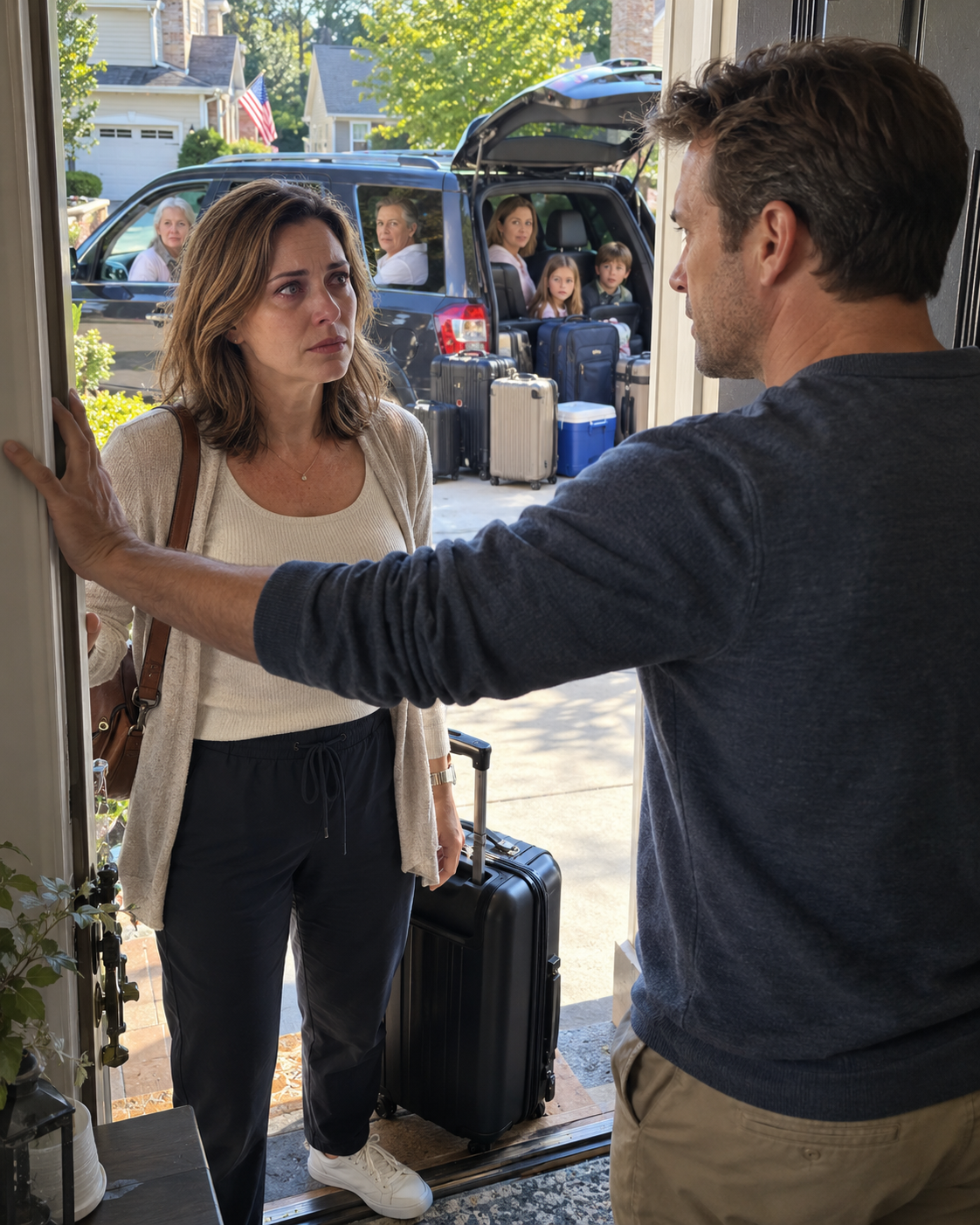
I stood on my Raleigh driveway holding a suitcase I had packed for ten happy days in Hawaii
I stared at the message until the screen dimmed.
For several seconds, I thought about deleting it.
Then another message appeared.
“You deserve to know why Martha fought so hard to move in.”
My stomach tightened.
I looked through the glass door.
David was still standing inside the kitchen, rinsing two coffee cups as if the past month had finally settled into something resembling peace.
I wanted to believe it.
More than anything, I wanted to believe it.
But I had learned something in Rome that I could no longer forget.
Peace built on missing information was not peace.
It was a pause.
I typed one question.
“Who are you?”
The reply came almost immediately.
“Someone who has watched your family from closer than you think.”
I stepped away from the window.
The old version of me would have shown David the messages immediately.
The newer version of me paused.
Not because I wanted secrets.
Because I had finally learned that I was allowed to understand something before handing it over to someone else.
The next message contained a photograph.
I opened it.
It showed Martha sitting at a kitchen table with a man I didn’t recognize.
A folder lay open between them.
On the folder was our address.
My heart began pounding.
I walked into the kitchen.
“David, who is this?”
He took the phone from my hand.
The color drained from his face.
“I don’t know.”
“You’ve never seen him?”
He looked at the photograph again.
Then he said something I had never expected.
“Actually, I have.”
I went completely still.
“When?”
David sat down.
“Three years ago.”
He rubbed both hands over his face.
“Before Mom moved in with us the first time, she asked me to meet someone.”
“Who?”
“A financial adviser.”
My chest tightened.
“What financial adviser?”
David looked at me.
“I don’t remember his name.”
“You remembered him long enough to meet him.”
“I know.”
“And you never told me?”
“I didn’t think it mattered.”
That sentence almost broke something in me.
Not because of the man.
Because of the pattern.
You don’t tell her.
You don’t involve her.
You let her handle it.
You assume she’ll forgive it.
I sat across from him.
“What was he advising you about?”
David hesitated.
Then he admitted that Martha had been considering selling her house years earlier.
The man had proposed moving her money into an investment tied to a development project in North Carolina.
The project had failed.
Most of Martha’s savings had been recovered through insurance, but not all of it.
David had quietly helped cover the difference.
I stared at him.
“With what money?”
He looked away.
“From our joint savings.”
My heart sank.
“How much?”
He named the amount.
It was more than twenty thousand dollars.
I stood up.
“David, you used our money to fix something involving your mother without telling me.”
“I was trying to protect her.”
“No.”
My voice surprised even me.
“You were trying to protect yourself from having to tell me the truth.”
He lowered his head.
That was when the stranger called.
David answered this time.
The man’s voice was calm.
He introduced himself as Eric Dalton, an attorney who had once represented Martha.
He told us that he had recently discovered discrepancies in the paperwork connected to Martha’s house.
I felt cold.
“What kind of discrepancies?”
“Someone had been trying to force a sale.”
David looked at me.
“Who?”
Eric said he could not discuss everything by phone.
He asked us to meet the following afternoon.
We did.
Eric’s office was small and quiet.
He spread several documents across the conference table.
The house Martha lived in was worth far more than she had realized.
Years earlier, a developer had tried to purchase several surrounding properties.
Martha refused.
The project stalled.
Then came the strange valuations, repeated calls, aggressive offers, and eventually the sudden pressure to sell.
Eric believed someone wanted control of the entire block.
Martha’s house was the final holdout.
I looked at David.
“And you thought the best solution was to move her into our home.”
He swallowed.
“Mom kept saying she was getting older.”
“So did you.”
“I thought I could make everyone happy.”
I almost laughed.
That had been his entire life.
Trying to make everyone happy by making me absorb the cost.
Eric continued.
“There’s more.”
He showed us a series of emails.
Several had been sent to Martha over the past two years.
One sentence appeared again and again.
“Move in with your son, and the issue disappears.”
My skin prickled.
That sentence changed everything.
The pressure to move Martha into our house hadn’t begun with a family argument.
Someone had encouraged it.
And somehow, I had become the obstacle standing between them and a property they wanted.
I thought about the Hawaii trip.
About David saying Martha wanted a family vacation.
About the cruelty of excluding me.
What if it hadn’t only been punishment?
What if someone had convinced David that separating me from the family would make me easier to pressure?
I looked at Eric.
“Who was behind it?”
He slid one final page across the table.
A development company.
Its name meant nothing to me.
But beneath it was the signature of one of its principals.
David went pale.
He knew the name.
“That’s my old business partner.”
I stared at him.
“What?”
David closed his eyes.
Years earlier, before I met him, David had worked with a man named Richard Cole.
They had built a small contracting company together.
The partnership ended badly.
Richard moved into development.
David moved into corporate operations.
They hadn’t spoken in years.
Or so David thought.
Eric believed Richard had begun pressuring Martha because acquiring her property would complete a larger parcel.
The final piece was worth millions.
I looked at David.
“You knew him.”
“I didn’t know he was doing this.”
“How do you know?”
“Because if I had known, I would never have let him near Mom.”
I held his gaze.
“That’s exactly what scares me.”
For years, David had made decisions based on what he believed was right.
He hadn’t been intentionally cruel every time.
Sometimes he had simply been careless.
But carelessness becomes cruelty when someone else constantly pays for it.
That evening, we returned home in silence.
Martha was waiting.
She had already heard about the attorney.
The moment she saw our faces, she understood.
“How much do you know?”
David stared at his mother.
“Everything.”
Martha sat down slowly.
She looked older than she had that morning.
“I didn’t want you to worry.”
I felt a strange sadness.
Not anger.
Sadness.
Because there it was again.
The same sentence in a different voice.
I didn’t want you to worry.
The excuse people use when they have already decided you don’t need a say in your own life.
Martha admitted that Richard had approached her through intermediaries.
He had offered financial help.
He had suggested that moving in with us would simplify everything.
He had even told her that I would eventually agree once David made me feel responsible for her.
I looked at David.
His face was devastated.
“You believed it.”
He nodded.
“I believed Mom.”
“And you believed your own guilt.”
He closed his eyes.
“I did.”
The next few weeks were difficult.
David had to confront Richard.
Martha had to speak with investigators.
Sarah had to admit she had known more than she had said.
Even Chloe began asking questions about why adults thought protecting children meant keeping them uninformed.
For the first time, our family had to stop pretending silence was kindness.
I also had to confront something uncomfortable in myself.
I had spent years presenting myself as endlessly patient because I thought patience made me a good wife.
But patience without boundaries had not created peace.
It had taught people how much I could endure.
That distinction changed everything.
I told David we were staying together only if our marriage became a partnership rather than a system where he made emotional decisions and I cleaned up the consequences.
He agreed.
But I didn’t make the mistake of accepting words as proof.
Trust would have to be rebuilt through behavior.
Small behavior.
Daily behavior.
He started taking responsibility for Martha without expecting me to supervise.
He opened every financial conversation to me.
He stopped saying, “You don’t understand,” and started asking, “What do you think?”
It was a tiny change.
But tiny changes are often the first evidence that something broken can actually heal.
Martha changed too.
Not overnight.
Not gracefully.
She apologized badly at first.
Then sincerely.
One afternoon, she came to my shop alone.
She stood beside a chair I was restoring.
“I treated you terribly,” she said.
I kept sanding the wood.
“Yes.”
She nodded.
“I thought you were taking my son away.”
I stopped.
“I never wanted to take him from you.”
“I know that now.”
She looked around my shop.
“I was afraid of becoming unnecessary.”
That sentence stayed with me.
For the first time, I saw the frightened woman beneath the difficult mother.
Understanding her did not erase what she had done.
It simply allowed me to release the need to hate her for it.
“I don’t need you to love me,” I told her.
“But you need to respect me.”
She nodded.
“I will.”
A year passed.
Martha stayed in her own house.
David and Sarah divided her expenses.
My $1,200 monthly transfer remained canceled.
Not because I wanted punishment.
Because generosity means more when it is freely chosen than when it is demanded.
Our children watched all of it.
Chloe became more outspoken.
Leo became more observant.
And both learned something I wish I had understood earlier.
Family is not the group that insists you sacrifice yourself to prove your love.
Family is the group that makes room for your dignity too.
One spring morning, I was standing in my shop when David walked through the door carrying two coffees.
He set one beside me.
“I have something for you.”
I looked at the envelope in his hand.
Inside was a reservation.
Rome.
Two tickets.
He smiled nervously.
“I thought we could go back.”
I looked at the itinerary.
Same little hotel.
Same neighborhood.
Same city where I had first remembered what it felt like to belong to myself.
But I wasn’t the same woman who had left.
I had learned that self-respect was not a wall.
It was a door.
I could choose who entered.
I could choose when.
And I could close it without apologizing.
I hugged David.
Not because everything had been forgotten.
Because something better had begun.
That evening, I sat on the back steps with my phone beside me.
Another message arrived from the same unknown number.
I opened it.
There was no threat this time.
Only one photograph.
It showed me standing alone in Rome twenty-eight days earlier, smiling beside the fountain.
Someone had taken the photograph from across the street.
On the back was a handwritten message.
“You were never alone.”
My breath caught.
I looked toward the dark street beyond our yard.
A car was parked at the corner.
Its headlights were off.
By the time I stood up, it was gone.
I never found out who had taken the photograph.
Maybe I never will.
But I learned something more important than the identity of the stranger.
I learned that the life I had fought to reclaim could not be built around fear, guilt, or endless patience.
It had to be built around truth.
The hardest part was not making David choose me.
The hardest part was choosing myself without needing anyone else to validate it.
Sometimes love survives when boundaries become stronger.
Sometimes family becomes healthier when everyone finally carries their own weight.
And sometimes the most powerful sentence a person can say is not “I forgive you.”
It is “This is where I stop abandoning myself.”
Years later, I still keep my Rome ticket in the back of my desk.
Not because I want to remember the day I left my family behind.
Because I want to remember the day I finally returned to myself.
And every time I look at it, I think of the woman standing on that Raleigh driveway with a suitcase in her hand, believing she had been rejected.
She hadn’t been rejected.
She had been redirected.
But there is one detail I have never been able to explain.
The unknown number stopped texting after that photograph.
Then, three months later, a letter arrived at my shop with no return address.
Inside was a single sentence.
“Your story is not the only one your husband has been protecting.”
I read it twice.
Then I slowly folded the paper and locked it away.
Because this time, I was not afraid of what I might discover.
Whatever came next, I knew one thing for certain.
I would not meet it by shrinking.
I would meet it standing.