I stood in Vanguard Apex Holdings’ marble lobby while Julian Vance shoved a $50 bill into my hand like I was a thief
For several seconds, nobody spoke.
The only sound in my living room was the ticking wall clock above the television.
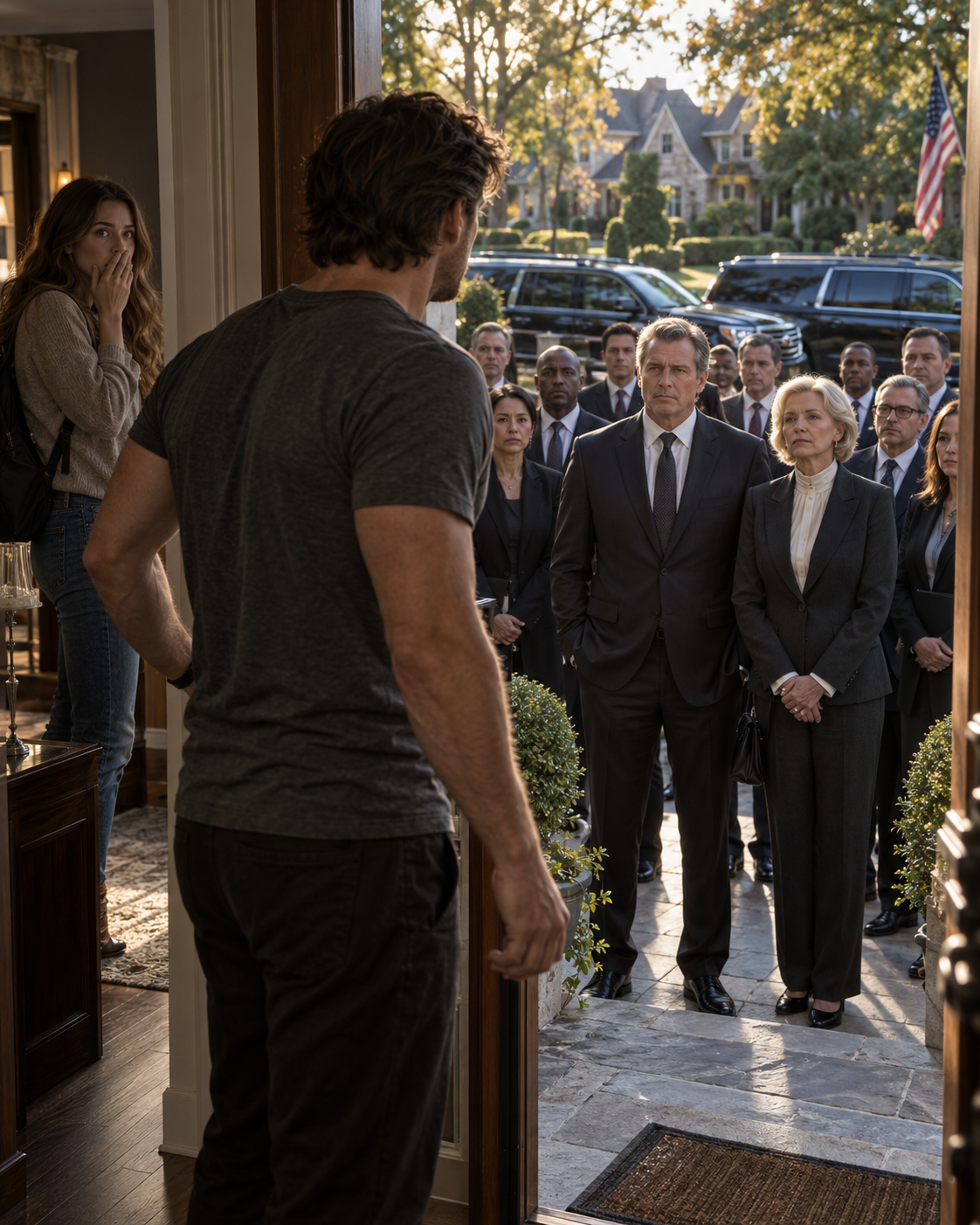
Chloe stood halfway down the stairs, still wearing her school sweatshirt, staring at the twelve people who had somehow made my little house feel smaller.
I looked back at the folder.
The signature at the bottom belonged to Julian Vance.
“How much time do we have?” I asked.
Eleanor Whitmore glanced at Arthur Sterling.
“Forty-eight hours before the board is scheduled to vote again.”
I closed the folder.
“Then you don’t have forty-eight hours.”
Eleanor’s expression changed.
“How much do we have?”
“Maybe twelve.”
The room became completely still.
I pulled a chair toward the coffee table and opened the documents again.
My old HVAC invoices were still scattered beside them, along with a socket wrench, a pressure gauge, and Chloe’s unfinished college application.
Eight years ago, I had sat in an office with a glass wall and a six-figure corporate salary.
Now I was reviewing a $4.2 billion acquisition in a living room that smelled faintly of machine oil and my daughter’s vanilla shampoo.
The irony almost made me laugh.
Instead, I reached for a pen.
“Who is the target company?”
Eleanor gave me the name.
I recognized it immediately.
Not because it was famous.
Because I’d seen three of its subsidiaries before.
They were buried in the appendix.
“These companies are connected.”
The CFO, Martin Hale, leaned forward.
“That’s a serious allegation.”
“It’s not an allegation.”
I turned the page.
“It’s arithmetic.”
I drew three circles around three different entities.
“They’re supposedly independent vendors, but their registered agents are connected.”
Martin shook his head.
“That’s common in private equity structures.”
“Not like this.”
I flipped another page.
“Look at the dates.”
Eleanor leaned closer.
All three entities had been formed within eleven days of one another.
Each had received capital from another company that appeared unrelated.
Then I found something worse.
The money wasn’t merely moving between them.
It was returning.
The same dollars were being counted as revenue at different stages.
I looked up.
“Someone has been making one pile of money look like several piles.”
Nobody spoke.
Arthur Sterling slowly removed his glasses.
“Northstar.”
I nodded.
“Exactly.”
That name changed the atmosphere.
I could see several executives glance at one another.
Apparently, Project Northstar had become something people inside Vanguard whispered about without knowing the whole story.
Arthur knew.
He remembered.
He asked everyone except Eleanor and Maya to leave the room for ten minutes.
When the door closed, he looked at me.
“Tell me what happened eight years ago.”
I hesitated.
“You’re asking because you don’t remember?”
“I remember the memorandum.”
“Not what happened after?”
His jaw tightened.
“No.”
So I told him.
I told him how I had spent six weeks tracing ownership structures after noticing that three supposedly unrelated companies had nearly identical cash-flow patterns.
I told him how I stayed until two in the morning rebuilding acquisition models from raw filings.
I told him how my thirty-one-page memorandum concluded that Northstar’s projected value depended on transactions between entities controlled by the same hidden group.
I told him Vance had called my analysis “needlessly alarmist.”
Then I told him about the meeting.
There had been six executives around the table.
Vance had placed my memorandum in front of them.
He hadn’t argued with the numbers.
He had questioned me.
“Are you sure you understand what you’re looking at?”
I had said yes.
He smiled.
Then he told me I wasn’t a team player.
Two weeks later, I was gone.
Arthur listened without interrupting.
When I finished, he stared at the floor.
“I signed that termination.”
I looked at him.
“You did?”
“I was told you had become difficult.”
The old pain returned with surprising force.
“That’s what they called me.”
Arthur looked genuinely shaken.
“I never read the memorandum.”
“Someone made sure you didn’t.”
Maya spoke for the first time.
“That’s why the briefcase matters.”
She placed a photograph on the table.
It showed the envelope recovered from inside the case.
“There was no name on it.”
“Fingerprints?”
“None useful.”
“Then why put it in the briefcase?”
Maya shook her head.
“We don’t know.”
I studied the photograph.
The envelope had been folded once.
On the corner was a tiny blue mark.
Three short lines.
I stared at it.
Then something inside me shifted.
“I’ve seen that.”
Maya leaned forward.
“Where?”
I couldn’t remember immediately.
Then I saw it in my mind.
A photocopy.
Eight years ago.
One of the pages attached to my Northstar memorandum had carried the same tiny blue mark.
I stood so quickly my chair struck the wall.
“Get me the original.”
Arthur nodded to Maya.
She left.
While she was gone, Chloe came into the room.
She looked at the executives, then at me.
“Are you in trouble?”
I crouched beside her.
“No.”
“Then why are all these people here?”
I looked at the folder.
“Because sometimes people don’t realize what something is worth until they lose it.”
She looked at me for a moment.
“Like when Vanguard fired you?”
The room went silent.
I hadn’t told her the details.
Kids remember more than parents think.
I smiled faintly.
“Something like that.”
She hugged me.
Then she whispered, “Don’t let them make you feel small again.”
Those words stayed with me.
Twenty minutes later, Maya returned with an archived copy of Project Northstar.
I spread the pages across the floor.
There it was.
Page seventeen.
A tiny blue mark in the margin.
Three short lines.
I looked at Maya.
“Whoever wrote the anonymous memo knew about my original work.”
Arthur’s face hardened.
“Could it have been Vance?”
“No.”
“Why not?”
“Because Vance wouldn’t have needed to hide Northstar.”
I pointed to the current acquisition documents.
“He buried my analysis because it threatened the deal.”
Eleanor looked at the numbers.
“Then why would he create another deal that contains the same pattern?”
I stared at her.
“Because this time, someone may be counting on the warning arriving too late.”
The room seemed colder.
We spent the next six hours pulling apart the transaction.
Every time we found something suspicious, another piece appeared.
A consulting firm with no employees.
A valuation report commissioned three days before the acquisition announcement.
A debt facility whose lender was indirectly connected to one of the target company’s subsidiaries.
And then we found the timeline.
The board had been given eleven days to approve a transaction worth $4.2 billion.
That wasn’t just aggressive.
It was almost impossible to examine properly.
I looked at Eleanor.
“Who designed the timeline?”
She didn’t answer.
Maya did.
“Martin Hale’s office.”
I turned toward the CFO.
He had remained unusually quiet.
Martin slowly stood.
“You have no authority to accuse me of anything.”
“I haven’t accused you.”
I closed the folder.
“I’m telling you where the documents lead.”
He looked at Eleanor.
“This is becoming absurd.”
She didn’t look at him.
“Sit down, Martin.”
He did.
For the first time, I saw fear.
Not anger.
Fear.
That night, everyone left except Eleanor, Maya, and Arthur.
Chloe went upstairs.
I stayed at the table.
My house was quiet again.
Arthur stood near the window, looking out at the street.
“I owe you an apology,” he said.
I didn’t answer immediately.
“You owe me more than that.”
He nodded.
“I know.”
I looked at him.
“Why didn’t you read Northstar?”
His eyes lowered.
“Because I trusted the wrong people.”
That answer hurt more than I expected.
Not because it was dramatic.
Because it was simple.
The next morning, Eleanor called an emergency board meeting.
Before it began, Maya brought me something.
A security report.
The briefcase had not been stolen from Vanguard’s headquarters.
It had disappeared from a private vehicle belonging to Martin Hale.
I read the line twice.
“Where was his vehicle?”
“Parked on Marchand Avenue.”
I looked up.
“Then someone wanted that case found.”
Maya nodded.
“That’s our theory.”
“But why?”
She slid another document toward me.
The briefcase contained internal transaction records that had never been distributed to the board.
One file showed payments between the target company and a consulting entity.
Another showed communications between Martin’s office and an outside advisor.
The final document was a draft agreement dated six weeks earlier.
I read the first paragraph.
Then I stopped.
There was a clause transferring certain liabilities to Vanguard Apex after the acquisition.
Not the target company.
Vanguard.
If the deal collapsed, the losses stayed behind.
If it succeeded, the upside was enormous.
I looked at Eleanor.
“Who negotiated this clause?”
She answered softly.
“Martin.”
The emergency board meeting began at nine.
By nine fifteen, Martin was defending the structure.
By nine thirty, he was blaming outside counsel.
By ten, Vance was arguing that the anonymous memo was unreliable.
Then Arthur Sterling entered the room.
He placed my old Northstar memorandum on the table.
Nobody moved.
“I should have read this eight years ago,” he said.
Vance stared at the pages.
“Arthur, this is ancient history.”
“No.”
Arthur looked directly at him.
“It’s evidence of a pattern.”
Vance’s face tightened.
“This is ridiculous.”
Arthur pushed the current acquisition documents across the table.
“Then explain why the same structure appears here.”
Silence.
Vance looked at Martin.
Martin looked at the floor.
Eleanor turned toward me.
“What do you see?”
I pointed to three pages.
“These numbers aren’t the real problem.”
Everyone leaned closer.
“The real problem is that someone designed this deal so that the board couldn’t see the problem in time.”
I explained the shortened diligence period, the related entities, the circular payments, the valuation assumptions, and the liability transfer.
Then I showed them Northstar.
Same pattern.
Different names.
Bigger numbers.
Higher stakes.
Nobody interrupted.
When I finished, Eleanor asked, “What happens if we proceed?”
I answered carefully.
“You could spend $4.2 billion buying an asset whose value depends on transactions that may not be sustainable.”
Arthur closed his eyes.
“Can it be fixed?”
“Maybe.”
“How?”
“Start over.”
The board voted to suspend the acquisition pending a complete independent review.
Martin Hale resigned before noon.
Julian Vance was placed on administrative leave.
Within days, regulators and outside counsel began examining the transaction.
But there was one question nobody could answer.
Who put the briefcase in the gutter?
Weeks passed.
The investigation uncovered enough evidence to confirm that several executives had manipulated the transaction process.
But the anonymous ten-page memo remained unexplained.
One evening, Eleanor came to my house alone.
She didn’t arrive in a convoy this time.
She sat at my kitchen table while Chloe did homework in the next room.
“You were right,” Eleanor said.
“About the deal?”
“About something bigger.”
She placed a folder in front of me.
Inside was an internal archive document.
The original version of Project Northstar.
Not the copy I’d written.
The one I’d never seen.
Someone had added four pages after my signature.
Those pages contained evidence connecting the Northstar shell companies to a senior executive.
I stared at the name.
Julian Vance.
But there was another name beneath it.
Arthur Sterling.
My chest tightened.
“Why is your name here?”
Arthur hadn’t come with her.
Eleanor looked uncomfortable.
“Because that’s the question we’re still trying to answer.”
I read the pages again.
They suggested Arthur had received warnings about Northstar before the acquisition.
But there was no proof he had knowingly approved anything.
Eleanor leaned back.
“The board believes someone may have used his authority without his knowledge.”
I thought about Arthur’s apology.
I thought about the way he had looked at my old memorandum.
Then I remembered the blue mark.
Three short lines.
I pulled out the anonymous memo.
There it was again.
Three short lines.
Except this time I noticed something I’d missed.
They weren’t a signature.
They were coordinates.
Maya helped decode them the next morning.
They pointed to an old storage facility outside the city.
We went there with investigators.
Inside a dusty records room, we found boxes belonging to Vanguard Apex from eight years earlier.
One box carried my name.
Inside was every version of Project Northstar.
Drafts.
Notes.
Meeting transcripts.
And a handwritten message.
I recognized the handwriting immediately.
It belonged to Arthur Sterling.
The message contained only one sentence.
“If they bury this, make sure someone finds it.”
I stood there for a long time.
Arthur had known.
Maybe not everything.
Maybe not who was responsible.
But he had suspected something was wrong.
And somehow, years later, someone had finished what he started.
We never discovered who placed the briefcase on Marchand Avenue.
There were cameras, but the storm had destroyed the footage from that stretch of road.
The person remained unknown.
The acquisition was eventually abandoned.
Vanguard Apex survived, but its leadership changed.
Maya became chief compliance officer.
Eleanor rebuilt the risk division.
Arthur retired from daily operations.
And me?
I never returned to the glass office where they had once made me feel disposable.
Instead, I accepted Eleanor’s offer to lead an independent transaction-review group.
I kept my HVAC business, too.
Every few weeks, I still climbed ladders, repaired compressors, and came home smelling like metal and dust.
Because I had learned something important.
A title can disappear overnight.
A salary can vanish.
A company can decide you’re not valuable anymore.
But integrity is different.
Nobody can fire it.
Nobody can demote it.
And nobody can take it from you unless you give it away.
Months later, Chloe finally took her senior trip.
She sent me a picture from the airport with a huge smile on her face.
Underneath it, she wrote, “You kept your promise.”
I stared at that message longer than I expected.
Because she wasn’t talking about the trip.
She was talking about the night I found the briefcase.
The night I could have opened it.
The night nobody would have known.
Except I would have known.
And sometimes that is the only witness that matters.
I thought the story was over.
Then, six months later, an envelope arrived at my office.
No return address.
Inside was a single photocopy from Project Northstar.
Page seventeen.
The three blue lines were circled in black ink.
Beneath them, someone had written six words.
“You still haven’t found the other file.”
I read the sentence twice.
Then I looked toward the locked archive room.
For the first time in months, I felt that familiar chill.
Because somewhere, buried beneath eight years of silence, there was still a file someone desperately didn’t want me to see.
And this time, I knew exactly where I was going to start looking.
… THE STORY CONTINUES IN THE COMMENTS! 👇