I stood in the rain outside my own house while my husband’s champagne photo exploded across Facebook
Part 2
At 9:00 that morning, Greg stepped onto the executive floor wearing a tailored navy suit and the expression of a man who believed his life had finally reached the level he deserved.
He carried an iced macchiato in one hand and his phone in the other.
People greeted him as he walked toward the executive offices.
Greg smiled at them like a politician on election night.
He had spent the previous week imagining his new title.
The salary increase.
The equity package.
The private office.
The invitations.
He had even rehearsed what he would say when the board congratulated him.
Near the espresso bar, one of his colleagues asked about his wife.
Greg laughed.
“Ex-wife, probably.”
The man looked uncomfortable.
Greg didn’t notice.
“You have to trim the anchors if you want to sail faster,” he said.
Then he smiled.
“Emily was never built for this world.”
A few people laughed politely.
One woman looked toward the corner office.
Greg mistook her expression for envy.
At 9:45, he sat alone in his office and adjusted his cufflinks.
His calendar showed the meeting in gold letters.
Senior Partner Review.
Equity Signoff.
He opened a spreadsheet showing what his new compensation would look like.
He was already deciding which car to buy after the bonus cleared.
Then his office door opened.
Two security officers stood there.
Behind them was the head of corporate compliance.
Greg looked up.
“Can I help you?”
The compliance director didn’t smile.
“Mr. Carter, please step away from your computer.”
Greg laughed.
“Is this some kind of surprise?”
“Hand over your badge.”
His smile disappeared.
“What?”
“Your badge.”
The room suddenly felt colder.
Greg looked from the compliance director to the security officers.
“There must be a mistake.”
“There isn’t.”
They took his phone.
They placed it inside a signal-blocking pouch.
Then they escorted him into the hallway.
Every conversation seemed to stop as he passed.
People stared through glass walls.
The same people Greg had spent years intimidating suddenly wouldn’t meet his eyes.
He tried to walk confidently.
His legs felt weak.
The elevator doors opened.
He was taken to the twentieth floor.
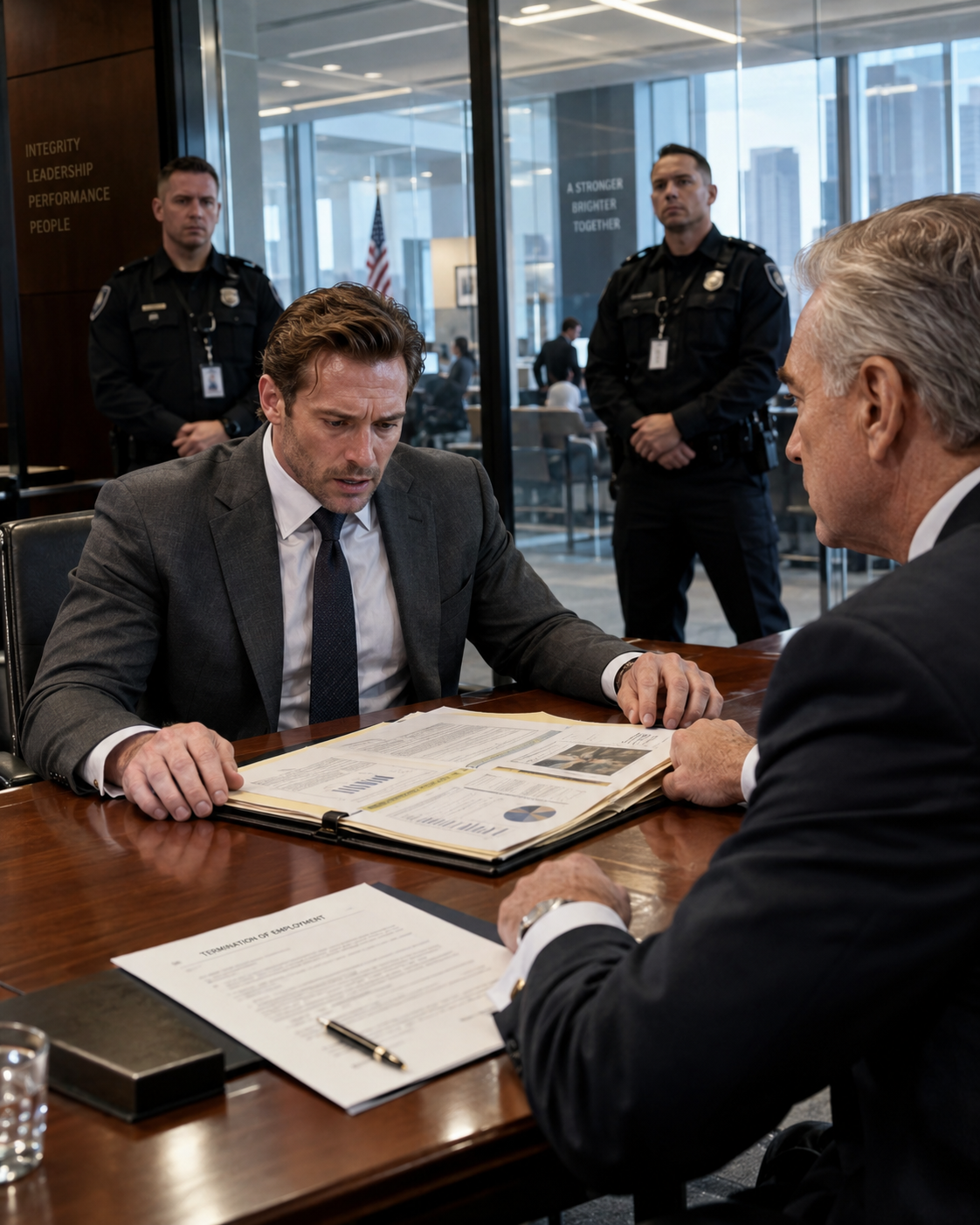
The boardroom was almost empty.
Arthur sat at the far end of a long mahogany table.
No assistants.
No lawyers.
No executives.
Just Arthur.
Greg stopped in the doorway.
“Sir, there seems to be some kind of misunderstanding.”
“Sit down, Gregory.”
Greg sat.
Arthur placed a printed photograph on the table.
It was Greg’s social media post.
The champagne.
The caption.
The comments from his family.
Greg swallowed.
Arthur tapped the paper once.
“You have exceptional confidence for a man with no actual equity.”
Greg forced a smile.
“With respect, sir, my record speaks for itself.”
Arthur leaned back.
“Does it?”
“I closed those accounts.”
“No.”
Arthur slid a thick folder across the table.
“You carried the briefcase.”
Greg stared at him.
“What does that mean?”
“It means you have spent seven years confusing access with ownership.”
Greg opened the folder.
Inside were legal documents.
Corporate covenants.
Trust agreements.
Historical investment records.
His eyes moved quickly across the pages.
Then he stopped.
One name appeared in bold.
Emily Carter.
He blinked.
“No.”
Arthur said nothing.
Greg read the paragraph again.
Then again.
His breathing changed.
“This can’t be right.”
Arthur’s voice remained calm.
“The family trust connected to your largest enterprise portfolio has existed for decades.”
Greg looked up.
“What does Emily have to do with it?”
Arthur stared at him.
“Everything.”
Greg’s fingers trembled.
“She’s an art teacher.”
“Yes.”
“She doesn’t work here.”
“She never needed to.”
Arthur pushed another document toward him.
“Emily is the controlling trustee connected to forty percent of this corporation.”
The room went silent.
Greg stared at the page as though the letters might rearrange themselves.
His face slowly lost its color.
“Forty percent?”
Arthur nodded.
“Her grandfather helped keep this company alive when everyone else thought it was finished.”
Greg’s mouth opened.
Nothing came out.
Then he remembered every dinner where he had complained about Emily’s salary.
Every time he had mocked her paint-stained clothes.
Every joke about her being ordinary.
Every time he had told people he had built himself from nothing.
He remembered the night he had first gotten his enterprise assignment.
He remembered coming home and telling Emily he had finally been given a chance.
She had hugged him.
He had barely thanked her.
He had assumed he had earned everything alone.
Arthur watched him carefully.
“You didn’t know.”
Greg shook his head.
“No.”
“You never asked.”
Greg looked down.
His voice broke.
“Why didn’t she tell me?”
Arthur’s expression hardened.
“Because she loved you.”
Those four words hurt more than any accusation.
Greg looked at the photograph again.
His own caption stared back at him.
Finally cut the dead weight.
Arthur opened another folder.
“Your public post violates the company’s ethics and reputation policies.”
Greg’s head snapped up.
“Sir, please.”
“Your access was terminated at 8:30 this morning.”
“What?”
“Your pending equity awards are revoked.”
Greg stood so quickly the chair rolled backward.
“You can’t do this.”
Arthur didn’t raise his voice.
“We already did.”
Greg’s face crumpled.
“Please.”
Arthur looked at him for a long moment.
“You were given opportunity because people believed you had character.”
Greg couldn’t answer.
“Apparently, they were wrong.”
The termination letter was placed in front of him.
Greg stared at it.
His hands shook.
Then the security officers stepped forward.
Five minutes later, he was walking through the same executive hallway where he had once bragged about being unstoppable.
This time, nobody laughed.
Nobody congratulated him.
Nobody followed.
He was pushed through the revolving doors into the rain.
He stood on the sidewalk in a suit that suddenly felt like a costume.
His phone regained service.
Notifications flooded the screen.
His luxury car payment had failed.
His bank requested collateral verification.
His corporate card had been declined.
His sister had left a voicemail.
“Greg, what is happening?”
Then he understood.
He had built his entire life around things that only existed while the company allowed him to have them.
And the company had just taken them away.
He called me.
Once.
Twice.
Five times.
I was sitting in my classroom when his first voicemail arrived.
The kiln hummed quietly in the background.
Students were painting clay figures at their tables.
I pressed play.
“Emily, please pick up.”
His voice was shaking.
“It was a joke.”
I closed my eyes.
“A stupid joke.”
Another message.
“Tell Arthur it was a mistake.”
Another.
“Please.”
Then came the words that finally revealed the truth.
“You’re ruining my life.”
I stared at the phone.
Not once did he say he was sorry for humiliating me.
Not once did he ask whether I was okay.
He was sorry because his life was falling apart.
I listened to every voicemail.
Then I blocked his number.
I forwarded the recordings to my estate attorney.
For the first time since I had known Greg, I stopped trying to protect him from the consequences of his own choices.
Part 3
That afternoon, I stayed late at school.
The halls were almost empty.
Rain tapped against the classroom windows.
A student had left a small painted sun on my desk.
Underneath it was a note.
“Ms. Carter, thank you for believing in me.”
I held the paper for a long time.
It was such a small thing.
Yet somehow, it mattered more than everything Greg had lost that day.
Because it reminded me who I had been before I became someone’s wife.
I was Emily.
I was a teacher.
I was a granddaughter.
I was a woman who had spent years quietly building a life without needing anyone to applaud it.
By three o’clock, my attorney called.
“The house is legally tied to the family trust,” he said.
“Greg’s attempt to lock you out won’t stand.”
I looked toward the rain.
“Can we handle it without turning this into something ugly?”
“We can handle it quietly.”
That was exactly what I wanted.
Two days later, I returned home.
A sheriff’s deputy stood outside.
The locks had been changed.
Again.
This time, they were changed for me.
Greg’s belongings were packed carefully into boxes.
His expensive suits.
His shoes.
His watches.
Everything he had once believed proved that he had become somebody.
His mother’s minivan arrived.
Greg stepped out.
For a moment, neither of us spoke.
He looked different.
Not because his clothes were different.
Because the certainty was gone.
He stood in the driveway staring at me.
“Emily.”
I said nothing.
“I’m sorry.”
The words sounded fragile.
I believed he meant them.
But forgiveness and reconciliation were not the same thing.
He took a step toward me.
“I didn’t know.”
“I know.”
“I thought I had earned everything.”
“I know.”
He looked toward the house.
“Can we fix this?”
I looked at the front door.
Then at the two trash bags he had left in the rain.
“I spent years helping you become the man you wanted to be.”
He lowered his eyes.
“And somewhere along the way, you decided the person helping you was beneath you.”
His eyes filled with tears.
“I was stupid.”
“No.”
I shook my head.
“You were given a choice every day.”
He looked at me.
“You chose.”
The deputy quietly opened the minivan door.
Greg stood there for another moment.
Then he whispered the question I knew he had been carrying since the boardroom.
“Did you ever love me?”
The answer hurt.
Because once, it had been easy.
“Yes.”
He swallowed.
“I still don’t understand how you can stand here so calmly.”
I looked at the house.
At the windows.
At the life I had nearly mistaken for a prison.
“Because I finally understand that losing you isn’t the same as losing myself.”
He nodded slowly.
Then he got into the van.
I watched until the vehicle disappeared at the end of the street.
I didn’t feel victorious.
I didn’t feel powerful.
I felt tired.
Then I walked inside.
My paintings were back where they belonged.
My grandfather’s clock ticked softly in the living room.
The house was quiet.
For the first time, the silence didn’t feel lonely.
It felt like peace.
That night, I made tea and sat beside the window.
I thought about my grandfather.
He had always told me that money could buy comfort, but it could never buy character.
I finally understood what he meant.
The trust had never been the real inheritance.
The real inheritance was knowing that I never had to become cruel just because someone had been cruel to me.
Greg had spent years trying to prove he was worth something.
He had confused wealth with worth.
Status with dignity.
Power with love.
And when those things disappeared, there was almost nothing left for him to hold.
I still teach art.
I still drive an ordinary car.
I still buy paint when it goes on sale.
I still wear old sweaters covered in colors that never quite wash out.
Nothing about my life looks impressive from the outside.
And I have never been happier.
Sometimes people ask what happened to Greg.
I tell them only what is necessary.
He lost his position.
He moved back in with his mother.
He spent a long time rebuilding a life that had been built on assumptions.
I don’t know whether he ever truly changed.
That part is no longer mine to carry.
What belongs to me is this.
I know now that love should never require you to become smaller so someone else can feel important.
I know that silence is not weakness.
Sometimes silence is the moment you finally stop arguing with a person who has already decided not to see you.
And I know that the most dangerous lie is not the one someone tells you.
It is the one you begin telling yourself because you love them.
For years, I had told myself that Greg was simply ambitious.
That his arrogance was temporary.
That his jokes didn’t matter.
That his success hadn’t changed him.
I was wrong.
But being wrong about someone I loved did not mean I had to be wrong about myself.
Months later, I was standing in my classroom after school when a student asked me why I had kept teaching after everything that happened.
I smiled.
“Because people deserve to be reminded that they are more than what the world sees.”
She thought about that.
Then she nodded.
I looked around the room.
The easels.
The paintbrushes.
The unfinished drawings.
The sunlight falling across the floor.
For the first time, I realized something.
Greg had once believed I was dead weight.
But I had never been dead weight.
I had simply been carrying something he could not see.
And when I finally put it down, I discovered I could breathe again.
That evening, I locked the classroom door and walked into the fading sunlight.
I didn’t need revenge.
I didn’t need applause.
I didn’t need anyone to know what my family owned or what my name could unlock.
I only needed to know that when everything was stripped away, I was still standing.
And sometimes, that is the greatest secret of all.
The person someone throws away may be the very person who was holding their entire world together.