I stood in a rain-soaked garage while a powerful CEO laughed at my thousand-dollar offer and called the property worthless
Part 2
Victoria looked around as if she were searching for the broken property she remembered selling.
Instead, she saw lifts full of cars, mechanics moving between work bays, shelves of refurbished parts, and young apprentices learning beside people twice their age.
A customer at the counter was laughing with one of my mechanics.
Another was waiting for an inspection.
A classic truck sat near the back with its engine exposed while one of the apprentices carefully cleaned a component.
Victoria turned toward me.
“You did all this in four months?”
“Almost five.”
She looked at the equipment.
“Most of this was already here?”
“Some of it.”
“And you restored it?”
“Whatever we could.”
She folded her arms.
“I thought you were buying scrap.”
“So did everyone else.”
She looked at me sharply.
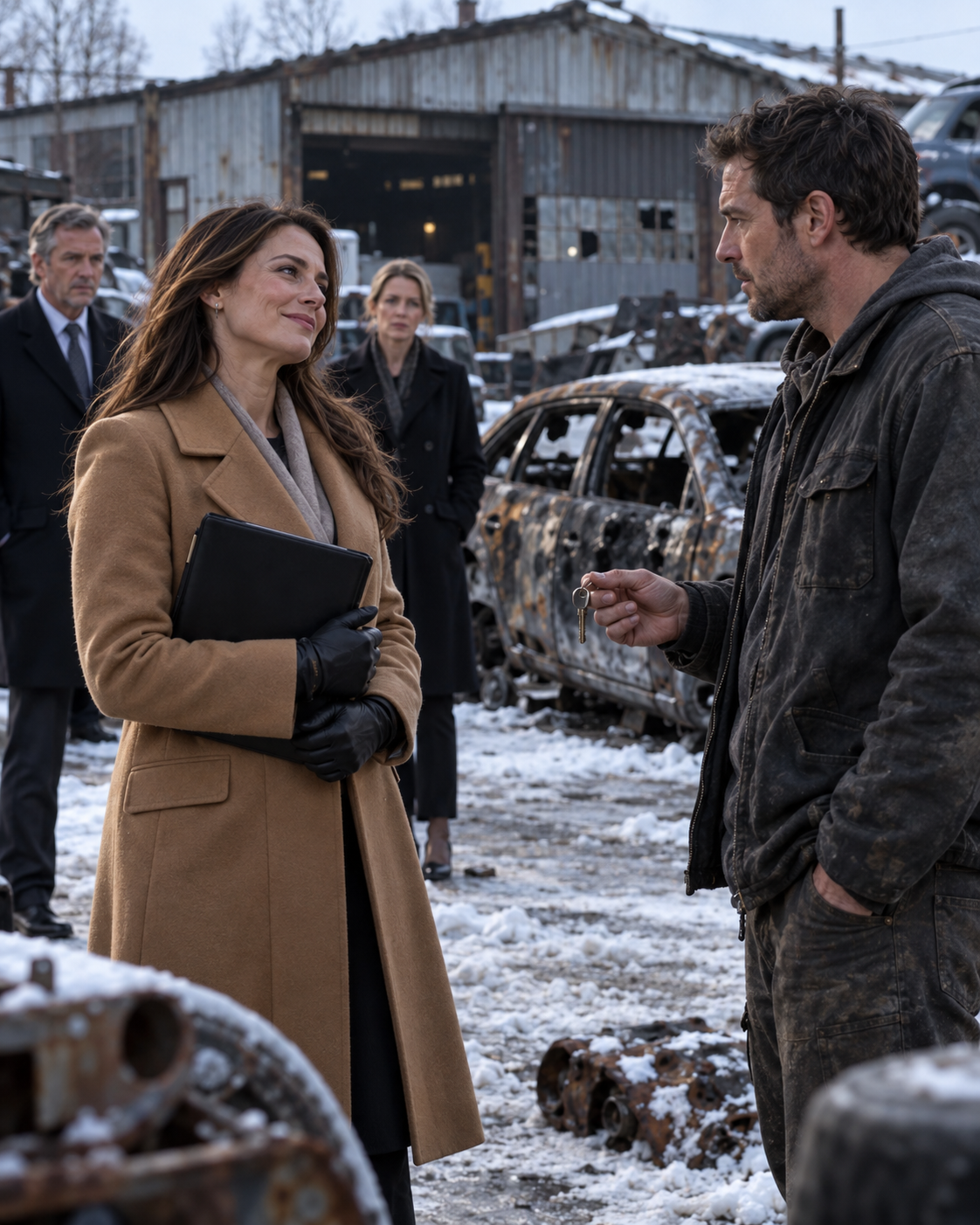
“Then what did you see?”
I glanced around the garage.
“Possibility.”
She didn’t answer.
I think that word bothered her more than any number could have.
Because possibility doesn’t fit easily into a spreadsheet.
It doesn’t always look impressive from behind a boardroom table.
Sometimes possibility looks like a leaking roof and a man with a thousand dollars in his pocket.
Victoria asked me about revenue.
I told her.
She asked about customers.
I told her.
She asked about employees.
I told her.
When she heard that we were training young people for free, she looked genuinely surprised.
“You don’t charge them?”
“No.”
“Why?”
“Because someone once gave me a chance.”
She stared at me.
“Who?”
“No one.”
That answer seemed to stop her.
I continued.
“So I decided to become the person I needed when I had nothing.”
Victoria looked away.
For the first time since I had met her, she didn’t seem like a CEO.
She seemed like a woman trying to understand something she couldn’t buy.
Over the next few weeks, Brooks Autoworks grew faster than I expected.
The restoration side attracted collectors from neighboring towns.
Independent mechanics started buying refurbished parts from us.
The apprentices became employees.
Customers began recommending us online.
Then people started asking if I would open another location.
I had no answer.
I was still trying to understand how one thousand dollars had become a business capable of paying twelve people.
Then an investor called.
Then another.
A larger automotive supplier wanted a partnership.
A regional company wanted us to refurbish fleets.
A private equity firm sent someone to my garage with a proposal that could have changed my life overnight.
I listened to all of them.
But I remembered what I had promised Lily.
We would never become successful by becoming the kind of people who forgot what desperation felt like.
So I built carefully.
We expanded the restoration division.
We increased training.
We created paid apprenticeships for people who had spent years being told they weren’t qualified.
And instead of building a luxury showroom first, I built a community workshop.
It had free equipment, evening classes, and a small scholarship fund for students who wanted to become certified mechanics.
The first day we opened it, Lily stood beside me while a group of teenagers gathered around an old engine.
One boy looked nervous.
I handed him a wrench.
“Don’t be afraid of not knowing,” I told him.
“Be afraid of pretending you already do.”
He smiled.
That was the kind of business I wanted.
Not just one that made money.
One that made room.
Six months after I bought the garage, a local business journal published an article about Brooks Autoworks.
The headline called us one of the fastest-growing independent automotive companies in the region.
Investors started using words like expansion and valuation.
I still had trouble hearing those words without thinking about the apartment ceiling.
Then came the number.
Our company was worth several million dollars.
I read the figure twice.
Then I closed the laptop.
Because the number was impressive.
But it wasn’t the thing that made my chest tighten.
What mattered was that the business now employed people who had once been sitting at home wondering what they were good for.
It mattered that customers trusted us.
It mattered that Lily could walk into the garage and proudly say, “My dad built this.”
Then Victoria came back.
This time, she didn’t arrive to inspect the property.
She came to ask me something.
“Would you consider partnering with Sterling Horizon?”
I looked at her.
“You’re asking me to work with the company that sold me the garage?”
“Yes.”
“Because you think it’s valuable now?”
She didn’t flinch.
“Because I think you are.”
That answer caught me off guard.
Six months earlier, she had looked at me and seen a struggling man with too little money.
Now she was looking at me as an equal.
I leaned back.
“What changed?”
She gave a small, tired smile.
“You did.”
I shook my head.
“No.”
“I was always this man.”
She lowered her eyes.
“You’re right.”
For a moment, neither of us spoke.
Then she said, “I misjudged you.”
That sentence mattered more than she realized.
Not because it erased anything.
It didn’t.
But because people rarely admit they were wrong when admitting it makes them smaller.
Victoria did.
And from that day forward, our relationship changed.
She became a business partner.
Not because I needed her permission.
Not because she needed to repair her pride.
Because she understood something she hadn’t understood before.
A person’s current circumstances are not always a measurement of their potential.
But before I signed anything, I went home.
Lily was sitting at the kitchen table with a small wooden box.
She pushed it toward me.
“Open it.”
Inside was the original receipt from the day I bought the garage.
One thousand dollars.
My name.
The property address.
The date.
I stared at it.
“You kept this?”
She nodded.
“I wanted to remember.”
“Remember what?”
“The day we stopped being stuck.”
I couldn’t speak for a moment.
I touched the receipt carefully.
It was just paper.
Faded ink.
A cheap little record of a decision made when I was terrified.
But looking at it, I realized something I had never understood before.
The garage was never the miracle.
The miracle was that I had been exhausted, nearly broke, scared about the future, and still decided to take one more step.
The miracle was not the building.
It was the decision.
Part 3
I sometimes think about that rainy afternoon when I first saw the garage.
If I had driven past, nothing would have happened.
If I had told myself I was too broke, nothing would have happened.
If I had listened to the voice in my head saying that people like me didn’t get second chances, nothing would have happened.
But I stopped.
I looked through a rusted gate.
And I chose to believe that something broken could still be useful.
That belief changed everything.
The business expanded again over the following year.
Brooks Autoworks added new locations.
Our restoration division became one of the strongest parts of the company.
The training program grew until we had students coming from towns I had once never heard of.
People who had struggled to find work began finding careers.
People who had been told they weren’t worth investing in started earning enough to support their families.
And Lily grew up watching all of it.
She watched me fail.
She watched me worry.
She watched me work.
Then she watched me learn.
One evening, we stood outside the original garage after everyone had gone home.
The building looked completely different now.
The old rusted gate was gone.
The broken windows had been replaced.
The sign above the door was illuminated against the dark.
I still kept the blue pickup parked near the side.
It was scratched.
Its paint had faded.
The passenger door still made that strange sound when you opened it.
But I couldn’t bring myself to replace it.
Lily stood beside me.
“Why do you keep that truck?”
I smiled.
“Because it remembers.”
“What does it remember?”
I looked toward the garage.
“The days when we had almost nothing.”
She was quiet.
Then she said, “You don’t look sad when you talk about those days.”
“I used to be.”
“Not anymore?”
I shook my head.
“Not anymore.”
I finally understood why.
Those were the days that taught me what I could survive.
The days that taught Lily that love isn’t measured by how much money you have.
The days that taught me that dignity doesn’t come from looking successful.
It comes from refusing to give up when nobody is watching.
Victoria and I continued working together.
She eventually told me something she had never admitted before.
“When I first met you,” she said, “I thought I was doing you a favor.”
I laughed.
“You gave me a garage with a hole in the roof.”
“I know.”
“You sold it because you thought it was worthless.”
“I know.”
She smiled.
“And you turned it into something worth millions.”
I looked at her.
“No.”
She waited.
“We turned it into something worth more than money.”
She knew what I meant.
The company mattered.
The valuation mattered.
The success mattered.
But the people mattered more.
That became the part of the story I cared about most.
Because success can build an empire.
But purpose decides what that empire is for.
Years earlier, when I was still working temporary jobs, I had wanted one thing more than anything.
I wanted Lily to grow up knowing that her father had not given up.
Not because I needed her to think I was strong.
Because I wanted her to understand that being afraid does not mean you have to stop moving.
Now she was older.
She understood more.
And one night, while we sat at the kitchen table, she took the little wooden box and placed the receipt back inside.
“You should keep it,” she said.
“I thought you kept it.”
“I did.”
She pushed it toward me.
“Now you don’t need it to remember.”
I opened the box one last time.
Then I took out the receipt.
I folded it carefully.
And I put it into the top drawer of my desk beside the steel wrench I had used on my first customer’s car.
Not because I needed proof of how far I had come.
Because I never wanted to forget where I started.
The world sees the millions.
It sees the polished buildings.
It sees the employees, the investors, the restored vehicles, and the photographs of me standing beside cars worth more than the first apartment Lily and I could barely afford.
But the world never sees the man who once counted grocery money at a kitchen table.
It never sees the father who stared at one thousand dollars and wondered whether spending it would destroy the little security he had left.
It never sees the child who looked at a broken garage and somehow saw a beginning.
That is the part I hold closest.
Because sometimes life doesn’t give you a perfect opportunity.
Sometimes it gives you a collapsing building.
A leaking roof.
An empty bank account.
A daughter watching your face and hoping you know what to do.
And sometimes the choice in front of you is terrifying.
Walk away and remain where you are.
Or step forward and risk everything you have left.
I chose the second path.
I was not guaranteed success.
Nobody promised me investors.
Nobody promised customers.
Nobody promised Victoria would ever understand what she had underestimated.
There was only a broken garage, one thousand dollars, and a promise I had made to my little girl without even saying it out loud.
That I would keep trying.
Even when I was tired.
Even when I was embarrassed.
Even when people laughed.
Even when the odds looked ridiculous.
Because Lily deserved to see that a hard beginning was not the same thing as a hopeless future.
And maybe that was the real empire I built.
Not the company.
Not the money.
Not the buildings.
It was a life where people who had been overlooked could finally walk through a door and hear someone say, “You belong here.”
It was a place where a struggling kid could pick up a wrench and imagine a career.
It was a workplace where an unemployed mechanic could earn back his confidence.
It was a future where my daughter would never have to measure her worth against the size of her circumstances.
Sometimes people look at what you have today and assume they understand your story.
They don’t see the nights you almost quit.
They don’t see the sacrifices.
They don’t see the fear.
They only see the finished building.
I know better now.
Every strong thing I have ever seen began as something fragile.
Every successful business began with someone willing to be uncertain.
Every second chance began with someone deciding that the past did not get the final word.
The CEO thought she was selling me a worthless garage.
She was wrong.
But the bigger truth is that she was not the only one who underestimated something that day.
I had underestimated myself too.
I thought I needed more money.
More connections.
A better resume.
A person in a suit telling me I was worth betting on.
What I actually needed was the courage to make one decision while I was still afraid.
Six months later, I stood in front of hundreds of people holding the keys to a company worth millions.
Cameras flashed.
Employees applauded.
Lily stood near the front, smiling so hard that I could see the gap where one of her baby teeth had once been.
For everyone else, it looked like a celebration of business success.
For me, it was something quieter.
I was remembering a rainy road.
A rusted gate.
A dying garage.
A thousand dollars on a kitchen table.
And a little girl who looked at her exhausted father and said, “You usually can.”
She was right.
Not because I was some extraordinary man.
Because sometimes ordinary people keep going long enough to become extraordinary in ways nobody predicted.
I still have the blue pickup.
I still keep the receipt.
And whenever I walk into that original garage before sunrise and smell oil, metal, and coffee, I remember what the place taught me.
You cannot always choose what life hands you.
But you can choose what you build from it.
A broken beginning does not make you a broken person.
Being overlooked does not make you worthless.
And the chapter where you are struggling is not the chapter where your story has to end.
Mine almost ended in that tiny apartment with the leaking ceiling and a thousand dollars I was afraid to spend.
Instead, it became the first page of everything that came after.
And every time I unlock those old garage doors, I think about the man I used to be, the daughter who believed in him, and the woman who thought she was selling me something worthless.
Then I look at the people inside.
And I remember.
Sometimes the thing everyone else has given up on is not waiting to be rescued.
Sometimes it is waiting for someone brave enough to believe in what it could become.
And sometimes, with enough patience, courage, and love, a broken garage can become more than a business.
It can become a second chance.
It can become a future.
It can become a home.
And sometimes, that is how an empire begins.