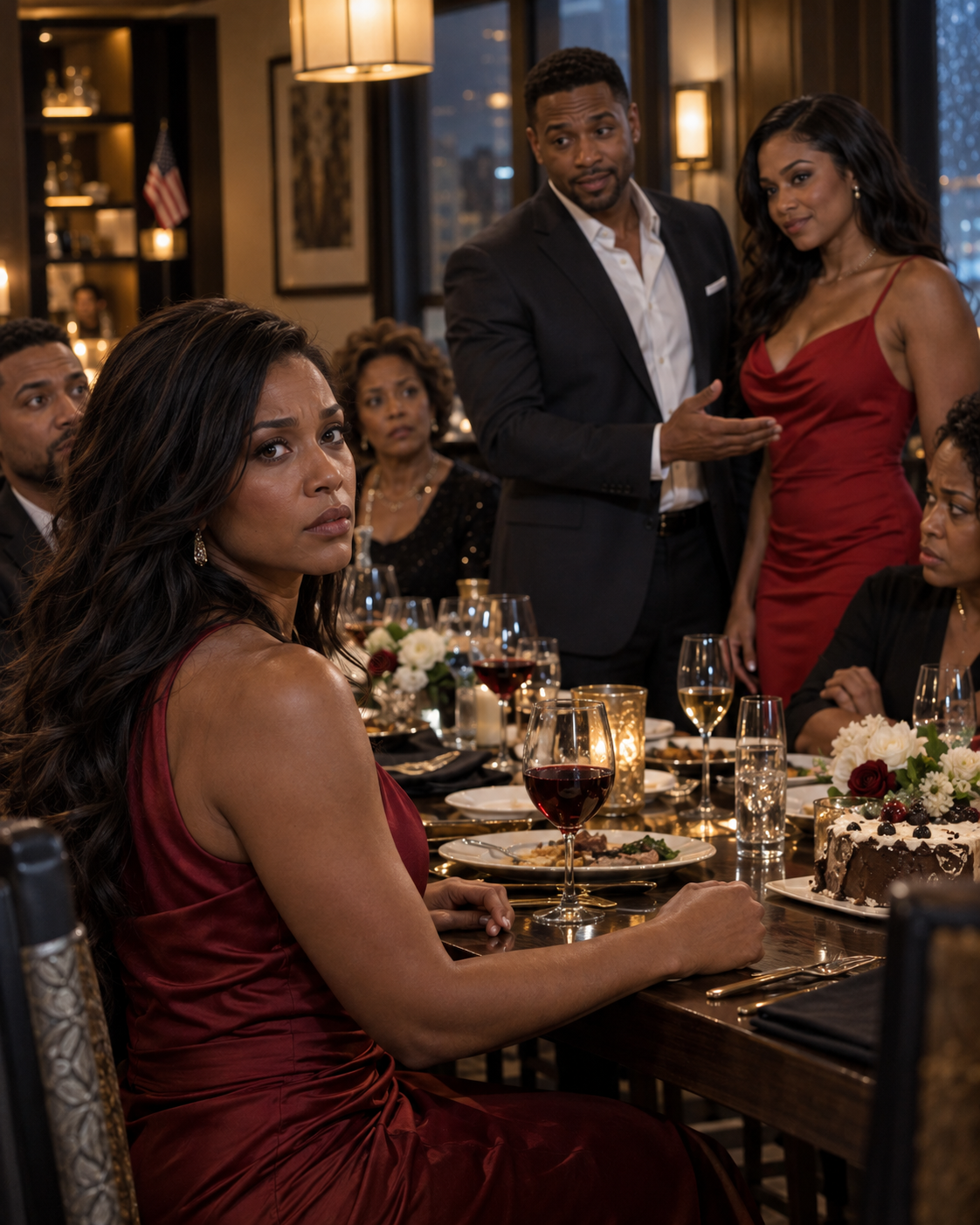
I stood frozen beside the birthday cake at our Manhattan hotel, watching my husband introduce another woman in a dress the exact color of mine
“For Clara, when she finally knows.”
I read those words three times before I realized I had stopped breathing.
Daniel stood silently across from my desk, giving me the kind of privacy people offer when they know grief has entered the room before you have even opened the door.
The envelope was old, its edges softened from being handled, and my name was written in a woman’s handwriting I had spent thirty years imagining.
Eleanor.
My biological mother.
The woman whose face I had never seen in person.
The woman whose blood ran through my veins but whose voice I could only reconstruct from other people’s memories.
I looked up at Daniel.
“How long have you had this?”
“It was discovered in a private archive your mother maintained.”
“Why didn’t you give it to me sooner?”
“Because the instructions were very specific.”
My fingers tightened around the paper.
“What instructions?”
He hesitated.
“She wanted you to receive it only after you had formally assumed control of the company.”
A chill moved through me.
I opened the letter.
“My dearest Clara,” it began.
I had to stop.
Nobody had ever called me that.
Not because the name was strange, but because hearing it in her handwriting made it suddenly belong to me in a way it never had before.
I continued reading.
Eleanor wrote that she had never forgotten me.
She explained that when I was born, her life had been tangled in business disputes, a dangerous marriage, and decisions made by people who believed they knew what was best for her.
She had surrendered me to adoption believing it would give me a safer childhood than she could provide.
She had been wrong about many things.
But she had never stopped trying to find me.
She described the first time she received a possible lead.
She described private investigators, sealed records, dead ends, false names, and years spent wondering whether I was alive.
Then I reached the part that changed the meaning of everything.
“My greatest fear was not that you would hate me,” she wrote.
“It was that you would believe I had forgotten you.”
Tears blurred the page.
I pressed my hand over my mouth.
For years, I had told myself that not knowing where I came from didn’t matter because I had been loved.
That was true.
But truth can have more than one shape.
I had been loved by my adoptive parents.
And I had also been missed by someone I had never known.
Both things could exist at once.
Eleanor wrote about my adoptive parents with surprising warmth.
She had found them.
She had watched from a distance.
She knew they were good people.
She had chosen not to interfere because she believed taking me back would destroy the only stable family I had ever known.
Then came another sentence.
“I gave you my fortune because I could not give you back the years.”
I cried so hard I had to put the letter down.
For several minutes, I simply sat there.
Then I noticed something else.
The letter wasn’t finished.
Eleanor had written a second page.
This one was different.
The handwriting became sharper.
More urgent.
“If you are reading this, Clara, there is something else you need to know.”
My heartbeat accelerated.
“There are people who will tell you that my death was natural and that every decision surrounding my estate was mine alone.”
I stared at the sentence.
“Do not believe everything you are told.”
I looked at Daniel.
He had gone pale.
“You knew about this?”
“No.”
“Then why do you look frightened?”
He didn’t answer immediately.
Finally he said, “Because your mother had concerns about people inside the company.”
I felt the old sensation from Julian’s birthday dinner return.
That quiet awareness that something beneath the surface was moving.
“Who?”
“She never named them in the letter.”
I read on.
Eleanor mentioned an internal investigation she had begun during the final year of her life.
Money had been disappearing from several subsidiaries.
Not enough to threaten the company.
Enough to be hidden.
Enough to accumulate.
She believed someone had been preparing to weaken her authority and eventually force a restructuring that would transfer control to people she didn’t trust.
Then came the final line.
“If they discover you are alive, they will try to make you disappear from the company before you understand why I left it to you.”
I lowered the letter.
“Daniel.”
“Yes?”
“Who knew I existed before you called me?”
He stared at me.
“Very few people.”
“How few?”
“Your mother, the investigators, me, and two attorneys.”
I thought about Julian.
He hadn’t known about Eleanor when I received the phone call.
At least, that’s what I had believed.
A week later, I flew to Philadelphia and walked into Vance Meridian’s headquarters for the first time as chairwoman.
The building rose above the city in glass and steel, but I didn’t feel powerful walking through the lobby.
I felt like an intruder carrying someone else’s name.
Employees stared.
Executives whispered.
Some greeted me warmly.
Others smiled too carefully.
The board meeting lasted four hours.
There were questions about my experience, my intentions, my knowledge of logistics, and whether I truly understood what I had inherited.
I answered honestly.
“No, I don’t know everything.”
One director leaned back.
“That concerns me.”
I looked at him.
“It should.”
The room went quiet.
“But I know how to learn.”
It was the first time I felt that the chair wasn’t Eleanor’s shadow.
It was mine.
Over the following months, I learned the company from the inside.
I visited distribution centers.
I spoke with drivers.
I reviewed contracts.
I read reports until two in the morning.
And slowly, I noticed the same pattern Eleanor had described.
Money was moving through layers of companies.
Small amounts.
Different subsidiaries.
Different vendors.
But the same names appeared again and again.
Then one name stopped me cold.
Julian.
Not directly.
Not as an owner.
His consulting company had received payments from a vendor connected to Vance Meridian.
I called Daniel immediately.
“Tell me this is a coincidence.”
He examined the documents.
“I can’t.”
The amount wasn’t enormous compared with the company.
But it was too clean.
Too carefully structured.
I thought back to the missing money from our joint accounts.
The affair.
The strange dinner.
The way Julian had reacted when I revealed the inheritance.
Suddenly, his question wasn’t just about money.
He had already known something.
Maybe not everything.
But something.
I hired a forensic accountant without telling anyone.
The investigation took six weeks.
Then the report arrived.
Julian’s consulting company had been receiving payments for eighteen months.
The vendor itself was controlled through another company.
That company was connected to an executive named Richard Hale.
Richard had been Eleanor’s chief financial officer.
He had also been one of the people arguing most aggressively that I should sell my controlling interest in Vance Meridian.
I stared at the report until the letters blurred.
Julian had betrayed me.
But he hadn’t been the only one.
I called him.
“Can we meet?”
There was a long pause.
“Of course.”
We met at a quiet restaurant outside the city.
He looked different.
The confidence was gone.
The divorce had stripped away more than our marriage.
Chloe had left him.
His friends had learned what he had done.
The consulting company was under investigation.
He had moved into a small apartment.
When he saw me, he smiled sadly.
“I’ve missed you.”
“I don’t want to talk about us.”
His smile faded.
“Then what?”
I placed a copy of the financial report on the table.
He looked at it.
His face changed.
“I didn’t know.”
“That’s not an answer.”
“I swear, Clara, I didn’t know what Richard was doing.”
“But you accepted the money.”
“Yes.”
“Why?”
He looked down.
“I was angry.”
“At me?”
“At everything.”
He admitted he had been drowning in debt and resentment.
He had met Chloe.
He had started taking money.
Richard had offered him consulting work.
He had told himself it wasn’t serious.
Then it became normal.
Then he couldn’t stop.
I listened without interrupting.
Finally I asked, “Did Richard know who I was?”
Julian’s eyes lifted.
“I think so.”
The restaurant suddenly felt too small.
“Why?”
“Because once, after your birthday dinner was planned, he asked me whether I knew anything about your family.”
My blood ran cold.
“What exactly did he say?”
Julian swallowed.
“He said, ‘Some people inherit more than money.'”
I went home and read Eleanor’s letter again.
This time I understood why she had sounded afraid.
She hadn’t only been searching for me.
She had been preparing for me.
The investigation widened.
Federal authorities became involved.
Richard resigned before investigators could formally question him.
Several executives cooperated.
Others disappeared behind attorneys.
The deeper we went, the more complicated Eleanor’s final years became.
She had discovered the financial scheme.
She had realized someone was attempting to gain leverage over the company.
And then she had changed her estate plan.
She had put everything in my name.
Not simply because she wanted to leave me money.
Because she believed ownership would protect the company from being quietly captured by the people she feared.
I sat alone in her old office one night.
The city glittered beyond the windows.
Her desk was still there.
Her chair was still there.
A framed photograph sat beside the lamp.
It was me.
Not as an adult.
Not as a child she had raised.
A photograph taken from far away when I was eight years old, walking beside my adoptive mother at a county fair.
I touched the glass.
“You were there.”
My voice broke.
“You really were there.”
Behind the photograph, I found another note.
This one was only three sentences.
“I watched because I loved you.
I stayed away because I loved you.
If you ever find this, forgive me for not knowing which kind of love you needed.”
I cried that night.
Not because I suddenly forgave her.
Not because everything made sense.
But because I finally understood that some losses cannot be repaired.
They can only be carried differently.
A year after I became chairwoman, I opened the Eleanor Vance Family Foundation’s first national center for birth mothers and adopted adults.
My adoptive parents came to the ceremony.
My father stood beside me with tears in his eyes.
“You know,” he said, “we were always afraid finding your biological family would make you love us less.”
I shook my head.
“You gave me my life.”
He smiled.
“Eleanor gave you your history.”
My mother took my hand.
“Maybe you needed both.”
I looked at them and realized she was right.
Identity wasn’t a door where one family had to leave for another to enter.
It was a house with more rooms than I had known existed.
Years later, people still asked me about the inheritance.
They wanted to know what it felt like to become a billionaire before thirty-one.
They wanted to know what happened to Julian.
They wanted details about the affair.
They wanted the dramatic ending.
But none of those things were the part I remembered most.
I remembered a letter.
A woman’s handwriting.
Six words on an old envelope.
“For Clara, when she finally knows.”
And I remembered that money could change where you lived, what you owned, and what doors opened when you arrived.
It could not buy back one birthday.
One childhood.
One conversation with a mother who had spent her final years searching for her daughter.
So I stopped trying to use Eleanor’s fortune to replace what was missing.
Instead, I used it to help other families find one another before years became decades.
I funded records access.
I created counseling programs.
I helped birth mothers leave letters for children they weren’t ready to raise.
I helped adopted adults search without feeling guilty for wanting answers.
And every year, on my birthday, I returned to the little county fair where Eleanor had once watched me from a distance.
I would stand near the old entrance and imagine her somewhere in the crowd.
Not as a billionaire.
Not as the founder of a global empire.
Just as a mother watching her daughter laugh.
On my thirty-fifth birthday, I brought the original letter with me.
The paper had become fragile.
The ink had faded slightly.
I unfolded it beneath the same summer sky.
Then I noticed something I had somehow missed all those years.
There was handwriting on the back.
Three words.
“Ask about Samuel.”
I froze.
Samuel was my father’s name.
Not the man who raised me.
My biological father’s name.
A name Eleanor had never mentioned anywhere else.
I turned the page over again.
There was no explanation.
No address.
No date.
Only those three words.
I stood there as the wind lifted the corner of the letter.
For the first time since discovering Eleanor, I understood something terrifying and beautiful.
Inheritance had never been the end of my story.
It had only been the door.
And somewhere beyond that door was another truth my mother had carried to her grave.
I folded the letter carefully against my heart.
Then I whispered the question I had spent thirty-five years not knowing how to ask.
“Who was Samuel?”
And somewhere in the distance, my phone began to ring.