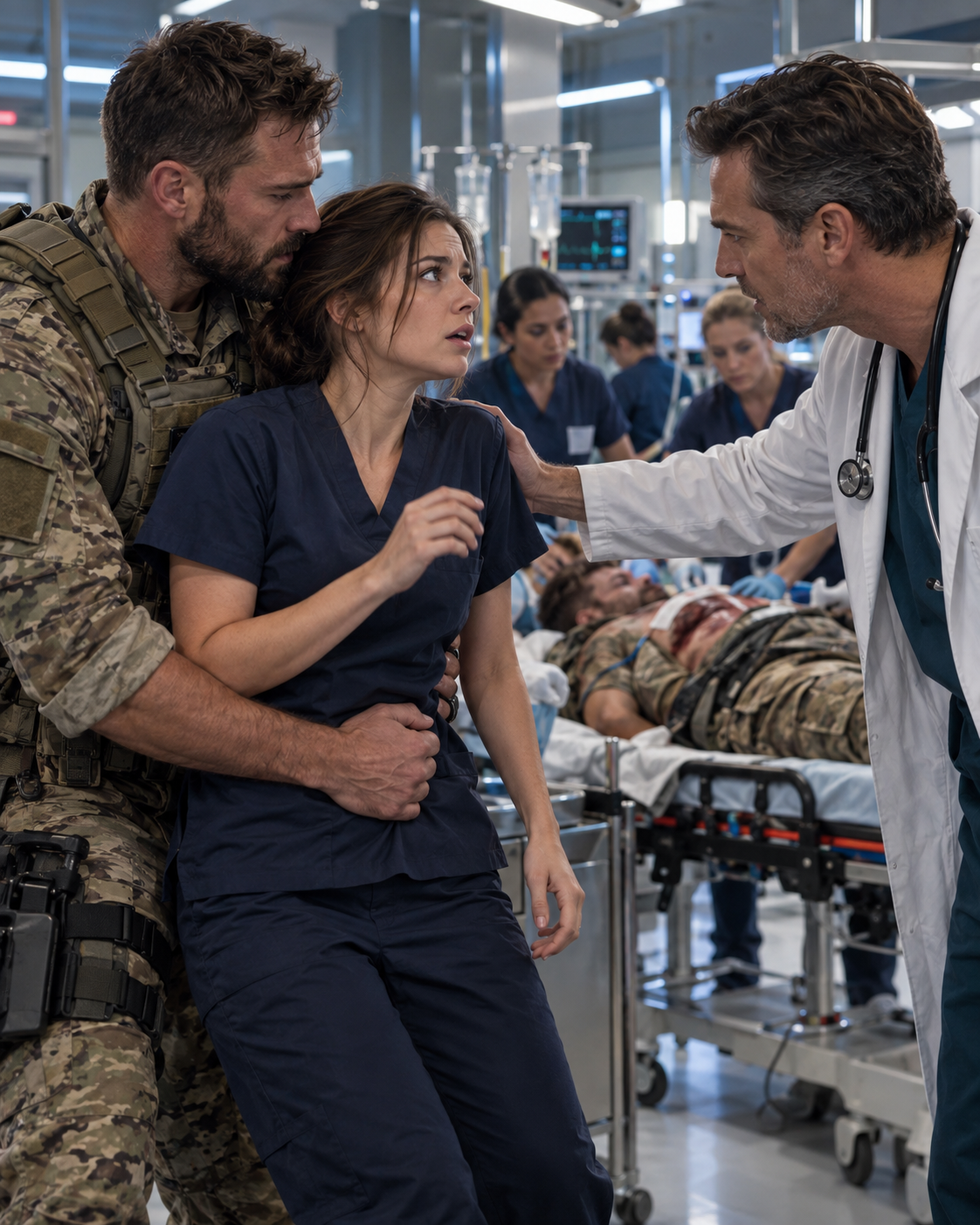
I stood frozen beneath the fluorescent lights of a Chicago trauma bay while Dr. Julian Thorne publicly called me a useless nurse
For one impossible second, nobody moved.
The trauma bay seemed to shrink around me, every monitor suddenly too loud, every fluorescent light painfully bright.
The giant operator lowered his salute, but his eyes never left mine.
“Commander Eleanor Vance,” he said quietly.
Julian stared at me.
“You told me your name was Eleanor.”
“It is.”
“You said you were a floor nurse.”
“I am.”
His voice became almost a whisper.
“Then why is a Navy operator saluting you?”
I looked toward the patient.
“Because right now, he’s not interested in my résumé.”
The patient groaned.
That sound brought everyone back to work.
“Pressure is holding,” one of the nurses said.
“Keep massive transfusion going,” I ordered.
Julian opened his mouth.
I looked at him.
“Unless you have a better idea.”
He said nothing.
For the first time since I had met him, Dr. Julian Thorne looked like a man who had run out of answers.
The giant operator leaned toward me.
“Commander, I’m Chief Marcus Caldwell.”
“I know.”
His expression tightened.
“You shouldn’t.”
“I remember faces.”
That was only partly true.
I remembered Marcus because fourteen years earlier, I had watched him carry three wounded men across a desert landing zone while rounds struck the ground around him.
He had been younger then.
So had I.
And there had been a fourth man.
A medic named Daniel.
Daniel had died before we reached the helicopter.
Marcus had never forgiven himself.
Neither had I.
But there was no time for ghosts.
“What’s his name?” I asked.
“Petty Officer Ryan Mercer.”
“How did this happen?”
Marcus glanced toward the trauma doors.
“Rail yard.”
Those two words changed everything.
I had heard rumors about an extremist network operating around Chicago.
Nothing official.
Nothing I could verify.
Just fragments appearing in encrypted reports before my transfer.
I had deliberately stopped reading them.
I had promised myself that civilian life meant civilian problems.
A broken arm.
A fever.
A car accident.
Not covert operations.
Not terrorism.
Not blood on concrete.
But Marcus had brought the war to my doorstep.
Ryan survived surgery that night.
Barely.
The vascular repair held.
The transfusions worked.
His blood pressure stabilized enough for us to move him upstairs.
When the elevator doors closed, Marcus turned toward me.
“Thank you.”
I shook my head.
“Don’t thank me yet.”
He frowned.
“You saved him.”
“No.”
I looked at the elevator numbers climbing.
“We bought him time.”
Then he said something that made my blood run cold.
“That’s what you always said.”
I looked at him.
“Where did you hear that?”
Marcus smiled sadly.
“Everyone who served under you heard it.”
Before I could answer, hospital security appeared.
Then came two administrators.
Then Julian.
He walked beside them with a fury I recognized immediately.
It wasn’t anger.
It was humiliation.
He wanted someone to blame.
And I was standing directly in front of him.
Inside the administrator’s office, the city lights glittered beyond the windows.
Arthur Pendelton, the hospital administrator, sat behind a polished mahogany desk.
Julian stood beside him.
“I want her terminated immediately,” Julian said.
Arthur looked at me.
“Dr. Thorne alleges that you physically interfered with his treatment and performed procedures outside your nursing scope.”
“I did.”
Julian blinked.
Arthur blinked too.
I folded my hands.
“I also kept your patient alive.”
Julian’s jaw tightened.
“You don’t get to decide that.”
“No.”
I looked directly at him.
“The monitor does.”
He stepped closer.
“You could have killed him.”
“I could have.”
“And you disregarded my orders.”
“Yes.”
“You should be arrested.”
I nodded.
“If that’s what the law requires.”
Julian seemed almost disappointed by my lack of fear.
Then the office door opened.
Three military police officers entered.
Behind them walked a silver-haired man in a dark uniform.
Vice Admiral Harrison Sterling.
I hadn’t seen him in almost seven years.
He looked at me.
I stood.
“Admiral.”
He nodded.
“Commander.”
Arthur rose so quickly that his chair rolled backward.
Julian stared between us.
Sterling placed a black folder on the desk.
The seal on it carried the words that had once controlled my life.
TOP SECRET.
Arthur swallowed.
“What is this?”
“The reason you will not be firing Commander Vance tonight.”
Julian’s face drained of color.
Sterling opened the folder.
“Eleanor Vance served fourteen years as chief medical officer for a Tier-1 Naval special operations unit.”
Arthur looked at me.
“Chief medical officer?”
Sterling continued.
“Combat surgeon. Trauma specialist. Tactical medicine instructor. And the medical lead for multiple classified operations.”
Julian whispered, “That’s impossible.”
Sterling looked at him.
“No, Doctor.”
He tapped the folder.
“What’s impossible is that you nearly opened the chest of a patient with catastrophic pelvic hemorrhage and essentially no remaining circulating volume.”
Julian said nothing.
Sterling’s voice remained calm.
“Commander Vance recognized the injury immediately.”
He turned toward me.
“You shouldn’t have had to.”
I looked away.
“I chose this life.”
“No.”
His expression softened.
“You chose peace.”
That sentence hurt more than I expected.
Because it was true.
I hadn’t left the military because I hated medicine.
I hadn’t left because I was tired of saving people.
I left because I was tired of becoming someone who could watch another human being die without crying.
Sterling closed the folder.
“The patient was injured while preventing a domestic terror attack at the rail yard.”
Arthur sat down slowly.
“Domestic terror?”
“Three suspects are in custody.”
Julian finally spoke.
“Why was she working here under a nurse’s credentials?”
Sterling looked at me.
“Because she requested anonymity.”
Julian stared.
“Why?”
I answered before the Admiral could.
“Because I wanted to be Eleanor.”
Silence filled the room.
“Not Commander Vance.”
“Not Chief Medical Officer.”
“Not the person everyone called when things went wrong.”
“Just Eleanor.”
Julian looked down.
For the first time, I saw something besides arrogance in his face.
Shame.
Sterling turned toward him.
“You accused her of criminal battery.”
Julian said nothing.
“You threatened to have her arrested.”
Still nothing.
“And tonight, she saved the life of a man whose death could have compromised a major federal investigation.”
Julian closed his eyes.
Sterling leaned forward.
“You owe her an apology.”
Julian looked at me.
His pride fought his conscience for several seconds.
Then his shoulders dropped.
“I’m sorry.”
The words were quiet.
Almost fragile.
“I was wrong.”
I studied him.
“About what?”
He swallowed.
“About you.”
I shook my head.
“That’s not enough.”
He looked confused.
“You’re not sorry because you were wrong about me,” I said.
“You’re sorry because you were wrong about the patient.”
His eyes lowered.
“You’re right.”
That was the first honest thing he had ever said to me.
Sterling eventually offered me something else.
A command.
A new deployment.
Eastern Europe.
Classified.
High risk.
The kind of assignment that would have once made my heart race.
I listened.
Then I said no.
Sterling wasn’t surprised.
“You’re certain?”
I looked through the office window toward the emergency department.
A nurse was helping an elderly man drink water.
A resident was comforting a frightened teenager.
Someone was laughing near the nurses’ station.
Ordinary sounds.
Beautiful sounds.
“I’m certain.”
“You know the work won’t stop.”
“I know.”
“The world will still need people like you.”
I smiled faintly.
“The world has enough commanders.”
He almost smiled.
“Perhaps.”
Then he left.
I returned to the trauma floor before sunrise.
Nobody knew what to say to me.
Some nurses stared.
Others pretended not to.
One young nurse finally approached.
“Are you really a commander?”
I sighed.
“Unfortunately.”
She smiled.
“That’s kind of incredible.”
“No.”
I looked at the trauma bay.
“It’s mostly exhausting.”
She laughed.
And somehow, that laugh made the whole night feel less heavy.
Julian changed after that.
Not overnight.
Not magically.
People don’t become different because someone humiliates them once.
But he started listening.
He asked nurses what they saw.
He stopped interrupting patients.
He apologized when he was wrong.
One evening, weeks later, he stood beside me after a difficult trauma.
“You were right about the bleeding pattern.”
I looked at him.
“Don’t sound so devastated.”
He smiled.
“I’m working on it.”
I smiled back.
Then my pager vibrated.
Unknown number.
I frowned.
The message contained only six words.
YOU WERE NEVER SUPPOSED TO FIND RYAN.
My smile disappeared.
A second message appeared.
WE KNOW WHERE YOU LIVE, COMMANDER.
I stared at the screen.
The emergency department continued around me.
Phones rang.
Stretchers rolled.
Someone called for blood.
Someone laughed.
Life went on as if nothing had changed.
But I knew better.
I had spent fourteen years learning how danger announced itself.
Sometimes it came with gunfire.
Sometimes with sirens.
And sometimes with six quiet words on a pager.
I looked across the room.
Julian noticed my expression.
“What happened?”
I locked the screen.
“Nothing.”
He didn’t believe me.
Neither did I.
Outside, Chicago disappeared beneath the first gray light of morning.
I had chosen this hospital because I wanted an ordinary life.
I had chosen anonymity because I wanted to forget the person I used to be.
But someone had just reminded me of something I had tried very hard to forget.
You can leave a war.
You can change your name.
You can put away the uniform.
But if the war remembers you, sometimes it follows you home.
And somewhere beneath the city, someone had just decided that Commander Eleanor Vance was not finished yet.