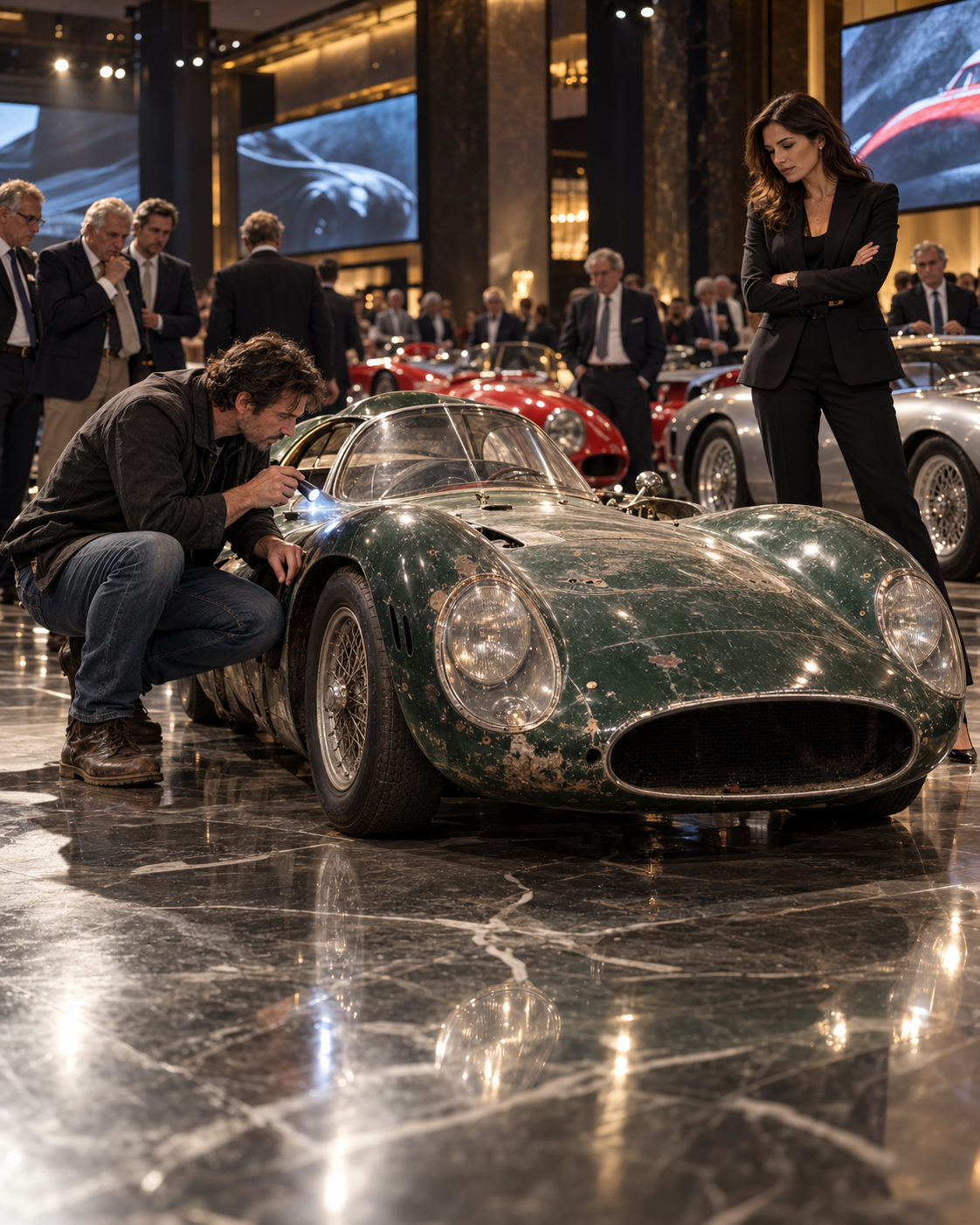
I stood beside lot 47 while Manhattan’s richest collectors laughed at my battered green wreck
The date beneath my father’s warning was May 14, 1962.
I read it three times.
Then a fourth.
The garage was silent except for the slow ticking of the wall clock and the occasional hiss of the old air compressor settling after a long day.
I turned the photograph over again, hoping I had somehow misunderstood his handwriting.
I hadn’t.
The words remained exactly where they were.
THE FIRE WAS NEVER AN ACCIDENT.
I sat down beside the workbench.
For the first time since the auction, I wasn’t thinking about the eight point two million dollars, the headlines, or the people who had suddenly learned my name.
I was thinking about my father.
About the basement.
About all those nights when I had been a kid and heard him turning pages long after midnight.
I had always thought his obsession with GTR 0 was about proving himself right.
Now I wondered if it had been something else.
Fear.
I opened the notebook.
Most of the pages were covered with diagrams, measurements, names, and fragments of conversations.
My father had always written as if someone might someday need to reconstruct his thoughts.
I turned slowly through the pages until I reached the year 1962.
There was almost nothing there.
Then I found a single sentence.
“Donald says the prototype was never supposed to leave the factory.”
My hands went cold.
Donald Vance.
The same man whose welding signature I had recognized on the chassis.
I kept reading.
“Someone changed the delivery order.”
Below that was another line.
“George knows.”
I stopped.
George was my father’s first name.
I had never seen him write about himself like that.
I took out my phone and called Dr. Kenneth Vance.
He answered on the fourth ring.
“Is everything okay?”
“I found something.”
He became quiet.
“What kind of something?”
“I think our fathers knew more than they told us.”
There was a long pause.
“Send me a picture.”
I did.
He didn’t respond immediately.
Then a message appeared.
“Come to my house tomorrow.”
The next afternoon, I drove across town with the notebook locked inside my jacket.
Kenneth lived in a modest brick house outside the city, far removed from the world of multimillion-dollar collector cars.
When he opened the door, he looked older than he had at my garage.
Not weak.
Just tired.
The kind of tired that comes from carrying a question for too many years.
He led me into his study.
Photographs covered one wall.
Donald Vance appeared in nearly all of them.
Young.
Serious.
Usually standing beside race cars.
Kenneth placed a magnifying glass on the desk.
“Show me.”
I opened the notebook.
He read the page.
His face changed.
“My father never told me about George.”
“Did he ever mention the fire?”
“Every year.”
I looked at him.
“Every year?”
“Not the way you think.”
Kenneth walked to a cabinet and removed a small metal box.
Inside was a stack of letters tied with faded string.
“My father left these for me with instructions not to open them until I was fifty.”
“Did you?”
“I did.”
He placed one letter in front of me.
The envelope was addressed to Donald Vance.
The date was September 3, 1965.
Two months before the warehouse fire.
I looked at Kenneth.
“Why would your father write a letter to himself?”
“He didn’t.”
I opened it carefully.
The letter was from my father.
My throat tightened.
Dear Donald, I wrote, if they move the car tonight, do not let them take it without you.
Kenneth leaned closer.
“What car?”
I pointed to the second paragraph.
“The prototype.”
Neither of us spoke.
Then Kenneth whispered, “My father knew GTR 0 was being moved.”
“Where?”
“That’s what we’re going to find out.”
We spent hours going through the letters.
The story that emerged was nothing like the official history.
Callaway Racing had developed GTR 0 as an experimental platform.
It was never meant to be sold.
The car contained an unusual chassis design, an experimental engine, and several engineering solutions that were years ahead of the company’s public racing program.
But someone inside the organization believed the prototype could be sold privately.
Not legally.
Privately.
The letters suggested a group of investors wanted the design and intended to dismantle the car, copy the engineering, and erase its connection to Callaway.
Donald resisted.
My father helped him.
And then something changed.
A week before the fire, Donald disappeared from the factory for two days.
When he returned, he had a broken wrist.
He told everyone he had fallen.
Nobody believed him.
Kenneth looked at me.
“My father never talked about those two days.”
“Maybe he was protecting someone.”
“Or himself.”
We found another document hidden beneath the false bottom of the metal box.
It was a handwritten inventory.
One line had been circled.
CGTR001.
Next to it was a location.
Brooklyn.
My stomach dropped.
“My garage is in Brooklyn.”
Kenneth stared at the page.
“Your father lived there.”
I thought about the old apartment where I grew up.
The basement where he kept his notebooks.
The boxes I had thrown away after his death because I couldn’t bear sorting through them.
For years, I had assumed those boxes contained nothing but old magazines and rusted parts.
I suddenly wondered what I had destroyed.
I drove home that night and went straight to the basement.
Lily was asleep upstairs.
I didn’t turn on the main light.
I used a flashlight, just like my father had taught me when the power failed during storms.
Every shelf looked ordinary.
Then I remembered something.
My father had always refused to let anyone touch one particular cabinet.
I had thought it was because of sentimental tools.
I opened it.
Behind a row of empty coffee cans was a small wooden box.
The lock was already broken.
Inside was a key.
And beneath the key was another photograph.
It showed my father, Donald Vance, and a third man standing beside GTR 0.
The third man had been scratched out with a knife.
I stared at the damaged face.
Something about the man’s jacket looked familiar.
Then I saw the company pin.
Callaway.
I called Kenneth.
He answered immediately.
“I found another photograph.”
“Send it.”
I did.
He called back within seconds.
“That man is Walter Crane.”
“Who?”
“Head of factory security in 1965.”
My chest tightened.
“Is he alive?”
Kenneth hesitated.
“I don’t know.”
I searched the name.
There were several results.
One obituary stopped me.
Walter Crane had died three months earlier.
At ninety-one.
But the obituary contained one detail that made my skin crawl.
For the final thirty years of his life, he had lived less than ten miles from my garage.
I barely slept that night.
The next morning, I took Lily to school and drove to the address.
An elderly woman answered the door.
When I showed her the photograph, she didn’t ask who I was.
She simply stared at it.
Then she said, “You’re George’s boy.”
I felt the world tilt.
“You knew my father?”
“Everyone knew your father.”
She opened the door wider.
“Come in.”
Her name was Evelyn Crane.
Walter’s widow.
The house smelled like old paper and furniture polish.
She led me to a room filled with boxes.
“Walter told me that one day someone would come asking about the green car.”
I couldn’t speak.
She handed me a small envelope.
“He said to give this to George’s son.”
My fingers shook as I opened it.
Inside was a cassette tape.
No label.
Just one sentence written in blue ink.
“Play this only when you’re ready to hear why your father lied.”
I looked at Evelyn.
“Did you know what was on it?”
She nodded.
“My husband confessed everything before he died.”
I took the tape home.
My garage still had an old cassette player because my father refused to throw anything away.
I inserted the tape.
Static filled the room.
Then a man’s voice emerged.
Walter Crane.
“I don’t know who will hear this.”
His breathing was slow and uneven.
“The fire was supposed to destroy the car.”
I closed my eyes.
“But George and Donald moved it before the flames started.”
My heart slammed against my ribs.
“They built a duplicate shell and placed it inside the warehouse.”
The room seemed to disappear.
“The real GTR 0 was hidden.”
I looked toward the garage door.
“Where?”
Walter’s voice continued.
“George knew the car was too dangerous to keep at Callaway, because the people funding the project wanted the engineering erased.”
Then came a pause.
“And George didn’t trust them.”
I leaned toward the speaker.
“Donald wanted to take the prototype to the authorities.”
Another pause.
“But George convinced him to hide it instead.”
The tape crackled.
“They believed someone inside the company was selling confidential designs.”
Then Walter said something that made my blood run cold.
“The person who ordered the fire was never exposed.”
The recording ended.
I sat there for a long time.
Then my phone rang.
It was Kenneth.
“I found something else.”
“What?”
“Your father’s old racing license.”
“I have it.”
“No.”
His voice was tense.
“Not the license itself.”
“What do you mean?”
“There is a handwritten number on the back.”
I looked at the license hanging in a frame above my desk.
I had never turned it over.
I pulled it down.
There, beneath years of dust, was a number.
Kenneth read it aloud.
It matched the serial number of a bank storage locker.
I drove to the bank with Kenneth beside me.
The locker contained no money.
No gold.
No documents.
Only a small metal cylinder and a sealed envelope.
The envelope had my name on it.
Not my father’s handwriting.
My wife’s.
I couldn’t breathe.
Anna had died three years earlier.
I opened it with trembling hands.
Inside was a short letter.
She had written it before she became sick.
She knew about the prototype.
I read her words slowly.
She said my father had contacted her shortly before his death.
He had asked her to promise that if anything ever happened to him, she would keep the truth from me until I was ready.
She had kept that promise.
Until now.
At the bottom of the letter she had written:
“Your father didn’t want you to inherit his fear, only his patience.”
I broke down.
Not because of the money.
Not because of GTR 0.
Because suddenly I understood why Anna had always told me to keep looking beneath the surface.
She knew what my father had left behind.
She knew I would eventually find it.
The metal cylinder contained a blueprint.
Not of GTR 0.
Of a second car.
A car marked CGTR002.
I stared at Kenneth.
“There’s another one.”
He didn’t answer.
His face had gone pale.
The blueprint showed the same 73-degree reinforcement bar.
The same experimental chassis.
But beneath the design was a handwritten note.
“CGTR002 was never completed.”
I exhaled.
Then I noticed something else.
A signature.
Donald Vance.
And below it, in my father’s handwriting:
“Unless someone finished it.”
For several minutes, neither of us spoke.
Then Kenneth stood.
“We have to find out.”
“Why?”
“Because if another prototype exists, whoever hid it may still be protecting the same secret.”
I thought about Marcus.
His strange reaction at my garage.
The way he had looked at GTR 0.
It suddenly made sense.
He hadn’t been afraid of losing money.
He had been afraid I would keep digging.
I called him.
He didn’t answer.
I called again.
Nothing.
Then a text arrived.
“Stop looking.”
Two words.
Nothing more.
I showed Kenneth.
He stared at the screen.
“We need to take this seriously.”
“I am.”
“No.”
He looked directly at me.
“You still think this is about an old race car.”
I looked at the blueprint.
He continued.
“It’s about who wanted these cars erased.”
That night I locked every door in the garage.
I checked the cameras twice.
Lily slept upstairs in the apartment above the shop.
I sat beside her bed for a long time, watching her breathe.
She looked peaceful.
I kissed her forehead.
Then I went downstairs.
At 2:13 a.m., the security alarm went off.
I ran into the garage.
The front door was still locked.
The windows were intact.
Nothing appeared stolen.
Then I saw the workbench.
The metal cylinder was gone.
My father’s notebook was open.
A page had been torn out.
I grabbed the camera footage.
There was nothing.
Only static.
Someone had disabled the system remotely.
I called the police.
Before they arrived, another message appeared on my phone.
A photograph.
It showed the inside of an abandoned warehouse.
In the center stood a second olive-green chassis.
The image was blurry, but the frame was unmistakable.
CGTR002.
Beneath the photograph was one sentence.
“Your father hid one car from us.”
A second message appeared.
“Don’t make us find out what else he left you.”
I stared at the screen.
For the first time since I was a child, I understood why my father had never celebrated his victory.
He hadn’t believed he had won.
He had only survived.
Weeks passed.
Investigators found no clear evidence connecting Marcus to the break-in.
Marcus denied everything.
The auction house distanced itself from him.
Kenneth and I continued researching, but we stopped discussing the second chassis publicly.
I put Lily’s trust in place.
I strengthened the garage.
And every night, I checked the locks before going upstairs.
Then one evening, almost six months after the auction, I was repairing an old Ford when a package appeared outside the garage.
No return address.
Inside was the metal cylinder.
Alongside it was a photograph.
I turned it over.
My father’s handwriting covered the back.
“You’re finally ready.”
Below that was an address.
I knew the place.
An abandoned racetrack outside Pennsylvania.
The same track where my father had won his final professional race.
I stood there holding the photograph while the shop lights hummed above me.
For years, I had thought my father’s greatest gift was teaching me how to repair machines.
I finally understood.
He had taught me how to listen.
Because broken things always tell the truth eventually.
I looked upstairs toward Lily’s room.
Then I looked at the photograph again.
Somewhere beyond that abandoned track was the answer to a question my father had carried until his death.
Who ordered the fire?
Who finished CGTR002?
And why had someone waited until after the sale of GTR 0 to send me there?
I locked the garage.
The next morning, I would drive to Pennsylvania.
Not for the money.
Not for another auction.
Not even for my father.
I would go because there are some stories that refuse to stay buried, no matter how much rust, silence, or fear someone piles on top of them.
And as I slipped the photograph into my jacket, I noticed one final detail I had missed.
In the corner of the image stood a little girl.
She was holding a sign.
On it were four words.
“HE KNEW YOU’D COME.”