I stood at the back of a Manhattan ballroom while my parents handed my sister a $13 MILLION penthouse
The next morning, I would learn that Harold’s words had not been a threat, a bluff, or some dramatic performance designed to ruin my sister’s celebration.
They were the beginning of the strangest night of my life.
For several seconds, nobody moved.
The ballroom remained frozen beneath the chandeliers, with two hundred guests staring at my family as though they had accidentally wandered into a private war.
My father finally found his voice.
“This is impossible.”
Harold calmly placed the original will on the table.
“No, Richard,” he said. “What is impossible is that you believed I would spend forty years protecting your father’s wishes only to help you destroy them.”
My father’s jaw tightened.
“You were supposed to bring this to me.”
“I was supposed to bring it to the beneficiary when the conditions of the will were met.”
He looked at me.
“Tonight, they were.”
Clarissa stepped forward.
“Wait.”
Her voice was smaller than I had ever heard it.
She looked at Harold, then at me.
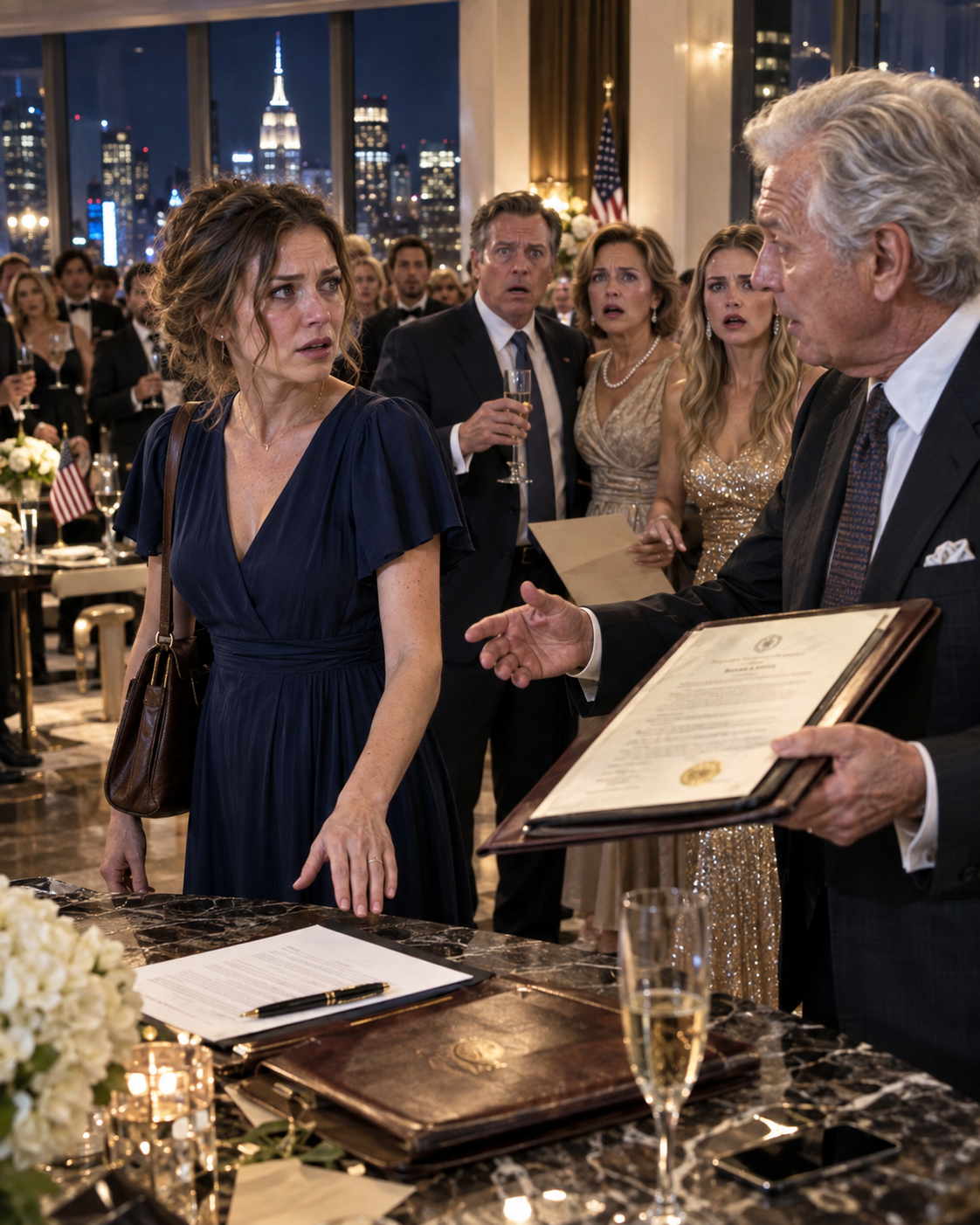
“You’re saying she gets everything?”
Harold didn’t answer immediately.
He opened another folder.
“Your grandfather established a fifteen-million-dollar trust for the qualifying granddaughter, along with provisions governing the remainder of the family estate.”
My mother’s hand flew to her mouth.
My father stared at the documents.
“That estate is worth over sixty million dollars.”
“Approximately sixty-four million at present valuation,” Harold replied.
Someone near the bar quietly gasped.
I felt sick.
This wasn’t what I had imagined when I was a little girl.
I had never dreamed of mansions or trusts.
I had dreamed of having my father come to my classroom once.
Just once.
I wanted him to see the children painting together.
I wanted him to see the boy who had stopped speaking after a violent home life begin whispering again while mixing blue and yellow paint.
I wanted him to understand why I stayed.
Instead, he had spent years asking when I planned to get a “real career.”
Now the answer sat in a leather folder between us.
My mother began crying.
“Please,” she whispered.
I looked at her.
“Please what?”
She shook her head.
“I didn’t know.”
I almost laughed.
“You didn’t know about the waiver you asked me to sign?”
“I didn’t know the clause would activate.”
That sentence hurt more than anything else.
Not because she admitted guilt.
Because she admitted she had intended to make me disappear from my grandfather’s will without even knowing what she was stealing.
My father stepped toward Harold.
“This is legally questionable.”
Harold smiled sadly.
“Your father anticipated that statement.”
He produced another document.
“Copies of the will were notarized and deposited with three separate law firms in three states.”
My father stopped.
“He knew you might try to interfere,” Harold continued.
The silence became unbearable.
Then Clarissa looked at me.
“You knew?”
“No.”
“Then why didn’t you tell me?”
I stared at her.
“Tell you what?”
“About Grandpa.”
I swallowed.
“Clarissa, I didn’t know.”
She looked down.
For the first time all evening, she didn’t look successful.
She looked scared.
Harold continued reading the relevant provisions.
My grandfather had written that wealth should never become a reward for vanity, status, or income alone.
He wanted his fortune to follow evidence of service, compassion, and measurable improvement in the lives of others.
And he had specifically named my art therapy program in a handwritten letter attached to the will.
My knees almost gave out.
“Grandpa knew about the program?”
Harold nodded.
“He visited one of your workshops without telling you.”
I covered my mouth.
I remembered an elderly man who had once sat quietly in the back of a community center while children painted paper birds.
I had assumed he was someone’s grandfather.
“He was proud of you,” Harold said.
Those four words broke something inside me.
I began crying.
Not because of the money.
Because for fifteen years, I had believed my grandfather had died thinking I had wasted my life.
Apparently, he had been watching.
Harold handed me another envelope.
“This was meant to be delivered after the will was executed.”
I couldn’t open it.
Not yet.
My father suddenly spoke.
“You can’t seriously expect everyone here to accept this.”
I looked at him.
“I don’t expect anything from you anymore.”
That was when the room changed.
I had spent my entire life trying to win his approval.
And suddenly, I didn’t want it.
The guests began leaving quietly.
Some hugged me.
Some avoided eye contact.
Some approached Harold and whispered questions.
I barely heard them.
All I could see was Clarissa standing beside the giant photograph of the penthouse she had just been given.
The same penthouse that was now legally tangled in an estate she might no longer control.
She looked at the keys in her hand.
Then she dropped them onto the table.
“I don’t want it.”
Everyone turned toward her.
My father stared.
“What did you say?”
“I don’t want the Tesla either.”
She looked at me.
“None of it.”
I didn’t know whether to believe her.
For fifteen years, Clarissa had been the golden child.
She had learned how to smile when people applauded.
She had learned how to speak confidently, dress perfectly, and win every argument.
But that night, she looked like a woman who had suddenly realized she had been climbing the wrong mountain.
Then she asked the question that would stay with me for months.
“How did I lose when I did everything right?”
Harold walked toward her.
He didn’t sound angry.
“Because being perfect is not the same as being good.”
Clarissa began to cry.
Not the elegant tears people shed at weddings.
These were ugly, exhausted tears.
The kind that come when the identity you’ve built your entire life around suddenly collapses.
I wanted to hate her.
Part of me did.
But another part remembered the little girl who used to sit beside me at the kitchen table and color butterflies with broken crayons.
Maybe neither of us had been allowed to become who we really were.
The next morning, lawyers arrived at my apartment.
By noon, the family company had been placed under new ownership provisions.
By evening, I had access to financial records I had never known existed.
There were investments, properties, businesses, foundations, and accounts spread across decades of family wealth.
The number at the bottom of the first report made me put the paper down.
I walked to my window and stared at the city.
For years, I had measured my worth against a $42,000 salary.
Now I was staring at millions.
And somehow, I still felt like the same woman who had bought secondhand paintbrushes for her classroom.
I called Harold.
“What am I supposed to do with all of this?”
He answered without hesitation.
“Your grandfather believed the answer would come from the work you’ve already been doing.”
So I returned to school the following Monday.
Nothing had changed there.
The same cracked sidewalk.
The same squeaky classroom door.
The same smell of tempera paint and cafeteria food.
My students ran toward me when I arrived.
“Ms. Bennett!”
One little girl hugged my waist.
I knelt beside her.
“How was your weekend?”
She smiled.
“I painted my dog.”
I laughed.
“Then I need to see it.”
For the first time, I understood something my family had never understood.
My life had never been small.
They had simply been measuring it with the wrong ruler.
Within weeks, we began restructuring the family company.
I refused to turn it into another monument to our last name.
Instead, I created a charitable foundation dedicated to art therapy, disability services, trauma recovery, and arts education.
We funded school districts that had no counselors.
We built sensory rooms.
We paid for adaptive art supplies.
We created scholarships for teachers.
And then came the Hamptons estate.
My father had once told me that the house was where successful people went to escape ordinary life.
I decided ordinary children needed it more.
We transformed the property into a summer camp for children with disabilities and trauma.
The first time I walked through the finished rooms, I saw colorful murals covering walls that had once held expensive paintings.
There were ramps where decorative stone steps had been.
There were sensory gardens where my parents had once planted ornamental roses.
The pool had been redesigned for adaptive swimming.
And in the largest room, sunlight poured through enormous windows onto tables filled with paper, clay, paint, and glitter.
It became known as the Color House.
The first group of children arrived in June.
One boy refused to leave the bus.
He was eight.
He wouldn’t make eye contact.
His mother stood beside him crying quietly.
I crouched several feet away.
“Do you like dinosaurs?”
His eyes moved toward me.
I held up a green paper dinosaur.
He took it.
That was all.
But sometimes all is enough.
Three weeks later, he painted an entire wall.
His mother stood behind me, crying into her hands.
“Nobody knew he could do that.”
I looked at the boy.
“I think he always knew.”
Six months after the ballroom disaster, my parents began volunteering at the camp every Saturday.
At first, they were awkward.
My mother didn’t know how to respond when children screamed.
My father kept trying to solve problems with money.
Then one afternoon, a little girl knocked over an entire tray of paint.
My father froze.
The room went silent.
He looked at the spilled colors, then at the terrified child.
For years, I had watched him demand perfection.
Now I watched him kneel on the floor.
“It’s okay,” he said.
The girl stared at him.
“We can clean it together.”
Something changed in him that day.
My mother began helping in the sensory garden.
She learned which textures overwhelmed certain children.
She learned that sometimes sitting quietly beside someone was more useful than giving advice.
And Clarissa surprised me most of all.
She could have returned to Manhattan.
She could have accepted a prestigious position and rebuilt the life she had lost.
Instead, she asked me for a job.
“I don’t know anything about art therapy.”
“I know.”
“I don’t know how to work with children.”
“I know.”
“I might be terrible at this.”
I smiled.
“Then you’ll finally be learning something.”
She laughed.
It was the first genuine laugh I’d heard from her in years.
She started in the sensory art program.
At first, she was impatient.
Then came a child named Marcus.
Marcus had severe sensory challenges and could become overwhelmed by noise without warning.
During his second week, he had a meltdown in the middle of the studio.
Other volunteers stepped back.
Clarissa stayed.
She sat on the floor several feet away and waited.
No lecture.
No commands.
No judgment.
Just patience.
After several minutes, Marcus looked at her.
She whispered, “You’re safe.”
His breathing slowed.
Then he reached for a blue crayon.
Clarissa handed it to him.
That night, she called me.
“I understand now.”
“What?”
“Why you stayed.”
I sat silently.
She continued.
“I thought you were afraid to become successful.”
My throat tightened.
“And now?”
“Now I think I was afraid to become human.”
Neither of us spoke for a while.
Then she said, “I’m sorry.”
This time, I believed her.
My father apologized months later.
It wasn’t dramatic.
There was no ballroom.
No audience.
He simply came to my classroom after school and stood beside a table covered in children’s paintings.
“I was wrong,” he said.
I kept arranging brushes.
“About what?”
“About you.”
I finally looked at him.
He swallowed.
“I thought success was something people could see.”
I nodded slowly.
“So did I.”
He looked at the paintings.
“Your grandfather understood.”
“Apparently.”
He smiled sadly.
“I wish I had.”
I didn’t tell him that I had wished for that sentence since childhood.
Some wounds don’t disappear when someone apologizes.
But they become lighter when the person finally stops pretending they aren’t there.
The foundation grew faster than any of us expected.
Within a year, programs were operating in schools across the country.
Teachers who had once bought supplies from their own pockets received grants.
Children who had been excluded from traditional classrooms found adaptive art programs waiting for them.
And I kept teaching at my old school.
Still earning my $42,000 salary.
People asked why.
I always gave the same answer.
“Because this is where it started.”
One evening, after the children had gone home, I sat alone in the Color House.
The sunset turned the windows gold.
I finally opened the letter from my grandfather.
The handwriting was shaky but unmistakable.
“My dear Emily, if you are reading this, then something has gone terribly wrong with the people who were supposed to protect you.”
I stopped breathing.
The letter continued.
“I knew your father loved you, but I also knew that fear can make good people selfish, and wealth can make selfishness look respectable.”
Tears blurred the page.
“Never confuse being underestimated with being insignificant.”
I pressed my fingers against the paper.
Then I read the sentence that changed the way I understood everything.
“I did not leave you my fortune because you were the best granddaughter.”
My chest tightened.
“I left it because you understood what wealth was supposed to do.”
The final paragraph was shorter.
“I gave you all the colors, Emily, because I believed you would paint the world better.”
I cried alone in that room for a long time.
Not because I had inherited millions.
But because, after fifteen years of being told I had failed, someone had finally seen what I had been trying to build.
When I returned to school the next morning, my students were waiting with paintings for me.
One child had painted a giant house filled with hundreds of tiny people.
“What is this?” I asked.
He smiled.
“Your house.”
I laughed.
“That’s a lot of people.”
He shrugged.
“You said everybody gets a place.”
I looked at the painting.
He was right.
Everybody deserved a place.
Even the children my family had never noticed.
Even the girl I used to be.
Even Clarissa.
Even my parents.
Maybe that was the real inheritance.
Not the money.
Not the penthouse.
Not the estate.
It was the chance to stop measuring human beings by what they owned and start measuring them by what they gave.
Years later, people would tell the story of the night a schoolteacher unexpectedly inherited a fortune.
They would talk about the $15 million trust.
They would talk about the $64 million estate.
They would talk about the Manhattan penthouse and the Tesla that started the whole disaster.
But whenever someone asked me what I inherited, I thought about a little boy holding a blue crayon in a room full of sunlight.
And I would say, “A responsibility.”
Because money can change a life.
But compassion can change generations.
And just when I thought my grandfather’s letter had told me everything, I noticed there was one final sentence written faintly beneath his signature.
It wasn’t part of the will.
It wasn’t mentioned by Harold.
And it made me realize that the secret my grandfather had kept for fifteen years might have been much bigger than the inheritance itself.