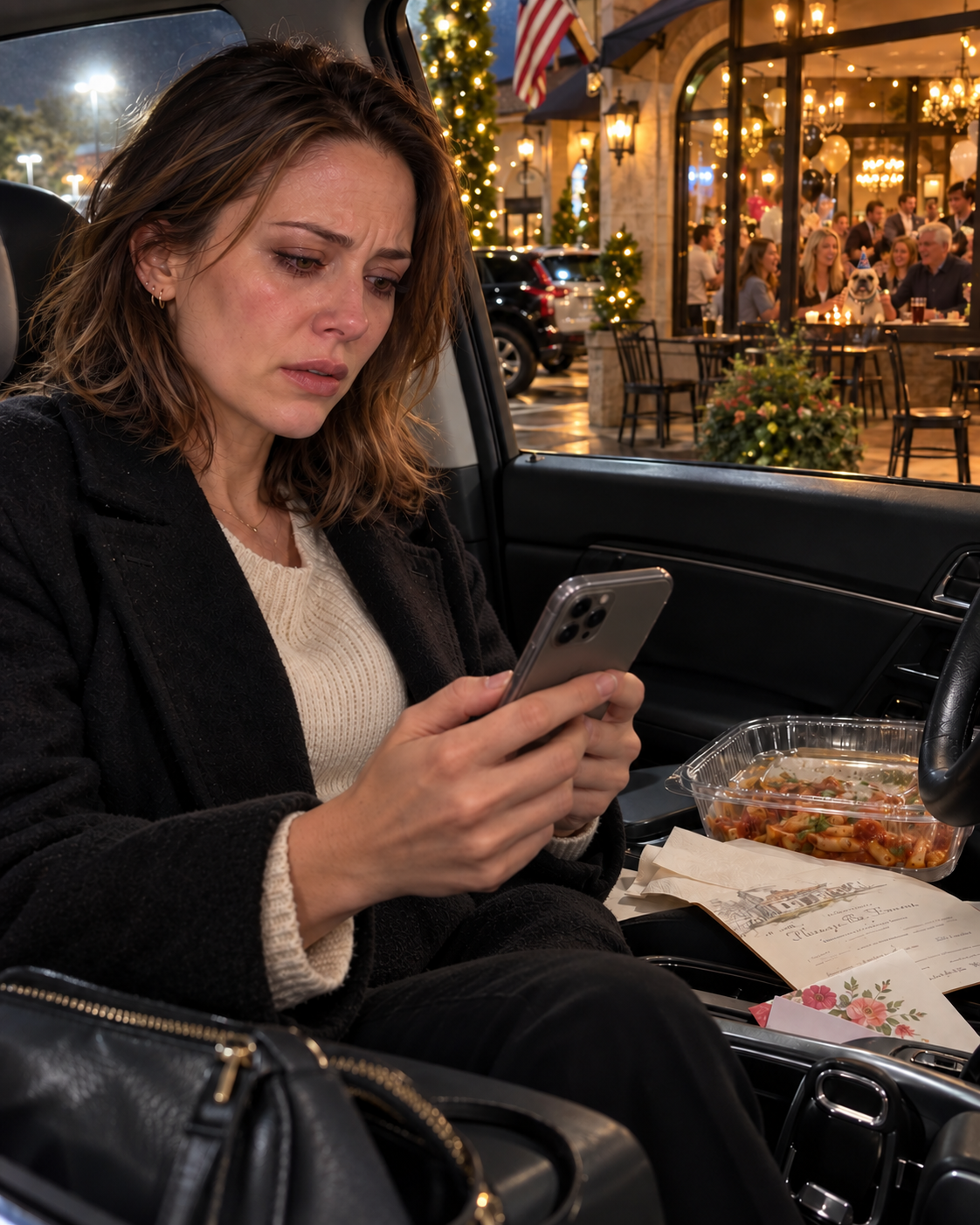
I sat alone at a ten-seat table in an Italian restaurant while my mother, Gavin, and Sierra ignored my calls
The thing I had discovered was not another unpaid bill, another hidden debt, or another cruel message waiting in my inbox.
It was a folder.
A plain blue folder sitting inside the locked filing cabinet I had forgotten about in the duplex.
I found it two days before the closing.
I had gone back to collect the last few things from the garage, expecting nothing more than dust, old holiday decorations, and the faint smell of Mom’s lavender detergent.
Instead, behind a stack of tax records, I found documents with my name on them.
Not one document.
Dozens.
Bank statements.
Copies of applications.
Old emails.
And notes written in Mom’s handwriting.
At first, I thought they were about the duplex.
Then I saw Gavin’s name.
I sat down on the concrete floor.
My hands began to shake.
For years, I had believed my family simply took advantage of me because I made it easy.
That belief had almost been comforting.
It meant I could blame myself for being too generous.
But the papers told a different story.
They had discussed my finances.
They knew exactly how much I earned.
They knew when my savings increased.
They knew which accounts paid my bills automatically.
They even knew which expenses I was most likely to cover if someone sounded desperate enough.
One handwritten note said, “Don’t ask her directly about the car again, she gets suspicious.”
Another said, “Let Gavin wait until Friday, then call her.”
I stared at those words until the room seemed to tilt.
There was nothing accidental about it.
My generosity had not merely been accepted.
It had been organized.
I found an email chain between Mom and Sierra from three years earlier.
Sierra had written, “She’ll cave.”
Mom replied, “She always does.”
I closed my eyes.
That sentence hurt more than any insult they had thrown at me.
Not because it was cruel.
Because it was true.
I had always caved.
Every time someone cried.
Every time someone reminded me of Dad.
Every time Mom said, “We’re family.”
Every time Gavin promised he was almost stable.
I had confused guilt with responsibility until I couldn’t tell where one ended and the other began.
Then I found something that made my stomach turn.
A printed page from a loan application.
My signature was copied at the bottom.
I recognized the form.
Gavin had asked me years earlier to co-sign a vehicle loan.
He had told me it was routine.
He had said I was only there because his credit history was thin.
But the paperwork showed a second financial account attached to the loan.
An account I had never opened.
An account connected to another debt.
I photographed everything.
I took the folder with me.
And for the first time in my life, I didn’t call my mother.
I called a lawyer.
The lawyer read through the documents without interrupting me.
When she finally looked up, her expression had changed.
“Do you have the originals?”
“Yes.”
“Keep them somewhere they cannot access.”
“What does this mean?”
“It means you need to stop treating this like a family argument.”
Those words followed me home.
A family argument.
That was how I had described everything for years.
Mom borrowing money.
Gavin missing payments.
Sierra expecting gifts.
Relatives calling me selfish.
It had all been filed in my mind under one harmless word.
Family.
But now I understood that sometimes the word family can become camouflage.
The next morning, I froze every account that could be compromised.
I changed passwords.
Added security keys.
Contacted the bank.
Reported the suspicious activity.
And when I received another login attempt, I knew someone was still trying.
Then my mother called from an unknown number.
“You are making a terrible mistake.”
I said nothing.
“You think selling that house makes you independent?”
I stared out my apartment window.
The city was moving below me, people carrying coffee, buses pulling away from curbs, ordinary lives continuing without asking permission.
Mom continued.
“You’ve always been so dramatic.”
I almost laughed.
The woman who had once taught me to lock the front door was now angry because I had finally learned to lock her out.
She lowered her voice.
“Come home.”
I closed my eyes.
“That’s not my home anymore.”
There was a pause.
Then she whispered, “It was.”
“No,” I said.
“It was a place I paid for.”
She hung up.
For several weeks, the silence afterward felt almost unreal.
No emergency calls.
No requests for money.
No messages asking me to cover something “just this once.”
I started sleeping through the night.
I bought groceries without calculating how much I needed to leave for someone else.
I took long walks.
I joined a small gym near my apartment.
I began cooking meals for one person and discovering that eating alone wasn’t lonely when nobody was making you feel guilty for it.
I bought a plant.
I named it June.
It sounds ridiculous now, but caring for something that didn’t constantly demand more from me felt healing.
Then the letters started.
The first contained photographs.
Me at six years old.
Gavin beside me at twelve.
Mom holding both of us at the beach.
On the back of one picture, she had written, “We were happy once.”
The second letter was longer.
“You’ve forgotten everything we’ve done for you.”
I read that sentence three times.
Then I wrote one sentence on the back.
“I haven’t forgotten.”
I put the letter in a drawer.
I never sent it.
Because the truth was, I remembered everything.
That was the problem.
I remembered being the child who learned to become useful whenever Mom was overwhelmed.
I remembered hearing adults argue about money and promising myself I would grow up and make everything easier.
I remembered Gavin crying when Dad left.
I remembered Mom working late.
I remembered being praised whenever I didn’t need anything.
So I became someone who needed nothing.
Someone who solved everything.
Someone who paid.
Someone who stayed.
And eventually, they stopped seeing me as a person.
They saw me as infrastructure.
That realization broke something inside me.
But it also set me free.
Then Uncle Ray showed up.
He found me at a coffee shop on a Tuesday morning.
He pulled out the chair across from me without asking.
“You’ve embarrassed your mother.”
I looked at him.
“Good morning to you too.”
“This has gone too far.”
“What has?”
“All of this.”
He waved his hand as though my entire life were a mess he had been assigned to clean.
“Your mother has nowhere to go.”
“She has somewhere to go.”
“Not the way she’s used to living.”
I took a sip of coffee.
“That’s different.”
He leaned forward.
“You have more than enough.”
I looked at him carefully.
“Is that why you think I’m obligated to give it away?”
“No.”
He hesitated.
“You’re family.”
I nodded slowly.
“That’s what everyone keeps saying when they want something.”
His jaw tightened.
“You’re becoming cold.”
“No,” I said.
“I’m becoming unavailable.”
He stared at me.
For once, he had no answer.
Then he pushed an old photograph across the table.
It showed me at seventeen, standing beside Mom outside the first apartment I had ever helped her rent.
On the back were four words.
“Don’t abandon your family.”
I turned it over.
Then I slid it back.
“That isn’t love, Uncle Ray.”
“What is it?”
“Love doesn’t require a hostage.”
He left angry.
I stayed.
My coffee was cold by then.
But my hands weren’t shaking anymore.
A month later, the duplex sold for significantly more than I had paid for it.
The development company demolished the old structure.
I drove past the property one evening and watched the excavators tear into the walls.
For a second, I felt guilty.
Then I remembered all the nights I had sat at my kitchen table calculating bills while Mom watched television upstairs.
I remembered the birthday dinner.
Ten chairs.
One person.
A plastic container of food growing cold beside me.
I kept driving.
The hardest part came later.
Not when they disappeared.
When they didn’t.
I expected them to eventually understand.
I expected an apology.
Maybe even a moment when Mom would call and say, “I was wrong.”
It never came.
Instead, there were rumors.
Family members told me Mom was struggling.
Sierra posted vague quotes about “betrayal from people who forget where they came from.”
Gavin changed his profile picture three times in one week.
I didn’t respond.
Silence became my boundary.
Then, one afternoon, I saw Gavin at a strip mall.
He was standing outside a discount store holding a paper bag.
He looked thinner.
Older.
His old confidence was gone.
I almost kept walking.
But he saw me.
He stared at me like he was seeing a ghost.
“You look good,” he said.
“So do you.”
It wasn’t true.
We both knew it.
He laughed once.
“You really don’t care anymore.”
I looked at him.
“I care.”
His expression softened.
“Then help me.”
There it was.
The old door.
The old key.
The old expectation.
For a second, I felt the familiar pressure in my chest.
The instinct to reach for my phone.
The instinct to ask how much he needed.
The instinct to fix everything.
But I didn’t move.
“I care about you,” I said.
“But I won’t rescue you anymore.”
His face hardened.
“After everything?”
I nodded.
“After everything.”
He looked away.
“Mom says you’re punishing us.”
“I’m not punishing anyone.”
“Then what are you doing?”
I thought about the blue folder.
The copied signature.
The notes.
The years of quiet manipulation.
“I am finally letting you live with your own choices.”
He swallowed.
Then he asked the question I knew was coming.
“Are you ever coming back?”
I looked across the parking lot at the traffic moving through the afternoon sun.
“No.”
The word was quiet.
But it felt heavier than anything I had ever said.
Gavin nodded slowly.
He didn’t apologize.
He didn’t thank me.
He simply walked away.
And somehow, that was enough.
That night, I went home and opened the last box from the old house.
Inside was the plastic cake topper from my birthday dinner.
I had forgotten I brought it with me.
It was small.
Cheap.
A little crooked.
I turned it over in my hand and remembered sitting alone at that table while my family celebrated a dog instead.
I had thought that night was when they broke my heart.
I was wrong.
That night was when I finally stopped breaking my own.
I threw the cake topper away.
Then I opened my laptop and looked at my finances.
Every account was mine.
Every bill was mine.
Every decision belonged to me.
For the first time, there was no invisible line connecting my life to everyone else’s emergencies.
No automatic transfer waiting to leave.
No family member expecting a rescue.
No guilt disguised as love.
I sat there for a long time, listening to the quiet hum of the refrigerator.
Then my phone buzzed.
Unknown number.
I almost ignored it.
Instead, I answered.
There was silence on the other end.
Then a man’s voice said, “You found the folder, didn’t you?”
My entire body went still.
I didn’t recognize the voice.
“Who is this?”
He laughed softly.
“Someone who knows your family better than you think.”
The call ended.
I stared at the screen.
For the first time in months, fear returned.
Not guilt.
Not obligation.
Fear.
I opened the drawer where I had kept the copied documents.
The blue folder was still there.
But underneath it was something I had never seen before.
A second envelope.
My name was written across it in handwriting I didn’t recognize.
I opened it slowly.
Inside was one photograph.
And on the back, six words were written in black ink.
“You were never the only one paying.”
I sat alone beneath the apartment light, holding that photograph, realizing that walking away from my family had not ended the story.
It had only ended my willingness to keep pretending I didn’t know the truth.
And for the first time, I wondered how much of my life had been built around a secret nobody had ever intended me to discover.