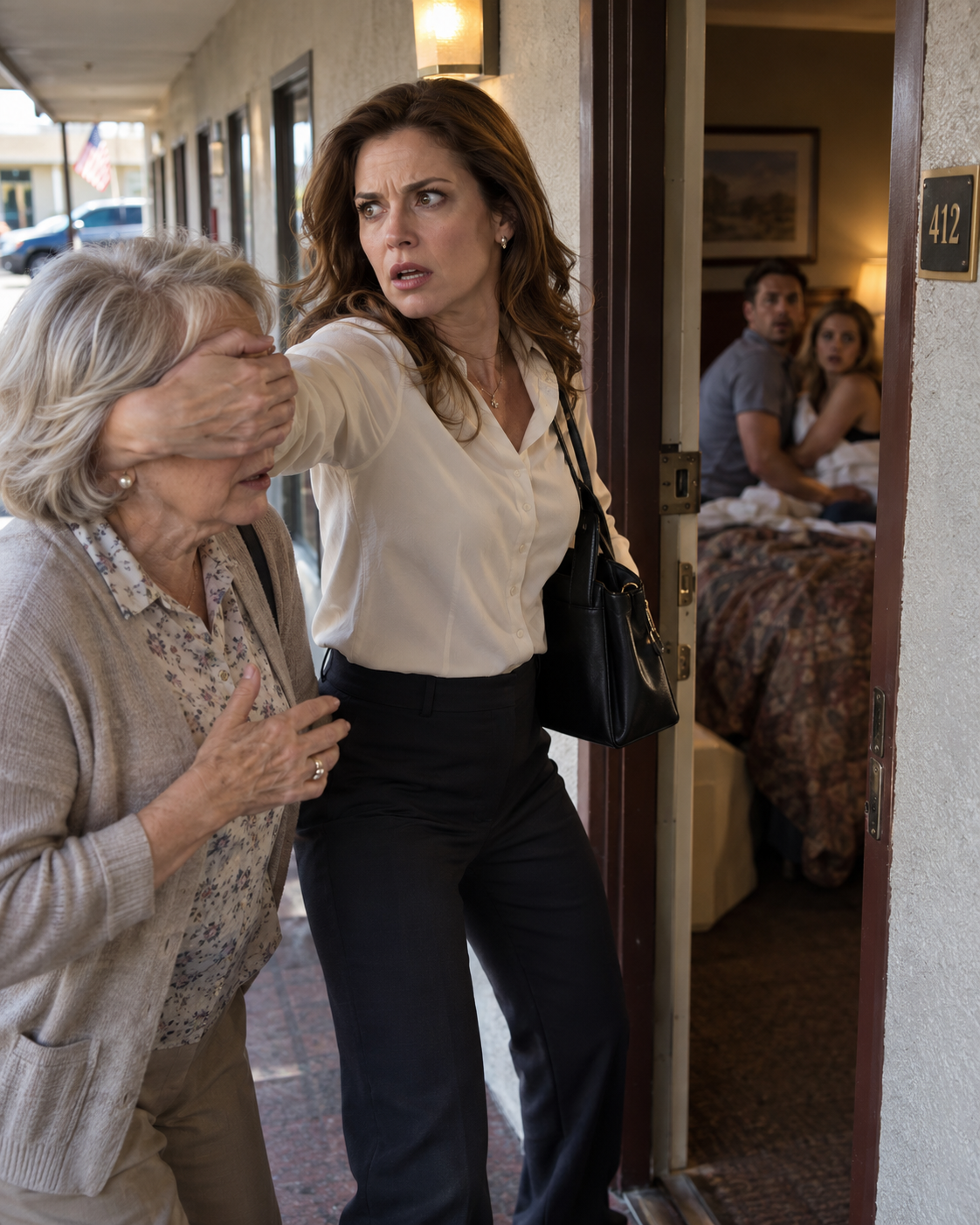
I kicked open room 412 at a roadside motel and found my husband in bed with the 24-year-old girl I had raised like family
For several seconds, I couldn’t hear anything except the faint hum of traffic outside my apartment.
“What didn’t you tell me?”
Eleanor took a slow breath.
“It isn’t about the affair.”
I set my paintbrush down.
“Then what is it about?”
“Your husband knew something about me.”
My stomach tightened.
“What could Julian possibly know about you?”
There was a pause.
“Something that happened before you married him.”
I walked to the window and looked down at the city lights.
Four months earlier, I had thought the hardest thing I would ever hear was my husband admitting he had slept with Clara.
Now Eleanor’s voice made that pain feel strangely distant.
“Mom, please tell me.”
She was silent long enough that I wondered whether the call had dropped.
Then she whispered, “Julian wasn’t supposed to know.”
The next morning, Eleanor came to my apartment alone.
She looked exhausted, but determined.
She placed an old envelope on my kitchen table.
The paper was yellowed at the edges.
“What is this?”
“A letter.”
“From whom?”
“My husband.”
I stared at her.
Julian’s father had always been a distant man, the kind who spoke about money before feelings and regarded family gatherings like business meetings.
Eleanor watched me open it.
Inside was a handwritten letter dated nineteen years earlier.
I read the first few lines.
Then I stopped.
“What does this mean?”
Eleanor sat down.
“Read all of it.”
The letter described an investment company owned by Julian’s father.
According to the letter, money had disappeared from several client accounts.
The missing funds were eventually restored, and the matter was quietly settled.
But one employee had threatened to expose what happened.
That employee was Eleanor’s younger brother.
I looked up.
“Your brother?”
“He discovered the fraud.”
“What happened to him?”
“He died in a car accident two weeks later.”
The kitchen suddenly felt smaller.
“Was it an accident?”
Eleanor looked down at her hands.
“I don’t know.”
“You think Julian knew about this?”
“I think he knew enough to become afraid.”
She told me that years before my wedding, Julian had found the old letter while searching through his father’s private files.
He confronted his father.
His father told him never to mention it again.
“Why would Julian care now?”
“Because the people involved were still connected to his business.”
I thought about Julian’s financial network.
His carefully polished reputation.
His obsession with appearances.
His fear of scandal.
Suddenly, I understood something I had missed while I was still married to him.
Julian didn’t merely fear losing money.
He feared losing control of the story.
But there was something else.
Eleanor looked directly at me.
“Three days before you found that motel key, Julian asked me where the old files were.”
My heart sank.
“Why?”
“He said he wanted to protect the family.”
I almost laughed.
Protect the family.
That was the same phrase people used when they wanted you to accept silence as love.
“What did you tell him?”
“Nothing.”
She reached across the table and squeezed my hand.
“That’s why I called you.”
I stared at the envelope.
“Mom, why didn’t you tell me this before?”
“Because I was ashamed.”
“Of what?”
“Of staying quiet for so many years.”
Her eyes filled with tears.
“I thought silence would keep everyone safe.”
I understood that kind of thinking.
I had once believed the same thing.
I had hidden the motel truth from her because I wanted to protect her heart.
But silence could protect someone for a night.
It could not protect them forever.
I hired an investigator.
Not because I wanted revenge.
Because I wanted facts.
He spent six weeks tracing the old accounts and locating former employees.
Most refused to speak.
One agreed.
Her name was Patricia Wells.
She had been an accountant at Julian’s father’s company.
We met in a small coffee shop outside Manhattan.
She kept both hands wrapped around her cup.
“I knew this day would come.”
“What happened?”
Patricia looked at me.
“Your brother-in-law’s father moved money between client accounts.”
“Why?”
“To cover losses.”
“And your uncle?”
“He found out.”
“What happened after that?”
Patricia looked toward the window.
“He wanted to report it.”
My pulse quickened.
“Did someone stop him?”
“I can’t prove that.”
I nodded.
“I don’t want assumptions.”
Patricia reached into her purse and pulled out a small flash drive.
“This is everything I kept.”
I stared at it.
“Why give it to me?”
“Because your husband isn’t the only person who believes money can make consequences disappear.”
The files revealed years of questionable transactions.
But they also revealed something more recent.
A transfer had been made shortly before Julian’s company collapsed.
The destination was an account controlled by one of his father’s former partners.
And the authorization carried Julian’s digital signature.
I took the evidence to federal investigators.
They already knew his company had financial problems.
They didn’t know about this.
The investigation expanded.
Julian’s attorneys called me within days.
“Mr. Mercer would like to speak with you.”
“No.”
“He says you owe him the opportunity to explain.”
“I don’t owe him anything.”
The lawyer lowered his voice.
“He believes you may have information damaging to him.”
I almost smiled.
“He should have thought about that before he betrayed me.”
Two weeks later, Julian appeared outside my building.
I saw him through the lobby window.
He looked thinner.
Older.
Not broken, exactly.
Just stripped of the confidence that had once filled every room he entered.
I didn’t go outside.
My phone rang.
“Please,” he said when I answered.
“Please what?”
“I need to talk.”
“You had years to talk.”
“I made mistakes.”
“You made choices.”
“I know.”
“No, Julian.”
I looked through the glass.
“You know what it cost you.”
He said nothing.
“You still don’t understand what it cost me.”
His voice became quiet.
“I loved you.”
I closed my eyes.
For one dangerous second, the woman I had been before the motel room wanted to believe him.
Then I remembered Eleanor’s trembling hands.
I remembered Clara’s silence.
I remembered standing in room 412 and realizing that the person beside me was a stranger.
“You loved having someone who trusted you,” I said.
“That’s not the same thing.”
I ended the call.
The following months were complicated.
The financial investigation became public.
Julian’s father was questioned.
Several former executives were subpoenaed.
The family name that had once appeared in charity galas and business magazines became associated with investigations and lawsuits.
Julian was eventually charged with financial crimes related to the transactions.
His defense argued that he had acted under pressure from senior executives.
The court would determine what he was responsible for.
I refused to become judge and jury.
I simply told the truth about what I knew.
That distinction became important to me.
There was a time when I wanted everyone to hurt as badly as I had.
But pain doesn’t become justice just because it changes hands.
I wanted my children to grow up knowing something different.
That consequences were real.
That honesty mattered.
That loving someone did not require surrendering your dignity.
Meanwhile, Clara disappeared from our lives.
Her parents refused to speak about her.
Eleanor still carried guilt about what happened.
One Sunday, she asked me to come over.
She had made dinner.
Halfway through the meal, she looked at me.
“I thought I lost you.”
I reached for her hand.
“You didn’t.”
“You should have.”
“I know.”
She began to cry.
“I don’t understand why you’re still here.”
I smiled through my own tears.
“Because you were never the person who betrayed me.”
She squeezed my hand.
“You really are my daughter.”
That sentence healed something in me that I hadn’t known was still wounded.
Not because it erased what happened.
Because it reminded me that family wasn’t always defined by blood.
Sometimes it was defined by who stayed when everything became difficult.
The children adjusted slowly.
There were difficult conversations.
There were therapy appointments.
There were nights when my son asked why Daddy didn’t live with us anymore.
I never lied to them.
But I also never gave them adult details they didn’t need.
“Sometimes grown-ups make choices that hurt a family,” I told them.
“That doesn’t mean you caused it.”
My daughter nodded.
“Will we be okay?”
I pulled her close.
“Yes.”
And for the first time, I knew the answer wasn’t a promise.
It was a plan.
We would build a life where okay was something we practiced every day.
My watercolor classes became more important than I expected.
At first, I went because I needed somewhere to put my hands when my thoughts became too loud.
Then I discovered I loved the patience of it.
A blank page didn’t demand perfection.
It simply waited.
One afternoon, I painted the motel hallway from memory.
Not the room.
Not the bed.
Just the hallway.
A closed door.
A strip of yellow light beneath it.
And a woman standing outside, deciding whether to open it.
The instructor looked at the painting.
“Who is she?”
I thought about it.
“Someone who finally learned she could walk away.”
I never displayed that painting.
I kept it in a drawer.
Some memories don’t need an audience.
A year after the motel incident, I received a letter from Julian.
I almost threw it away.
Instead, I opened it.
There was no apology for the affair.
No request to return.
No accusation.
Just a few pages about regret.
He wrote that the apartment he shared with Clara had lasted seven months because reality eventually became impossible to ignore.
Bills replaced romance.
Resentment replaced excitement.
And when the money disappeared, so did the illusion that they had escaped into some better life.
He wrote that Clara had left first.
Then he admitted something I hadn’t expected.
“I thought you would collapse without me.”
I stared at that sentence for a long time.
Then I folded the letter and put it away.
Not because I forgave him.
Because I finally understood how little his opinion mattered.
My life no longer needed to prove him wrong.
It only needed to belong to me.
Several months later, Eleanor called again.
Her voice sounded lighter.
“I have something for you.”
When I visited, she gave me a small wooden box.
Inside was my wedding ring.
I had forgotten that she had taken it from the house after I moved out.
“I thought you might want it.”
I held it in my palm.
The diamond caught the light.
For years, I had believed that ring represented a promise.
Now it represented something else.
A lesson.
Trust is precious because it cannot be demanded.
Love is meaningful because it is freely given.
And dignity begins the moment you stop bargaining with someone who has already shown you what they value.
I placed the ring back inside the box.
“Keep it.”
Eleanor looked surprised.
“You’re sure?”
“Yes.”
I didn’t need to destroy the past.
I simply didn’t need to wear it anymore.
That evening, I went home to my children.
My daughter was painting at the kitchen table.
My son was building something with wooden blocks.
The apartment was messy.
Dinner was late.
Someone had spilled juice on the floor.
And I had never felt more peaceful.
I stood there for a moment and listened to them laugh.
Then my daughter looked up.
“Mom, come paint with me.”
I sat beside her.
“What should I paint?”
She handed me a clean sheet.
“Something happy.”
I smiled.
For a moment, I didn’t know what to draw.
Then I painted a window.
Behind it was morning light.
In front of it stood a woman with her back turned toward the darkness.
I didn’t paint her face.
She didn’t need one.
She was every woman who had ever believed leaving meant losing everything.
She was every woman who had stayed too long because she was afraid of what came next.
And she was me.
The woman who discovered that survival wasn’t the end of the story.
It was the beginning of choosing what came after.
Years later, people would sometimes ask how I survived the worst night of my life.
They expected a dramatic answer.
I never had one.
I survived because I kept making one small decision after another.
I protected Eleanor.
I protected my children.
I told the truth.
I asked for help.
I left.
Then I rebuilt.
None of those choices felt heroic while I was making them.
They simply felt necessary.
And perhaps that is what courage really is.
Not feeling fearless.
Not knowing everything will work out.
Just refusing to abandon yourself because someone else already did.
One Sunday morning, Eleanor called as usual.
“How are you, sweetheart?”
I looked around my home.
Sunlight spilled across the kitchen.
My children were laughing upstairs.
A half-finished watercolor sat beside my coffee.
For the first time, I answered without hesitation.
“I’m happy.”
There was a soft silence on the other end.
Then Eleanor laughed.
“Good.”
I smiled.
Outside, the city moved as it always had.
Cars passed.
People hurried.
Doors opened and closed.
Life continued without asking permission from the past.
I picked up my brush and returned to the painting.
The woman in the picture was almost finished.
There was only one thing left to add.
A doorway behind her.
Open.
Waiting.
And this time, she wasn’t standing there wondering whether she was allowed to leave.
She was already walking toward the light.
Because sometimes the most powerful ending isn’t watching the person who hurt you suffer.
Sometimes it’s waking up one morning and realizing you no longer need them to suffer at all.
You simply need to know that you didn’t lose yourself trying to keep someone who had already chosen to leave.
And as I put down my brush, Eleanor’s words came back to me.
“You really are my daughter.”
For the first time, I understood why they meant so much.
She had not chosen me because I was perfect.
She had chosen me because, after everything fell apart, we chose each other.
That was the family I carried forward.
Not the one betrayal had destroyed.
The one truth had rebuilt.
And somewhere in a drawer, the painting of room 412 remained hidden, reminding me that one closed motel door had once looked like the end of my life.
I know now it was only the door I needed to walk through to find the life that had been waiting for me on the other side.