I gave Dennis the last helicopter seat because he said Selene would die without it, and seven years later
For a moment, neither of us moved.
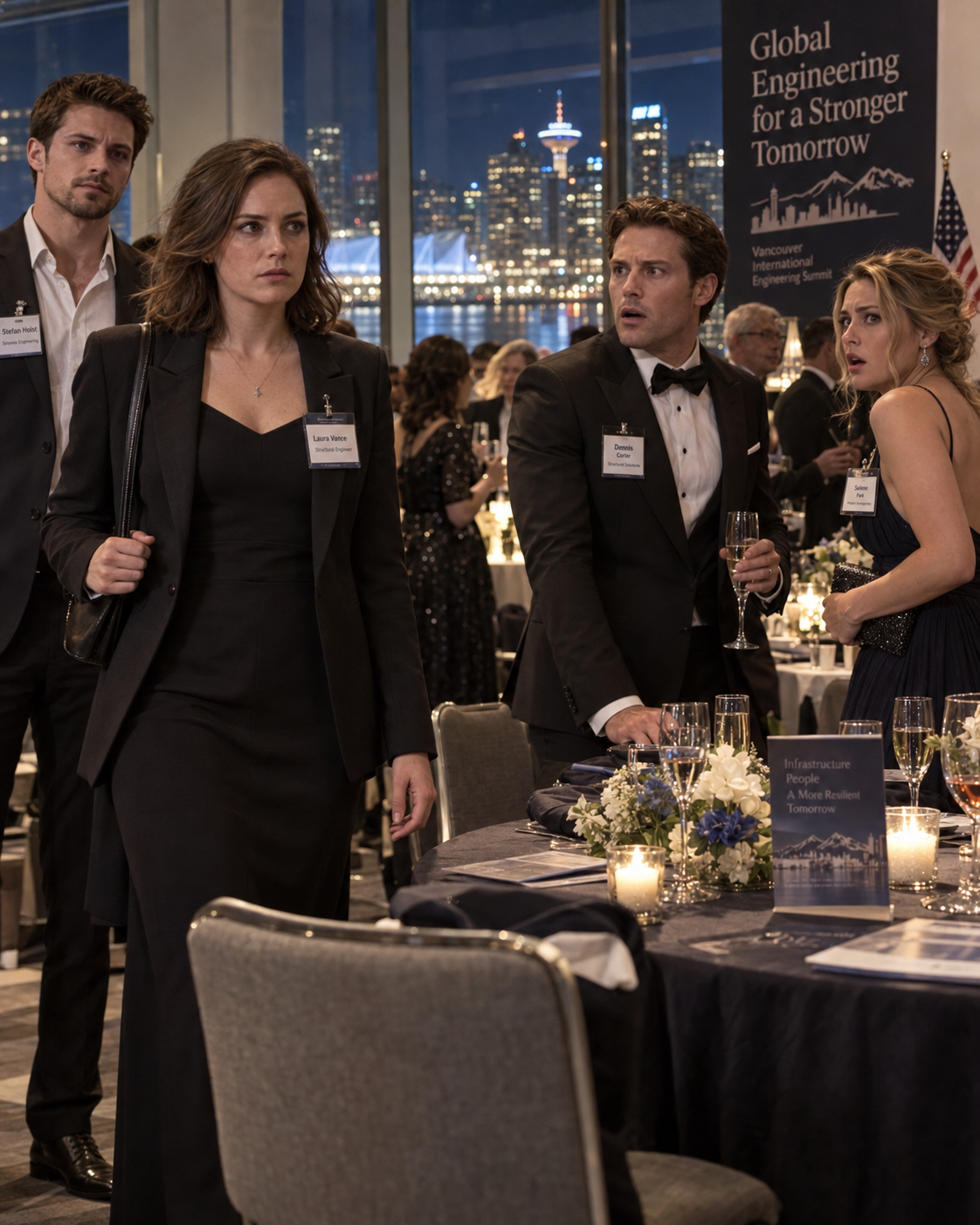
The orchestra kept playing near the stage. Someone laughed too loudly at a cocktail table. A server passed behind us carrying a tray of tiny desserts with the solemn concentration of a surgeon.
I could hear all of it.
But the only sound that mattered was Dennis breathing.
“Selene had an evacuation priority certificate,” he said quietly.
“I never saw one.”
“You weren’t supposed to.”
Selene’s fingers tightened around his sleeve.
“Dennis.”
He pulled his arm free.
“You told me it was legitimate.”
“I said it was issued by the medical team.”
“Was it?”
She didn’t answer.
That was enough to make something cold settle beneath my ribs.
Not rage.
Not yet.
Recognition.
For years, I had carried one memory like a stone: Dennis kneeling beside me, choosing Selene because she had a heart condition and I was the stronger one.
I had built my entire understanding of that day around those words.
But now he was telling me there had been a document.
A priority designation.
Something official enough that he had believed it.
I looked at Selene.
“Who gave it to you?”
Her face hardened.
“This isn’t the place.”
“You’re right.”
I stepped back.
“Then tell me where.”
She stared at me as if she were trying to decide whether the woman standing in front of her was the same woman who had once been trapped under concrete.
I knew what she saw.
Not the girl she had left behind.
Someone who had survived without her permission.
I turned to Stefan.
“Let’s go.”
He didn’t ask questions.
Outside, the Vancouver air was cold enough to clear the champagne haze from my head.
We sat in the back of a taxi for several minutes without speaking.
Finally Stefan said, “You don’t have to investigate this.”
“I know.”
“Do you want to?”
I watched rain gather on the window.
“I don’t know.”
That was the truth.
I had spent seven years refusing to let Dennis occupy my mind. I had built a life that did not require his apology.
But there was a difference between reopening a wound and discovering someone had stitched it incorrectly.
Three days later, I hired an independent forensic auditor named Miriam Cho.
I chose her because she had no connection to construction, Guatemala, Dennis, or our company.
I told her exactly what I remembered.
I gave her the names of the people who had been on the site.
I gave her copies of my old medical records.
I told her I didn’t want a verdict.
“I want the sequence,” I said.
Miriam nodded.
“Facts first.”
“Exactly.”
“Even if the facts don’t help you?”
I thought about that.
“Especially then.”
Her first discovery came two weeks later.
She found the original triage ledger.
Not a scan.
Not a summary.
A paper record kept by the lead medic during the first hours after the earthquake.
My name was written beside a large red mark.
RED TAG.
Critical.
Open fracture.
Suspected pneumothorax.
Crush injury.
Immediate evacuation recommended.
Selene’s entry was beside it.
Yellow.
Minor lacerations.
Stable vitals.
Ambulatory.
No cardiac distress noted.
I read the page three times.
The room seemed to narrow around me.
Miriam watched quietly.
“There’s more,” she said.
I looked up.
She slid another document across the table.
At the top was the evacuation priority certificate Dennis had mentioned.
It listed Selene as a critical cardiac patient.
The issuing physician’s signature was there.
So was the time.
The problem was that the certificate had been created after the helicopter left.
Miriam pointed to the timestamp.
“Look at the ink.”
I didn’t understand.
“The medical ledger was written in sequence. The certificate was added later.”
“How much later?”
“At least forty minutes.”
I stared at the paper.
Forty minutes after I had been left beneath the beam.
“Could it have been a correction?”
“Maybe.”
She pushed another sheet toward me.
“That’s why I kept looking.”
It was an internal hospital note from the physician who had signed the certificate.
There was no diagnosed heart condition in Selene’s prior records.
Miriam had found the physician’s billing records too.
Several unexplained cash payments.
A consulting fee from a company connected to Selene.
And then came the detail that made me put my hand over my mouth.
The physician had later admitted, through counsel, that he had been paid to document a cardiac emergency that had not occurred.
I sat back.
For seven years, I had believed Dennis had made a terrible choice based on false information.
Now I had to consider something uglier.
The information itself might have been manufactured.
But Miriam wasn’t finished.
She had found weather and slope-monitoring records from the project site.
The lead geologist had issued an early warning about a secondary landslide zone less than an hour before the first evacuation attempt.
The warning had been transmitted to the site coordination team.
Selene had received it.
She had acknowledged it.
Then she had told the helicopter crew the landing zone was stable.
Miriam’s voice was careful when she said it.
“She knew the area was becoming more dangerous.”
I looked at her.
“Why would she stay?”
“Because she needed Dennis to believe she was in immediate medical danger before the helicopter left.”
I shook my head.
“No.”
Miriam didn’t argue.
She simply showed me the landing-zone communications.
A medic reported Selene had suddenly complained of crushing chest pain.
A second report, made minutes later, described her as pale and distressed.
But a third note recorded that when the helicopter crew arrived, Selene was walking without assistance.
There was no collapse.
No loss of consciousness.
No cardiac arrest.
No objective evidence of a cardiac event.
She had created a crisis inside a larger crisis.
And Dennis had responded to it.
I asked Miriam the question I had avoided for seven years.
“Did he know?”
“Know what?”
“That she was lying.”
“We don’t have evidence of that.”
That distinction mattered.
I wanted to hate him.
The evidence refused to make it simple.
Dennis had been wrong.
He had trusted someone he should not have trusted.
He had abandoned me.
But if Selene had deliberately constructed the lie, then the choice he made had been manipulated.
That did not erase what happened.
It changed the shape of it.
I called him.
He answered on the first ring.
“Laura?”
“I know about the certificate.”
Silence.
Then a breath.
“Where did you get that?”
“Does it matter?”
“I need to see you.”
“No.”
“Please.”
I closed my eyes.
“Tomorrow. Ten minutes.”
We met at a quiet coffee shop in Gastown.
Dennis arrived early.
He looked exhausted.
Not theatrically exhausted. There were dark circles beneath his eyes, and his hands trembled when he picked up his coffee.
He had aged more in the last three days than he had in the seven years before them.
“I didn’t know,” he said.
I sat across from him.
“I believe you.”
His eyes filled.
“That’s worse.”
I didn’t answer.
He stared down at the table.
“I thought I was making a medical decision.”
“You made a choice.”
“I know.”
“You heard a doctor say she had a heart condition.”
“Yes.”
“And you heard me say I was injured.”
“Yes.”
“You saw me trapped.”
His jaw tightened.
“Yes.”
“Then you left.”
He closed his eyes.
“I thought I was coming back.”
“You promised ten minutes.”
“I know.”
“You never came back.”
“I tried.”
That was the first time I raised my voice.
“You left before the second slide.”
He flinched.
“Yes.”
“Whatever happened after that, you left.”
“I did.”
The admission sat between us.
There was no defense inside it.
For a long time, neither of us spoke.
Then he said, “I loved you.”
I believed that too.
And strangely, it didn’t comfort me.
“I know,” I said.
His face crumpled.
“Then why couldn’t I see you?”
I looked at him.
“Because love isn’t the same thing as knowing what someone is worth when you’re frightened.”
He cried quietly.
I let him.
Not because I forgave him.
Because I no longer needed his suffering to prove mine had mattered.
The investigation became public after Miriam’s report was completed.
Selene’s organization opened its own inquiry.
The physician faced professional and legal consequences for falsifying medical information.
Selene was dismissed after the internal investigation confirmed the fabricated cardiac emergency, the altered priority documentation, and her failure to pass along the landslide warning.
There were criminal referrals.
There were statements from people who had been afraid to speak years earlier.
There were reporters.
There were photographs.
There were strangers online who decided they understood everything about my life.
I refused most interviews.
The truth had finally become public, but I didn’t want my survival turned into entertainment.
The strangest part was what happened with Dennis.
His construction company was bidding on a regional school project.
Our firm was consulting on seismic resilience.
When I saw his company’s name on the technical submission, I almost laughed.
Of course.
Of all the projects in all the provinces, this one had to cross my desk.
Stefan found me staring at the proposal late one evening.
“You can recuse yourself,” he said.
“I know.”
“You don’t owe anybody fairness.”
I looked at him.
“Actually, I think I do.”
He waited.
“Not to Dennis. To the school.”
So I evaluated the submission the same way I evaluated every other contractor.
Structural methodology.
Material standards.
Redundancy.
Slope stabilization.
Emergency egress.
Sensor integration.
Response time.
Nothing personal.
Nothing punitive.
Dennis’s company won the contract.
Not because I favored him.
Not because I wanted to prove I was above revenge.
They won because their revised technical plan met the requirements.
When I called to tell him, there was a long silence.
“Thank you,” he said.
“This isn’t a favor.”
“I know.”
“I’d have rejected you if the work wasn’t good enough.”
“I know that too.”
That was the last time we discussed us.
The school project took three years.
We redesigned the foundation system.
We added automated slope sensors along the hillside.
We built redundant communication channels that could function if the primary network failed.
And beneath the school, in the utility tunnels, we installed acoustic tapping plates connected to a low-power listening system.
It was Stefan’s idea to make them passive enough to survive structural damage.
Mine was to put them within reach of every emergency access chamber.
We tested them with controlled impacts.
Three taps.
Pause.
Three taps.
The system recognized the pattern immediately.
The first time we heard it echo through the monitoring room, I had to leave.
I walked outside and sat on the steps.
Stefan found me there.
“Too much?”
I nodded.
He sat beside me.
After a while I said, “I used to think the worst part was being trapped.”
“What do you think now?”
“Being unheard.”
He took my hand.
We didn’t say anything else.
Months later, the school opened.
Children ran through hallways that had been designed to move with an earthquake rather than resist it by brute force.
Teachers practiced evacuation drills without turning them into nightmares.
The maintenance tunnels had bright markings and emergency lights.
Nobody thought the acoustic plates were particularly beautiful.
I did.
They were small, almost boring pieces of engineering.
And I loved them.
The first major test came on a Tuesday morning.
A real earthquake.
Strong enough to knock books from shelves and crack plaster in older buildings across the region.
At the school, alarms activated.
Slope sensors registered movement.
Emergency doors released.
Power switched to backup.
The acoustic monitoring system remained online.
Teachers followed the evacuation plan.
No one was trapped.
No one was left behind.
I was standing in the control room when the final status screen turned green.
Stefan looked at me.
“All clear.”
I exhaled.
Then a technician called my name.
“There is one more signal.”
My stomach dropped.
We hurried to the monitoring station.
On the screen was a pattern from one of the utility chambers.
Three taps.
Pause.
Three taps.
Pause.
I felt the blood leave my face.
“Open the camera.”
The image flickered.
A maintenance worker appeared, crouched beside a fallen tool cabinet.
He was waving.
He’d been knocked down but wasn’t injured.
The system had registered him tapping against the acoustic plate because his radio had been buried.
They reached him within minutes.
He laughed when they pulled him out.
I didn’t.
I stood there shaking, remembering cold metal against my fingers in the dark.
That night, I drove home with Stefan through rain.
Neither of us talked much.
I had spent seven years believing survival meant putting Guatemala behind me.
I finally understood that wasn’t what I had done.
I had carried it forward.
Just differently.
The student who had once been trapped with me near the school site had survived too.
His name was Mateo.
He had been twelve when the earthquake happened, and I remembered him because I had helped pull him from a damaged classroom before the second slide.
Years later, he emailed our firm asking about internships.
He eventually enrolled in civil engineering.
When he visited our office, he brought the same battered red notebook he had carried as a child.
“I kept it,” he said.
Inside, on the first page, he had written:
Buildings should listen.
I had to turn away for a moment.
“That’s a good engineer’s first rule,” I told him.
He smiled.
“Did you teach me that?”
“No.”
“You did.”
I shook my head.
“Maybe you taught yourself.”
He looked at the designs on my desk.
“Are you still afraid of earthquakes?”
“Yes.”
He nodded as though that answer made sense.
“Good.”
I laughed.
It was the first time I had ever heard fear described as useful.
A year later, Stefan and I got married in the mountains.
There were no reporters.
No ballroom.
No speeches about resilience.
Just a small group of people we loved, cold air, pine trees, and a lake below us catching the last light.
Before the ceremony, I stood alone for a few minutes.
I thought about the woman I had been beneath the concrete.
I wished I could tell her what came after.
Not that she would become successful.
Not that she would fall in love again.
Not that the man who left her would eventually understand what he had done.
Those things were too small.
I would have told her that silence would not be the end of her story.
That somebody would hear the tapping.
That one day she would build systems designed to hear it sooner.
And that she would eventually stop measuring her worth by the person who failed to save her.
When I walked toward Stefan, he smiled in that quiet way he had always smiled at me, as if he were happy simply because I had arrived.
I took his hand.
Far below us, the mountains were darkening.
For the first time in years, darkness did not feel like a place where I might disappear.
It was only darkness.
And I was no longer waiting inside it.