I found my eight-year-old daughter alone on a grocery-store bench at midnight,” I whispered into the phone
The name on the document was Carol.
I stared at it for several seconds, convinced I had misunderstood what Sarah was showing me.
“Carol?” I asked.
“The woman who found Chloe.”
Sarah nodded.
My stomach tightened.
“What does she have to do with this?”
Sarah slid another page across the desk.
It was a sworn statement from the grocery store.
Carol had not simply found Chloe that night.
She had been the employee who noticed her sitting alone.
And according to the store’s security footage, Carol had seen Chloe enter the store carrying the same emergency backpack hours before the call.
I looked up.
“Why didn’t she tell me?”
“She did,” Sarah said carefully, “but there’s more.”
My hands began to shake.
The next page was a copy of a police report.
Carol had told officers that Chloe said something unusual while waiting on the bench.
Something I had never heard from my daughter.
She had said, “Daddy told me nobody would come back.”
I couldn’t move.
Sarah watched me quietly.
“That doesn’t necessarily mean what you’re thinking.”
“I know.”
But I was already remembering every strange detail from the weeks before my trip.
The way Mark had started asking Chloe whether she knew how to lock the doors.
The way he had complained about having to drive her to school.
The way he once told me, jokingly, that children needed to learn “consequences.”
I had dismissed all of it because I wanted our family to work.
That was the cruelest part.
Sometimes the truth doesn’t arrive as a single explosion.
Sometimes it arrives as a hundred tiny memories suddenly rearranging themselves.
Sarah tapped the report.
“There’s also a statement from a neighbor.”
I read it.
The neighbor had seen Mark loading suitcases into his truck five nights before Chloe was found.
But there was another detail.
He had not looked surprised when someone later asked him about Chloe being alone.
He had allegedly said, “She’s probably at her mother’s friend’s house.”
I felt something inside me crack.
He had known.
He had known exactly where she was.
“Why would he lie about that?”
Sarah leaned back.
“That’s what we’re trying to establish.”
I drove back to the hotel with the documents sitting on the passenger seat.
Chloe was drawing at the small table near the window when I entered.
She looked up immediately.
“Mommy?”
“I’m here.”
She smiled.
Then she looked at my face.
“What happened?”
I forced myself to smile.
“Nothing you need to worry about.”
She studied me for another second before returning to her drawing.
It was a picture of three people standing beneath a giant yellow sun.
There was me.
There was Chloe.
And there was an empty space beside us.
I didn’t ask who belonged there.
I was afraid I already knew.
That night, Chloe finally fell asleep without her backpack beside her.
I sat awake and read every page Sarah had sent me.
At 2:14 in the morning, I found the detail that changed everything again.
There was a charge on our joint credit card from the same evening Mark left.
A storage facility.
I had never known about it.
I called Sarah before sunrise.
“Find out what he stored there.”
She was silent for a moment.
“You’re sure?”
“Yes.”
“Then we’ll request the records.”
The next afternoon, Sarah called.
“Mark rented the unit two weeks before your assignment began.”
My heart dropped.
“What did he put inside?”
“We don’t know yet.”
“But why would he rent storage?”
“I don’t know.”
For the first time since coming home, I felt something worse than anger.
Fear.
Because anger is about what someone did.
Fear is about what they might still be hiding.
Two days later, Sarah obtained the necessary authorization to inspect the contents as part of the financial investigation.
I went with her.
The storage unit smelled like cardboard, dust, and old fabric.
There were boxes stacked against the walls.
Most were ordinary.
Tools.
Winter clothes.
Old toys.
Then Sarah opened a plastic bin.
Inside were copies of our financial statements.
Not just recent ones.
Years of them.
Bank statements.
Insurance documents.
Tax records.
Property paperwork.
My house deed.
My life, organized into folders.
“Why would he keep all this?” I whispered.
Sarah didn’t answer.
She opened another box.
There were printed emails.
Some were between Mark and a financial adviser.
Others were with a realtor.
I read one sentence twice.
“Once the marriage ends, the property needs to be positioned as jointly acquired.”
My hands went numb.
The house.
My house.
The one I had owned before I met him.
He had been preparing to challenge my ownership of it.
For how long?
Sarah found another email dated months before my assignment.
It said, “The child complicates the situation.”
I stared at those four words.
“The child.”
Not Chloe.
Not my daughter.
The child.
Sarah gently took the paper from me.
“We’ll preserve everything.”
I nodded.
But there was one question burning through me.
“Was he planning to leave me?”
Sarah looked at the documents.
“It appears he was planning for a separation of some kind.”
I swallowed.
“And Chloe?”
“We don’t know.”
That uncertainty followed me back to the hotel.
I wanted to believe the worst explanation wasn’t true.
I wanted to believe Mark had been selfish, reckless, and cruel in one terrible decision.
But the documents suggested something colder.
He had been planning.
Maybe not the abandonment itself.
Maybe not every detail.
But he had been preparing for a life in which my daughter and I were no longer part of his plans.
That night, I sat beside Chloe while she slept.
Her face looked peaceful.
I brushed her hair away from her forehead.
“I should have seen it,” I whispered.
But children don’t need perfect mothers.
They need mothers who come back.
And I had come back.
The custody investigation moved quickly after Sarah submitted the evidence.
Mark’s attorney tried to frame the incident as a misunderstanding.
They argued that Chloe was capable of caring for herself for short periods.
They questioned whether the power outage had truly frightened her.
They even suggested I was exaggerating the emotional impact because I wanted leverage in the divorce.
I sat silently while they talked.
Then Sarah presented the grocery store footage.
There was Chloe.
Small.
Alone.
Her backpack nearly as large as her torso.
She sat on the bench and watched every adult who entered the store.
Every time the doors opened, she looked up.
Every time, disappointment crossed her face.
I had watched that footage once.
I never watched it again.
The judge asked Mark whether he disputed what the footage showed.
His attorney answered carefully.
Mark remained silent.
Then Leo spoke.
It wasn’t part of the hearing.
He had been waiting outside with a relative.
When he learned what was happening, he asked to talk to his father.
I wasn’t there for the conversation.
Sarah later told me that Leo had asked one question.
“Did you really leave Chloe alone?”
Mark reportedly said it was complicated.
Leo answered, “No, Dad.”
Just three words.
“No, Dad.”
For the first time, the boy who had always defended his father stopped doing so.
That mattered.
Not because I wanted Mark punished through his son.
I never did.
Leo was twelve.
He didn’t choose any of this.
He was a child caught inside an adult’s decisions.
I told Sarah that I wanted Leo protected from being pulled into the divorce.
“If he wants a relationship with Chloe someday, I won’t stop him,” I said.
Sarah nodded.
“That’s probably the healthiest thing you can do.”
But the hardest conversation was still waiting for me.
Chloe eventually asked why Mark wasn’t coming home.
We were sitting on the hotel balcony when she finally said it.
“Is Daddy mad at me?”
I put my coffee down.
“No.”
“Then why did he leave?”
I stared at the city lights.
How do you explain betrayal to an eight-year-old without teaching her that she was the reason for it?
“You didn’t do anything wrong.”
“But he took Leo.”
“I know.”
“Did he choose Leo over me?”
My throat tightened.
I reached across the table and held her hand.
“Adults sometimes make choices that hurt children.”
She looked at me.
“Was I not enough?”
That question nearly destroyed me.
I pulled her into my arms.
“You were always enough.”
She cried against my shoulder.
So did I.
That night, I realized something important.
The divorce wasn’t about proving that I had been right.
It wasn’t about making Mark suffer.
It was about making sure Chloe never again believed someone else’s cruelty was evidence that she was unworthy of love.
Weeks passed.
The court granted temporary custody arrangements that kept Chloe with me.
Mark was allowed supervised contact under the terms set by the court.
The first visit was difficult.
Chloe refused to go inside the room.
She stood behind me, clutching my hand.
Mark looked different.
Not physically.
Emotionally.
The arrogance was gone.
He looked tired.
“I just want to talk to her,” he said.
Chloe shook her head.
I crouched beside her.
“You don’t have to do anything you’re not ready for.”
She looked at me.
“Can I say something?”
“Always.”
She faced Mark.
“Why didn’t you take me?”
Mark’s eyes filled with tears.
For several seconds, he said nothing.
Then he whispered, “I made a terrible choice.”
Chloe waited.
“Why?”
He looked down.
“I don’t have a good answer.”
She squeezed my hand.
“I thought you didn’t love me.”
Mark began crying.
But Chloe didn’t move toward him.
She simply said, “I loved you.”
Then she turned away.
That sentence stayed with me for days.
Because sometimes love doesn’t disappear when someone hurts you.
Sometimes it simply learns where the door is.
The financial investigation continued.
Sarah discovered that Mark had been diverting small amounts from our shared accounts for months.
Nothing dramatic.
Nothing large enough to trigger immediate suspicion.
But together, the transactions told a story.
He had been building a private reserve.
He had been preparing for a future without me.
And the cruise had simply been the first part I couldn’t ignore.
The house remained legally mine.
The court recognized its premarital ownership, and Mark’s attempt to claim it became another failed piece of his plan.
His truck was no longer my responsibility.
His personal debts were no longer quietly being absorbed by our shared finances.
For years, I had mistaken financial peace for marital peace.
They were not the same thing.
One morning, Sarah called me with news.
“The divorce agreement is nearly finalized.”
I expected relief.
Instead, I felt strangely empty.
I had spent months surviving.
Suddenly, survival was turning into a life.
I looked at Chloe sitting on the living room floor, arranging stuffed animals in a circle.
Her backpack was in the closet.
Still there.
Still untouched.
That tiny detail felt more important than any court document.
She was healing.
Not quickly.
Not perfectly.
But honestly.
Her therapist taught her that safety wasn’t something she had to carry on her back.
It was something she could build around herself.
She started sleeping through the night.
She stopped checking the front door whenever I went into another room.
She began asking for things again.
Ice cream.
Movie nights.
A puppy.
A bedroom painted purple.
Normal childhood requests.
Every one felt like a miracle.
Then came the final hearing.
Mark sat across the room.
Leo sat beside a family member.
I didn’t look at Mark for most of the morning.
When the judge finalized the divorce, I expected the room to feel like an ending.
It didn’t.
It felt like the first page of something I hadn’t learned how to write yet.
Outside the courthouse, Leo approached me.
His eyes were red.
“Can I see Chloe?”
I looked at him.
“Yes.”
He swallowed.
“Even after everything?”
“None of this was your fault.”
He nodded.
Then he asked quietly, “Does she hate Dad?”
I thought about it.
“I don’t know.”
“Do you?”
I looked toward the courthouse doors.
“I don’t know if hate is what I feel anymore.”
It was the truth.
I didn’t forgive Mark.
Not then.
Maybe not ever.
But I had stopped allowing him to occupy every corner of my mind.
That was its own kind of freedom.
A month later, Chloe and I moved back into my house.
The first night, she walked through every room with me.
She checked the closets.
The pantry.
The bedrooms.
The hallway.
Then she opened the front door and looked outside.
“Nobody’s here,” she whispered.
“No.”
“Just us?”
“Just us.”
She smiled.
Then she went upstairs.
I followed her into her room.
Her emergency backpack sat in the closet.
She stared at it for a long time.
“Mom?”
“Yeah?”
“Can I leave it there?”
I smiled.
“You can leave it there forever.”
She nodded.
Then she closed the closet door.
That was the moment I finally understood what healing looked like.
It wasn’t forgetting.
It wasn’t pretending nothing happened.
It was being able to close a door without fearing you would need to run through it.
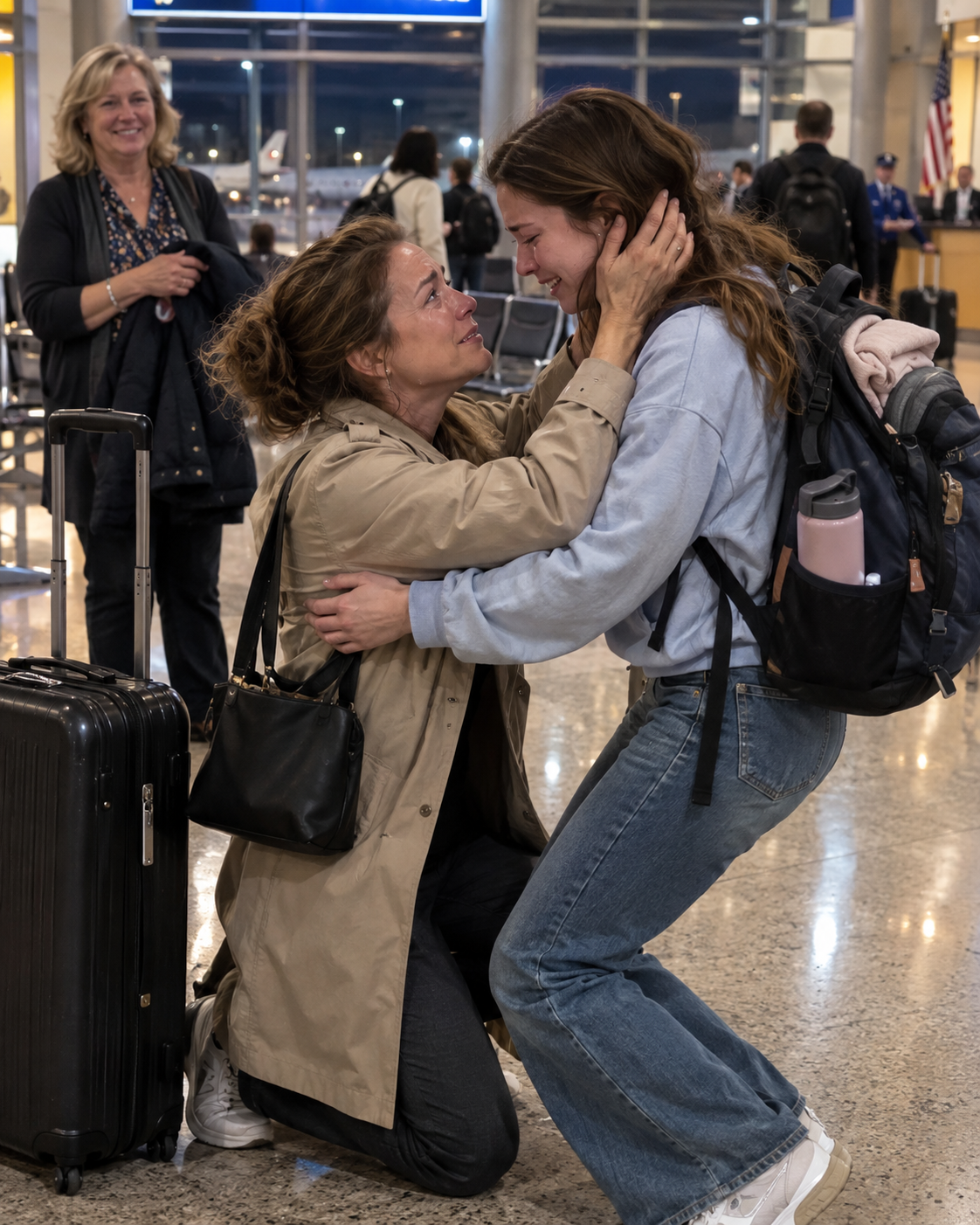
Months later, Carol came to visit us.
Chloe ran into her arms.
They hugged for a long time.
Carol looked at me afterward.
“She seems different.”
“She is.”
“So are you.”
I laughed softly.
“Probably.”
Before Carol left, she handed me a small envelope.
“I almost forgot.”
Inside was a photograph from the night she found Chloe.
I stared at it.
Chloe was sitting on the store bench with her backpack in her lap.
Her face was frightened.
But behind her was something I hadn’t noticed before.
A woman standing near the checkout aisle.
Watching her.
I looked closer.
The woman wasn’t Carol.
I knew that face.
I had seen her once before.
In one of Mark’s old family photographs.
Sarah later identified her as someone connected to Mark’s previous marriage.
Someone who had contacted him repeatedly during the months before my assignment.
I called Sarah immediately.
“There’s something else.”
She was quiet.
“What did you find?”
I sent her the photograph.
Minutes passed.
Then my phone rang.
Sarah’s voice was unusually serious.
“Where did you get this?”
“Carol gave it to me.”
“Listen to me carefully.”
I sat down.
“What?”
“The woman in that photo has already been interviewed.”
My heart began pounding.
“By whom?”
“The police.”
“Why?”
Sarah paused.
“Because she claims Mark told her something about Chloe before he left.”
I couldn’t speak.
“What did he tell her?”
Sarah took a breath.
“He allegedly said, ‘When the power goes out, she’ll know where to go.'”
The room seemed to tilt beneath me.
I looked toward the hallway.
Toward the closet where Chloe’s backpack rested.
For months, I had believed the worst thing Mark had done was abandon my daughter.
Now I wondered whether abandoning her had ever been the entire plan.
I walked upstairs and opened Chloe’s closet.
The backpack was exactly where she had left it.
I touched the zipper.
And for the first time since that terrible night, I wondered what else my daughter had been carrying that she had never told me.
Because sometimes the thing that saves a child is the same thing that hides the truth.
And sometimes, when the danger is finally gone, the questions are only beginning.