“Graham was born to succeed. You were born to embarrass us,” my mother said across the dinner table. I looked at my older brother.
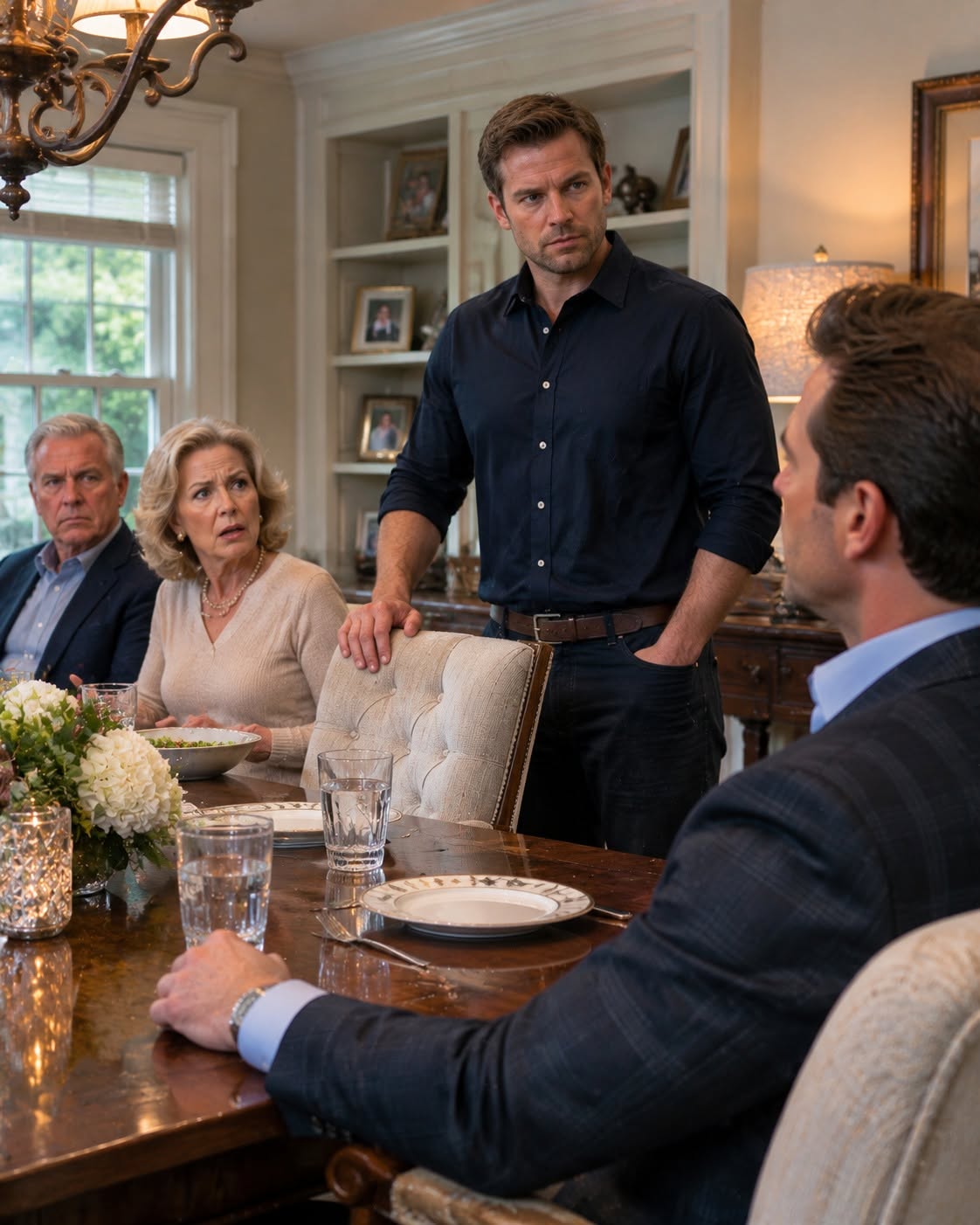
Graham stood at the head of my parents’ dining table, smiling like a man who had already won.
He had prepared a presentation.
An actual presentation, complete with a leather folder for everyone, color-coded charts, and a document titled “The Whitmore Family Legacy Preservation Trust.”
I almost admired the arrogance.
Almost.
“Families with real wealth don’t leave their futures to chance,” Graham announced. “They consolidate their assets, eliminate unnecessary risks, and appoint someone qualified to manage everything.”
He paused, waiting for someone to compliment him.
My mother, Evelyn, practically glowed.
“This is why your father and I have always trusted your judgment.”
I looked at Tessa, who was sitting beside me.
She pressed her lips together to keep from smiling.
Graham clicked to the next slide.
“Under this arrangement, Mom and Dad will transfer their remaining property interests into the trust. I’ll contribute my investment holdings. And my sibling will contribute the rental portfolio.”
I raised my hand.
Graham frowned.
“This isn’t a classroom.”
“Then stop treating us like students who forgot to do the homework.”
Uncle Walter coughed into his napkin.
Graham ignored him.
“The trust will protect everyone from individual financial exposure.”
“Interesting,” I said. “Who controls the trust?”
“I would serve as managing trustee.”
“And who can remove you?”
He hesitated.
“That’s addressed in the governing documents.”
“Which page?”
His jaw tightened.
“Page twenty-three.”
I opened the folder.
Page twenty-three contained a provision allowing Graham to appoint his own successor and limiting the circumstances under which beneficiaries could challenge his decisions.
There was another clause allowing the trustee to borrow against trust assets.
And another authorizing the sale of real estate without obtaining unanimous beneficiary approval.
I looked up.
“So you want me to transfer twelve rental properties into a trust where you can mortgage them, sell them, or use them as collateral without my permission.”
Graham gave an impatient sigh.
“That’s an oversimplification.”
“No. It’s a summary.”
Dad leaned forward.
“Your brother knows more about finance than you ever will.”
I nodded.
“Then he should have no trouble answering a simple question.”
I turned back to Graham.
“What happens if the trustee has personal debts he hasn’t disclosed?”
The smile disappeared from his face.
“That’s irrelevant.”
“Is it?”
Mom slapped her hand against the table.
“We invited you here to discuss your brother’s generous proposal, not interrogate him.”
I closed the folder.
“Then let’s discuss generosity.”
I reached into my briefcase and removed a second folder.
Graham watched my hands.
For the first time that evening, he looked nervous.
I placed a document in front of Dad.
It was a copy of the mortgage payment history.
His expression changed immediately.
“Where did you get this?”
“Through a loan portfolio my company acquired. Leo has already reviewed what we can legally disclose and how the account must be handled.”
Dad stared at the page.
Mom leaned over his shoulder.
“What is that?”
I answered before he could.
“Your mortgage. Eight months of missed or partial payments. Delinquent property taxes. And a loan balance that’s almost as large as the current value of the house.”
Mom’s mouth opened.
“That can’t be right.”
“Unfortunately, it is.”
Graham pushed back his chair.
“This is private financial information.”
“It certainly is,” I said. “Which makes it strange that you’re proposing to manage everyone’s assets without mentioning it.”
Dad’s face turned crimson.
“You have no right to humiliate us.”
I looked at him.
“Funny. That’s exactly what Mom was doing to me at dinner last week.”
The silence was brutal.
Then Graham laughed.
A short, dismissive sound.
“You bought some distressed loans and suddenly think you’re a financial genius?”
“No,” I said. “I think someone has been taking money from our parents while telling them he’s protecting their future.”
I slid another document across the table.
It showed a series of transfers from my parents’ accounts to a business called Whitmore Strategic Holdings.
Graham’s business.
The transfers totaled more than $280,000 over three years.
Mom looked confused.
“Those were investments.”
I turned toward her.
“Investments in what?”
She looked at Graham.
He answered quickly.
“Private market opportunities. Long-term positions.”
“Then show us the statements.”
“I don’t carry confidential client records to family dinners.”
“Convenient.”
He leaned toward me.
“You’re making accusations you can’t prove.”
I opened my briefcase again.
“Actually, I brought something else.”
I placed three printed photographs on the table.
They showed Nadine standing outside one of my apartment buildings, speaking to a tenant.
In the second photograph, Dad was beside her.
The third was a still frame from a doorbell camera, timestamped the previous Tuesday.
Graham stared at them.
“What is this supposed to prove?”
I pressed play on my tablet.
Nadine’s voice filled the dining room.
“The owner is having financial trouble. These buildings are going to be liquidated, and you should start looking for somewhere else to live.”
Then Dad’s voice followed.
“We’re just trying to give people a fair warning.”
I stopped the recording.
Mom turned toward him.
“Howard?”
Dad looked down.
Graham recovered first.
“They were trying to help.”
“By lying to my tenants?”
“People deserve to know if their housing is unstable.”
“Absolutely,” I said. “Which is why spreading false information about their homes is especially cruel.”
Tessa spoke for the first time.
“One tenant is seventy-four years old. She called us crying because she thought she had thirty days to find somewhere else to live.”
Nadine rolled her eyes.
“Oh, please. Nobody told her thirty days.”
Tessa opened her phone.
“Would you like to hear the recording?”
Nadine went quiet.
I looked around the table.
“I’m not transferring a single property into Graham’s trust. And if anyone contacts my tenants again, they’ll be hearing from my attorney.”
Graham’s face hardened.
“You think you can threaten this family?”
“No,” I said. “I’m telling you where the boundaries are.”
I stood.
Tessa stood with me.
As we reached the doorway, Graham called after us.
“You’re making a mistake. You have no idea what you’re interfering with.”
I turned around.
“Then enlighten me.”
He smiled.
It wasn’t a pleasant smile.
“Soon enough.”
Three mornings later, I discovered what he meant.
My business account had been flagged for review by our primary lender.
The bank had received an anonymous complaint alleging that my company was misrepresenting rental income, concealing vacancies, and using improper accounting practices.
Within twenty-four hours, a prospective refinancing was put on hold.
Then two insurance carriers requested additional documentation.
And finally, a local real estate blog published an article questioning whether my properties were financially stable.
The article quoted an unnamed “family member familiar with the owner’s finances.”
I sat in my office staring at the screen.
Tessa walked in carrying two coffees.
“You’re going to want to see this.”
She handed me her phone.
Graham had posted a long message on social media.
He described himself as a concerned brother trying to help a struggling family member who had become reckless with money.
He never mentioned my company by name.
He didn’t need to.
The comments were already filling with speculation.
I felt something cold settle in my chest.
“He’s trying to destroy my credit.”
Tessa nodded.
“And he’s hoping you’ll panic.”
I called Leo.
He listened without interrupting.
Then he said, “Don’t respond publicly yet. Preserve everything. We need to establish where these allegations came from.”
“Can we stop him?”
“We can challenge false statements and report misconduct. But we need evidence, not assumptions.”
I hated that answer.
Not because it was wrong.
Because it meant Graham could keep hurting people while we worked to prove what he was doing.
That afternoon, I visited my oldest property, a brick apartment building on Maple Street.
Mrs. Alvarez was waiting near the entrance.
She had lived there for eleven years.
When she saw me, she hurried over.
“Are we losing our homes?”
“No, ma’am.”
She searched my face.
“People keep saying the bank is taking everything.”
I crouched slightly so we were eye level.
“The building isn’t being sold. Your lease is valid. And if anything ever changes, you’ll hear it directly from my office in writing.”
She gripped my hand.
“My husband died in that apartment. I don’t want to leave.”
Something tightened in my throat.
“You don’t have to.”
Driving back, I realized Graham wasn’t simply attacking my reputation.
He was using the people who trusted me as leverage.
That changed everything.
The following morning, Uncle Walter called.
“I need you to come by my house.”
His voice sounded unusually serious.
“What’s wrong?”
“I found something your grandfather left behind.”
My grandfather had died twelve years earlier.
He’d been a quiet man who ran a hardware store and believed a person’s word was worth more than a signed contract.
Walter had inherited most of his personal papers.
When I arrived, he was sitting at the kitchen table beside a battered metal filing box.
“I’ve been looking through old family records,” he said.
He handed me a yellowed envelope.
Inside was a letter written in Grandpa’s unmistakable handwriting.
It was addressed to my father.
I read the first paragraph.
Then I read it again.
Grandpa had helped Dad purchase the family home decades earlier.
But the letter made something clear.
He had never intended the house to become a monument to status.
He’d written that the property was supposed to provide stability, not become a source of competition between his grandchildren.
Near the bottom was a sentence that made me stop.
“Howard, never let one child believe he must become smaller so another can appear greater.”
I stared at the words.
Walter watched me quietly.
“Your grandfather noticed things,” he said.
I folded the letter carefully.
“Why didn’t you show me this before?”
“Because I thought your father would eventually figure it out himself.”
He sighed.
“I was wrong.”
Then he pushed another folder toward me.
“This is what I really called you about.”
Inside were copies of documents from a small investment partnership Walter had entered with Graham eighteen months earlier.
Walter had invested $90,000.
Graham had promised quarterly returns.
There had been two small payments.
Then nothing.
Walter had asked for his money back.
Graham kept postponing.
I examined the statements.
Something about the account numbers looked familiar.
“Can I take copies of these to Leo?”
Walter nodded.
“That’s why I called.”
Two days later, Leo asked us to meet at his office.
Tessa was there, along with a forensic accountant named Marissa Cole.
Marissa had spent twenty years investigating financial misconduct.
She wasn’t dramatic.
She didn’t need to be.
She placed a chart on the conference table.
“We’ve identified several transactions that raise serious questions.”
She pointed to three entities.
Whitmore Strategic Holdings.
Crestline Capital Partners.
And Northbridge Property Acquisitions.
All three appeared connected through overlapping addresses, management records, or banking information.
Graham controlled the first.
Nadine had been listed as a manager of the second.
The third had recently submitted inquiries about purchasing distressed rental properties.
My rental properties.
I felt my stomach drop.
“He was trying to buy my buildings?”
Marissa shook her head.
“We don’t know whether a purchase would have happened. But there’s evidence someone associated with Northbridge was gathering information about your financing and tenant occupancy.”
Tessa leaned forward.
“So the rumors weren’t random.”
“Possibly not,” Marissa said. “But we need to distinguish what we can document from what we suspect.”
Leo looked at me.
“The trust proposal would have given Graham control over your assets. When you refused, pressure appeared on your business. We have enough to take protective steps, but we shouldn’t make public allegations until we’ve verified more.”
I stared at the chart.
“What about my parents’ money?”
Marissa’s expression grew serious.
“Some transfers appear to have moved through accounts connected to those entities. We haven’t traced every dollar.”
“Could it be a legitimate investment?”
“Some of it could. But the records Walter provided don’t reconcile with the reported returns.”
I thought about Dad’s mortgage.
The missed payments.
The desperate attempt to hide the grain of truth beneath Graham’s polished presentation.
Then I asked the question nobody had answered.
“Where did the money go?”
Marissa hesitated.
“We found evidence of payments to luxury retailers, vehicle leases, and a substantial transfer to an offshore brokerage account.”
The room went silent.
Tessa whispered, “Oh my God.”
Leo closed the folder.
“We need to move carefully.”
I nodded.
But inside, I was shaking.
Graham hadn’t merely borrowed money from our parents.
He might have been financing an entire false life with other people’s savings.
And he was still trying to get his hands on mine.
That evening, I received a call from Nadine.
I almost ignored it.
Then I answered.
“What do you want?”
Her voice was trembling.
“I need to talk to you.”
“Talk.”
“Not on the phone.”
I looked at Tessa.
She mouthed, “Put it on speaker.”
I did.
Nadine took a shaky breath.
“Graham doesn’t know I’m calling.”
“That doesn’t make me trust you.”
“I know.”
She was silent for a moment.
Then she said something I hadn’t expected.
“He’s going to blame everything on me.”
We met the next morning at Leo’s office.
Nadine arrived without makeup, wearing jeans and a plain sweater.
She looked nothing like the woman who had spent years making sure everyone noticed her expensive clothes.
Leo explained that he represented me, not her, and advised her to obtain independent legal counsel before discussing potentially incriminating matters.
She nodded.
Then she placed a flash drive on the table.
“I copied the records from our home computer.”
Leo didn’t touch it immediately.
“Do you have lawful access to those files?”
“They were in our shared household financial folder. I had access to them.”
He asked several more questions before accepting it for review.
Nadine twisted her wedding ring.
“Graham told me the family trust was the only way to save everything.”
“Save what?” I asked.
“Our house. His business. Your parents’ house.”
She looked down.
“He said if your properties were transferred into the trust, he could use the equity to secure new financing and pay off the old investors.”
My skin went cold.
“He wanted to borrow against my buildings to cover his losses.”
She nodded.
“And when I refused?”
“He said you were too stubborn to understand what was best for you.”
Tessa folded her arms.
“So you went to our tenants and lied.”
Nadine began crying.
“I know what I did.”
“Why?”
“Because Graham said the buildings would be sold eventually anyway. He told me we were helping people prepare.”
I studied her.
“You believed him?”
She wiped her eyes.
“I wanted to.”
That answer sounded more truthful than anything she’d said before.
She looked at me.
“There’s something else.”
My pulse quickened.
“Go on.”
“He told your father that you were planning to foreclose on the house personally. He said you bought the mortgage to punish them.”
I stared at her.
“He knew I hadn’t even decided how to handle that loan.”
“He said it didn’t matter. That once your father was frightened enough, he’d sign anything.”
For a moment, I couldn’t speak.
Then Nadine whispered, “I’m sorry.”
I didn’t tell her it was okay.
It wasn’t.
But I thanked her for coming forward.
Over the next week, Leo and Marissa worked with the records Nadine had provided.
Some were incomplete.
Others required independent verification.
But the picture became clearer.
Graham had been operating a failing investment business while maintaining the appearance of extraordinary success.
He’d borrowed from relatives, moved funds between entities, and used incoming investor money to satisfy earlier obligations.
The evidence raised serious concerns about fraud.
Leo helped Walter and my parents consult separate attorneys about their potential claims.
We also submitted documented information to the appropriate financial regulators and law enforcement authorities.
Meanwhile, I worked with my lender to address the anonymous allegations.
We provided audited rent rolls, bank deposits, signed leases, occupancy records, and independent property valuations.
The bank eventually lifted its review hold.
The insurance questions were resolved.
My company survived.
But Graham wasn’t finished.
He called me late on a Friday night.
I answered because I wanted to hear what he had to say.
“You’ve ruined my marriage,” he snapped.
I sat back in my chair.
“That’s an interesting interpretation.”
“Nadine’s staying with her sister. My investors are calling. Dad won’t answer me.”
“Maybe you should talk to an attorney.”
He laughed bitterly.
“You always wanted this.”
“Wanted what?”
“To see me fail.”
I thought about all the years I’d spent trying to earn a fraction of the praise he received without effort.
There had been a time when watching him stumble would have felt satisfying.
But now?
All I could think about were the tenants he’d frightened and the relatives whose savings might be gone.
“No, Graham,” I said. “I wanted you to stop trying to make me fail.”
He went quiet.
Then his voice softened.
“We can still fix this.”
I closed my eyes.
“How?”
“Withdraw the complaints. Tell everyone this was a misunderstanding. Help me refinance the business.”
There it was.
Even now, he was asking me to save him from consequences without admitting what he’d done.
“I won’t lie for you.”
“You’d let your own brother go to prison?”
“That’s not my decision.”
“You know what Mom will say.”
I looked at the photograph on my desk.
It showed Tessa and me standing in front of our first duplex, both of us covered in paint.
We’d bought that property with savings, a small business loan, and three years of exhausting work.
Graham hadn’t contributed a dollar.
For years, I’d let my family’s opinion make that accomplishment feel smaller.
Not anymore.
“Mom can say whatever she wants,” I replied.
Then I ended the call.
The next family meeting was nothing like Graham’s.
There were no presentations.
No glossy folders.
No speeches about legacy.
We met at Uncle Walter’s house because Dad couldn’t bear the thought of gathering in the dining room where everything had started.
Mom looked exhausted.
Dad seemed to have aged ten years.
Graham wasn’t there.
Neither was Nadine.
Walter had invited Leo to explain the mortgage situation and the steps my parents could consider.
The house was still in danger.
That hadn’t changed.
My company owned the loan, but ownership didn’t erase the debt or give me unlimited freedom to ignore the legal obligations attached to it.
Leo explained the available options, including a properly documented modification, a negotiated sale, or a voluntary move to a smaller home.
Dad stared at the floor.
Finally, he asked, “Are you going to take our house?”
The question hurt.
Not because I wanted revenge.
Because he genuinely believed I might.
“I haven’t started foreclosure proceedings,” I said. “And I don’t want to make that decision without exploring the alternatives.”
Mom looked up.
“After everything we’ve said to you?”
I nodded.
“Yes.”
Her eyes filled.
“Why?”
I thought about it carefully.
“Because I don’t want to become someone who uses money to punish people.”
Dad covered his face with his hands.
Mom began crying.
For once, nobody rushed to comfort her.
After a while, she looked at me.
“I was cruel to you.”
I said nothing.
She continued.
“I kept comparing you to Graham because he looked like the kind of son I thought successful families were supposed to have.”
Her voice broke.
“And every time you accomplished something, I found a way to make it sound smaller.”
I felt my throat tighten.
“Why?”
She shook her head.
“Because admitting you were successful meant admitting I’d been wrong about you for years.”
That answer hurt more than another insult would have.
Dad looked up.
“I let it happen.”
“Yes,” I said.
He nodded.
“I know.”
Mom reached across the table.
I didn’t take her hand immediately.
“I can forgive you eventually,” I told her. “But I can’t pretend those years didn’t happen.”
She lowered her eyes.
“I understand.”
And for the first time, I believed she might.
The months that followed weren’t easy.
Graham’s financial affairs became the subject of a formal investigation.
Several investors pursued civil claims.
His professional reputation collapsed as more information emerged.
Nadine filed for divorce.
She also worked with her own attorney to address her role in what had happened.
I didn’t celebrate any of it.
There were too many people who’d lost money, trust, or both.
My parents eventually decided to sell the family house.
It wasn’t the outcome they’d wanted.
But it allowed them to settle the mortgage and tax obligations through a properly negotiated transaction without a foreclosure.
They moved into a modest two-bedroom townhouse.
Dad complained about the smaller garage.
Mom complained about the kitchen.
Then, slowly, they began adjusting.
One Saturday, I visited to help Dad assemble some shelves.
He handed me a screwdriver and watched me work.
“You always were good with your hands,” he said.
I smiled faintly.
“That’s what you used to say when you wanted to explain why Graham was smarter.”
He looked embarrassed.
“I remember.”
We worked quietly for a while.
Then he said, “I was wrong.”
I tightened the final screw.
“About what?”
“About what makes a person successful.”
I looked at him.
He continued.
“I thought Graham’s title and salary meant he’d made something of himself. I thought your work was beneath him.”
He glanced around the small townhouse.
“But when everything fell apart, you were the one who had actually built something solid.”
I set down the screwdriver.
“Dad, I didn’t build my business to prove I was better than Graham.”
“I know.”
“I built it because I wanted a life that belonged to me.”
He nodded slowly.
“Your grandfather used to say that a house isn’t worth much if the people inside it can’t trust one another.”
I smiled.
“Sounds like Grandpa.”
Dad looked toward the window.
“I wish I’d listened.”
A year after Graham’s disastrous family meeting, Tessa and I hosted a small gathering at one of our newly renovated properties.
It was a twelve-unit building we’d purchased from an owner who had neglected it for years.
We’d replaced the roof, repaired the plumbing, updated the heating system, and created a small community garden.
Mrs. Alvarez had helped choose the flowers.
She insisted on roses.
There were tenants, employees, contractors, and a few friends.
Uncle Walter arrived carrying a homemade pie.
Mom brought cookies.
Dad spent twenty minutes talking to our maintenance supervisor about the new boiler.
Nobody mentioned Graham.
Not because we’d forgotten.
But because, for once, the evening wasn’t about him.
As the sun began to set, Tessa found me standing beside the garden.
“You okay?”
I nodded.
“Just thinking.”
“About what?”
I looked at the building.
The warm lights glowing behind the windows.
The children laughing near the picnic tables.
Mrs. Alvarez showing Mom the rosebush she’d planted.
“I used to think I’d finally feel successful when Mom and Dad admitted I was.”
Tessa slipped her hand into mine.
“And now?”
I smiled.
“Now I think I was successful long before they noticed.”
She rested her head against my shoulder.
A few minutes later, Uncle Walter approached us.
He handed me a small envelope.
“Found this in your grandfather’s things,” he said.
Inside was an old photograph.
It showed Grandpa standing in front of his hardware store.
On the back, in faded blue ink, he’d written:
“Never confuse the person who looks wealthy with the person who knows how to build something worth keeping.”
I stared at those words for a long time.
Then I tucked the photograph into my pocket.
That evening, after everyone had gone home, I walked through the building one last time.
I checked the front door.
Made sure the hallway lights were working.
Picked up a forgotten paper cup near the entrance.
Small things.
Ordinary things.
The kind of work my family had once considered embarrassing.
And I felt proud.
Not because I’d defeated my brother.
Not because my parents had finally admitted their mistakes.
But because I’d refused to let their judgment determine my worth.
Graham had spent his life trying to appear successful.
I’d spent mine learning how to create something real.
He’d wanted control over everyone else’s assets because he couldn’t control the truth about his own.
I’d learned that the most valuable things I owned weren’t the buildings, the bank accounts, or the contracts.
They were my integrity, my independence, and the trust people placed in me.
Those were things no family trust could manufacture.
And no foreclosure could take away.
I locked the front door and walked toward Tessa’s waiting car.
For the first time in my life, I wasn’t wondering whether my parents were proud of me.
I already knew who I was.
And that was enough.