“Give me the keys, Nate,” my father said while turkey slid under the china cabinet and my brother stood in a snowdrift of mashed potatoes
“What?”
“The utility accounts aren’t the only recurring expenses.”
I leaned against the side of my truck.
“What else?”
“There’s a storage unit.”
I frowned.
“Whose?”
“Julian’s.”
“Since when?”
“Almost two years.”
“What does he have in there?”
Maya hesitated.
“I don’t know. But your card has been paying twelve hundred dollars a month.”
I closed my eyes.
Twelve hundred.
Every month.
For almost two years.
That was more than I had spent on my own groceries in a year.
“Cancel it.”
“There’s a problem.”
“What?”
“There’s an automatic renewal tomorrow. If I cancel now, the facility may lock the account. Whoever’s belongings are inside will need to deal with it.”
“That’s fine.”
“Nate.”
“What?”
“I want you to understand something. You don’t have to fix the consequences after you stop paying for them.”
I almost laughed.
“I know.”
But I didn’t.
Not yet.
The next morning, my phone was quiet.
That was new.
Usually my family group chat woke up before sunrise with questions about schedules, bills, deliveries, errands, and Julian’s latest emergency.
At 6:17 a.m., my father finally called.
I let it ring.
He called again.
Then my mother.
Then Julian.
I answered my father on the fourth attempt.
“Your mother says the power’s off.”
“Okay.”
“What do you mean, okay?”
“I canceled the payment.”
There was a long silence.
“What payment?”
“The one I made every month.”
“You paid our electric bill?”
“For years.”
He breathed out slowly.
“Why?”
I didn’t have a good answer.
Because I loved you.
Because I was afraid of what would happen if I stopped.
Because fixing things was easier than watching people struggle.
Because somewhere along the way, being useful became the safest way I knew to belong.
Instead I said, “I thought you knew.”
“We didn’t.”
That landed differently than I expected.
My father had always been a proud man. He was terrible at asking for help, which had made it easier for me to help without asking permission.
“We’ll handle it,” he said.
“Okay.”
He hung up.
At 9:30, my mother called.
Her voice was smaller.
“Your father says we have enough money to catch up, but the bank account is lower than he thought.”
“I’m sorry.”
She paused.
“No. I’m sorry.”
I sat at my kitchen table.
“For what?”
“For letting you do this.”
I didn’t answer.
Then she said, “Julian’s downstairs.”
I heard him in the background.
“He says the goats are cold.”
I closed my eyes.
“What goats?”
“Apparently he brought them home.”
“Home where?”
“Here.”
I stood up.
“Mom, don’t let him bring livestock into the house.”
“He’s already done it.”
I drove over.
Four goats were standing in my parents’ living room.
One had its front hooves on the coffee table.
Another was chewing something that looked suspiciously like a decorative garland.
The smallest one had climbed onto the sofa.
And the largest—brown, broad-chested, with one crooked horn—was staring at me with an expression that suggested she had personally reviewed my financial decisions and found them wanting.
Julian pointed at her.
“That’s Brenda.”
“Of course it is.”
“She’s the lead.”
“Lead what?”
“Goat.”
I stared at him.
“Julian.”
“Listen.”
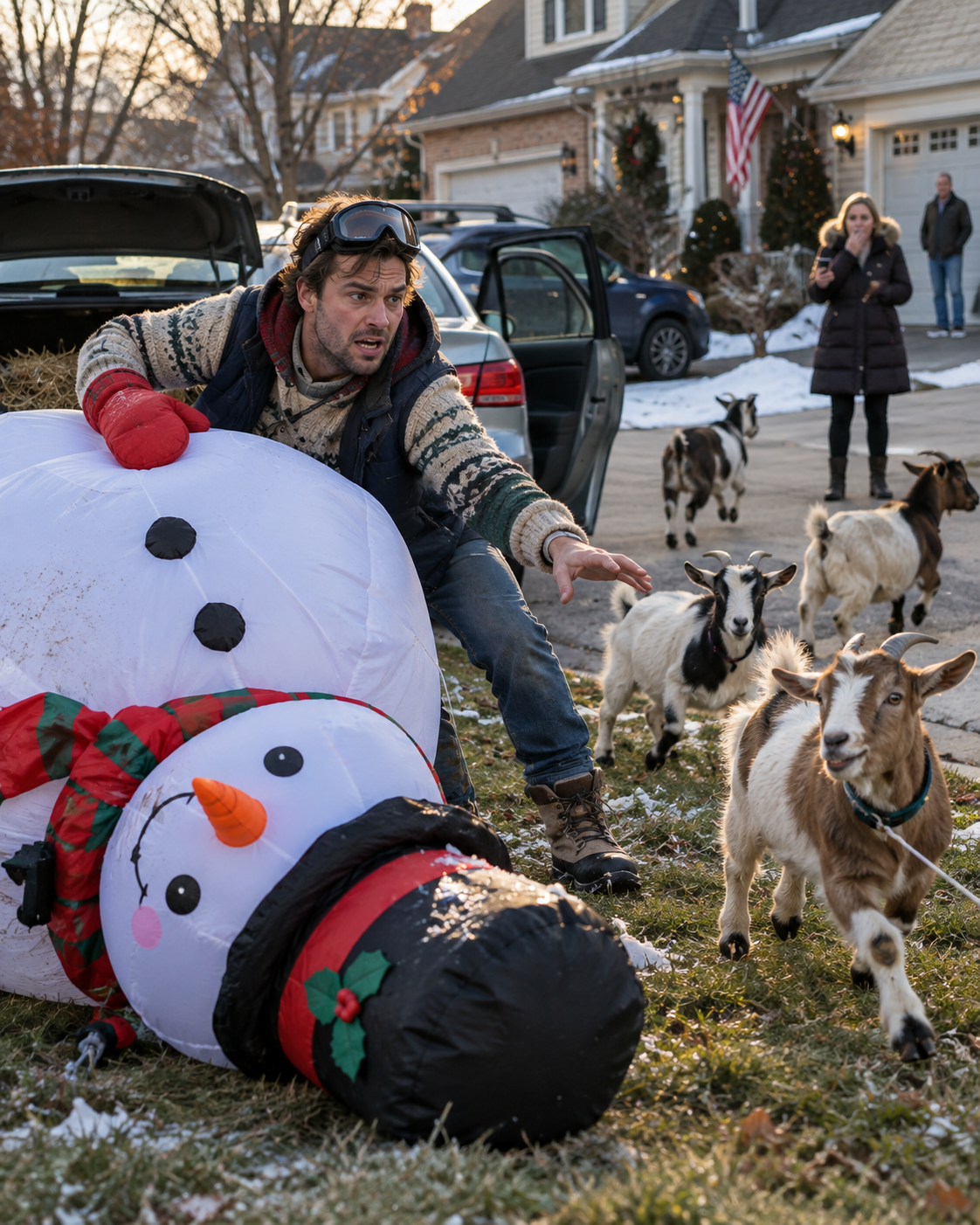
He had three sweaters on, ski goggles around his forehead, and an oven mitt on one hand.
“The house is freezing, okay? I had to keep them somewhere.”
“Your house.”
“I don’t have heat.”
“Because you don’t have money.”
“Exactly.”
I looked at my mother.
She looked exhausted.
My father stood behind her holding a space heater.
For the first time, I understood something uncomfortable.
The consequences weren’t landing only on Julian.
They were landing on everyone.
And that meant my boundary couldn’t simply be punishment.
It had to be a line I could hold without abandoning people who hadn’t asked for the mess.
I took my mother aside.
“I’m not paying the bills again.”
“I know.”
“But if you need groceries while you get things sorted, I’ll help once.”
She nodded.
“Once?”
“Once.”
She looked at me for a long moment.
“That’s fair.”
Behind us, Brenda ate a piece of newspaper.
Julian shouted, “No, no, no!”
The next forty-eight hours were ugly.
My parents found out exactly how much they owed.
My father sold his second motorcycle.
My mother picked up extra shifts at the medical billing office where she’d worked part-time after retirement.
Julian’s response was to insist his seminar business would solve everything.
He arrived at my apartment two days later with the four goats crammed into the back of his dented sedan.
I opened the door.
He stood there wearing the same ski goggles.
“Before you say no—”
“No.”
“You haven’t heard the forecast.”
“I don’t need the forecast.”
“Eight hundred thousand dollars in annual revenue.”
“With goats.”
“Corporate goats.”
“Still goats.”
“They’re trained.”
Brenda immediately jumped out of the car and ran toward my neighbor’s inflatable snowman.
Julian chased her.
The other three goats followed.
Within seconds, the street became a parade of panicked animals, shouting neighbors, and one furious man in pajamas trying to rescue an inflatable snowman from a goat determined to eat its scarf.
I stood on my porch.
And then, unexpectedly, I started laughing.
Not because Julian was suffering.
Because for the first time, I wasn’t running after him.
He eventually caught Brenda.
She had eaten part of the snowman’s arm.
“I’m sorry,” he called.
My neighbor shouted something I won’t repeat.
Julian looked at me.
There was no performance left in his face.
Just exhaustion.
“I don’t know what I’m doing,” he said.
It was the first honest thing he’d told me in years.
I nodded.
“I know.”
“I thought if I could just get one thing to work…”
“I know.”
He rubbed both hands over his face.
“I don’t want to be thirty-one and still asking you for your truck.”
“Then don’t.”
He looked at me.
“That’s it?”
“That’s it.”
He waited for me to solve it.
I didn’t.
That silence did more than any lecture could have.
The next week, Julian returned the goats.
There was one final disaster first.
He’d arranged a trial seminar at a small manufacturing company. He had borrowed a conference room and prepared a presentation called “Leading From the Herd.”
Brenda shredded the client’s quarterly report.
Julian called me afterward.
“I think I’m done.”
“With the goats?”
“With pretending every bad idea deserves another chance.”
I sat quietly.
“What are you going to do?”
“I got a job.”
“Doing what?”
“Feed supply depot.”
I smiled.
“That’s actually a real job.”
“I know.”
He laughed.
“So rude.”
It was the first conversation we’d had in months that sounded like siblings instead of creditors and debtors.
Three months passed.
My parents caught up on their utilities.
My mother kept working full-time.
My father rebuilt his savings.
Julian showed up at his new job every morning at six-thirty.
He complained about the hours.
He complained about his boss.
He complained about the smell of grain.
But he kept going.
And slowly, something changed.
Not in them first.
In me.
I stopped checking their bank accounts.
I stopped anticipating emergencies.
I stopped keeping a mental list of which bills might need rescuing.
When my father mentioned the water heater was acting strange, I didn’t immediately reach for my phone.
I said, “Have you gotten an estimate?”
He said yes.
We talked about it.
That was all.
A month later, my mother invited me over for dinner.
She said she’d repainted the dining room.
I almost declined.
Then I remembered the table.
When I walked in, the room looked different.
The walls were a soft gray.
The chandelier had been cleaned.
The china cabinet had a repaired door.
And the twelve-seat table stood in the center, polished and steady.
There was no turkey yet.
That made me smile.
My father came into the room.
“We owe you an apology.”
I pulled out a chair.
“You don’t have to make it dramatic.”
“We’re your parents,” he said. “Apparently dramatic is hereditary.”
I laughed.
My mother sat across from me.
“I blamed you because I was embarrassed.”
“I know.”
“No, you don’t.”
She folded her hands.
“I was embarrassed that our son was thirty-one and couldn’t support himself. I was embarrassed that you had been paying our bills. And instead of facing that, I blamed you because it was easier.”
My throat tightened.
“I should’ve told you,” I said.
She nodded.
“Yes.”
That was the part nobody wanted to say.
I had not been some innocent hero.
I’d made myself indispensable without telling anyone the cost.
I had confused rescue with love.
My father looked at me.
“You were trying to keep us from worrying.”
“Yeah.”
“And you were keeping us from changing.”
I looked down at the table.
“Yeah.”
He reached across and squeezed my hand.
“We’re still figuring it out.”
“So am I.”
Julian arrived twenty minutes late.
He smelled faintly like grain and diesel.
“Sorry.”
My mother looked at him.
“Wash your hands.”
He grinned.
“Good to see you too.”
Dinner was normal.
Almost painfully normal.
Nobody asked me for money.
Nobody asked to borrow the truck.
Nobody brought up goats until dessert.
Then Julian said, “Brenda got adopted.”
I nearly choked on my pie.
“By who?”
“A petting zoo.”
“Is that wise?”
He smiled.
“Probably not.”
We laughed.
The next Thanksgiving, the turkey stayed on the table.
The mashed potatoes stayed on their plates.
No one flipped anything.
My father still teased me about my “emergency fund,” and my mother still tried to send me home with enough leftovers to feed a fire station.
Julian had been at the feed depot for almost a year by then. He’d received a promotion.
He had his own apartment.
He even bought a used pickup.
It was nowhere near as nice as my F-250.
He was ridiculously proud of it.
One evening, he asked if I wanted to go fishing.
“Sure.”
“You bringing the big truck?”
I raised an eyebrow.
He laughed.
“No. I’m bringing mine.”
That tiny sentence meant more to me than he knew.
I had spent years believing family meant making sure nobody ever hit the ground.
Now I understood something different.
Sometimes love was standing close enough to help someone back up—but far enough away that they had to use their own legs.
We never became perfect.
My mother still worried too much.
My father still pretended he didn’t need anyone.
Julian still had ideas.
Most of them were better now.
None involved livestock wearing neckties.
And I still kept the F-250.
Not because it represented freedom.
Not because it was a symbol of some grand victory.
I kept it because I liked the truck.
Because it was mine.
Because sometimes a boundary can be something as ordinary as keeping your keys in your own pocket.
A year after the Thanksgiving disaster, my family gathered around that same twelve-seat table.
Julian raised his glass.
“To boundaries.”
My father raised his.
“To paid utility bills.”
My mother laughed.
I lifted mine last.
“To Brenda.”
Everyone groaned.
Outside, the porch light came on as evening settled over the yard.
Inside, the table stayed upright.
And for once, nobody needed me to hold it there.