Gianna, if you know something I don’t, tell me now,” Dr. Sterling said, his voice barely audible beneath the alarms
I read the message twice before I let myself breathe.
It was on my phone, sent from an unknown number.
I had received it less than thirty seconds after the trauma-bay doors closed.
I wasn’t supposed to be here.
Not Riverside General.
Not this city.
Not anywhere that required me to answer questions about the years before I became Gianna Moretti.
I looked at Garrick Thorpe.
He was still standing beside Bradley’s gurney, one hand resting against the rail.
“Who are you?” Dr. Sterling asked.
Garrick didn’t answer him.
His eyes stayed on me.
“Corpsman,” he said quietly, “when did you get back?”
“I didn’t.”
The words came out automatically.
He shook his head.
“You disappeared.”
“I transferred.”
“That isn’t what happened.”
Sterling stepped between us.
“Master Chief, with respect, my patient is bleeding into the floor.”
Garrick glanced down.
He was right.
The argument vanished from his face.
“Finish the job.”
I did.
The residents followed my instructions without hesitation now. One held pressure. Another prepared blood. Someone called the operating room.
Bradley remained conscious just long enough to squeeze my fingers.
“Mara,” he whispered again.
“Don’t call me that.”
His eyes closed.
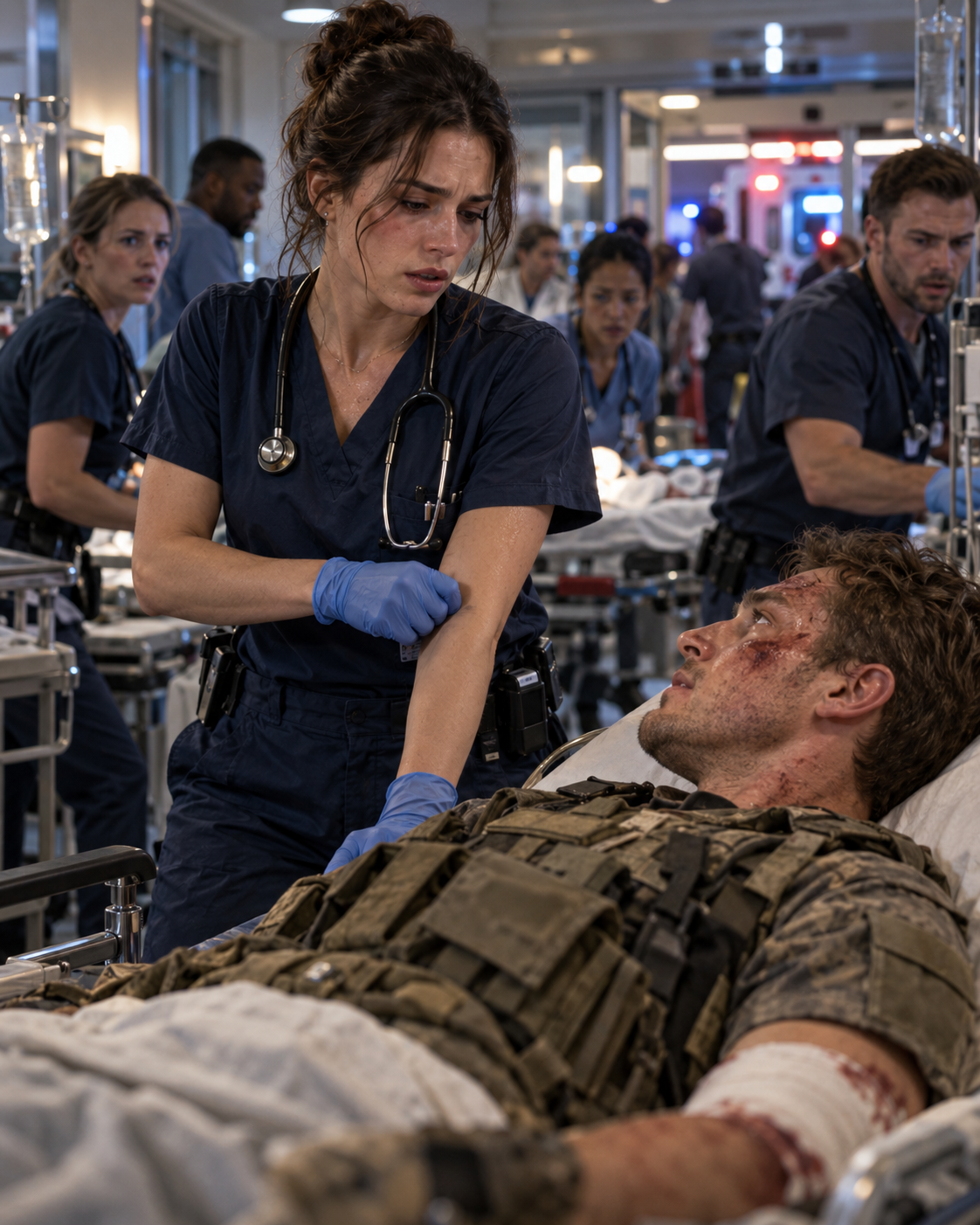
I nearly lost him on the way upstairs.
The surgeons took over, and for the first time since the convoy arrived, I had nothing left to do.
My hands started shaking.
Not badly.
Just enough for me to notice.
I locked myself in the staff bathroom and sat on the closed toilet lid.
Fourteen months without a flashback.
Fourteen months without hearing that name.
I pressed my palms against my knees.
Mara.
Nobody had called me Mara in a year and a half.
Nobody was supposed to know.
A knock came at the door.
“Gianna.”
Sterling.
I almost laughed.
Of all the people.
“Go away.”
He didn’t.
“I’m not asking as your chief.”
I opened the door.
He stood there without his usual expression of polished certainty.
“You saved his life.”
“Temporarily.”
“That’s not what I meant.”
I washed my hands even though they were already clean.
He watched the water run.
Then he said, “I owe you an apology.”
“Not now.”
“No. Probably not.”
He left.
That was the first thing he did that surprised me.
The second came an hour later.
He didn’t tell anyone what he had seen.
By midnight, Bradley was in surgery, and the military personnel had taken over the hallway outside the ICU.
I found Garrick sitting alone in the waiting area.
He looked older than I remembered.
Everyone looked older after enough time.
He stood when he saw me.
I shook my head.
“Don’t.”
“Okay.”
He sat.
I sat across from him.
For a while, neither of us spoke.
Then he said, “Seven years.”
I stared at the floor.
“Six years and nine months.”
“You kept count.”
“You did too.”
He smiled without humor.
“I was hoping I was wrong.”
“About what?”
“That you were alive.”
I looked at him.
“What kind of thing is that to say?”
“The kind you say when somebody disappears and leaves behind a death report.”
My chest tightened.
“I wasn’t dead.”
“No. But that’s not the same thing.”
He reached into his jacket and pulled out a folded piece of paper.
He didn’t hand it to me.
He just held it between us.
“Bradley asked for you before he went under.”
“Why?”
“I don’t know.”
“You knew my name.”
“I knew your old name.”
“That’s different.”
“It wasn’t to him.”
I stood.
“I can’t do this.”
“You need to.”
“No.”
“Gianna.”
I stopped.
His voice softened.
“Your past didn’t come looking for you. Bradley did.”
I left before he could say anything else.
The next morning, I came to work early.
I expected whispers.
There were none.
Instead, there was a note on my locker.
Come to my office at 0700.
—Sterling
I almost threw it away.
Instead, I went.
His office was on the third floor, all glass walls and immaculate shelves. The man who had once corrected my charting from across a trauma bay now looked like he’d slept in his clothes.
“Close the door.”
I did.
He pointed to the chair.
I stayed standing.
“Bradley made it through surgery.”
I let out a breath.
“His arm?”
“They repaired the artery. He’s going to lose some function, but they think they’ll save the hand.”
I nodded.
“That’s good.”
“There’s more.”
He slid a folder across the desk.
My name was on it.
Not Gianna.
The other one.
Mara Moretti.
I didn’t touch it.
“Where did you get that?”
“Military liaison.”
“You had no right.”
“I know.”
“Then why?”
“Because Garrick threatened to have you removed from my department if I interfered.”
That almost made me smile.
“He didn’t threaten you.”
“No,” Sterling said. “He politely explained exactly how much damage he could cause my career.”
That sounded like Garrick.
Sterling opened the folder.
“I found your credential history.”
“You shouldn’t have.”
“No.”
He swallowed.
“I also found the incident report from three years ago.”
I looked at him.
He lowered his voice.
“There was a convoy explosion overseas. Three corpsmen killed. One listed as missing.”
I said nothing.
“Your name was attached to it.”
My mouth went dry.
“You don’t know what you’re reading.”
“Then tell me.”
“I can’t.”
“Why?”
“Because it isn’t just mine.”
That stopped him.
For the first time, he seemed to understand that secrecy wasn’t always shame.
Sometimes it was loyalty.
Sometimes it was survival.
Sometimes it was the only thing left you could give the people who weren’t there to speak for themselves.
I took the folder.
“I need time.”
He nodded.
“Take it.”
I turned toward the door.
“Gianna.”
I looked back.
“I was wrong about you.”
I waited.
“I thought you were hesitant because you lacked experience.”
His voice cracked slightly.
“You were hesitant because you knew exactly what experience costs.”
I left without answering.
For the next three days, Bradley remained sedated.
I avoided the ICU.
Garrick avoided me.
Sterling didn’t mention the folder again.
Then, on Friday afternoon, Bradley woke.
And he asked for me.
The hospital administration wanted Garrick and two military officers present. Sterling was there too.
I stood beside the bed.
Bradley looked terrible.
Pale.
Bruised.
One arm wrapped almost to the shoulder.
But his eyes were clear.
“Hey,” he said.
“Hey.”
He smiled faintly.
“You still hate being called Mara.”
“I never liked it.”
“You used to.”
“That was a long time ago.”
He stared at the ceiling.
“Not that long.”
I pulled the chair closer.
“What happened?”
His face changed.
“We were running the exercise.”
“I know.”
“No.”
He looked at me.
“You don’t know.”
The room became still.
Bradley told us the explosion wasn’t supposed to happen.
A training charge had detonated early.
The official investigation would call it equipment failure.
But Bradley had noticed something.
The charge had been moved.
The wiring had been altered.
Someone had bypassed two safety controls.
He had recognized the setup because he had seen something similar years earlier.
My stomach turned.
“Where?”
He looked at Garrick.
Garrick nodded.
Bradley continued.
“Afghanistan.”
I couldn’t speak.
He did.
“Mara, I was there when your team disappeared.”
I stood so quickly the chair scraped the floor.
“Don’t.”
“I need to tell you.”
“No.”
“You deserve to know.”
“No, Bradley.”
My voice broke.
“You don’t get to decide that.”
He looked wounded.
Not physically.
Something deeper.
“I watched them load the bodies.”
I turned away.
“I watched them put your name on the list.”
“Stop.”
“You weren’t there.”
“I said stop.”
“You came back.”
“I said stop!”
Silence.
My breathing sounded too loud.
Bradley closed his eyes.
When he opened them again, there were tears in them.
“I saw you.”
That sentence destroyed something inside me.
Not because it was shocking.
Because for fourteen months I had built my entire life around believing nobody had.
I sat down.
“Where?”
“Outside the village.”
“When?”
“After the second blast.”
My hands went cold.
“What did you see?”
“You were carrying Ortega.”
I shut my eyes.
I remembered.
Not the explosion.
Not the blood.
Her boots dragging behind me.
The weight of her body.
The smoke.
The impossible decision.
“She’s alive,” I whispered.
Bradley didn’t answer.
I opened my eyes.
He looked at Garrick.
Then at me.
“That’s why I asked for you.”
The room seemed to tilt.
“Where is she?”
Bradley’s face tightened.
“I don’t know.”
Hope rose so quickly it hurt.
Then he added, “But someone does.”
The door opened.
A naval investigator stepped inside.
“Captain Vance,” she said, “we need to speak with you.”
Bradley shook his head.
“Not yet.”
She looked at me.
Then at Garrick.
Then at Sterling.
“You all need to leave.”
“No,” Bradley said.
The investigator’s expression hardened.
“This is a military investigation.”
“And she’s part of it.”
The investigator stared at me.
“No, she isn’t.”
Garrick stood.
“She is now.”
The woman’s jaw tightened.
“You don’t have authorization.”
Garrick smiled.
“I have enough.”
Sterling looked between them.
Then he did something I never expected.
He stepped beside me.
“She’s staying.”
The investigator looked at him.
“You’re a civilian physician.”
“Yes.”
“This doesn’t concern you.”
Sterling glanced at Bradley.
Then at me.
“It concerns my patient.”
It was the first time I had ever heard him use the word without sounding like he owned the room.
The investigator left.
Garrick exhaled.
“Now we’re in trouble.”
Sterling said, “I noticed.”
Despite everything, I laughed.
It was small.
But real.
That night, Garrick came to my apartment.
I almost didn’t let him in.
When I opened the door, he looked at the duffel bag on the floor.
“You still live out of that thing.”
“Yes.”
“Why?”
I looked at it.
“I don’t know.”
He nodded slowly.
“You do.”
I didn’t answer.
He walked inside.
“I thought if I unpacked, I was admitting I was safe.”
“And are you?”
I looked toward the window.
“I don’t know.”
He sat at the kitchen table.
“I found something.”
He put a photograph down.
It showed our old field team.
Eight people.
Dusty uniforms.
Bad smiles.
One person had been cut out of the image with a blade.
My heart stopped.
“Who removed them?”
“I did.”
“Why?”
“Because I thought they were dead.”
I looked at him.
“Who?”
“Ortega.”
I couldn’t breathe.
Garrick leaned forward.
“Listen to me. Bradley didn’t know this when he woke up. But I found a personnel movement record from three years ago. Somebody used Ortega’s identification to enter a classified recovery program.”
“Recovery program?”
“Witness protection.”
I stared at the photograph.
“Why would a corpsman need witness protection?”
“Because she saw something.”
“What?”
Garrick hesitated.
“The same thing Bradley thinks caused the training explosion.”
My phone rang.
Unknown number.
I answered.
Nobody spoke.
Then a woman’s voice whispered, “Mara?”
My knees nearly gave out.
“Who is this?”
A breath.
Then:
“You need to stop asking about the convoy.”
The line went dead.
Garrick was already standing.
“Who was it?”
I looked at him.
“I think it was Ortega.”
The next morning, I went to the hospital before dawn.
Sterling was already there.
He had coffee in both hands.
He handed me one.
“Don’t ask.”
I took it.
“Thanks.”
We stood beside the empty nurses’ station.
“Did you sleep?”
“No.”
“Me neither.”
I looked at him.
“Why are you helping me?”
He stared into his coffee.
“Because I was arrogant.”
“That isn’t enough.”
“No.”
He sighed.
“Because I watched you save Bradley, and all I could think about was every time I dismissed you.”
He looked up.
“I don’t want to be that man anymore.”
I believed him.
That was the frightening part.
Not because I trusted him.
Because I was beginning to.
Two weeks later, Bradley was stable enough to speak with investigators.
The military investigation widened.
The training explosion had not been equipment failure.
Someone had sabotaged the exercise.
The person responsible had access to restricted materials and knew enough about naval medical operations to understand exactly who would respond.
The trail eventually led to a contractor.
Then to another.
Then nowhere.
Every record had been cleaned.
Every witness had an explanation.
Every explanation sounded almost reasonable.
It was the kind of case designed to make you doubt your own memory.
And I nearly did.
Until Sterling found the inconsistency.
It was buried in an emergency transport log.
One line.
One timestamp.
A vehicle listed as leaving the naval base nine minutes before the explosion.
Impossible.
Sterling circled it.
“Why would someone fake a departure time?”
“To create an alibi.”
“Exactly.”
We stared at the log.
Then he looked at me.
“You know who had access?”
“Yes.”
“Who?”
I pointed to the signature.
The initials belonged to a senior medical administrator.
Someone who had worked with our team years earlier.
Someone who had known me before I disappeared.
Garrick confronted him.
The administrator denied everything.
Then Bradley remembered one detail.
A voice.
A phrase.
Something the man had said during the explosion.
Not a name.
A sentence.
“Your people always leave someone behind.”
I knew immediately.
Because that sentence had been said to me before.
Years ago.
In a field hospital.
By the same administrator.
He hadn’t been trying to frighten me.
He had been warning me.
We brought everything to federal investigators.
The case moved beyond the hospital.
I never learned all the details, and I don’t think I ever will.
Some truths belong in sealed rooms.
Others belong to families who have spent years waiting for answers.
But one truth came back to me.
Ortega was alive.
She had been hidden under a new identity after witnessing the sabotage network.
She had contacted Bradley because the explosion convinced her the people responsible were still active.
She had contacted me because she knew I would understand one thing no investigator could put into a report:
sometimes survival requires disappearing before anyone can decide you are worth finding.
Months passed.
Bradley began rehabilitation.
Garrick returned to base.
Ortega eventually agreed to speak with investigators.
And Riverside General changed.
Not overnight.
Hospitals don’t transform because one person makes a speech.
They change because people begin asking different questions.
Why are we doing this?
Who gets heard?
What happens when the textbook answer arrives thirty seconds too late?
The administration created a civilian-military trauma liaison position.
They offered it to me.
I almost refused.
Garrick told me not to.
Bradley told me I should.
Sterling said nothing.
That made me suspicious.
I found him in the emergency department one evening, reviewing a training protocol.
“You’re not going to tell me what to do?”
He looked up.
“No.”
“Why?”
“Because I finally learned something.”
“What?”
He turned the page.
“I don’t know everything.”
I laughed.
“Write that down. I want witnesses.”
He smiled.
I accepted the position on one condition.
Sterling had to serve beside me.
Not as my supervisor.
Not as my mentor.
As a partner.
He agreed.
Six weeks later, I stood in a training room filled with emergency physicians, nurses, paramedics, and naval medical personnel.
On the front row sat Dr. Alistair Sterling.
Notebook open.
Pen in hand.
Actually taking notes.
I talked about field triage.
About recognizing patterns before the machines confirmed them.
About listening when the quiet nurse in the corner says something doesn’t look right.
About how protocols are valuable until they become excuses for hesitation.
Then I stopped.
For a second, the room was silent.
I looked down at my forearm.
The trident and anchor were still there.
I had spent fourteen months hiding them beneath buttoned sleeves.
Now I let my arm rest openly on the table.
Sterling noticed.
He didn’t say anything.
Neither did anyone else.
That was what made it matter.
After the session, he walked beside me into the hallway.
“You coming back tomorrow?”
I smiled.
“Unfortunately.”
“Good.”
I stopped outside the emergency department.
The doors opened.
A new ambulance rolled in.
Sirens.
Voices.
Movement.
The same chaos I had once thought I needed to escape.
I reached down, picked up my duffel bag, and carried it to my office.
For the first time since I arrived at Riverside, I opened it.
I took out the clothes.
The boots.
The unfinished book.
Then I folded the bag and placed it in the bottom drawer.
Not because the past had disappeared.
Not because I had stopped carrying it.
Because I finally understood I didn’t have to keep living as though I was about to run.
And when the trauma pager sounded again, I walked toward it with my sleeves rolled past my elbows.