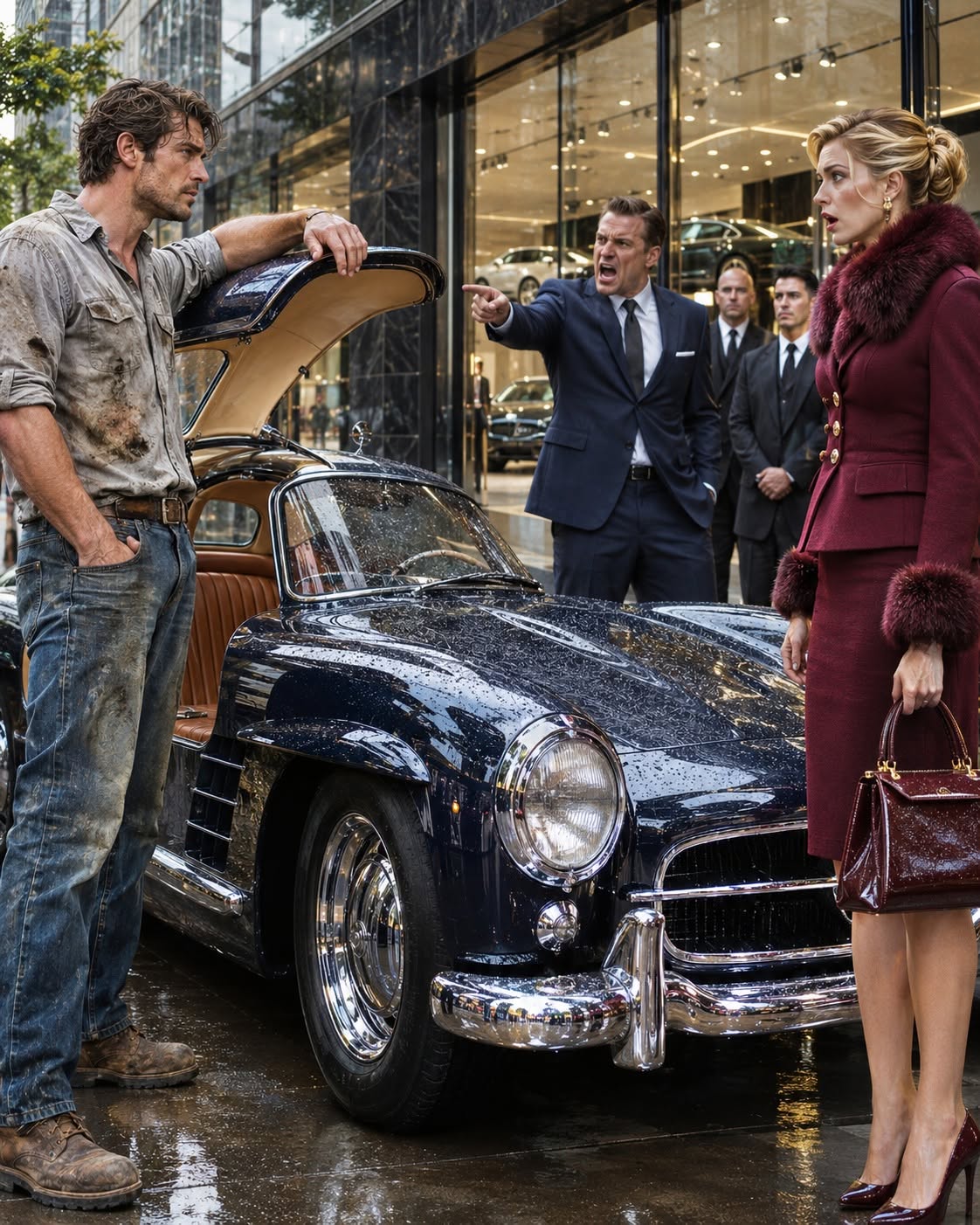
“Get your filthy hands away from that car!” the salesman shouted. My seven-year-old son, Milo, froze beside me.
PART 3: THE KEY THAT CHANGED EVERYTHING
“Because,” Astrid Vance said, looking directly into my eyes, “your son deserves to remember his seventh birthday for something other than cruelty.”
I stared at the black key fob resting on my workbench.
For several seconds, I couldn’t speak.
The silver emblem belonged to the Valkyrie Apex, the same midnight-blue supercar Milo had dreamed about for months. The same car we’d been ordered away from less than two hours earlier.
“Ms. Vance,” I finally said, “I appreciate the gesture, but I can’t accept a car worth that kind of money.”
Astrid smiled faintly.
“I haven’t offered you the car.”
My face warmed with embarrassment.
She picked up the key and held it toward Milo.
“I’ve offered your son something much more important.”
Milo stepped out from behind me, still clutching the little birthday cupcake I’d bought him.
“What is it?” he whispered.
“A chance to experience his dream,” Astrid answered. “The Apex is waiting outside. And if your father agrees, I’d like you both to take it for a drive.”
Milo’s mouth fell open.
“Like… a real drive?”
“A real drive. Your dad behind the wheel, of course.”
He looked up at me with an expression I hadn’t seen since his mother was alive.
Pure, uncomplicated joy.
“Dad? Please?”
I looked at Astrid.
There was something unusual about her expression. Beneath the expensive clothes and confident posture, I could see a sadness she was trying to hide.
“Why are you doing this?” I asked.
She glanced toward my old Mercedes parked outside.
“Because I know what it feels like to have someone decide your worth before they know your name.”
Before I could answer, Milo tugged my sleeve.
“Dad, can we take Mom’s picture?”
My throat tightened.
He meant the small photograph we kept in the Mercedes, tucked into the corner of the dashboard.
It showed my wife, Emily, laughing beside a half-restored engine.
She’d always said our family was happiest when we were surrounded by cars.
“Of course, buddy,” I whispered.
Astrid turned away for a moment.
When she looked back, her eyes were shining.
“Then let’s make this a birthday worth remembering.”
Twenty minutes later, Milo was sitting inside the Valkyrie Apex.
The leather seat practically swallowed him, and his small fingers traced the stitching on the door.
I adjusted his child safety seat while Astrid stood nearby, watching.
“It’s even cooler than the pictures,” Milo breathed.
Then he noticed something on the dashboard.
“Dad, look! It’s got the same blue stitching Mom used on your old racing jacket.”
I froze.
Emily had sewn that jacket herself, years before Milo was born.
I hadn’t thought about it in a long time.
Astrid leaned closer.
“Your wife liked cars?”
“She loved them,” I said. “More than I did, sometimes.”
“What was her name?”
“Emily.”
Astrid’s expression changed.
“Emily what?”
“Emily Carter.”
For the first time since entering my garage, Astrid Vance seemed genuinely shaken.
She stepped back.
“Carter?”
I nodded.
“Did she ever work in automotive design?”
The question caught me off guard.
“She was a mechanical engineer. Worked on experimental powertrains before she got sick.”
Astrid gripped the edge of the open car door.
“Where?”
“An engineering company called Halcyon Dynamics.”
Her face went pale.
I frowned.
“Ms. Vance, is something wrong?”
She didn’t answer immediately.
Instead, she looked at Milo.
Then at the Apex.
Then back at me.
“I think,” she said quietly, “there’s something about this car you need to know.”
I felt an uncomfortable chill.
“What do you mean?”
Astrid glanced toward Trevor, who had been standing beside the black sedan.
“Please take Milo inside for a moment. Show him the model collection we brought.”
Trevor nodded and gently offered Milo his hand.
“Want to see a miniature race car with working headlights?”
Milo looked at me for permission.
“Go ahead, buddy. I’ll be right here.”
Once they disappeared into the garage office, Astrid closed the Apex’s door.
“Your wife worked on a project called Phoenix,” she said.
I stared at her.
I hadn’t heard that name in eight years.
Emily had mentioned Phoenix during the early days of our marriage.
She’d called it the most important engineering project of her career.
Then, one evening, she’d come home upset and told me she was leaving Halcyon.
She never explained why.
“How do you know about Phoenix?” I asked.
Astrid exhaled slowly.
“Because Dominion Motors bought the project six years ago.”
I looked at the supercar.
“No.”
She nodded.
“The Valkyrie Apex uses a propulsion-control architecture developed from Phoenix.”
For a moment, the world seemed strangely quiet.
I remembered Emily sitting at our kitchen table, surrounded by sketches and calculations.
I remembered her falling asleep over blueprints.
I remembered the excitement in her voice when she’d told me she was working on something that could change automotive engineering.
And I remembered the night she burned a stack of documents in our backyard.
“Some things aren’t worth the price they ask you to pay,” she’d told me.
I’d assumed she meant the long hours.
Now I wasn’t so sure.
“Astrid,” I said, my voice low, “what exactly happened to that project?”
She hesitated.
“That’s what I’ve been trying to find out.”
Then her phone rang.
She glanced at the screen.
Her expression hardened.
“It’s my chief operating officer.”
She answered.
“Richard.”
I couldn’t hear the man on the other end, but his voice sounded sharp and angry.
Astrid listened without interrupting.
Then she said, “No, I will not return to headquarters.”
Another pause.
“And you will not contact the Carter family.”
She ended the call.
I stared at her.
“What was that about?”
Astrid slipped the phone into her handbag.
“Apparently, someone at Dominion is very concerned that I’ve found you.”
A black SUV rolled slowly past my garage.
It didn’t stop.
But I noticed the tinted windows.
And I noticed Astrid watching it.
“Ms. Vance,” I said, “I think you should tell me everything.”
She nodded.
“Then we need to start with your wife’s work.”
Inside the office, Milo was happily examining a miniature race car.
I sat across from Astrid at the same battered desk where Emily used to handle our accounts.
Astrid opened a folder Trevor had retrieved from her vehicle.
Inside were photographs, patent diagrams, and copies of engineering documents.
At the top of the first page was a familiar name.
Emily Carter — Lead Systems Engineer.
My chest tightened.
I touched the paper.
Her handwriting filled the margins.
Even after four years without her, I recognized every curve of those letters.
“She designed this?” I asked.
“Much of the original control system,” Astrid replied. “But when Dominion acquired Phoenix, the records credited another engineer.”
“Who?”
“Richard Bellamy.”
The same man who had just called her.
I looked up.
“Your chief operating officer?”
“Yes.”
I stared at the diagrams.
Emily had once told me Richard Bellamy was brilliant, ambitious, and dangerous when someone stood between him and success.
She’d stopped mentioning him after leaving Halcyon.
“Why are you showing me this now?”
“Because three weeks ago, one of our engineers discovered inconsistencies in the Apex’s original development records. There were missing signatures, altered dates, and a confidential complaint that had been buried.”
“Emily’s complaint?”
Astrid nodded.
“Your wife alleged that Bellamy had falsified safety-test results.”
My stomach dropped.
The Apex wasn’t just Milo’s dream car.
It was connected to something Emily had tried to stop.
“Was she right?”
“We don’t know yet.”
I looked toward the office window.
Milo was laughing at something Trevor had said.
He had no idea that his mother’s name had just appeared in a mystery neither of us understood.
“Why didn’t anyone investigate?”
“Someone made sure they couldn’t.”
Astrid leaned forward.
“And yesterday, I received an anonymous message telling me to look for a 1957 Mercedes-Benz 300 SL Gullwing painted midnight blue.”
I felt the blood drain from my face.
“My car?”
“Yes.”
“Who sent it?”
“We don’t know.”
She opened another photograph.
It showed my Mercedes parked outside an old brick building.
The picture had been taken years ago.
Emily was standing beside it.
Smiling.
And next to her was Richard Bellamy.
I stared at the image.
“What the hell is this?”
Astrid studied my face.
“You’ve never seen it?”
“No.”
I picked up the photograph.
Emily looked younger, healthier, full of life.
Bellamy stood close enough that his hand rested on the car’s roof.
On the back, someone had written a date.
October 14, 2018.
Three days before Emily quit Halcyon.
Suddenly, I remembered something.
A rainy night.
Emily coming home after midnight.
Her hands shaking as she removed her coat.
She’d gone straight to the garage and spent nearly two hours working on the Gullwing.
When I asked what she was doing, she’d said she was fixing an electrical problem.
But the car hadn’t had an electrical problem.
I knew that because I’d checked it myself.
I stood so quickly my chair scraped across the floor.
“Trevor, could you stay with Milo?”
He nodded.
Astrid followed me outside.
I walked straight to the Mercedes.
My father’s old Gullwing had always been more than a car to me.
It was the last thing he’d left behind.
I’d restored its engine, rebuilt its transmission, and spent countless nights bringing its body back to life.
Emily had helped whenever she could.
But there was one area she’d insisted on handling herself.
The passenger-side dashboard.
I opened the door.
The smell of aged leather and polished wood filled the air.
My fingers moved beneath the glove compartment.
There was a small metal panel I’d never removed.
Emily had told me it protected a custom wiring harness.
I reached for a screwdriver.
Astrid stood silently behind me.
Three screws came loose.
Then the panel shifted.
Behind it was a narrow compartment.
Inside sat a small waterproof case.
My heart began pounding.
I pulled it free.
There was a folded letter taped to the lid.
My name was written across the front.
Daniel.
I knew Emily’s handwriting.
I opened the letter with trembling fingers.
“My love,
If you’re reading this, something has happened that I hoped would never happen.
I didn’t tell you everything about Phoenix because I was afraid of putting you and our family in danger.
Richard changed the test results. He knew the thermal-control system could fail under specific conditions, but he refused to delay production.
When I confronted him, he threatened to destroy my career.
I copied the original files.
I hid them somewhere only you would think to look.
Not because I wanted you involved, but because I trusted you more than anyone.
If the truth ever comes out, promise me one thing.
Don’t let anger decide what kind of man you become.
And please tell our son that his mother tried to build things that made the world safer.
I love you.
Always,
Emily.”
By the time I finished reading, tears were running down my face.
I hadn’t cried in front of anyone since her funeral.
But standing beside the car we’d restored together, holding the last secret she’d left behind, I couldn’t stop.
Astrid quietly stepped away.
She gave me the dignity of being alone with my grief.
I sat in the driver’s seat and pressed the letter against my chest.
For four years, I’d wondered whether Emily had known how much we loved her.
Now I realized she’d spent part of her final years protecting us from something I hadn’t even understood.
When I finally opened the waterproof case, I found a small encrypted storage drive and a notebook.
The notebook contained test dates, engineering observations, and several names.
One name appeared repeatedly.
Richard Bellamy.
Another appeared near the end.
Kenneth Bellamy.
I blinked.
Kenneth.
The salesman.
I turned to Astrid.
“What’s Kenneth’s last name?”
She frowned.
“Bellamy.”
My stomach tightened.
“Richard’s son?”
Astrid nodded slowly.
“Unfortunately, yes.”
Suddenly, the humiliation at Dominion Motors felt different.
Had Kenneth recognized me?
Had he known who I was?
Or had we simply walked into a showroom where arrogance had been passed down like an inheritance?
Before I could ask, tires screeched outside.
The black SUV had returned.
Two men stepped out.
One wore a gray suit.
The other carried a leather briefcase.
The man in the suit approached us.
“Mr. Carter?”
I closed the Mercedes door.
“Who’s asking?”
“My name is Victor Hayes. I represent Richard Bellamy.”
Astrid moved beside me.
“Victor, you’re trespassing.”
He ignored her.
“Mr. Carter, we’re aware you’ve recently come into possession of certain proprietary documents.”
I felt my hands curl into fists.
“Funny. I just found them.”
Victor smiled.
“Then you understand that retaining confidential corporate material could expose you to significant legal consequences.”
Astrid stepped forward.
“Are you threatening him?”
“I’m explaining his options.”
He opened the briefcase.
Inside was a document.
And a check.
I looked at the amount.
Five million dollars.
For a moment, I couldn’t breathe.
Five million dollars would pay off every debt I had.
It would secure Milo’s education.
It would mean never worrying about keeping the garage open again.
Victor placed the check on the hood of the Mercedes.
“All Mr. Bellamy requires is the return of the storage device and a standard confidentiality agreement.”
I stared at the money.
Then I thought about Emily.
About the nights she’d worked until dawn.
About the fear in her eyes when she left Halcyon.
And about Milo apologizing for wanting a birthday photograph.
I picked up the check.
Victor smiled.
“An excellent decision.”
I tore it in half.
Then into quarters.
The pieces fluttered onto the pavement.
“Tell Richard Bellamy,” I said, “my wife wasn’t for sale when she was alive. And she isn’t for sale now.”
Victor’s smile disappeared.
“You’re making a serious mistake.”
“No,” Astrid said, raising her phone. “You are. My security team has recorded this entire conversation.”
Victor glanced toward Trevor, who was standing in the garage doorway with his phone raised.
Astrid continued.
“Leave. And tell Richard that Dominion’s board will be hearing from me tonight.”
Victor slammed his briefcase shut.
As the SUV drove away, I noticed Milo watching from the office window.
He looked frightened.
I hurried inside.
“Hey, buddy.”
“Dad, were those bad guys?”
I knelt beside him.
“They were people who wanted something that didn’t belong to them.”
“Did they get it?”
“No.”
He studied my face.
“Were you scared?”
I could have lied.
I could have told him I wasn’t afraid of anything.
Instead, I nodded.
“A little.”
Milo wrapped his arms around my neck.
“Mom used to say being brave doesn’t mean you’re not scared.”
My eyes burned.
“Yeah,” I whispered. “She did.”
That evening, Astrid arranged for an independent forensic specialist to examine Emily’s storage drive.
I insisted on remaining present.
The specialist worked for nearly three hours.
When the files finally opened, the room fell silent.
There were original test recordings, internal emails, and engineering simulations.
Emily had documented everything.
One video showed a prototype power-control module overheating during a laboratory test.
Another showed Richard Bellamy ordering the test classified as a minor sensor malfunction.
But the most devastating evidence was an audio recording.
Richard’s voice filled the office.
“We cannot afford another delay.”
Emily answered, calm but firm.
“Then we cannot afford to release this system.”
“You’re being emotional.”
“I’m being an engineer.”
A pause.
Then Richard spoke again.
“If you refuse to sign the approval, I’ll find someone who will.”
Emily’s response made my chest ache.
“Then make sure you can live with what happens afterward.”
The recording ended.
Astrid sat motionless.
Finally, she whispered, “He lied to all of us.”
But the specialist wasn’t finished.
“There is one more file.”
He opened a document labeled FINAL WARNING.
It contained evidence that the defective design had been corrected in later prototypes, but that Richard had concealed the original failure and falsified records to claim sole credit for the engineering breakthrough.
The Apex on the showroom floor wasn’t necessarily unsafe.
But the story behind its creation had been built on a lie.
And Emily’s name had been erased.
Astrid stood.
“I’m calling an emergency board meeting.”
I looked at her.
“What happens now?”
She met my eyes.
“Now we find out whether my company deserves to survive the truth.”
The next morning, the story exploded.
Dominion Motors announced an independent investigation into its development records and engineering safety disclosures.
Richard Bellamy was placed on administrative leave.
By noon, several former Halcyon employees had contacted investigators.
Two confirmed that Emily had raised concerns years earlier.
A third provided additional documents.
By evening, Richard had resigned.
But he didn’t go quietly.
He appeared on television, calling the allegations a personal vendetta.
He claimed I was a desperate mechanic looking for a payday.
He suggested Astrid had been manipulated.
Then he made the mistake that changed everything.
He mentioned Emily.
“A disgruntled former employee,” he called her, “whose technical judgment was questionable.”
I watched the interview from my garage.
Milo sat beside me.
“Dad,” he asked, “why is that man saying bad things about Mom?”
I turned off the television.
“Because sometimes people tell lies when they’re afraid of the truth.”
Milo was quiet.
Then he asked something I wasn’t prepared for.
“Can we tell everyone what Mom really did?”
I looked at his small face.
Seven years old.
Still missing his mother.
Still believing that the world could be made fair if someone simply explained what was right.
“Yes,” I said. “I think we can.”
Three days later, Astrid invited us to Dominion Motors.
Not through the showroom entrance.
Through the main doors of the company’s headquarters.
Reporters crowded the sidewalk.
Cameras flashed as we stepped from my old Mercedes.
I wore my best jacket.
Milo wore the little blue tie Emily had bought him before his first birthday.
Inside, Astrid was waiting.
She took my hand.
“Are you ready?”
I glanced at Milo.
He nodded.
So did I.
The auditorium was packed.
Employees, engineers, journalists, and board members filled every seat.
On the enormous screen behind the stage was a photograph of Emily.
She was standing in a laboratory, holding a prototype component and smiling proudly.
I hadn’t seen that picture before.
For a moment, I forgot how to breathe.
Astrid stepped to the microphone.
“Several years ago, our company acquired technology that helped shape one of our most celebrated vehicles.”
She paused.
“We believed we understood its history.”
The screen changed to show Emily’s original engineering drawings.
“We were wrong.”
Astrid explained that the independent review had uncovered falsified development records and serious misconduct.
She announced that Dominion would cooperate with regulators, review affected systems, and correct the historical record.
Then she said the words I’d waited years to hear.
“The foundation of this technology was developed through the work of an extraordinary engineer named Emily Carter.”
Applause filled the auditorium.
I lowered my head.
Milo squeezed my hand.
“That’s Mom,” he whispered.
I nodded.
“That’s Mom.”
Astrid continued.
“Emily Carter refused to compromise safety for profit. She paid a professional price for her integrity, and her contributions were deliberately concealed.”
She turned toward us.
“Today, Dominion Motors formally recognizes her work and apologizes to her family.”
The audience stood.
Hundreds of people applauded.
But I barely heard them.
I was watching Milo.
He was staring at his mother’s photograph with the biggest smile I’d seen in years.
For the first time, he wasn’t just remembering the woman who’d tucked him into bed.
He was discovering the woman she’d been before he could understand her.
Then Astrid invited me onto the stage.
I hadn’t prepared a speech.
I didn’t know what to say.
I walked toward the microphone with Milo holding my hand.
The room grew quiet.
“My wife,” I began, “was the smartest person I ever knew.”
My voice cracked.
“She could look at a machine and understand what was wrong before anyone else even knew there was a problem.”
A few people smiled.
“But what made Emily special wasn’t her intelligence.”
I looked at her photograph.
“It was that she never forgot the people who would depend on the things she built.”
I swallowed.
“Four years ago, I lost my wife. My son lost his mother. And for a long time, I thought the best I could do was keep our little garage running and make sure Milo had enough.”
I glanced down at him.
“Three days ago, we walked into a showroom because my son wanted a picture of a beautiful car.”
The room became completely silent.
“We were treated like we didn’t belong there.”
I paused.
“But I’ve learned something since then.”
I looked directly toward the cameras.
“A person’s value isn’t measured by the car they drive, the clothes they wear, or the money in their bank account.”
I took a breath.
“It’s measured by what they do when nobody important is watching.”
The applause began slowly.
Then grew louder.
But I wasn’t finished.
“Emily believed good engineering should protect people. I believe good people should do the same.”
I stepped away from the microphone.
Milo tugged my sleeve.
“Dad?”
I bent down.
“Yeah, buddy?”
“Can I say something?”
I hesitated.
Then lifted him toward the microphone.
He looked out at the enormous audience.
His little hands trembled.
“My mom used to fix things,” he said.
A few people laughed softly.
“She fixed my toys. And she helped Dad fix cars.”
He looked back at her photograph.
“But Dad says she also tried to fix something bigger.”
His voice became very small.
“I just wish she was here to see everybody clapping for her.”
The auditorium went silent.
Then, from somewhere near the back, someone began applauding.
Others joined.
Within seconds, everyone was standing again.
Astrid wiped tears from her cheeks.
I held Milo close.
And for one beautiful moment, it felt as though Emily was standing beside us.
After the ceremony, Astrid led us into a private exhibition room.
At its center sat the midnight-blue Valkyrie Apex.
The velvet rope was gone.
Beside the car stood a plaque.
THE EMILY CARTER EDITION
Dedicated to engineering integrity, courage, and the pursuit of safer innovation.
Milo stared at it.
“Dad, they put Mom’s name on the car.”
“They sure did.”
Astrid smiled.
“This is the first of a special limited series. A portion of the proceeds will support scholarships for young engineers who demonstrate exceptional commitment to safety and ethical design.”
I looked at her.
“Emily would have loved that.”
“There’s something else,” Astrid said.
She handed me a folder.
Inside was a proposal.
Dominion wanted to fund a technical apprenticeship program at my garage.
Young people from families who couldn’t afford expensive training would receive paid instruction, tools, and professional certifications.
The program would bear Emily’s name.
I read the first page twice.
“You want to do this at my shop?”
Astrid nodded.
“Your shop has something many expensive institutions struggle to teach.”
“What’s that?”
“Respect for the work. And respect for the people doing it.”
I looked through the glass wall toward the Apex.
For the first time, I wasn’t thinking about what the car cost.
I was thinking about what it could represent.
“I’ll consider it,” I said. “But the apprentices get paid fairly. And nobody gets turned away because of their background.”
Astrid extended her hand.
“Agreed.”
I shook it.
Then a voice interrupted us.
“Mr. Carter?”
I turned.
Kenneth Bellamy stood near the doorway.
He wasn’t wearing his expensive showroom suit.
Just a plain shirt and dark trousers.
His face looked exhausted.
Security stood several feet behind him.
Astrid’s expression hardened.
“Kenneth, you were told not to come here.”
“I know,” he said. “But I needed to apologize.”
I folded my arms.
He looked at Milo.
“I’m sorry for what I said to you.”
Milo moved closer to me.
Kenneth swallowed.
“I was cruel. And I was wrong.”
I studied him.
“Did your father send you?”
“No.”
“Then why are you here?”
He hesitated.
“Because I watched him lie about your wife on television. And I realized I’ve spent my whole life treating people the way he taught me.”
His eyes lowered.
“I thought having money made me better than other people.”
I said nothing.
Kenneth continued.
“When you walked into the showroom, I saw your clothes and decided you didn’t belong. I didn’t even know who you were.”
He looked at Milo.
“And I made a little boy feel ashamed on his birthday.”
For the first time, his voice sounded genuinely broken.
“I’m sorry.”
Milo looked up at me.
I could see the question in his eyes.
Should we forgive him?
I knelt beside my son.
“What do you think, buddy?”
Milo studied Kenneth for a long moment.
Then he asked, “Would you have been sorry if my dad didn’t have that old Mercedes?”
Kenneth went still.
The question hung between us.
Finally, he answered.
“I don’t know.”
Milo nodded slowly.
“Then maybe you should think about that.”
I nearly smiled.
Not because Kenneth had been humiliated.
But because my son had understood something many adults never learn.
An apology matters most when it comes from recognizing the harm, not fearing the consequences.
Kenneth looked at me.
“I don’t expect you to forgive me.”
“Good,” I said quietly. “Because forgiveness isn’t something you get to demand.”
He lowered his head.
“But you can become someone who wouldn’t do it again.”
He nodded.
Then he left.
I never asked Astrid to give him his job back.
Some lessons require consequences.
And some changes have to begin without an audience.
Six months passed.
The investigation into Richard Bellamy continued, and the authorities pursued the evidence of falsified records and attempted suppression.
Dominion revised its engineering oversight procedures and began independent safety reviews.
Emily’s contributions were formally recognized in the company’s patent and development records wherever the evidence supported correction.
But the biggest changes happened far away from the headlines.
At my garage.
The Emily Carter Technical Apprenticeship Program opened with twelve students.
Some were fresh out of high school.
Some were single parents trying to start over.
One was a nineteen-year-old named Jordan who’d been sleeping in his car while working nights at a grocery store.
On his first day, he arrived wearing a torn jacket and boots held together with tape.
He stood near the entrance, looking embarrassed.
“Sir,” he said, “I know I don’t look very professional.”
I looked at his boots.
Then at his hands.
They were rough, scratched, and stained with grease.
I remembered the showroom.
Kenneth’s voice.
Milo’s tears.
I smiled.
“Son, around here, those look like working hands.”
Jordan’s eyes filled.
“Does that mean I can stay?”
I handed him a clean set of coveralls.
“It means you’re already late for your first lesson.”
He laughed.
And I realized something.
The best revenge against cruelty wasn’t humiliation.
It was building a place where cruelty had no room to grow.
One Saturday afternoon, nearly a year after Milo’s seventh birthday, I was working beneath the Gullwing when I heard footsteps.
“Dad?”
I slid out from under the car.
Milo stood beside the workbench.
He was eight now.
Taller.
More confident.
And still obsessed with cars.
“What is it, buddy?”
He held up a drawing.
It showed a bright-blue sports car with enormous wheels and wings that looked suspiciously like airplane wings.
“I designed something.”
I examined it seriously.
“That’s quite a machine.”
“It can go really fast,” he explained. “But it also has sensors so nobody gets hurt.”
I smiled.
“Sounds like something your mom would build.”
Milo looked at the Gullwing.
“Dad, do you think Mom would be proud of us?”
I sat on the workbench and pulled him close.
“I think she’d be proud of you every single day.”
He leaned against me.
For a while, we listened to the quiet sounds of the garage.
Then he asked, “Can we go for a drive?”
“Where?”
“Anywhere.”
I glanced toward the Mercedes.
Its midnight-blue paint gleamed beneath the afternoon sunlight.
The same car that had brought Astrid Vance into our lives.
The same car Emily had trusted with her secret.
The same car my father had rescued from a collapsing barn.
Three generations of memories, held together by steel, leather, and love.
I picked up the keys.
“Come on, buddy.”
We drove out of town with the windows cracked and the autumn breeze filling the cabin.
Milo talked about engines, school, and the puppy he desperately wanted.
I listened to every word.
Eventually, we reached the hill overlooking the valley.
It was the place Emily and I used to visit before Milo was born.
I parked beneath an old oak tree.
The sun was setting.
Milo climbed out and stood beside me.
“Dad?”
“Yeah?”
“Do you think we’re rich now?”
I looked at him.
The garage was doing better.
The apprenticeship program was growing.
We had money in the bank for the first time in years.
But I thought about the night I’d sat beside Emily’s hospital bed, wishing I could trade everything I owned for one more ordinary day with her.
Then I thought about the little boy standing beside me.
“Why do you ask?”
“Because everybody at school says we’re famous. And they say you know a lady who owns supercars.”
I laughed softly.
“Well, that’s true.”
“So are we rich?”
I put my arm around his shoulders.
“Buddy, money can make life easier. And there’s nothing wrong with working hard to earn it.”
I looked toward the sunset.
“But the richest I’ve ever felt was the day you were born.”
Milo smiled.
“Even though I cried a lot?”
“Especially because you cried a lot.”
He laughed and hugged me.
Then he looked toward the Mercedes.
“Dad, can we take a picture with the car?”
My heart tightened.
A year earlier, all he’d wanted was one picture beside his dream car.
And someone had made him feel he wasn’t worthy of standing near it.
Now we had access to cars most people would never see.
But the one he wanted a picture with was the old Mercedes his grandfather had saved, his mother had worked on, and his father had restored.
“Of course,” I said.
I set my phone against a rock and started the timer.
Milo stood beside the driver’s door.
I knelt next to him.
Behind us, the Gullwing’s doors rose like wings against the golden sky.
Just before the camera clicked, Milo whispered something.
“I think Mom would like this picture.”
I held him a little tighter.
“Me too, buddy.”
The camera flashed.
And for the first time in a very long time, I didn’t feel like our family was incomplete.
I felt like Emily was still with us.
In the car she’d helped restore.
In the work she’d left behind.
In the courage she’d taught our son.
And in every young person who would now get a chance because she’d refused to remain silent.
Later that night, I printed the photograph.
I placed it on the garage wall beside Emily’s picture.
Underneath, I wrote six words.
“Your worth was never for sale.”
People sometimes ask me whether I regret what happened at Dominion Motors that day.
I tell them no.
Not because the humiliation was necessary.
Not because cruelty somehow becomes acceptable when something good follows.
But because that day taught my son something I could never have taught him with a thousand lectures.
That dignity doesn’t come from wealth.
That integrity matters more than reputation.
And that the way we treat people who can do nothing for us reveals far more about our character than the way we treat those who can.
Kenneth saw a poor mechanic and his little boy.
Astrid saw a remarkable car.
Richard saw a secret worth millions.
But Emily had seen something none of them understood.
She saw a future worth protecting.
And Milo?
He saw his dad.
A man with worn boots, grease-stained hands, and an old Mercedes.
A man who couldn’t buy him the most expensive birthday present.
But who would never let him believe he was worth less than anyone else.
And in the end, that was enough.
Because the greatest inheritance we leave our children isn’t a fortune, a famous name, or a beautiful car.
It’s the courage to stand for what’s right, the compassion to treat others with dignity, and the knowledge that their value can never be measured by someone else’s opinion.
THE END.