“Get out,” Parker Reid said, stopping his truck on an empty country road. “If you won’t sign over your mother’s land, you can find your own way home.”
I hurried toward the truck, suddenly afraid of what those papers might prove.
Wade followed me without a word.
Neither of us spoke during the drive back to the ranch. I kept staring at the north pasture through the passenger window, remembering how my mother used to stand on the porch every evening and watch the sun disappear behind those hills.
She had refused every offer to sell that land.
Even when the ranch struggled.
Even when medical bills piled up.
Even when Parker insisted she was being stubborn.
Now I was beginning to understand why.
When we reached the house, Rosa was waiting on the porch.
Her face was pale.
“Parker was here,” she said.
My stomach dropped.
“When?”
“Twenty minutes ago. He went into your mother’s office. I told him you weren’t home, but he said he still had authority to access the records.”
I ran inside.
The desk drawers were open.
Papers covered the floor.
And the old wooden box where Mom kept her original land documents was gone.
I turned toward Wade.
“He knows.”
Wade looked at the empty space on the shelf.
“Maybe. But he doesn’t know everything.”
“How can you be sure?”
“Because your mother was smarter than Parker ever gave her credit for.”
Before I could answer, Rosa appeared in the doorway.
“There’s something you should know about that box.”
I turned.
“What?”
“Your mother stopped keeping the important papers in it two years ago.”
For the first time that morning, I felt a flicker of hope.
“Where did she put them?”
Rosa hesitated.
“She made me promise not to tell anyone unless you came looking.”
“Rosa, please.”
She reached into her pocket and pulled out a small brass key.
“She said you’d know what to do when the time came.”
The key was old, with a tiny horseshoe engraved near the top.
I recognized it immediately.
It belonged to the locked cabinet in Mom’s sewing room.
A cabinet Parker had always dismissed as a collection of worthless family junk.
We hurried upstairs.
The sewing room smelled faintly of lavender, just as it had when Mom was alive.
For a moment, grief caught me so suddenly that I had to grip the doorframe.
Her unfinished quilt still lay across the table.
Her reading glasses rested beside a basket of thread.
It felt impossible that someone could be gone while so much of her remained.
Wade waited quietly behind me.
I crossed the room and unlocked the cabinet.
Inside were several folded quilts, an old photograph album, and a metal document case.
My mother’s handwriting covered a yellow envelope taped to the lid.
“For my daughter. When she’s ready to know the truth.”
My hands trembled as I opened it.
The first document was the original ranch deed.
The second was a water-rights agreement dated nearly seventy years earlier.
And the third was a letter from my mother.
I unfolded it carefully.
“My darling girl,
If you’re reading this, someone has finally tried to take the north pasture from you.
I wish I could be there to explain everything myself.
But some truths are too important to leave to chance.
The north pasture isn’t valuable because of the grass or the view.
It’s valuable because of the water beneath it.
Your grandfather helped build the old culvert after a terrible drought. The agreement he signed protected water access for six neighboring farms.
No single owner was ever supposed to control that water.
The land carries an obligation that cannot simply be erased by a private sale.
I have spent years protecting that promise.
And lately, I’ve been afraid someone wants to break it.
If Parker is involved, don’t confront him alone.
Find Wade Miller.
His father helped me uncover what was happening.
And please remember this: a person who loves you will never demand that you surrender what matters most to you.
Love,
Mom.”
I lowered the letter.
The room seemed to tilt.
“Your father?” I whispered.
Wade’s expression changed.
He looked down at the floor.
“My dad worked with your mother before he died.”
“You knew?”
“I knew there was a problem with the water rights. I didn’t know she’d left instructions for you to find me.”
“Why didn’t you tell me when you found me on the road?”
He took a slow breath.
“Because you were scared, exhausted, and stranded. You needed help, not another stranger telling you a complicated story.”
I studied his face.
“And you just happened to be riding there?”
“My property borders that road. Ruby and I ride it most mornings.”
He paused.
“When you told me your name, I recognized it. Your mother talked about you.”
That surprised me more than anything else.
“What did she say?”
Wade smiled faintly.
“That you were the only person she’d ever met who could argue with her for an hour and still make her laugh afterward.”
A painful smile broke through my tears.
That sounded exactly like Mom.
Then Wade’s expression grew serious again.
“My father believed someone was planning to redirect the water. He collected evidence, but he died before he could finish investigating.”
“How?”
“Heart attack. Three years ago.”
He looked at the documents.
“I’ve been trying to understand his notes ever since.”
I spread the agreement across the sewing table.
There was a map attached, showing the culvert and a network of underground channels.
One line ran through the north pasture.
Another extended toward a large parcel of land west of the ranch.
The name printed beside that parcel made my blood run cold.
Blackstone Development Holdings.
I had seen that name before.
On the credit documents Parker had arranged.
“Wade,” I said slowly, “Parker told me Blackstone wanted to build a luxury resort.”
Wade leaned over the map.
“They don’t just want your pasture.”
He traced the blue line with his finger.
“They want control of the water.”
I stared at him.
“Why?”
“Because without that water, the farms downstream can’t survive. And if those farms fail, Blackstone can buy their land for almost nothing.”
The pieces began fitting together.
Parker’s insistence that the ranch was drowning in debt.
His constant pressure to sell.
The mysterious credit line.
The way he’d laughed whenever I mentioned keeping Mom’s land.
He hadn’t been trying to save the ranch.
He’d been trying to make sure I believed it couldn’t be saved.
I sat down hard.
“How much of this did Mom know?”
Wade pointed toward the bottom of the document case.
“Maybe there’s more.”
There was.
A small notebook lay beneath the papers.
Inside, Mom had recorded dates, names, phone numbers, and suspicious transactions.
One entry was circled in red.
“Parker met with Daniel Mercer. Offered access to culvert in exchange for private payment.”
Daniel Mercer.
Blackstone’s regional director.
Another entry read:
“Parker says the ranch needs a new loan. Bank confirms no existing emergency. Why is he lying?”
And the final entry, written only two weeks before Mom entered the hospital, made my chest tighten.
“If anything happens before I can stop this, Rosa knows where the proof is.”
I looked up.
“Rosa?”
She stood motionless near the door.
Then she closed it.
“There’s something I haven’t told you.”
Her voice shook.
“Your mother asked me to keep copies of everything. I was supposed to give them to you after the funeral.”
“Why didn’t you?”
“Because Parker threatened my son.”
The room went silent.
Rosa’s son, Mateo, was twenty-three and had recently started a trucking business.
“He told me Mateo’s loan would be called in if I interfered. He knew which bank financed the trucks. He knew everything.”
Tears filled her eyes.
“I was afraid.”
I stepped toward her.
“Rosa, you should’ve told me.”
“I know.”
She wiped her cheeks.
“But when I saw him searching your mother’s desk today, I realized being quiet wasn’t protecting anyone.”
She reached into her jacket and produced a flash drive.
“Your mother gave me this.”
Wade took one look at it.
“We need to get that somewhere safe.”
Before either of us could move, a truck engine roared outside.
I looked through the window.
Parker’s black pickup pulled into the yard.
And he wasn’t alone.
A silver SUV stopped behind him.
Two men climbed out.
One wore an expensive suit.
The other carried a leather briefcase.
Parker marched toward the house as if he still owned it.
“Stay upstairs,” Wade told me.
I shook my head.
“No. I’ve spent six months letting him speak for me.”
I placed the flash drive inside my pocket.
“Not anymore.”
We went downstairs together.
Parker was already standing in the living room when we reached it.
His eyes immediately found Wade.
“Well,” he said with a bitter smile. “That explains a lot.”
I folded my arms.
“What are you doing in my house?”
“Trying to save your future.”
“You mean trying to sell it.”
His smile disappeared.
“Don’t start this again.”
The man in the suit stepped forward.
“I’m Daniel Mercer, representing Blackstone Development.”
I recognized the name from Mom’s notebook.
He offered his hand.
I didn’t take it.
“We’re prepared to make a generous offer,” he continued. “One that would eliminate your financial difficulties immediately.”
“What financial difficulties?”
Parker laughed sharply.
“Don’t play dumb.”
I looked directly at Mercer.
“Did Parker tell you he had my permission to borrow against the north pasture?”
Mercer’s eyes flickered toward Parker.
“He represented himself as the authorized manager of the property.”
“He was authorized to help with routine operations. Not to mortgage my inheritance.”
Parker stepped closer.
“Careful.”
That single word changed the atmosphere.
Wade moved slightly beside me.
I didn’t retreat.
“Did you threaten Rosa’s son too?”
Parker’s face darkened.
“You’ve been talking.”
“Yes,” I said. “And I’ve been reading.”
I held up a copy of the original water agreement.
“Did you tell Blackstone about the protected water rights?”
Mercer reached for the document.
I pulled it away.
His expression became unreadable.
“I’m not familiar with that agreement.”
“Then perhaps you should’ve done more research before offering to buy the land.”
Parker slammed his hand against the table.
“Enough!”
I flinched despite myself.
He noticed.
For a second, I saw the familiar satisfaction in his eyes.
The satisfaction of a man who believed fear was the same thing as control.
“You don’t understand business,” he snapped. “Your mother didn’t either. That’s why this place is falling apart.”
I felt something settle inside me.
Not anger.
Not even fear.
Clarity.
“My mother understood enough to keep you from stealing her land while she was alive.”
His face went white.
Mercer turned sharply.
“Parker, what exactly have you told her?”
Parker ignored him.
He pointed at Wade.
“You think this cowboy is going to protect you? You barely know him.”
Wade spoke calmly.
“She knows enough to make her own decisions.”
Parker took another step toward me.
“You’ll regret this.”
I looked him in the eye.
“I already regret trusting you.”
Then I opened the front door.
“Get off my property.”
For a moment, I thought he might refuse.
Instead, he gave me a cold smile.
“You have no idea what’s coming.”
He walked out.
Mercer followed, but not before giving the water agreement one final, troubled glance.
The trucks disappeared down the driveway.
Only then did I realize my hands were shaking.
Wade closed the door.
“Are you okay?”
“No,” I admitted.
Then I looked at the papers in my hand.
“But I will be.”
That afternoon, we drove to the county courthouse.
Wade had arranged a meeting with a property attorney named Evelyn Brooks, who had known his father.
She listened carefully as we explained everything.
Then she spent nearly an hour studying the documents.
Finally, she removed her glasses.
“This is serious.”
My stomach tightened.
“How serious?”
“The original agreement appears to establish recorded water easements benefiting several neighboring properties. If it’s still legally enforceable, a buyer cannot simply ignore those rights.”
“So Parker couldn’t sell the water?”
“Not as unrestricted private water rights, no.”
She tapped the financial records.
“But that’s not your only problem.”
I leaned forward.
“What do you mean?”
“These loan documents contain signatures that appear to be yours.”
My heart stopped.
“I never signed them.”
“I suspected as much.”
She turned another page.
“There’s also a document purporting to give Parker expanded authority over ranch finances.”
I stared at the signature.
It looked like mine.
Almost.
But the final letter was wrong.
My mother had taught me to make that particular loop when I was little.
I had stopped writing it that way in college.
“It’s forged,” I whispered.
Evelyn nodded.
“We’ll need a forensic examination. But if someone used false documents to obtain credit, this could become a criminal investigation.”
Wade leaned forward.
“What about Blackstone?”
“That depends on what they knew and when they knew it.”
I took the flash drive from my pocket.
“Maybe this will help.”
Evelyn connected it to her computer.
Several folders appeared.
Bank statements.
Emails.
Scanned contracts.
And an audio file labeled “Meeting—October 14.”
I recognized the date.
Three weeks before Mom’s final hospitalization.
Evelyn pressed play.
At first, there was only the scrape of chairs.
Then Parker’s voice filled the office.
“Once she’s gone, the daughter will be easy to manage.”
My breath caught.
Another man answered.
Mercer.
“And the water agreement?”
“Old paperwork. Nobody’s enforced it in decades.”
“You’re certain?”
“I can get her to sign the sale. She trusts me.”
Mercer was silent for a moment.
Then he said, “Blackstone needs clear title and a legal path to the water. Don’t bring me anything that creates a lawsuit.”
Parker laughed.
“Leave the girl to me.”
The recording ended.
I couldn’t move.
My mother had been alive when Parker said those words.
Alive, sick, and trusting him to help.
I felt sick.
Wade reached for my hand.
I held on.
Evelyn saved a copy of the file.
“This recording may not prove everything, and we need to establish how it was obtained. But combined with the documents, it’s enough to justify immediate action.”
“What kind of action?”
“First, we notify the lender that the signatures are disputed. Then we seek an injunction to stop any unauthorized transfer while the ownership and water rights are examined.”
She paused.
“And we contact the authorities.”
I nodded.
“Do it.”
For the first time since Mom died, I felt as though I was doing something she would have wanted.
But Parker wasn’t finished.
Two nights later, I woke to the smell of smoke.
At first, I thought I was dreaming.
Then I heard Rosa shouting outside.
“Fire! The north pasture!”
I jumped out of bed and ran to the window.
An orange glow spread across the horizon.
Flames were climbing through the dry grass near the old culvert.
My heart pounded.
I grabbed my boots and ran downstairs.
Rosa was already calling the fire department.
Several ranch hands were gathering hoses and moving livestock away from the fence.
Wade’s truck appeared moments later.
He jumped out before the engine had fully stopped.
“Where’s the fire?”
“Near the culvert!”
His expression hardened.
“That’s no accident.”
We drove toward the pasture while the first emergency vehicles approached from the highway.
The wind was carrying sparks toward the old wooden fence.
Firefighters ordered us to stay back.
I stood beside Wade, watching flames consume the grass my mother had spent her life protecting.
Then Rosa pointed toward the far side of the pasture.
“Someone’s out there!”
A dark figure was moving near the service gate.
Wade saw him too.
He grabbed his phone and called the deputy who had taken our report.
I wanted to run after the figure.
Wade caught my arm.
“Don’t.”
“He’s getting away!”
“Let the deputies handle him. We need to stay alive.”
I hated that he was right.
Within minutes, two sheriff’s vehicles arrived.
One deputy headed toward the gate.
Another questioned us while firefighters battled the flames.
Then a radio crackled.
“Suspect vehicle located. Driver detained.”
I stared down the road.
A black pickup sat beneath the flashing lights.
Parker’s pickup.
My knees nearly gave out.
But the worst discovery came an hour later.
After the flames were contained, the fire chief approached us.
“We found containers near the culvert. We’re treating this as a suspected intentional fire.”
I looked toward the blackened pasture.
Parker hadn’t simply wanted to frighten me.
He had tried to destroy the very place Mom had asked me to protect.
Then Wade said something that made me turn.
“The survey marker.”
We hurried toward the culvert after the firefighters cleared the area.
The brush was gone.
The stone channel stood exposed beneath the moonlight.
But the old marker had been smashed.
Someone had struck it repeatedly with a heavy tool.
I stared at the broken pieces.
“He knew what we found.”
Wade crouched beside the stones.
“Maybe he thought destroying the marker would erase the agreement.”
“Will it?”
He looked up.
“No. The recorded documents still exist.”
Then he noticed something beneath the damaged stonework.
A narrow iron plate had become visible where the fire burned away the roots.
He brushed ash from its surface.
There were numbers engraved into the metal.
And beneath them, a date.
1938.
Wade stared at it.
“My father wrote about this.”
“What is it?”
“A secondary survey reference. He believed there was another marker, but he never found it.”
I knelt beside him.
The plate was secured inside the original stone foundation.
Not something Parker could simply pull out of the ground.
Wade took photographs.
Then he turned to me.
“Your mother knew this was here.”
“How?”
“Because someone protected it long after the original culvert was built.”
I looked at the carefully fitted stones.
For the first time, I understood that Mom hadn’t just been preserving a legal agreement.
She had been preserving a promise made by people who depended on one another to survive.
And Parker had nearly burned that promise to the ground.
By sunrise, Parker was in county custody.
Investigators had found him near the service gate, and evidence from the scene connected his vehicle to the suspected arson.
The case would take months to resolve.
But he could no longer walk into my home and threaten me.
I thought that would be the end.
I was wrong.
Three days later, Evelyn called.
“I need you at my office.”
Her voice sounded different.
Not frightened.
Almost excited.
When Wade and I arrived, she had a stack of documents spread across her desk.
“Remember the original water agreement?”
I nodded.
“I had a specialist review the recorded property history.”
She pointed to an old county map.
“The agreement protects water access for six farms. But there’s something else.”
I leaned closer.
“Your mother acquired an additional interest in the water infrastructure through a conservation trust arrangement.”
I blinked.
“What does that mean?”
“It means the ranch may be entitled to compensation for certain authorized commercial uses of the water system, subject to the agreement’s restrictions.”
Wade stared at her.
“Commercial uses?”
Evelyn nodded.
“Blackstone’s proposed development requires a substantial water supply. They were trying to secure access without negotiating properly with the parties holding the relevant rights.”
I looked down at the map.
“So Mom wasn’t sitting on worthless land.”
“Far from it.”
Evelyn smiled.
“She was protecting something that could support the entire valley.”
For several seconds, I couldn’t speak.
Then I asked the question that had been haunting me.
“Could this save the ranch?”
“It could help. But the forged loans still need to be resolved, and any future water arrangement would require careful legal and environmental review.”
I nodded.
That was enough.
For the first time, there was a future worth planning.
Over the following weeks, everything changed.
The lender froze collection activity on the disputed credit line while investigators reviewed the signatures.
A judge issued temporary orders preventing unauthorized transfers of the north pasture.
Several neighboring farmers came forward with their own records of the water agreement.
And Blackstone suspended its acquisition plans pending the investigation.
But the biggest surprise came from the people I barely knew.
One morning, six trucks pulled into our driveway.
Farmers from the neighboring properties climbed out.
An older man named Harold Bennett approached me.
“Your mother helped us through the drought of 2017,” he said.
I remembered that summer.
The fields had turned brown.
Cattle had been sold.
Everyone had worried about the wells.
Harold removed his hat.
“She made sure the water kept reaching our farms, even when she could’ve charged us more.”
My throat tightened.
“She never told me.”
He smiled sadly.
“That sounds like her.”
Then he gestured toward the trucks.
“We heard you lost fencing in the fire. Figured we’d return the favor.”
Before I could answer, the men and women were unloading posts, wire, tools, and supplies.
By sunset, nearly half the damaged fence had been rebuilt.
I stood beside Rosa, watching neighbors work beneath the golden evening sky.
“Mom really knew all these people?”
Rosa smiled.
“She knew their children. Their birthdays. Which families needed help after a bad harvest.”
She glanced at me.
“Your mother never measured wealth the way Parker did.”
I looked across the pasture.
For six months, I’d believed I had inherited a struggling ranch and a mountain of responsibilities.
Now I realized I’d inherited something much larger.
A community.
A history.
And a reason to stay.
Wade became part of my days without either of us making a decision about it.
He showed up when a fence needed repairing.
He helped Rosa replace the damaged water gates.
He taught me how to read the old irrigation maps.
And sometimes, when the work was finished, he stayed for dinner.
Chloe always insisted on sitting beside me.
One evening, she brought a folded piece of paper to the table.
“I made something.”
I opened it.
It was a drawing of four people standing beside a chestnut horse.
Chloe had written names above everyone.
Daddy.
Chloe.
Ruby.
And me.
I smiled.
“Where’s Ruby’s tail?”
Chloe looked offended.
“Behind the fence, obviously.”
Wade laughed so hard he nearly spilled his coffee.
For the first time in months, laughter came easily.
But I was careful with my heart.
Parker had taught me how dangerous it could be to confuse attention with love.
Wade seemed to understand.
He never rushed me.
Never demanded answers.
Never made me feel guilty for needing time.
One afternoon, while we repaired a gate, I finally asked him about Chloe’s mother.
His hands stopped moving.
“She died when Chloe was two.”
“I’m sorry.”
He nodded.
“Car accident. I spent a long time thinking I could protect Chloe from every bad thing if I just worked hard enough.”
He looked toward the farmhouse in the distance.
“Eventually, I realized I couldn’t give her a life without pain. I could only give her a home where she didn’t have to face it alone.”
His words stayed with me.
That night, I sat in Mom’s sewing room and finished the quilt she’d left unfinished.
I wasn’t very good at it.
My stitches were uneven.
I had to redo the corners twice.
But when I finally spread it across my bed, I cried.
Not because it was perfect.
Because it wasn’t.
And somehow, that made it feel more like us.
Four months after the fire, Parker’s case reached a turning point.
Investigators had obtained bank records, communications, and additional evidence supporting charges related to fraudulent financial documents, threats, and the pasture fire.
Parker eventually accepted a plea agreement covering several offenses, including fraud and arson.
The judge sentenced him to prison and ordered restitution, with the final recovery of the ranch’s financial losses to be handled through the appropriate proceedings.
I attended the sentencing.
Not because I wanted revenge.
Because I needed to hear the truth spoken somewhere Parker couldn’t interrupt it.
When the judge asked whether I wanted to make a statement, I stood.
My hands trembled.
But my voice didn’t.
“You left me on a road because you thought I couldn’t survive without you.”
Parker stared at the table.
“You tried to convince me that everything my mother built was worthless unless you controlled it.”
I took a breath.
“But you were wrong.”
He finally looked up.
“I didn’t lose my home. I found out what it really meant.”
I paused.
“And I learned that the people who truly care about you don’t use your fear to make themselves powerful.”
When I sat down, Wade quietly squeezed my hand.
I didn’t look back at Parker as we left.
Outside the courthouse, the morning air felt clean and cool.
Wade opened the passenger door for me.
“Ready to go home?”
I smiled.
“More than ever.”
By the following spring, the ranch had begun to recover.
With Evelyn’s help, we established a formal water stewardship partnership with the neighboring farms.
The arrangement protected existing agricultural access, created a shared maintenance fund, and prevented any one landowner from secretly bargaining away the valley’s future.
We also secured a legitimate agricultural loan to repair the fire damage and improve irrigation.
It wasn’t easy.
Some months were still frightening.
Equipment broke.
Cattle got sick.
Storms damaged fences.
But the difference was that I knew what I was fighting for.
I wasn’t trying to save the ranch to prove Parker wrong.
I was saving it because I loved it.
One Sunday afternoon, Wade invited me and Rosa to a small gathering at his farmhouse.
Chloe had decorated the porch with wildflowers.
Ruby stood near the fence, looking mildly annoyed by a pink ribbon tied around her mane.
After dinner, Chloe tugged at my sleeve.
“Can you come outside?”
I followed her toward the pasture.
Wade was waiting beneath an old oak tree.
He looked unusually nervous.
I stopped.
“What’s going on?”
Chloe grinned.
“Daddy has something to say.”
Wade rubbed the back of his neck.
“I was hoping to do this without an audience.”
“Nope,” Chloe announced. “I’m important.”
I laughed.
Wade took my hand.
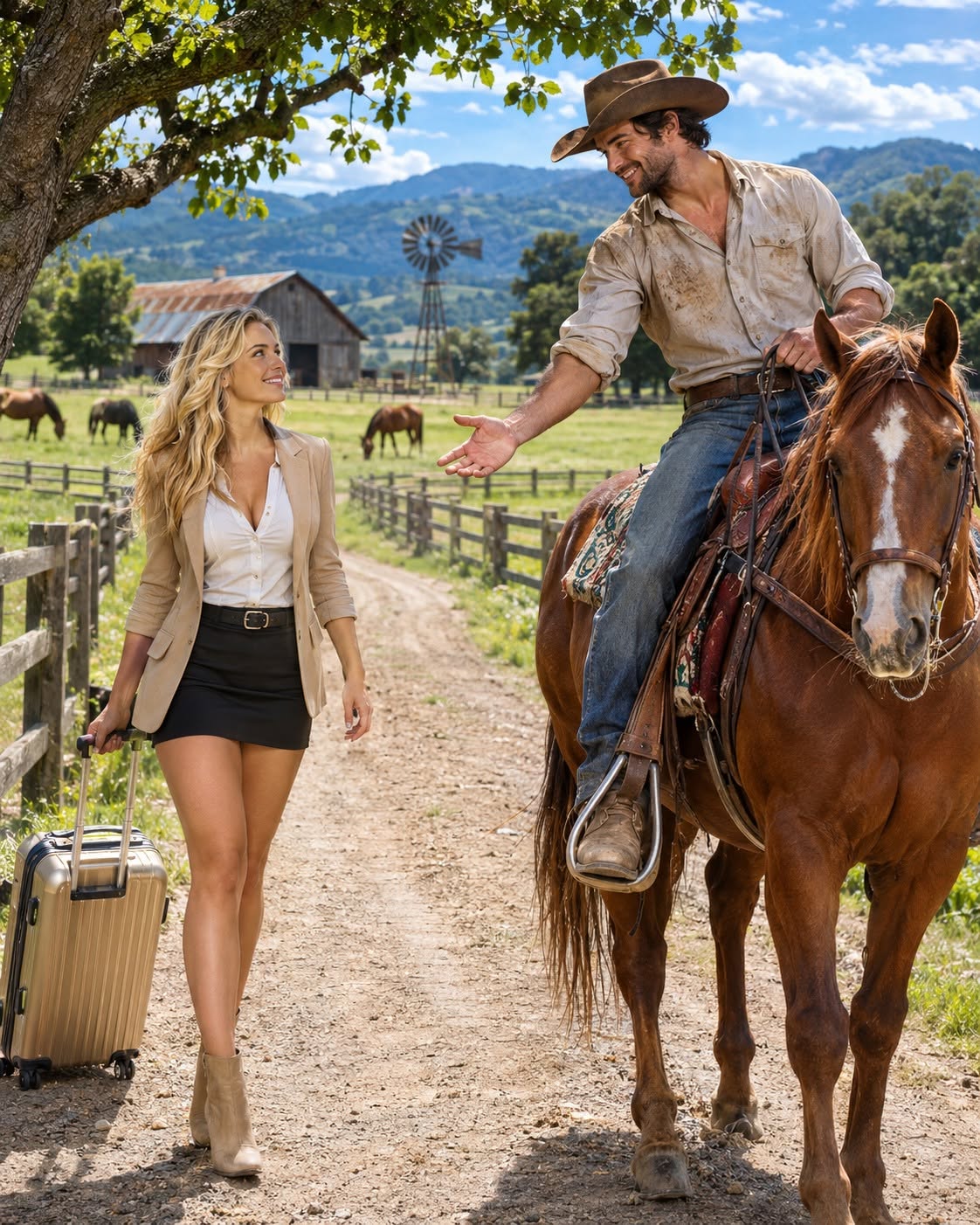
“A year ago, I found a woman walking down a dusty road with a silver suitcase.”
“Technically,” I said, “Ruby found me.”
“Ruby has excellent judgment.”
He smiled.
“I thought I was helping someone get home.”
His expression softened.
“But somewhere along the way, you became part of ours.”
My eyes filled.
“Wade…”
He shook his head gently.
“I’m not asking you to leave your ranch. I’m not asking you to change who you are or give up anything your mother left you.”
He took a small velvet box from his pocket.
“I’m asking whether you’d like to build something new together, while keeping everything that makes you who you are.”
Then he knelt.
“Will you marry me?”
Chloe bounced on her toes.
“Say yes! I already told Ruby!”
I laughed through my tears.
Then I looked at Wade.
The man who had offered me help without asking what I could give him.
The man who had stood beside me when my world was falling apart.
The man who had never once made love feel like a debt.
“Yes,” I whispered.
Then louder, “Yes, Wade. I will.”
Chloe shrieked with happiness.
Ruby startled at the noise.
And Wade stood and wrapped his arms around me.
For a moment, everything felt wonderfully simple.
That summer, we married beneath the oak trees on my mother’s ranch.
Rosa walked me down the aisle.
Harold Bennett officiated.
Chloe carried the rings in a tiny wooden box she’d decorated herself.
And Ruby stood behind the fence, wearing another pink ribbon.
I wore a simple white dress.
Pinned inside it was a small piece of fabric from Mom’s unfinished quilt.
Before the ceremony, I visited her grave.
I brought wildflowers from the north pasture.
And I told her everything.
About Parker.
About the fire.
About the neighbors who helped rebuild.
About Wade and Chloe.
About how frightened I’d been.
And how much I wished she could be there.
Then I placed my hand against the headstone.
“You were right, Mom,” I whispered.
“The land was worth protecting.”
I smiled through my tears.
“But you were protecting more than land.”
That evening, after the guests had gone and the last lanterns were flickering beneath the trees, Wade and I walked toward the north pasture.
The rebuilt fence stood strong.
The culvert had been restored.
Water flowed steadily through the old stone channel, carrying life toward the farms beyond our property.
Wade slipped his arm around my shoulders.
“Penny for your thoughts?”
I leaned against him.
“I was thinking about that road.”
“The day we met?”
I nodded.
“I thought Parker had taken everything from me.”
Wade kissed the top of my head.
“He didn’t.”
“No,” I said softly. “He didn’t.”
I looked across the land my mother had loved.
The fields were green.
The evening sky glowed gold.
And somewhere behind us, Chloe was laughing with Rosa on the porch.
I had spent so long believing that being abandoned meant I wasn’t worth staying for.
But the truth was different.
Sometimes, being left behind is the moment you finally discover who was never meant to walk beside you.
Parker had driven away with my phone, my purse, and the belief that he controlled my future.
But he had left me with the one thing he could never take.
The right to choose my own life.
I reached for Wade’s hand.
Together, we walked toward home.
And for the first time since my mother died, I no longer felt like I was trying to find my way back to the person I’d been.
I was becoming someone new.
Someone stronger.
Someone who understood that love wasn’t proven by promises, expensive gifts, or grand declarations.
Love was the neighbor who arrived with fence posts after a fire.
The little girl who pulled out an extra chair at dinner.
The foreman who found the courage to tell the truth.
The mother who protected her daughter’s future even when she knew she might never see it.
And the man who stopped on an empty country road, offered help to a stranger, and asked for nothing in return.
My mother had left me a ranch.
But her greatest inheritance was the lesson hidden beneath its soil.
Never surrender your freedom to someone who calls control love. And never mistake the person who walks away from you for the person who determines your worth.
Because sometimes, the road where someone abandons you becomes the very road that leads you home.
THE END.